Month: February 2020

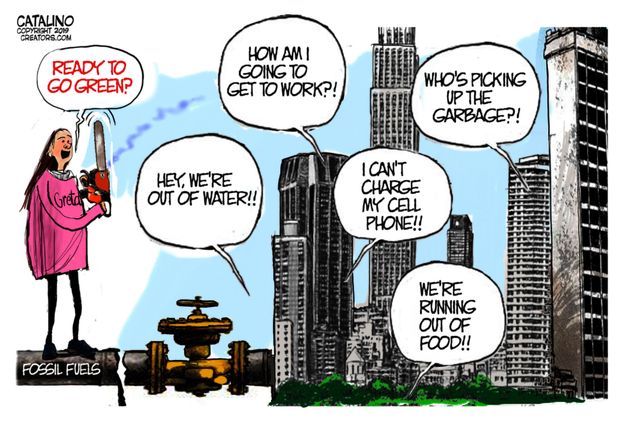
What If the US Banned Fracking?

Other posts have addressed the murky science underneath the claim that burning fossil fuels makes the earth warmer, and the alarmist claims that a warmer world is more dangerous than a colder one. This post takes up the issue that even if rising human CO2 emission were causing dangerous warming, what are the likely consequences of policies to cut down on carbon-based energy. Text below in italics comes from sources listed as links at the end.

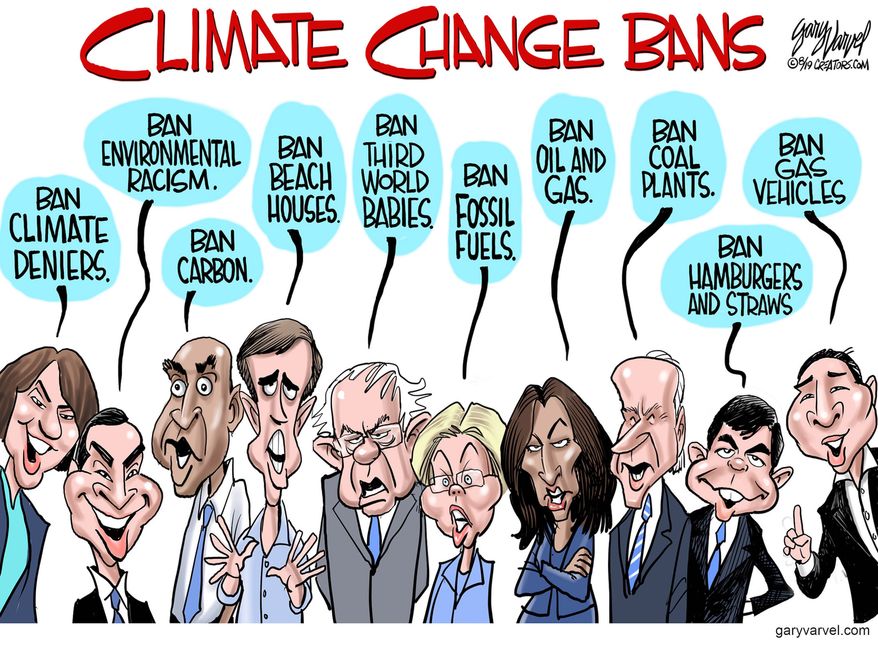
This issues arises in the US context because presidential candidates of leftist stripes have pledged to do away with fracking operations and forego the resulting boom in natural gas and tight oil production.

The Narrative

“I will ban fracking—everywhere.”
— Elizabeth Warren

“Any proposal to avert the climate crisis must include a full fracking ban on public and private lands.”
— Bernie Sanders

“I favor a ban on new fracking and a rapid end to existing fracking.”
— Pete Buttigieg

“I want you to look in my eyes. I guarantee you, I guarantee you we’re gonna end fossil fuel.”
— Pete Joe Biden

And don’t forget the Democratic 2016 nominee whose election was narrowly averted by the Trump surprise:

“So by the time we get through all of my conditions, I do not think there will be many places in America where fracking will continue to take place.”
– Hillary Clinton in 2016

In other words, she declared her intention to follow the Obama program: Regulate anything that moves until it stops moving.

Some skeptics caution against overreacting to electioneering rhetoric, citing the practical limits of presidential authority to implement a ban on fracking. But “elections have consequences,” executive orders have an impact, and few industries have been subjected to such consistent attack and misinformation. It might be hard to imagine serious proposals to ban, say, farming or at least all grain farms, but it would be theoretically possible to do so by radically increasing imports. Administrative agencies can pursue creative interpretations of the labyrinth of rules and issue aggressive “guidances.” A broad and coordinated set of such actions can slow or outright stop all manner of industrial activities up and down supply chains, including, especially, the construction of vital pipelines and ports. And lest one forget, Congress enacted legislation in 1972 and 1982 to ban oil production on about 90% of America’s offshore domains.

A detailed analysis has been performed by the Global Energy Institute. The updated report is What if . . . Hydraulic Fracturing Was Banned?

The Economic Benefits of the Shale Revolution and the Consequences of Ending It.

The Reality

The extraction of oil and gas through the techniques of horizontal drilling and hydraulic fracturing (colloquially, “fracking”) has catapulted the United States into leadership of the world’s energy markets. Since 2007, fracking has doubled U.S. oil production and increased gas production by 60%. Instead of a major importer, America is rapidly becoming the largest exporter of oil and is expected to supply the majority of net new energy traded on global markets over the next two decades.

If the U.S. imposed a fracking ban, the supply disruption would trigger the biggest oil and natural gas price spikes in history—almost certainly by more than 200%—which would, in turn, tip the world into recession. Even the expectation that a ban could be enacted would destabilize markets. U.S. imports and the trade imbalance would soar, as would consumers’ spending on energy. To keep the lights on, America would have to nearly double the quantity of coal burned, as well as import up to 1 million barrels of oil per day for dual-fueled power plants that would lose access to natural gas.

A fracking ban, regardless of motivation, is anchored in magical thinking that non-hydrocarbon energy sources could fill a massive global energy shortfall if the U.S. exited the world stage as a major supplier of oil and natural gas. Both fuels will be critical for the global economy for decades to come. The key issue is not whether wind and solar can supply more energy—they can and will—but whether a future American administration would reverse the progress of the last decade in lowering energy prices and enhancing geopolitical stability.”
—Mark Mills, senior fellow, Manhattan Institute

Supply Impact

The study is based on what GEI calls conservative assumptions. These include the continued use of hydraulic fracturing in non-tight oil and gas plays, and a 23.7% annual decline rate for existing shale plays. GEI also assumes a drop in gas exports to Mexico, and increase in gas imports from Canada, and a shift from LNG exporting to LNG importing—all designed to close the supply/demand gap that would occur as shale gas is phased out.
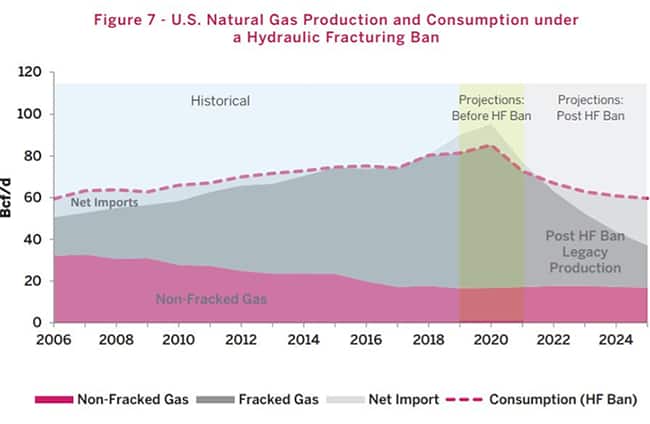
“Currently, shale production is about 50.5 Bcf/d or 62 percent of U.S. production. Under a hydraulic fracturing ban, production from existing sources would drop significantly due to the field production decline rates. Similarly, natural gas production from tight gas formations would drop quickly as well, since they rely on hydraulic fracturing to generate production,” GEI said.

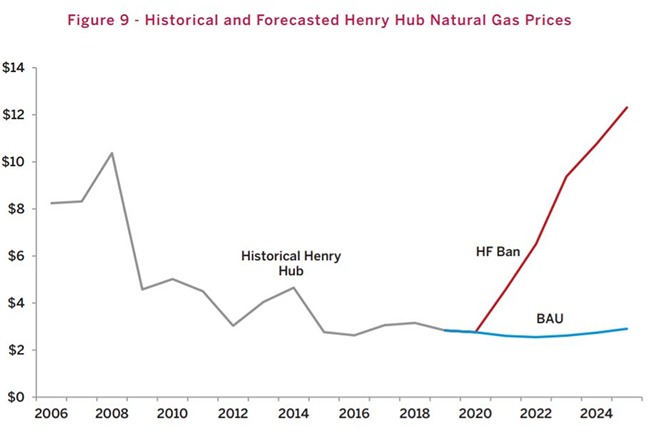
With gas in tighter supply (see 1st graph below), prices would soar to $12/MMBtu by 2025 (2nd graph).
Economic Impact

With supply for gas and oil constricted, energy prices would rise dramatically. In addition to $12/MMBtu gas, GEI says that West Intermediate crude would reach about $130/bbl by 2025, or more than double today’s price and nearly double the forecast out to 2025.

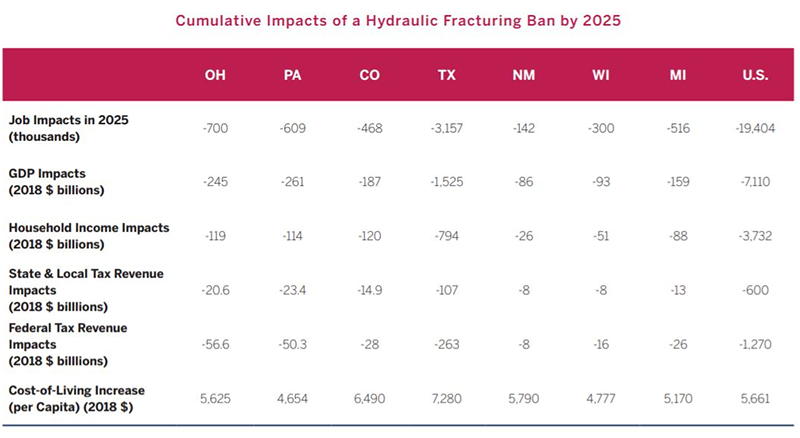
“In 2025, the U.S. would lose around 19 million jobs and $2.3 trillion in GDP. For comparison, this is roughly three times the economic impact of the Great Recession of the late 2010s,” GEI said. “Disallowing hydraulic fracturing would shrink the size of the U.S. energy industry and eliminate its ability to cushion the economy against large swings in prices. A ban on hydraulic fracturing would essentially be the worst of both worlds – low production as if prices were low, while the rest of the economy (in the form of millions of households and businesses) struggles to adapt to a doubling of oil prices and quadrupling of natural gas prices,” it said.

The economic results for the nation and for key energy-producing states (as well as two, Michigan and Wisconsin, which are considered to be close in the 2020 election) is shown below.
Why a US Self-embargo is Unicorns All the Way Down

The fracking ban campaign is neither new nor connected only to the politics of this presidential election cycle. The movement emerged from the intersection of two global trends: the expansion of hydrocarbon production; and a time when many pundits and policymakers believe that an “energy transition” to something different is urgently needed. For example, some 400 domestic and international environmental leaders and organizations petitioned the United Nations in September to demand “a global ban on fracking.”[14] Essentially all fracking production is done in the United States.

A ban on fracking would end U.S. exports, cause imports to soar, and increase the trade deficit by hundreds of billions of dollars. The more serious impact would come from the shock to global markets. Global oil prices swing widely when markets are surprised by even a 1%–2% change in the supply/demand balance. A fracking ban would entail a loss of 7% of global oil production, comparable to the 7% lost with the infamous 1973 Arab oil embargo—an embargo that drove world oil prices up 400% and triggered a global recession.[25] Similarly, the 1979 Iranian revolution took 5% of oil off global markets. Prices rose more than 200%, sparking another global recession.[26] Today, taking shale production off the market would also constitute an additional 17% loss to global markets in the form of natural gas.[27] Higher energy prices would hit global consumers; Americans would pay more than $100 billion a year at the gas pump alone, an average of $1,000 per household.[28] Even a slow 10-year production phase-out would trigger an estimated two-year recession in America and eliminate $270 billion of private investment.[29] There would be some winners: Russia and OPEC would derive huge revenue and geopolitical benefits.

Losing the share of new electricity generation that is now fueled from natural gas (produced by fracking) would push utilities to increase the use of existing underutilized power plants where they’re available, which are mainly coal-fired.[30] That would increase carbon dioxide emissions by some 600%—more than all emissions avoided from wind and solar on U.S. grids.[31]

Regions heavily dependent on natural gas but with minimal coal capacity would be faced with rolling blackouts—such as New England (where gas currently provides 49% of electricity), the Mid-Atlantic region (38%), and the Pacific coast (30%).[32] Some of that shortfall could come from burning oil in the 130 GW of gas-fired turbines designed to be dual-fueled.[33] If fully utilized, those turbines would burn about 1 mmbd of oil (necessarily imported), a 10-fold increase in U.S. oil-fired power generation.

The Impossibility of Filling the Gap

The central motivation for the movement to ban fracking is the global abundance of hydrocarbons at a time when many pundits and policymakers believe that an “energy transition” is urgently needed. But America’s shale production could not be replaced quickly by alternatives, at any price, regardless of climate-change motivations. To the extent that there is an “energy transition” to new technologies, it is happening in slow motion.

Politically popular wind and solar power have become far less expensive and have enjoyed massive global subsidies; but together, they still provide only 1.8% of global energy. The 5 million electric vehicles on all the world’s roads now displace 0.1% of global oil use.[34]

Replacing the quantity of energy produced by fracking in the U.S. shale fields would entail (in energy-equivalent terms) expanding all of America’s solar and wind production by 2,000% more than what has been added in the past decade.[35] Somehow accomplishing that miracle wouldn’t help the 99% of Americans driving oil-fueled cars. In fact, because the hydrocarbon market is global, the entire world would have to increase global wind and energy supply by 500% to replace the energy that would be lost from an American fracking ban—never mind the additional energy needed to fuel global economic growth.[36]
Resources:

New Study by Global Energy Institute Puts Impact of Fracking Ban at $7.1 Trillion Over Four Years

A Fracking Ban Would Trigger Global Recession

New Chamber Analysis Quantifies Economic Risks of Proposed Fracking Ban

U.S. Chamber of Commerce says proposed fracing ban puts Texas economy at risk


via Science Matters

https://ift.tt/2Syb1Kc

February 11, 2020 at 06:52AM

US Chamber of Commerce: What if we banned frac’ing?

Guest “fracking A, Bubba!” by David Middleton

Note: This is a politically charged post. If you don’t like such posts, don’t bother reading it.

What would happen if frac’ing was banned?

The short answer: We all freeze in the dark. For the long answer, read the US Chamber of Commerce paper.

The 2016 report was intended to lay out the implications of reckless, if not treasonous, energy policy demands of politicians and activists.

WHAT IF… HYDRAULIC FRACTURING WAS BANNED?

This paper marks the fourth in a series of reports produced by the Energy Institute being released this fall, each taking a substantive look at what might have happened in the past – or could happen in the future – if certain energy-related comments and policy prescriptions put forth by prominent politicians and their supporters were actually adopted. We’re calling it the Energy Accountability Series.

One doesn’t need to look far these days to find platforms or outlets that claim to be definitive “factcheckers” of all manner of utterances candidates make on the campaign trail. On that, the Energy Accountability Series is not reinventing the wheel. What we’re much more interested in – and what we think will be much more valuable to voters – is taking a step back to better understand (and quantify where possible) the real-world, economy-wide consequences of living in a world in which candidates’ rhetoric on critical energy issues were to become reality.

Too often, there is a temptation to dismiss statements made by candidates as things said “off the cuff” or in the “heat of the moment,” or perhaps offered up merely to “appeal to their base.” This is incredibly cynical, and it needs to change. A candidate’s views and the things they say and do to win the support of interest groups have a real impact on how policy is shaped and implemented. That is especially true on energy issues, as groups continue to advance a “Keep It In the Ground” agenda that, if adopted, would force our country to surrender the enormous domestic benefits and global competitive advantages that affordable energy development have made possible.

[…]

In this report, we explore what would happen if the politicians and environmental activists got what they say they support: a complete ban on fracking. While many proponents of such a ban may choose to ignore these economic impacts, it is our hope that the general public – including in particular the constituents of the politicians supporting these bans – will not so casually dismiss these findings. The job loss numbers alone that would result from a ban on fracking are enough to encourage greater scrutiny of those who have allied themselves with the “Keep It In the Ground” campaign.

[…]

US Chamber of Commerce

The Chamber of Commerce (CoC) then listed some particularly reckless, if not treasonous, energy policy prescriptions by politicians and activists.

By the time we get through all of my conditions, I do not think there will be many places in America where fracking will continue to take place.

Hillary Clinton, Democratic nominee; Mar. 6, 2016

I’m going to pledge to stop fossil fuels.

Hillary Clinton, Democratic nominee; Feb. 5, 2016

Figure 1. “You’re welcome.”

Let me make it as clear as I can be … we are going to ban fracking in 50 states of this country.

U.S. Sen. Bernie Sanders (D-Vt); June 1, 2016

Which is more likely: The “Bern” knowing jack schist about frac’ing? Or the “Bern” thinking that there might be 57 states in this country?

Figure 2. Despite all of his efforts to block oil & gas producion on Federal lands and waters, not even Barrack Hussein Obama could stem the “shale” revolution in any of the 57 states.

There is an urgent need to keep fossil fuels in the ground if we want to protect the planet for future generations.

Rep. Jared Huffman (D-Calif.); Feb. 11, 2016

There is an urgent need for Jared Huffman to be institutionalized.

[F]rom this point on, anyone proposing a new fracking field … or oil well is, in effect, a climate denier

Bill McKibben, founder of 350.org & DNC platform committee member; Sept. 29, 2016

WTF is a “fracking field”? Regarding proposing new oil wells… I denied climate four times in 2019!

Until we fully understand the effects [of fracking], the only way to avoid these risks is to halt fracking entirely

Rep. Mark Pocan (D-Wisc.); April 22, 2015

Only a fracking idiot would say something that stupid… Oh wait, (D-Wisc.)… ‘Nuff said.

We must keep our United States fossil fuel reserves, owned by the citizens, in the ground.

U.S. Sen. Jeff Merkley (D-Ore.); Nov. 4, 2015

Setting aside the fact the Merkley clearly doesn’t know the difference between reserves and resources… The only way that the citizens can benefit from United States fossil fuel resources is to convert them to reserves and take them out of the ground.

Any serious plan to combat climate change must include a ban on fracking.

Food & Water Watch; June 8, 2016

In which case, Food & Water Watch would be watching food & water disappear from supermarket shelves… Because skyrocketing oil & natural gas prices would quickly make farming and the transportation of food and bottled water to supermarkets unaffordable.

WHAT IF FRACKING WAS BANNED IN THE U.S., STARTING NEXT YEAR?
A fracking ban would be a disaster for the U.S. economy, exceeding the economic harm caused by the financial crisis, the housing bust, and the Great Recession – combined. Those concurrent events cost the United States around 8 million jobs. A ban on fracturing would destroy more
than 14 million jobs, all while raising costs for families and considerably reducing American energy security.

Here are a few of the key impacts:

  • “The United States would lose 14.8 million jobs”
  • “Gasoline prices would almost double”
  • “Natural gas prices would skyrocket to over $12 per mmBtu”

This one would be great for me… I work the Gulf of Mexico. At $12/mcf (~mmBtu), there’s a lot of natural gas to be had, and most of it doesn’t require frac’ing. Of course, the same treasonous idiots who would ban frac’ing, would also ban offshore drilling.

  • “U.S. electricity prices would nearly double”

And… As Marcellus/Utica and Texas “shale” gas production took a nose-dive, we would be importing much more of our gas from places like Russia, Qatar, etc.

Other “lowlights”:

  • “COST-OF-LIVING WOULD GO UP BY NEARLY$4,000 A YEAR, WHILE HOUSEHOLD INCOMES WOULD DROP BY $873 BILLION”
  • “THE U.S. WOULD SURRENDER ITS STATUS AS A GLOBAL ENERGY SUPERPOWER”
  • “U.S. GDP WOULD BE REDUCED BY $1.6 TRILLION”
  • “OHIO, PENNSYLVANIA, COLORADO, AND TEXAS WOULD BE AMONG THE HARDEST HIT BY A BAN”

2020: “It’s worse. It’s so much worse.”

Is 2020 any better than 2016?

From The Washington Post

“Yes, I support a ban on all hydraulic fracking operations.”

Tulsi Gabbard

“Yes. Fracking is a danger to our water supply. It’s a danger to the air we breathe. It has resulted in more earthquakes. It’s highly explosive. And, to top it off, methane from natural gas is contributing to climate change.”

Bernie Sanders

“Safe fracking is, like clean coal, pure fiction. … No amount of regulation can make it safe. When [Sanders] is in the White House, he is going to ban fracking nationwide and rapidly move to 100 percent clean, sustainable energy.” 

Bernie Sanders campaign spokesman

“Yes, we should ban fracking, but that can’t happen instantly. We need to push as hard as possible to make the transition as fast as possible.”

“We need to stop the expansion of all forms of fossil fuel infrastructure and production. Under my administration no new fracking or other types fossil fuel development would occur on public lands, and we would implement a responsible plan to phase out existing operations. We need to responsibly phase out the existing operations in line with a transition to 100% clean energy while investing in workers and communities.”

“The question in all of this is how fast can you change your electricity generation and how can you do it without disrupting the economy.”

“When you think about this, when you think about the percentage that’s fracked, and what the alternatives are, and what it would mean, I’m not sure you can just say there is no fracking for starters. You can say there’s no fracking on federal land. You can say, no new federal leases for fracking. I would do that. I think you can push as hard as possible to make the transition as fast as possible.”

Tom Steyer

“I favor a ban on new fracking and a rapid end to existing fracking so that we can build a 100 percent clean energy society as soon as possible,”

Pete Buttigieg

In the Permian Basin, alone, this would destroy somewhere between $25 and $100 trillion of value.

What the “shale” revolution has delivered

The CoC graphs are a little dated; they are from the EIA’s 2016 Annual Energy Outlook. However, they clearly demonstrate the value of frac’ing, without which our natural gas and crude oil production would have been declining since 2006.

The dominance of the “shale” plays in our natural gas production is unmistakable. In 2000, tight/”shale” gas only comprised about 25% of our production. By 2018, it accounted for over 80% and EIA projects that it will be over 90% by 2050.

Figure 3. U.S. dry natural gas production, trillion cubic feet per year (Tcf/yr). EIA

The Marcellus/Utica formations in the Appalachia region account for nearly half of our “shale” gas production.

Figure 4. U.S. dry “shale” gas production, billion cubic feet per day (Bcf/d). EIA

A frac’ing ban would immediately lead to a nose dive in natural gas production. Almost all of the growth since 2010 was due to frac’ing:

Figure 5. Appalachia region natural gas production. (US EIA Drilling Productivity Report)

Without frac’ing, natural gas production would have done something like this:

Figure 6. Appalachia decline curve for legacy production. (US EIA Drilling Productivity Report)

The EIA currently projects natural gas prices to trade in the range of $2.33 to $2.54/mmBtu (million Btu) over the next couple of years.

Figure 7. US natural gas prices. EIA

The upper and lower bounds of the 95% confidence interval reflect the uncertainties about demand, production, economic growth, the weather, etc. Even then, the upper bound is $4-5/mmBtu. A frac’ing ban would quickly drive prices back up above where they were in 2005-2008 and higher.

Figure 8. “Yes we can” would have been the correct reply to Barrack Hussein Obama in March 2012.

We had already drilled our way to lower natural gas prices when Obama uttered that particular lie.

A frac’ing ban would drive prices higher than they were in 2005-2008, to over $12/mmBtu.

We drilled our way to lower gasoline prices from 2008 to 2015, by increasing the supply of crude oil.

We can easily drill our way to lower oil prices… Just like we could easily not-drill our way back to higher oil prices.

The Benedict Arnold One-Two Punch

Most of the treasonous Enviromarxist terrorists politicians and activists, demanding a frac’ing ban, are also demanding an end to offshore drilling: A one-two punch knockout blow to our nation’s energy security.

Figure 9. Federal “lands” includes the Federal waters of the Gulf of Mexico. Washington Post

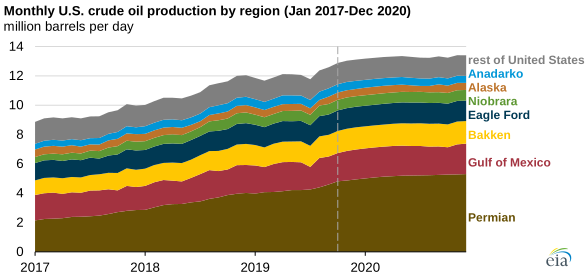
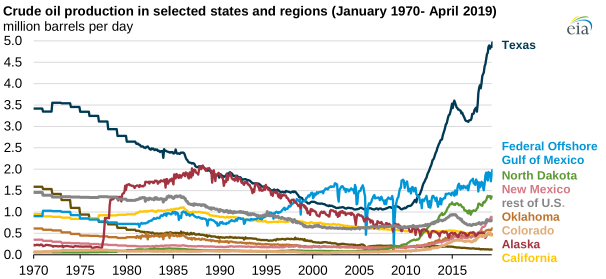
The vast majority of US crude oil production, and all of the growth since 2008, is from the Permian Basin, Gulf of Mexico and various “shale” plays.

Figure 10. U.S. Energy Information Administration, Short-Term Energy Outlook, November 2019

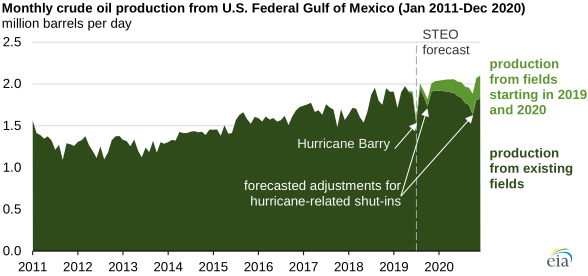
The only one of those regions that wouldn’t be eviscerated by a frac’ing ban, is the Gulf of Mexico. However, a ban on offshore drilling would be a serious “two punch.”

Hurricanes in 2005 (Katrina & Rita) and 2008 (Ike) inflicted extensive damage on Gulf of Mexico oil & gas infrastructure, depressing production by about 250,000 bbl/d from 2006-2008.  The Obama maladministration’s unlawful drilling moratorium and “permitorium” in response to the Deepwater Horizon blowout and oil spill depressed production by about 500,000 bbl/d from 2011-2013.

Figure 11. Gulf of Mexico OCS oil production. US EIA

Since then, Gulf of Mexico oil production has surged to record levels and is expected to top 2 million barrels per day in 2020 as a dozen recent deepwater discoveries are brought online.

Figure 12. U.S. Energy Information Administration, Short-Term Energy Outlook

While a President Fauxcahontas or Commissar Bernie could inflict similar damage, barring new legislation from Congress, the courts would probably slap her/him down even harder than they slapped Obama down.

About 9.2 million barrels per day of current US oil production comes from tight formations and the Gulf of Mexico.

Figure 13. U.S. Energy Information Administration, Petroleum Supply Monthly and State Energy Data System

Frac’ing and offshore drilling account for over 75% of current US crude oil production and almost all of the future growth potential for US production and reserves growth.

While an Enviromarxist ban on frac’ing and offshore drilling wouldn’t drop our production to zero-point-zero immediately, the decline would be quick and particularly sharp in the tight formations, like the Permian Basin. Obama’s unlawful Gulf of Mexico moratorium, very quickly dropped production by about 500,000 bbl/d and the 2014-2016 crash in oil prices caused a similar decline in the Permian Basin. A ban on frac’ing would be catastrophic in the Permian Basin. It would be even worse for natural gas. About 70% of current US natural gas production and all of the future growth potential is from “shale” and other tight formations requiring frac’ing.

Conclusion

Anyone calling for frac’ing ban is mentally ill. A frac’ing ban wouldn’t change this:

Figure 14. It’s a fossil fueled world. (2018 BP Statistical Review of World Energy).

A frac’ing ban would just drive up oil & natural gas prices, force us to import more crude oil and convert LNG export terminals into import terminals. To paraphrase Jeff Goldblum as Dr. Ian Malcolm in The Lost Word, Jurassic Park

A frac’ing ban would be “the worst idea in the long, sad history of bad ideas.”

Any POTUS who tried to enact frac’ing and offshore drilling bans ban would be committing a treasonous act. Our national security is dependent on access to abundant, affordable, useful energy. U.S. crude oil production helped win World Wars I and II.

FRACKING BAN WOULD ERASE PROGRESS TOWARDS U.S. ENERGY SECURITY. API

A frac’ing ban would be a deliberate attempt to sabotage our nation’s energy infrastructure and national security. It would return us to dependence on Saudi Arabia, Iran, Iraq, the Soviet Union Russia, Venezuela and other “friendly” nations for the oil needed to defend this nation.

Treason against the United States, shall consist only in levying war against them, or in adhering to their enemies, giving them aid and comfort.

US Constitution, Article III, Section 3

A frac’ing ban would be giving “aid and comfort” to the Kremlin, the Mullahs in Tehran and the Communist dictator in Venezuela.

Notes about nomenclature

Fracking vs. frac’ing

Frac’ing is a common well completion procedure that has been safely employed in oil & gas production for more than 70 years. There is no evidence whatsoever that frac’ing has ever polluted groundwater or triggered significant palpable earthquakes. Wastewater injection wells aren’t frac’ing. Frac’ing is a contraction of “hydraulic fracturing”. Fracking is a cleaned up version of the “F” word.

Shale vs. “shale”

I try to put quotation marks around the word shale when I use it in reference to “shale” plays. Many “shale” plays aren’t actually shale.

Is it Shale or not Shale? That is the Question.

In a previous blog on unconventionals, ”Conventional vs. Unconventional Shale: What is my Reservoir?,” Richard Day wrote about the nontrivial problem of classifying reservoirs as conventional or unconventional formations. I would like to continue this topic, as, in Europe, this issue has made it into the headlines of local newspapers. People in small villages have become “experts” in the field of geology, and believe they can determine whether exploration is for conventional or unconventional hydrocarbons, and whether it threatens their tranquillity. If they deem it so, from England to Poland, they voice their concerns.

Personally, if I had a choice, I would prefer to have unconventional drilling in my backyard rather than conventional. The high environmental standards and restrictive regulations give more guarantees that unconventional drilling is more secure and environmentally friendly than conventional drilling. But, sometimes, local people are afraid of whatever we call “shale.” Here, I would like to show examples of rocks that do not meet the definition of shale, but are still perceived as shale. Definitions can be misleading, and the nature of shale is more complex than people believe.

[…]

Recently, I was forced to change my presentation because I used the word “shale” for a rock containing over 45% clay minerals (as was reported in an X-ray diffraction (XRD) test and consistent with my petrophysical analysis), but the operator was wary of naming this rock as a “shale.” Shale can be defined as: ”Shale is laminated, indurated (consolidated) rock with > 67% clay-sized materials.” Jackson, J.A. (1997). Glossary of Geology, 4th Ed., American Geological Institute.

While it is always good to have reliable sources of knowledge, please take a look at the mineral composition of known shale gas plays in the U.S., as presented in Fig. 1 – which shows that almost none of the U.S. shale gas plays meet the criteria of the definition given above. According to this definition, there are no shale gas plays in the U.S. “Houston, we have a problem…”

[…]

Halliburton

Halliburton Figure 1. ” Ternary diagram of all shales in database. The color represents the individual shale, and the size of the bubble represents the brittleness as determined from XRD data (computed by mineral composition).

About the author of this WUWT post

I have been a geologist/geophysicist in the “climate wrecking” (oil & gas) industry since 1981. I am a member of the American Association of Petroleum Geologists (AAPG), Society of Exploration Geophysicists (SEG) and Houston Geological Society (HGS).

via Watts Up With That?

https://ift.tt/2UJMKUa

February 11, 2020 at 04:06AM

Coronavirus 101

The best overview I have seen comes from Rud Istvan at Wuhan Coronavirus–a WUWT Scientific Commentary  Excerpts in italics with my bolds

Basic Virology

What follows perhaps oversimplifies an unavoidably complex topic, like sea level rise or atmospheric feedbacks to CO2 in climate science.

There are three main types of human infectious microorganisms: bacteria, fungi, and viruses. (I skip important complicating stuff like malaria or giardia.) Most human bacteria are helpful; the best example is the vast gut biome. In human disease some bacteria (typhoid, plague, tetanus, gangrene, sepsis, strep) and certain classes of fungi (candida yeasts) can cause serious disease, as do some human viruses (polio, smallpox, measles, yellow fever, Zika, Ebola).

There are two basic forms of bacteria (Prokaryotes and Archaea, neither having a genetic cell nucleus). Methanogens are exclusively Archaean; most methanotrophs are Prokaryotes. Membrane bound photosynthetic organelle containing cyanobacteria are the evolutionary transition from bacteria to all Eukaryotes (cells having a separate membrane bound genetic nucleus) like phytoplankton, fungi, and us. Both Prokaryote and Eukaryote single cell (and all higher) life forms have a basic thing in common—they can reproduce by themselves in an appropriate environment.

Viruses are none of the above. They are not ‘alive’; they are genetic parasites. They can only reproduce by infecting a living cell that can already reproduce itself. The ‘nonliving’ viral genetic machinery hijacks the reproductive machinery of a living host cell and uses it to replicate virions (individual virus particles) until the host cell ‘bursts’ and the new virions bud out in search of new hosts.

There are two basic virus forms, and two basic genetics.

Form

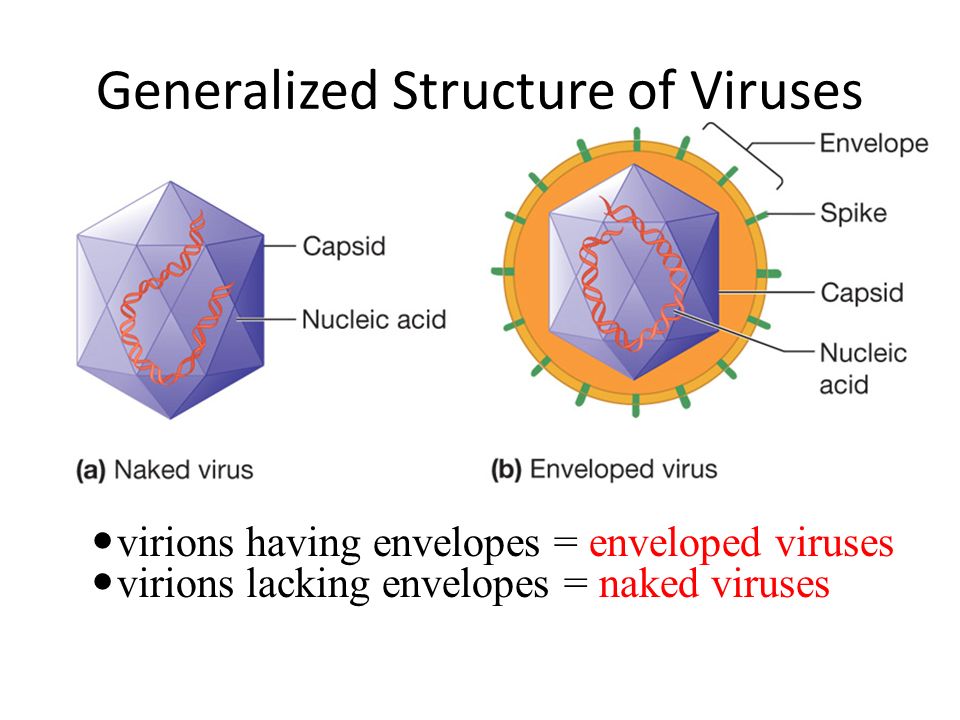
1. Viruses are either ‘naked’ or ‘enveloped’. (see image at top).  A naked virus like cold causing rhino has just two structural components, an inner genetic whatever code (only the two basic types–DNA and RNA–are important for this comment) and an outer protective ‘capsid’ protective viral protein coat. An example is cold producing rhinovirus in the family picornavirus (which also includes polio).

2.Enveloped viruses like influenza and corona (Wuhan) include a third outer lipid membrane layer outside the capsid, studded with partly viral and partly host proteins acquired from the host cell at budding. These are used to infect the next host cell by binding to cell surface proteins. The classic example is influenza (internal genetic machinery A or B) designated HxNy for the flavor of the (H) hemagglutinin and (N) neuraminidase protein variants on the lipid membrane surface.

Genetic Type

The second major distinction is the basic genetics. Viral genetic machinery can be either RNA based or DNA based. There is a huge difference. All living cells (the viral hosts) have evolved DNA copy error machinery, but not RNA copy error machinery. That means RNA based viruses will accumulate enormous ‘transcription’ errors with each budding. As an actual virology estimate, a single rhinovirus infected mucosal cell might produce 100000 HRV virion copies before budding. But say 99% are defective unviable transcription errors. That math still says each mucosal cell infected by a single HRV virion will produce about 10 infective virions despite the severe RNA mutation problem. The practical clinical implication is that when you first ‘catch’ a HRV cold, the onset to clinical symptoms (runny nose) is very fast, usually less than 24 hours.

This also explains why adenovirus is not very infective. It is a DNA virus, so mutates slowly, so the immune memory is longer lasting. In fact, in 2011 the FDA approved (for military use only) a vaccine against adeno pharyngoconjuntivitis that was a big problem in basic training. (AKA PCF, or PC Fever, highly contagious, very debilitating, and unlike similar high fever strep throat untreatable with antibiotics.) In the first two years of mandatory PCF vaccine use, military PCF disease incidence reduced 100 fold.

Upper Respiratory Tract viral infections.

So-called URI’s have only two causes in humans: common colds, and influenza. Colds have three distinguishing symptoms–runny nose, sore throat, and cough—all caused not by the virus but by the immune system response to it. Influenza adds two more symptoms: fever and muscular ache. Physicians know this well, almost never test for the actual virus seriotype, and prescribe aspirin for flu but not colds. Much of what follows in this section is based on somewhat limited actual data, since there has been little clinical motivation to do extensive research. A climate analogy would be sea surface temperature and ocean heat content before ARGO. Are there estimates? Yes. Are there good estimates? No.

Common cold URI’s stem from three viral types: RNA rhinovirus (of which there are about 99 seriotypes but nobody knows for sure) causing about 75% of all common colds, RNA coronaviruses, for which (excluding SARS, MERS, and Wuhan) there are only 4 known human seriotypes causing about 20% of common colds, and DNA adenoviruses (about 60 human seriotypes, but including lots of non-cold symptom seriotypes like conjunctivitis (pink eye and pharyngoconjunctivitis) causing about 5% of common colds.

Available data says rhinovirus seriotypes are ubiquitous but individually not terribly infective, coronavirus seriotypes are few but VERY infective, and adenoviruses are neither. This explains, given the previous RNA mutation problem, why China and US are undertaking strict Wuhan quarantine measures.

This also explains why there is no possibility of a common cold vaccine: too many viral targets. You catch a cold, you get temporary (RNA viruses are constantly mutating) immunity to that virus. You next cold is simply a different virus, which is why the average adult has 2-4 colds per year.

A clinical sidebar about URI’s. Both are worse in winter, because people are more indoors in closer infectious proximity. But colds have much less seasonality than flus. Summer colds are common. Summer flus aren’t.

There is a differential route of transmission explanation for this empirical observation. Colds are spread primarily by contact, while flus are spread primarily by inhalation. You have a cold, you politely (as taught) cover your sneeze or cough with a hand, then open a door using its doorknob, depositing your fresh virions on it. The person behind you opens the door, picking up your virions, then touches the mouth or nose (or eyes) before washing hands. That person is now probably infected. This is also why alcohol hand sanitizers have been clinically proven ineffective against colds. They will denature enveloped corona and adeno, but have basically no effect on the by far more prevalent naked rhinos.

There is an important corollary to this contact transmission fact. Infectivity via the contact route of transmission depends on how long a virion remains infective on an inanimate surface. This depends on the virion, the surface (hard doorknob or ‘soft’ cardboard packaging), and the environment (humidity, temperature). The general epidemiological rule of thumb for common colds and flus is at most 4 days viability. This corollary is crucial for Wuhan containment, discussed below.

The main flu infection route is inhalation of infected aspirate. This does not require a cough, merely an infected person breathing in your vicinity. In winter, when you breathe out outside below freezing ‘smoke’ it is just aspirate that ‘freezes’ and becomes visible. Football aficionados see this at Soldier and Lambeau Fields every winter watching Bears and Packers games. The very fine micro-droplet residence time in the air depends on humidity. With higher humidity, they don’t dry out as fast, so remain heavier and sink faster to where they don’t get inhaled, typically minutes. In typical winter indoor low humidity, they dry rapidly and remain circulating in the air for much longer, typically hours. This is also why alcohol hand sanitizers are ineffective against influenza; the main route of flu transmission has nothing to do with hands.

[Note: The flu virus is contained in droplets that become air borne by sneezing or coughing.  Unless you inhale the air sneezed or coughed by an infected person, the main risk is direct skin contact with a surface on which the droplet landed.]

Wuhan Coronavirus

As of this writing, there are a reported 37500 confirmed infections and 811 deaths. Those numbers are about as reliable as GAST in climate change. Many people do not have access to definitive diagnostic kits; China has a habit of reporting an underlying comorbidity (emphysema, COPD, asthma) as cause of death, the now known disease progression means deaths lag diagnoses by 2-3 weeks. A climate analogy is the US surface temperature measurement problems uncovered by the WUWT Surface Stations project.

There are a number of important general facts we DO now know, which together provide directional guidance about whether anyone should be concerned or alarmed. The information is pulled from reasonably reliable sources like WHO, CDC, NIH, and JAMA or NEJM case reports. Plus, we have an inadvertent cruise ship laboratory experiment presently underway in Japan.

The incubation period is about 10-14 days until symptoms (fever, cough) evidence. That is VERY BAD news, because it has been demonstrated beyond question (Germany, Japan, US) that human to human transmission PRECEDES symptoms by about a week. So unlike SARS where all air travelers got a fever screening (mine was to and from a medical conference in Panama City). Since transmission did not precede symptoms, SARS fever screening sufficed; with Wuhan fever screening is futile. That is why all the 14-day quarantines imposed last week; the only way to quarantine Wuhan coronavirus with certainty is to wait for symptoms to appear or not. Quarantine is disruptive and expensive, but very effective.

Once symptoms appear, disease progression is now predictable from sufficient hundreds of case reports—usual corona cold progression for about 7-10 days. But then there is a bifurcation. 75-80% of patients start improving. In 20-25%, they begin a rapid decline into lower respiratory pneumonia. It is a subset of these where the deaths occur with or without ICU intervention. And as whistleblower Dr. Li’s death in Wuhan proves, ICU intervention is no panacea. He was an otherwise healthy 34 years old doctor.

We also now know from a JAMA report Friday 2/7/2020 analyzing spread of Wuhan coronavirus inside a Wuhan hospital, that 41% of patients were infected within the hospital—meaning the ubiquitous surgical masks DO NOT work as prevention. The shortage of masks is symptomatic of panic, not efficacy.

Scientists last week also traced the source. There are two clues. Wuhan is now known to be 96% genetically similar to an endemic Asian bat corona. Like SARS and ‘Spanish flu’, it jumped to humans via an intermediate mammal species. No bats were sold in the Huanan wet market in Wuhan. But pangolins were, and as of Friday there is a 99% genetic match between pangolin corona and Wuhan human corona. Trade in wild pangolins is illegal, but the meat is considered a delicacy in China and Vietnam and pangolins WERE sold in the Wuhan wet market. This is is similar to SARS in 2003. A bat corona jumped to humans via live civets in another Chinese wet market. Xi’s ‘simple’ permanent SARS/Wuhan coronavirus solution is to ban Chinese wet markets.

Conclusions

Should the world be concerned? Perhaps.

Will there be a terrible Wuhan pandemic? Probably not.

Again, the analogy to climate change alarm is striking. Alarm based on lack of underlying scientific knowledge plus unfounded worst case projections.

Proven human to human transmissibility and the likely (since proven) ineffectiveness of surgical masks were real early concerns. But the Wuhan virus will probably not become pandemic, or even endemic.

We know it can be isolated and transmission stopped with 14-day quarantine followed by symptomatic clinical isolation and ICU treatment if needed.

We know from infectivity duration on surfaces that it cannot be spread from China via ship cargo. And cargo ship crews can simply not be given shore leave until their symptomless ocean transit time plus port time passes 14 days.

Eliminating Chinese wet markets and the illegal trade in pangolins prevents another outbreak ever emerging from the wild, unfortunately unlike Ebola.

via Science Matters

https://ift.tt/2tLsCWD

February 11, 2020 at 03:26AM

WHY WE WILL NEED TO BE FORCED TO CHANGE TO ELECTRIC VEHICLES

I’m certain that the government will have to apply a good deal of force, or as they will call it "incentives" in order to get us to replace our petrol or diesel cars with pure electric ones (hybrids are also to be banned). This article explains why.

via climate science

https://ift.tt/2HcdoNt

February 11, 2020 at 01:30AM