
Michael Mann Takes His Fraud Down Under
via Real Climate Science
February 10, 2020 at 10:40AM
via Real Climate Science
February 10, 2020 at 10:40AM
After fifteen years of nonstop propaganda about record heat and record polar melting, sea ice extent is normal both poles.
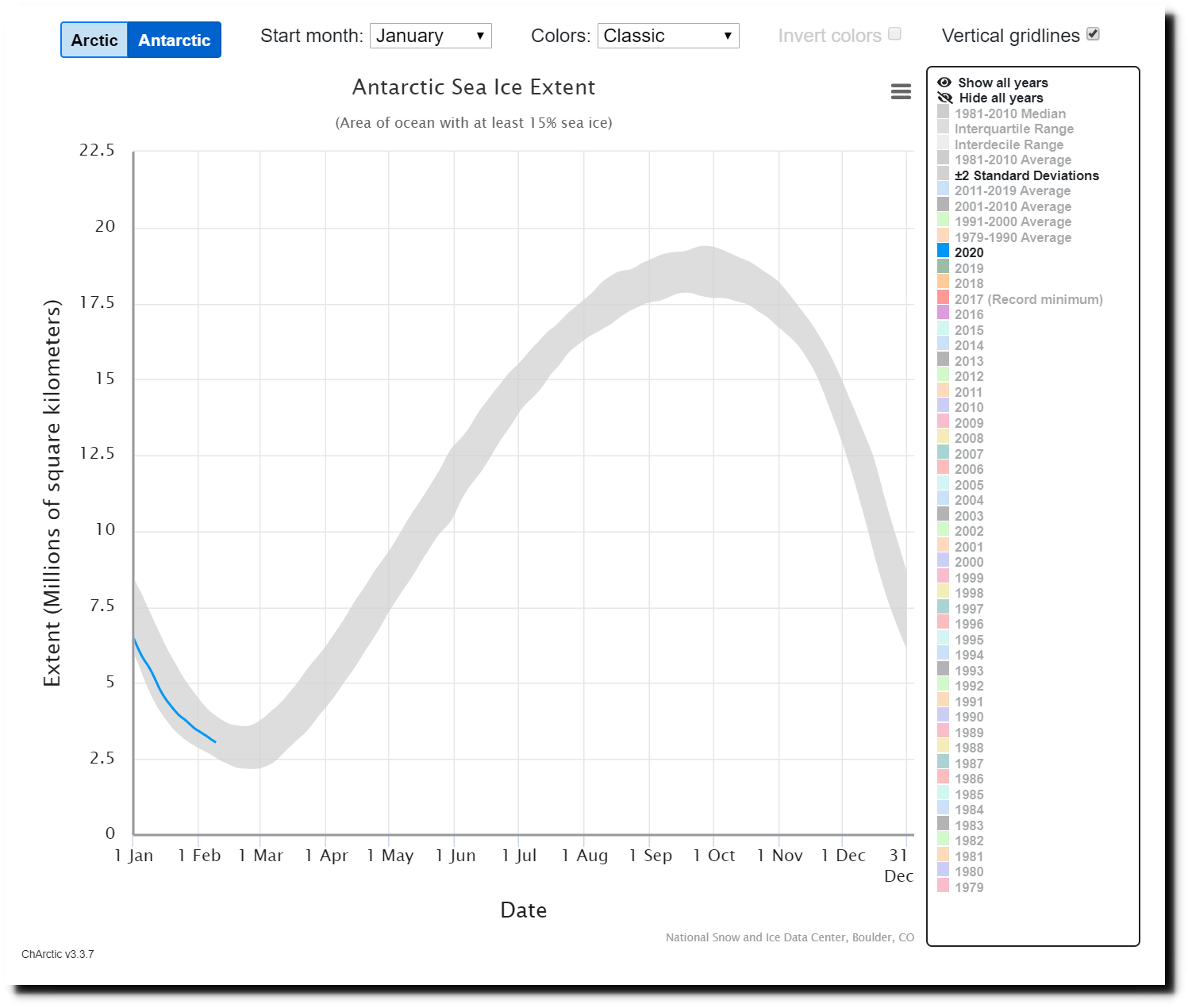

Charctic Interactive Sea Ice Graph | Arctic Sea Ice News and Analysis
via Real Climate Science
February 10, 2020 at 10:40AM
By Paul Homewood
Storm of the century? Storm in a teacup, more like!

Britain is facing further mayhem over the next 48 hours in the wake of Storm Ciara which battered Britain with winds of up to 100mph causing widespread flooding and travel chaos.
Hundreds of flights were grounded, motorways and main roads shut and trains cancelled and delayed in the wake of a storm that threatens further disruption.
The Met Office warned that ‘exceptional’ gusts of up to 70mph would strike again on Monday and issued snow and ice warnings for large swathes of northern England and almost all of Scotland. The south of England will also be hit for a second day by heavy winds.
Gusts of 97mph were recorded at the Needles off the Isle of Wight while Manchester Airport was buffeted by winds of up to 86mph.
Helen Roberts, a senior meteorologist at the Met Office, said that Storm Ciara threatened to be the worst this century, rivalled only by the 19th December 2013 storm that caused widespread power cuts.
“It’s definitely the biggest storm in seven years and in terms of area affected it’s probably the biggest this century,” she said.
https://www.telegraph.co.uk/news/2020/02/09/storm-ciara-hits-britain-mph-wind-rain-travel/
As usual the Met Office have exaggerated the power of the storm by using gust speeds at exposed headlands and the like:

The Needles are tall lumps of rock off the coast of the Isle of Wight, and nearly always appear near the top of wind speed lists. Similarly with Capel Curig and Lake Vyrnway, both high up in Snowdonia, and Aberdaron, at the top of cliffs at the tip of the Llyn Peninsula.

The Needles
The wind speeds recorded at these places bear no resemblance to those at places where people actually live and travel.
The Met Office don’t even seem to have bothered listing representative lowland and inland sites, something they used to in the past. But I have pieced together a cross section from the Met Office:


I have picked Bournemouth because of its proximity to the Isle of Wight and coastal position, and Manchester (Rostherne) where a high gust was recorded at the airport.
Top gusts reached 60mph in Manchester and 54mph in Bournemouth. Sustained wind speeds however ranged between 31 and 34mph at the three sites, putting them into the Near Gale category:

I notice that the Met Office is still forecasting ‘exceptional’ gusts of up to 70mph today. I presume they mean gusts of that today will be few and far between, rather than meaning that a gust of 70mph itself is “exceptional”!
In fact the Met forecast is for sustained wind speeds of between 20 and 25mph at worst for inland sites, and up to 30 mph for coastal sites with the exception of Lands End and the Western Isles. In other words a Fresh Breeze for most of the country:

So what about this nonsense about the “Storm of the Century”?
If this meant to be the 21stC, all I can say is the Met Office must have a very good crystal ball! But if they mean the last 100 years, the claim is patent nonsense.
In fact we only have to go back two years for claims of 100mph winds, when Eleanor blew by:

Two years before that, the Telegraph absurdly claimed “record breaking winds” from Imogen, which reached 96mph on the Needles.


And in 2013, the St Jude’s Day storm saw winds of 99mph on the Needles:

https://www.metoffice.gov.uk/weather/learn-about/past-uk-weather-events
As the Met Office rightly pointed out, that storm was not in the same category as the Great Storm of 1987. Nor was it in the same league as the Burns Day storm in 1990, when even inland sites across a wide swathe of England experienced gusts of between 80 and 90mph.

Finally, a look at the Met Office page for record gusts at low-level sites shows that every district has seen gusts of 100mph and over since 1969. Some are exposed sites, such as the Needles and St Bees, but most are genuine, representative sites.
All the records, bar one, were set prior to 2000:

https://www.metoffice.gov.uk/research/climate/maps-and-data/uk-climate-extremes
This episode highlights how the Met Office has lost all sense of objectivity, and instead are intent on hyping every bit of bad weather to play to their climate agenda.
via NOT A LOT OF PEOPLE KNOW THAT
February 10, 2020 at 10:24AM
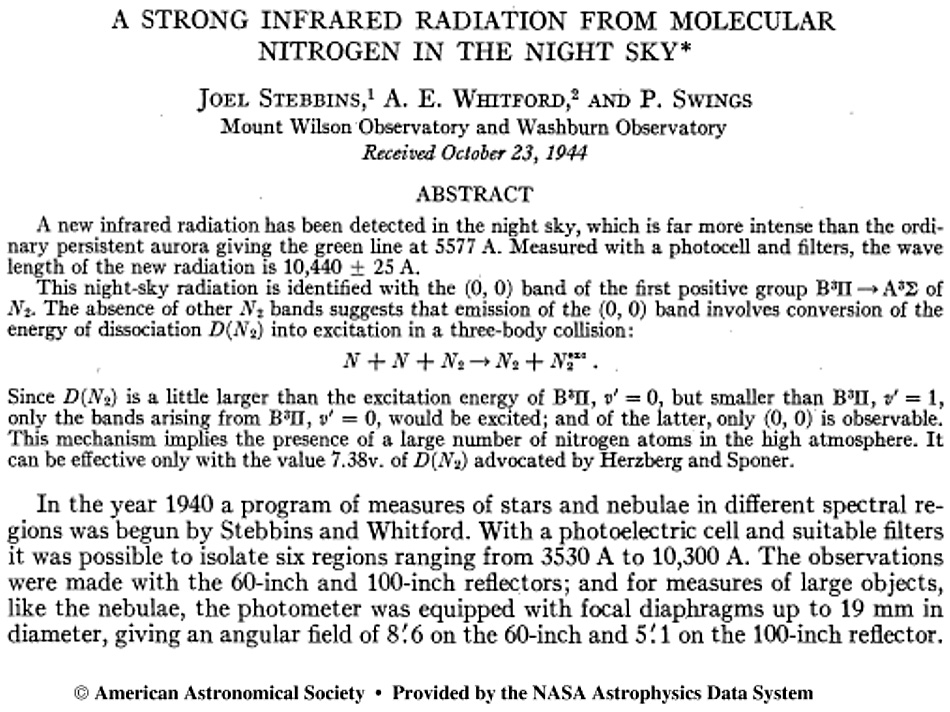
It’s been known for 75 years that nitrogen – the Earth’s most prevalent atmospheric gas – absorbs and “strongly” radiates infrared energy (Stebbins et al., 1944)
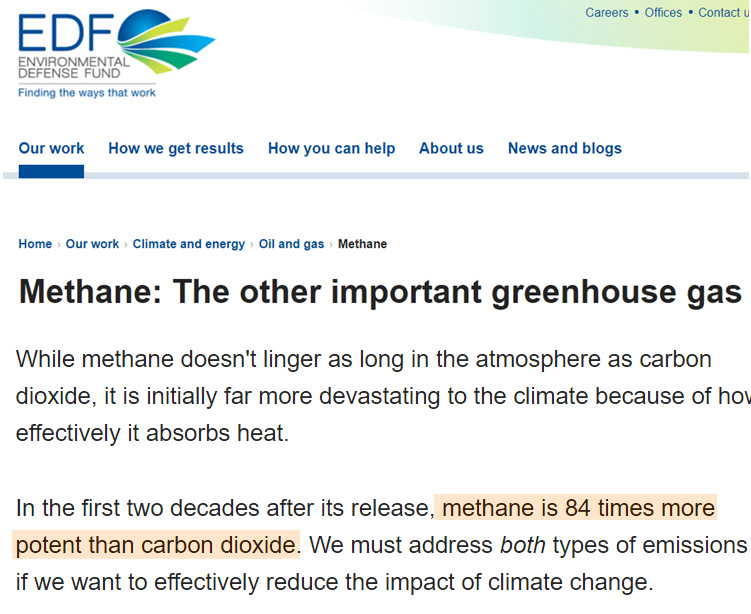
Methane (CH4) is thought to be an 84 times more potent greenhouse gas than CO2.
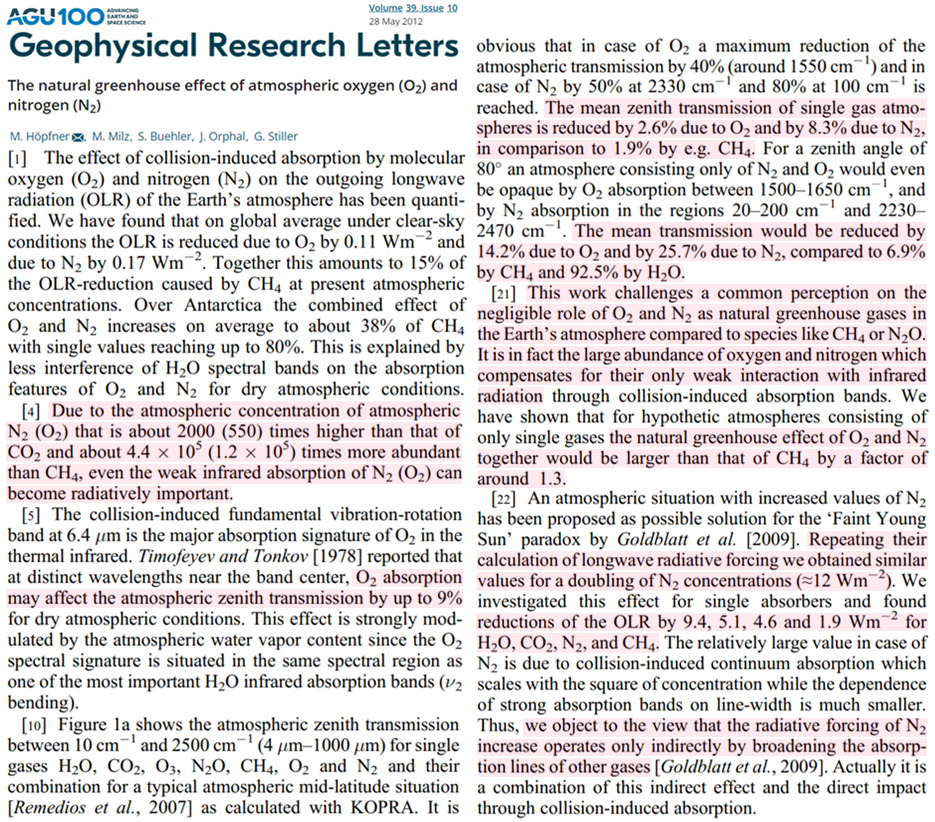
Scientists (Höpfner et al., 2012) publishing in Geophysical Research Letters dispute the “common perception” that nitrogen and oxygen – accounting for 78% and 21% of the Earth’s atmospheric gases – do not contribute signficantly to the Earth’s greenhouse effect.
They assert N2 and O2 are “radiatively important” “natural greenhouse gases” primarily because their concentration is “about 2000 (550) times higher than that of CO2 and about 4.4 × 10⁵ (1.2 × 10⁵) times more abundant than CH4.”
The atmospheric abundance of N2 and O2 compensates for their relatively weaker IR function (when directly compared to CH4).
For example, “the natural greenhouse effect of N2 and O2 would be larger than that of CH4 by a factor of 1.3” when considering their combined isolated GHE influence.
Further, the reduction in the atmosphere’s infrared transmission amounts to 25.7% for N2, 14.2% for O2, and only 6.9% for CH4.
Höpfner and colleagues also suggest N2 reduces outgoing longwave radiation (OLR) by 4.6 W/m² compared to CO2’s 5.1 W/m² when assesing their solo absorption capacity. This would appear to be a rather minor difference.
If the number of N2 molecules in the atmosphere were hypothetically doubled, it would produce a 12 W/m² longwave greenhouse effect forcing.
Doubling CO2 from 280 ppm to 560 ppm only yields a 3.7 W/m² radiative forcing.
The authors reject the “view that the radiative forcing of N2 increase operates only indirectly by broadening the absorption lines of other gases.” Instead, N2 has a “direct impact” (as well as an indirect impact) within greenhouse effect forcing.
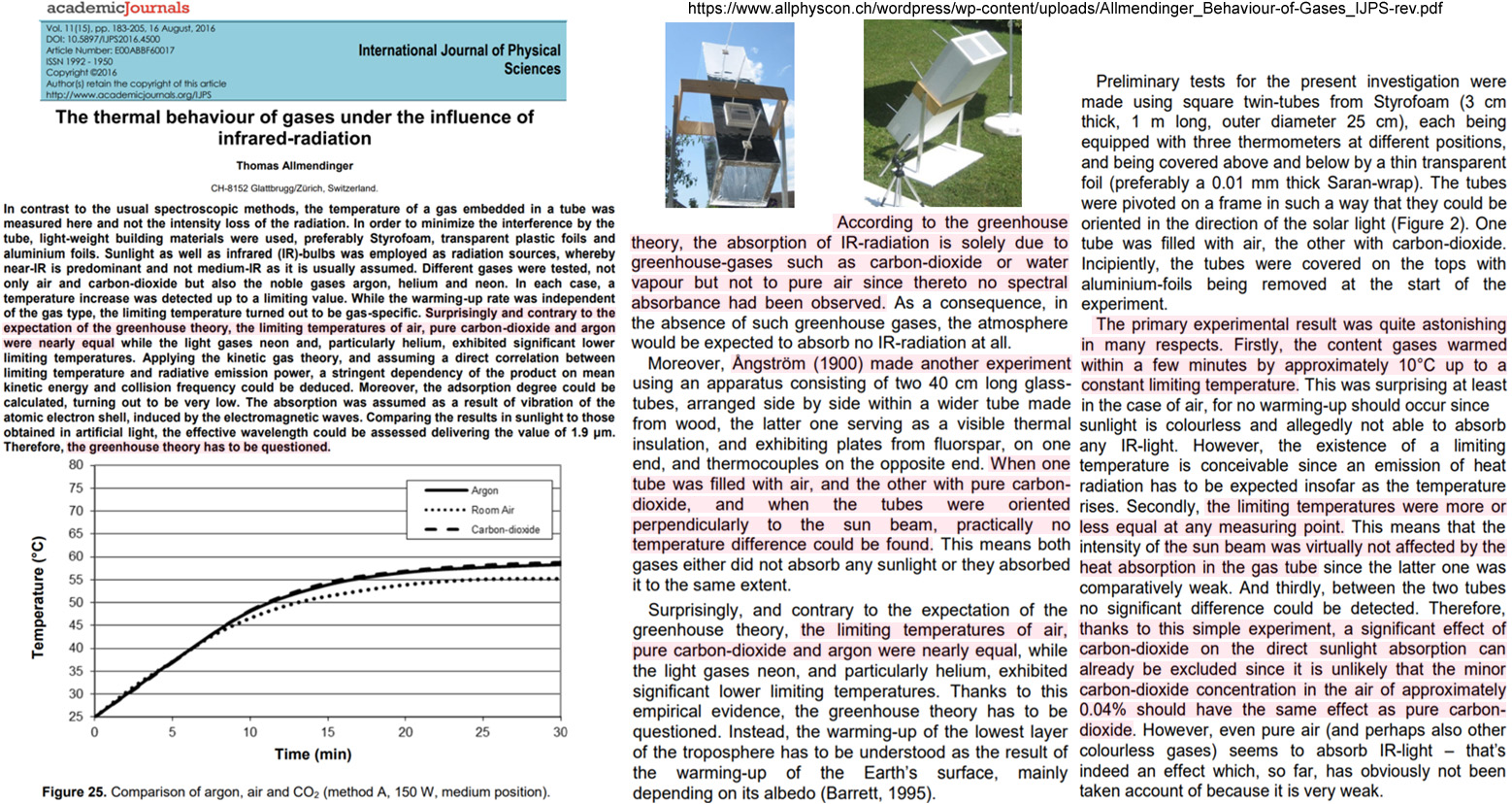
A real-world experiment (Allmendinger, 2016) assessing the efficacy of CO2’s IR-absorption temperature capacity relative to air (N2, O2) and Argon (Ar) further establishes CO2 is not the “special” GHG it is commonly thought to be.
Twin styrofoam Saran-wrap-sealed tubes exposed to sunlight were used, one with pure (1,000,000 ppm) CO2 and the other with air (N2, O2) and/or Ar.
The results were admittedly “surprising” given expectations CO2 would operate as a radiatively distinct GHG.
The tube absorbing IR with N2 and O2 (air) and Ar warmed to a temperature limit quite similar to (55°C to 58°C) the temperature limit in the 100% CO2 tube (58°C).
There was no remarkable or “special” heat absorption capacity for CO2 relative to air observed. And Argon – not considered a greenhouse gas – absorbed IR to the same temperature limit as CO2. With a concentration of 9300 ppm, Ar is the third-most abundant gas in the Earth’s atmosphere.
Because there is so little to distinguish CO2 from the most abundant gas molecules in Earth’s atmosphere, Dr. Allmendinger assesses “a significant efect of carbon-dioxide on the direct sunlight absorption can already be exluded.”
Further, “the greenhouse theory has to be questioned.”
via NoTricksZone
February 10, 2020 at 09:08AM
 Iowa Climate Science Education