Month: February 2020

Cooling the Past: Made Easy for Paul Barry

Reposted from Jennifer Marohasy’s Blog

February 6, 2020 By jennifer

It is not disputed that Blair Trewin under the supervision of David Jones (both working at the Australian Bureau of Meteorology) remodel all the historical temperature data generating trends and statistics that look quite different from the actual measurements.

The remodelled series are then passed on to university and CSIRO climate scientists who base much of their climate research on these ‘second-hand’ statistics.

So, when Michael Mann and David Karoly tell you it’s getting hotter and hotter, this is their interpretation of Blair Trewin’s statistics, not their interpretation of the actual data.

When I say there needs to be more scrutiny of what Blair does to the actual measurements, I’m simply making a request.

As Andrew Bolt explains in his column yesterday harshly entitled ‘On the deceit of Paul Barry’:

Marohasy does not say the Bureau is “part of a huge conspiracy”. What she does say is undeniably true: the Bureau has repeatedly adjusted its data, with the result that the past looks cooler and therefore the warming greater.

The only dispute is over whether the Bureau has done this correctly, to make the data more accurate. It says yes, Marohasy says no.

What evidence does Barry offer that she’s wrong? None. No interest. All he has is mockery and an appeal to his mob.

Thanks Andrew, for explaining the situation so succinctly.

It is the case that none of the adjusting is denied by Blair at the Bureau.

To help Paul Barry and others explore what Blair has actually done, my colleague Jaco Vlok has created a table with an interactive drop-down menu for each of the 112 weather stations with remodelled data.

The adjusting is laid-out, and explained here:

https://jennifermarohasy.com/acorn-sat-v1-vs-v2/

Go and have a play!

For example, if you click on the link, and scroll down (the 112 stations are listed alphabetically) all the way to Wagga, and then across to TMax you will find a chart that shows the raw data, and then the Blair Trewin reconstructions for this weather station that is used to calculate national averages and global warming.

Wagga-Tmax072150Wagga-Tmax072150One of the charts from the drop-down table created for Paul Barry by my friend and colleague Jaco Vlok.

First Blair created ACORN V1, that was back in 2011.

ACORN V2 is the data reworked to further increase the rate of warming.

Thanks Jaco. Thanks Andrew.

Now, Paul … go and have a look, and play. It is not a conspiracy, nor is it rocket science. But understanding can take time, especially when it is not what you might expect Bureau employees to be doing to the historical temperature data.

****
The feature image shows Jaco Vlok (far left) backing me up in a dispute about the value of remodelling historical temperature data.

via Watts Up With That?

https://ift.tt/2urEmOl

February 6, 2020 at 12:20PM

Electric Cars and the Error of ‘Picking Losers’

What are we to make of the Government’s decision to bring forward the ban on petrol and diesel cars from 2040 to 2035?

electric cars picking losers

It’s a fine example of what is known as government picking losers – one of those decisions which makes our economy more inefficient and our lives more expensive as a result.

To start with, there is remarkably little evidence that electric cars, battery powered, produce fewer emissions than those standard internal combustion engine (ICE) models. VW has released the comparative numbers for their new electric Golf as against the diesel version. The all-clean all-climate-friendly version must do 120,000 km to actually be so, given the emissions required to make the thing. There are more than a few cars that go to that Great Scrapyard in the sky before this milestone (sorry).

Then there’s the fact that hybrid cars are going to be included in the 2035 ban. This seems a particularly misguided decision, given the manner in which hybrids help solve the long distance journey problem.

The vast majority of all car journeys are local pootling around which can be managed by a hybrid’s small battery. The combustion engine picks up the load only when longer distances are required. This means not needing a vast and hugely expensive network of fast charging stations across the country, which would be a significant saving in infrastructure spending.

That’s not all though. Hydrogen powering a fuel cell rather than a lithium battery can and could feed the same electric motors.  Algal oil production – creating hydrocarbons out of atmospheric CO2 – would mean not needing to change the fuel infrastructure at all. It’s something that can already be done, and is getting cheaper (admittedly only from eyewateringly expensive to vastly) all the time.

It is not even true that cars, however they are powered, need to be the solution. Everyone moving closer to work and commuting shorter distances would be just as big a boon to the environment. We Europeans already do this compared to Americans, partly as a result of the higher fuel taxes paid over the decades. This offers a significant clue to how the problem should actually be addressed. .

Friedrich Hayek had something to say about this, as did Sir Nicholas Stern in his eponymous report on global warming. The possible reactions to climate change are multitudinous. The economy is a large and complex thing, not amenable to planning. Where action must indeed be taken the only efficient and effective solution is to stick the one single lever into the price system. This then works on all decisions and options at the same time.

What does that mean? Probably that the optimal solution to climate change is a revenue-neutral carbon tax – not politicians making airy promises about technologies they don’t understand.

Full Post

The post Electric Cars and the Error of ‘Picking Losers’ appeared first on The Global Warming Policy Forum (GWPF).

via The Global Warming Policy Forum (GWPF)

https://ift.tt/2GX7eAS

February 6, 2020 at 11:50AM

Coercing China On Climate Change?

Absent drastically different policies, China will continue to emit 5.5-6 billion more tons of carbon than the US every year.

The atmosphere does not respond to greenhouse gas emissions per capita or scaled by economic size or to “fairness,” only to the quantity of emissions. The latest data on those quantities reinforce that (prospective) American policy-makers who see climate change as an unparalleled risk must be ready to coerce China.

The Netherlands Environmental Assessment Agency (NEAA) started measuring greenhouse emissions 30 years ago. They have since built a comprehensive and statistically consistent global time series. They don’t rush to estimate global emissions even before the year in question ends, odd yet routine behavior elsewhere.

It’s common to call China and the US “the two largest emitters” or the like. The NEAA’s just-updated data show that is accurate, yet badly misleading. The data put Chinese 2018 CO2 emissions of 11.18 billion metric tons at more than twice American and roughly equal to that of the US plus the EU plus India.

The China-US gap dwarfs other numbers thought to be important. China became the second-largest national emitter in 1987, passing the then-USSR. From the start of 1987 through the end of 2018, total Chinese emissions were 18 billion tons larger than American. That gap is larger than climate-maligned Australia’s total emissions from 1970 (first year recorded) through 2018.

Still, the US led in annual emissions for most of this period. In 2005, China took over and the gap between the countries has widened each year since. From 2005 through 2018, Chinese emissions were 56 billion tons larger than American. That gap is larger than the EU’s total emissions over the period.

Absent drastically different policies, China will continue to emit 5.5-6 billion more tons of carbon than the US every year. It is hardly scientific to treat the two as comparable; it would be more accurate arithmetically to lump Nigeria – at 110 million tons of emissions in 2018 — together with the US.

Against the numbers, it is frequently argued that the US must act first for China to be willing to make difficult changes. American emissions in 2018 were about the same as they were in 1993. From 1993 to 2018, the correlation between same-year American and Chinese emissions is -0.5. The US has capped emissions for a generation and China has not followed.

President Obama’s two terms are a very small sample but one where the US attempted to lead on climate change and induce China to follow. The emissions correlation during his time in office is -0.7. China may have moved more definitively in the opposite direction.

The good news is Chinese emissions growth has slowed, climbing 400 million tons from 2013 to 2018. The largest increment to emissions over this period belongs to India, at near 600 million tons. Moreover, India’s level and recent trend look in 2018 very similar to China’s in 1991. India could lead the world in the increment to emissions for decades.

If the goal is to curb global emissions growth from this point, the critical actions are aimed at sharply changing India’s trajectory. Its economy is small enough that large-scale financial and technological transfers from the US and other rich countries may be effective. It’s of course possible that emissions will rise as rapidly with aid as without — India seeks to develop, not control carbon.

Full post

The post Coercing China On Climate Change? appeared first on The Global Warming Policy Forum (GWPF).

via The Global Warming Policy Forum (GWPF)

https://ift.tt/2tyNv7m

February 6, 2020 at 11:10AM

Corrected RCP Scenario Removal Fractions

Well, as I suspected (and warned everyone) in my blog post yesterday, a portion of my calculations were in error regarding how much CO2 is taken out of the atmosphere in the global carbon cycle models used for the RCP (Representative Concentration Pathway) scenarios. A few comments there said it was hard to believe such a discrepancy existed, and I said so myself.

The error occurred by using the wrong baseline number for the “excess” CO2 (atmospheric CO2 content above 295 ppm) that I divided by in the RCP scenarios.

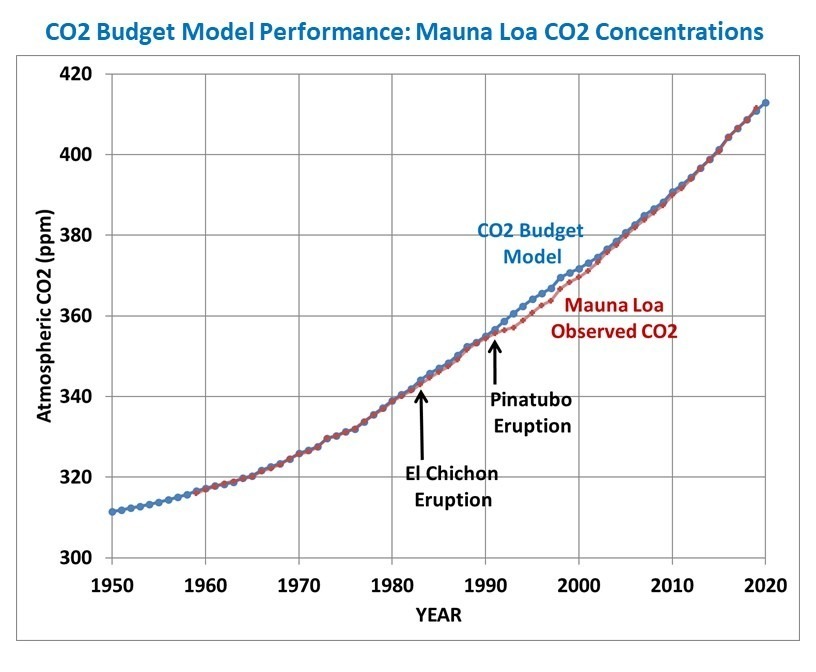
Here is the corrected Fig. 1 from yesterday’s post. We see that during the overlap between Mauna Loa CO2 observations (through 2019) and the RCP scenarios (starting in 2000), the RCP scenarios do approximately match the observations for the fraction of atmospheric CO2 above 295 ppm.

Fig. 1. (corrected) Computed average yearly rate of removal of atmospheric CO2 above a baseline value of 295 ppm from (1) historical emissions estimates compared to Mauna Loa CO2 data (red), (2) the RCP scenarios used by the IPCC CMIP5 climate models Lower right), and (3) in a simple time-dependent CO2 budget model forced with historical emissions before, and EIA-based assumed emissions after, 2018 (blue). Note the time intervals change from 5 to 10 years in 2010.

But now, the RCP scenarios have a reduced rate of removal in the coming decades during which that same factor-of-4 discrepancy with the Mauna Loa observation period gradually develops. More on that in a minute.

First, I should point out that the CO2 sink (removal rate) in terms of ppm/yr in three of the four RCP scenarios does indeed increase in absolute terms from (for example ) the 2000-2005 period to the 2040-2050 period: from 1.46 ppm/year during 2000-2005 to 2.68 ppm/yr (RCP4.5), 3.07 ppm/yr (RCP6.0), and 3.56 ppm/yr (RCP8.5). RCP2.6 is difficult to compare to because it involves not only a reduction of emissions, but actual negative CO2 emissions in the future from enhanced CO2 uptake programs. So, the RCP curves in Fig.1 should not be used to infer a reduced rate of CO2 uptake; it is only a reduced uptake relative to the atmospheric CO2 “overburden” relative to more pre-Industrial levels of CO2.

How Realistic are the Future RCP CO2 Removal Fractions?

I have been emphasizing that the Mauna Loa data are extremely closely matched by a simple model (blue line in Fig. 1) that assumes CO2 is removed from the atmosphere at a constant rate of 2.3%/yr of the atmospheric excess over a baseline value of 295 ppm.

OK, now actually look at that figure I just linked to, because the fit is amazingly good. I’ll wait….

Now, if I reduce the model specified CO2 removal rate value from 2.3 to 2.0%/yr, I cannot match the Mauna Loa data. Yet the RCP scenarios insist that value will decrease markedly in the coming decades.

Who is correct? Will nature continue to remove 2.0-2.3%/yr of the CO2 excess above 295 ppm, or will that removal rate drop precipitously? If it stays fairly constant, then the future RCP scenarios are overestimating future atmospheric CO2 concentrations, and as a result climate models are predicting too much future warming.

Unfortunately, as far as I can tell, this situation can not be easily resolved. Since that removal fraction is MY metric (which seems physically reasonable to me), but is not how the carbon cycle models are built, it can be claimed that my model is too simple, and does not contain the physics necessary to address how CO2 sinks change in the future.

Which is true. All I can say is that there is no evidence from the past 60 years (1959-2019) of Mauna Loa data that the removal fraction is changing…yet.

There is no way for me to win that argument.

via Roy Spencer, PhD.

https://ift.tt/3bdH3Um

February 6, 2020 at 10:32AM