
A verse by W.B. Yeats has been adapted to many a polemic but should not be used lightly:
And what rough beast, its hour come round at last,
Slouches towards Bethlehem to be born?
Still, the image is appropriate for our local barbarians now calling for state-sanctioned silencing of those they brand “climate deniers”. It’s sad that these people infest the ABC, academia and journalism, three institutions where democratic values and support for free inquiry should be the default positions. I’m particularly appalled by the authoritarian views last month of an ABC darling Rebecca Huntley, and a pro-censorship piece last Friday by retired Fairfax and Melbourne University journo Denis Muller.
Dr Huntley was fawned over by the ABC’s Big Ideas program last Wednesday. Her big idea was this:
And finally — in my opinion, and I say this with no trepidation whatsoever — we need to drive the Dismissive group [climate sceptics aka “denialists”] out of positions of power in our government, stop the flow of their donations into our political parties, and find smarter ways to engage with them in the media, including social media.
To be generous to Huntley, by “driving them out” she just might be urging defeat of sceptics by democratic processes and debate. But her add-on about “stopping the flow of their donations into political parties” suggests that she really wants State power to silence and crush sceptics. Where could such a precedent lead? Maybe to Prime Minister Scott Morrison legislating to ban donations to Tim Flannery’s Climate Council? To a Labor government banning donations to the Institute of Public Affairs or Pauline Hanson’s party? To the end of Australia as a free and open society? Rough beasts indeed are the censorship advocates.
I’ll deal first with Huntley’s material, then Muller’s.
Huntley’s labelled as “one of Australia’s foremost researchers on social trends”. She has degrees in law, film studies (first class honors) and a Gender Studies Ph.D. She’s a regular on Radio National and a one-time ABC Drive presenter. She’s also a regular for the censorship-loving Guardian. Currently she’s an adjunct senior lecturer at UNSW. Her ABC Q&A bio says, “Her law and film studies lead [sic] her to become interested in film censorship, feminism and pornography and she published in this area and was actively involved in the Sydney Film Festival and the anti-censorship lobby group Watch on Censorship.” Early this century she worked for numerous federal Labor politicians. She was on the national committee of Emily’s List and the ALP federal policy committee. She ceased ALP work in 2006 but is on the board of the Whitlam Institute. In her ABC piece she writes:
This [winning the propaganda war] will then expose those who dismiss both the science and the solutions, the denialists — who are today a minority, albeit a powerful one — as what they are: out of step with the rest of us, determined to put our collective wellbeing and our way of life at risk. We must not let their voices be the loudest in the public arena.
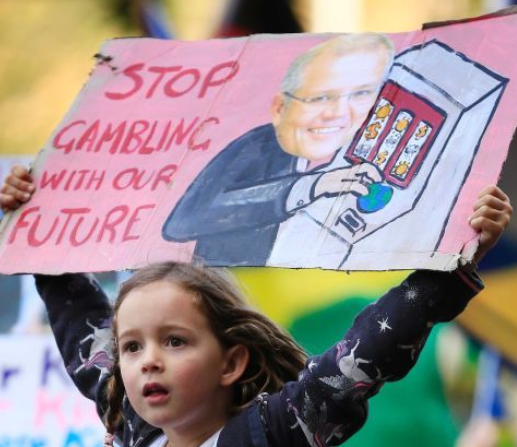 The ABC’s page featuring Huntley’s rant is illustrated, appropriately, with a cute girl about 6 years old brandishing a placard. It features a wicked Prime Minister Morrison hugging a slot machine, and a slogan, “Stop Gambling with our Future.” The pic is captioned, “Girl joins climate protest. We must create a chorus of different communities demanding a viable future.” The caption reeks with ambiguities. Does an early primary schooler “join” a climate protest or is she someone’s puppet? Does the 6yo, like Dr Huntley, want “denialists” de-funded?
Huntley originally delivered her thoughts last November 21 as an “Oration” for Melbourne University’s Sustainable Society Institute. The Institute’s crazed nostrums are constant entertainments for Quadrant Online. The ABC was so impressed with Huntley that it re-ran her Oration on its Big Ideas. She began,
In Australia there is now widespread public acceptance of the reality of climate change; we seem to see its effects almost hourly [as if].
But the electorate still votes for political parties with environment policies that I would call recalcitrant, and with significant groups of climate deniers in their ranks. [Dr Huntley, this system’s known as ‘democracy’].
She grades alarmists and “denialists” into six groups and discusses ways to push sub-groups towards the alarmist camp. But she concedes that the alarmists have problems of their own, which I’d call being victims of their own neuroses.
Huntley: “And we need to provide social and emotional support as many of them — many of us — struggle with feelings of grief, dread and burning anger about what’s happening to the planet and the response of many of our political leaders.” She’s a bit of a mess herself, struggling to “manage the angst that overwhelms me from time to time in the night.” (I’d recommend Temazepan soothers).
Sceptics are sceptics because they perceive that climate data doesn’t back the alarm narrative, and that climate modelling forecasts are acknowledged as junk by the IPCC itself.[i] Instead, Huntley attributes scepticism to “world views, values, political identification, social and cultural conditioning and gender identity.” Then in a common refrain among academic hangers-on to the climate wars, she sees solutions in semantics.
She’s in two minds about hyping the language about climate, e.g.“planetary heating” rather than “climate change”. She thinks failure to use hyped terms about climate crises would be “an outright lie to the public about the scale of the threat and what’s at stake.” But the hype is a “turn-off” to disengaged and cautious people who resent politicisation, doom and gloom. Hyped terms can even drive them into resistance against her climate solutions, especially if the solutions “penalise already struggling groups in our society,” she admits.
So Huntley suggests maybe turning down the hype a bit when talking to potential converts.
We need to find a way to convince the Cautious that urgent action is necessary. This, very difficultly, often requires language that isn’t fraught with tones of crisis.
Her solution is the same as that pushed by the climate crowd everywhere now: to mask their actual anti-capitalism agenda with motherhood stuff like “the desire for secure work, safe neighbourhoods, a good standard of living, security and happiness — whatever that might look like for different groups of people.”
Huntley describes her own Damascene conversion to zealotry like this:
In December 2018 I woke up, made myself a cup of coffee and turned on the TV. I saw hundreds of teenagers skipping school and protesting in the streets about climate change, with handmade signs that spanned from the serious and angry to the humorous and profane.
‘There are no jobs on a dead planet. ‘You’re burning our future.’ And my favourite: ‘Why should we go to the school if you won’t listen to the educated?’”
In her innocence, Huntley doesn’t know these signs are templates provided to kids by Get-Up and the adult-run Youth Climate Coalition.
As I sat sipping my coffee, I thought to myself, “Good on those kids telling the powers that be, the older generation, that they need to do more about climate change.
And then it hit me. At almost 50 years of age, I am part of that older generation, part of that generation with a platform and a voice some of these young people don’t have yet.
It was as if those teenagers were speaking to me. In that moment something shifted inside me, a sensation hard to describe and yet I can recall it now with clarity. It actually felt physical. [Readers, refrain from speculation]. I felt like they were telling me to do something.
And so I made a decision at that moment to put climate change at the heart of everything I do: in my work, as a parent, as a consumer, as a citizen.
It’s a factor in every decision I make about the research jobs I will accept, about the energy that I will have in my house, about the transport that I will take, about the food that I will eat and about where I will invest my superannuation…
That I can make a contribution to this movement, probably the most important in our history, is such a relief to me and helps me manage the angst that overwhelms me from time to time in the night.”
Good luck with all that, Dr Huntley. But first I suggest you read IPCC reports, rather than the “ICCP” ones you mention.[ii] Second, I hope you’ve backed up your fridge with a diesel generator in the garage – green electricity is prone to blackouts.
Now for media expert Dr Denis Muller, who lusts for censorship of deniers. He’s an Honorary Fellow at Melbourne University’s so-called Centre for Advancing Journalism,[iii] after a career with Sydney Morning Herald and the Age, where he became an associate editor. His 2006 PhD was on media ethics and accountability. In the university and taxpayer-funded Conversation last week, he demanded that the media follow suit with the Guardian and The Conversation and suppress sceptic views about the climate. “Media acquiescence in climate change denial, failure to follow the weight of evidence, or continued adherence to an out-of-date standard of impartiality looks like culpable irresponsibility,” he wrote.
Muller continued that climate change “is not an issue like any other. It is existential on a scale surpassing even nuclear war.”
Stop there, Denis. Nuclear war can be depicted as follows. The nine nuclear powers today have about 14,000 nuclear warheads. Of these, 3750 are deployed ready for action. Many are of 1-5 million tonnes of TNT-equivalent. Allow one warhead for each Australian capital and there’s still 3745 warheads available to pulverise the world’s other cities. The Hiroshima bomb was only 13,000 tonnes of TNT-equivalent. In 1976 I interviewed a survivor in a Hiroshima hospital whose fellow 20,000 schoolgirls died in the blast. Here’s some advice, Denis. Climate change doesn’t compare with nuclear war. Please grow up.
Alas, Muller’s track record doesn’t indicate he’ll grow up any time soon. For a start, he has a bad case of Murdoch Derangement Syndrome. Last May, days before the federal election, he started a piece for The Conversation: “There is mounting evidence that Australia is sick of Rupert Murdoch and the political propaganda machine he runs in the guise of a news organisation.” He quoted favourably a US correspondent, Richard Cooke of The Monthly, “arguing that News Corp represents a grave threat to democracy.” Cooke opined, “It isn’t a normal news organisation any longer… It is the unhinged propaganda outfit that is central to the identity of the company. It is the core that is lunatic, not the fringe.” Muller concluded, “at some level, democratic societies have had enough of Murdoch and his propaganda operation masquerading as a news service.” The only fly in Muller’s Murdoch ointment is the readership data. The Australian’s print readership fell 4 per cent year-on-year to last September, but the leftist Age was down 17 per cent and Sydney Morning Herald was down 22 per cent.
Four days after Muller’s team lost the federal election, he was using TheConversation again to say the result showed “the media need better regulation.” He wrote, and please note his weird conclusion on Labor’s coal-based Queensland disaster:
News Corp’s unconstrained anti-Labor bias cannot account entirely for Labor’s disastrous showing, but common sense says it accounts for some. For example, the company has a daily newspaper monopoly in Brisbane through The Courier-Mail. It was virulently anti-Labor and Labor did astonishingly badly in Queensland. Coincidence? Possibly, but unlikely.
If Australia had a half-decent system of media accountability, there would be a public inquiry into the increasing polarisation of Australian newspapers and into the conduct of Sky [TV] at night.
Now let’s get on to his piece last week advocating climate censorship. The heading was “Media ‘impartiality’ on climate change is ethically misguided and downright dangerous.”
Muller began by lauding The Conversation’s “zero-tolerance” from last September to so-called “deniers”, with their comments blocked and accounts locked. The site’s editor Misha Ketchell, ex-Age and Crikey, provided what Muller called a “succinct” rationale: “Climate change deniers and those shamelessly peddling pseudoscience and misinformation are perpetuating ideas that will ultimately destroy the planet.” Muller continued
From the standpoint of conventional media ethics, it was a dramatic, even shocking, decision. It seemed to violate journalism’s principle of impartiality—that all sides of a story should be told so audiences could make up their own minds. But in the era of climate change, this conventional approach is out of date. A more analytical [euphemism alert] approach is called for.
He ran through the policies of the ABC, Nine (ex-Fairfax), Guardian and Murdoch press on climate reporting, saying their common element was against publishing false or misleading material. The Guardian, he says, has an outright ban on “climate change denialism”. This denialism is harmful to the planet and to planet-saving initiatives that (by the way) involve “fundamental societal change”. Muller justifies his disdain for impartiality because editors have a duty to prevent the harm that sceptics cause. This outweighs, or somehow doesn’t violate, “free speech principles”.
Muller does feel a need to demonstrate what “harms” are created by so-called denialism. On the planetary level, he cites last year’s IPCC special report forecasting that another half-degree of warming by 2030 to 2052 is likely if we don’t reduce emissions. But he doesn’t say what harm this would do, given that the past century’s 1degC of warming has brought undreamt-of human health and progress. Instead he quotes a farcical climate-and-health statement last June by the Left-lobbyist Australian College of General Practitioners. Again, this involves just a forecast of deaths and disasters to come. Muller doesn’t cite the GPs on any harms from present warmth and their claim about current declining agricultural yields is false on a global scale.[iv]
Muller quotes them:
Projected changes in Australia’s climate would result in more frequent and widespread heatwaves and extreme heat. This would increase the risks of heat stress, heat stroke, dehydration and mortality, contribute to acute cerebrovascular accidents, and aggravate chronic respiratory, cardiac and kidney conditions and psychiatric illness.
But who knows if the “projected climate changes” will occur?
This dire futurism comprises what, to Muller, is “overwhelming scientific evidence.” Case closed – censoring sceptics is the smart and ethical thing to do, he concludes. Muller is upset that external scrutineers don’t give guidance to the media on climate censorship. These bodies include the Press Council, ACMA[v] and the journos’ union MEAA. He calls on them, in the interests of the profession and public, to develop climate reporting standards and guidance – obviously not leaning towards open debate. Imagine what the Labor-affiliated MEAA could come up with.
We get a laugh about post-war censorship panels which banned Australians from reading sexy or radical authors. Yet how much more laughable – or horrifying – are the would-be censors of minority views against alleged climate perils. They are everywhere now – 350 media groups have signed on to incessant climate hype. Do these would-be censors believe in a democratic society? Or what sort of society do they indeed want?
Footnote: The would-be censors never specify what it is that “deniers” deny. “They deny the science,” these people claim, unaware or ignoring that “the science” includes annually many hundreds of peer reviewed studies favouring the sceptic case (last year, more than 440).
To help censors refine their abuse, I’d say the informed “deniers” deny that current warming is necessarily human-caused. They deny that IPCC climate models are fit to forecast 4degC warming by 2100, given the models’ well-known and admitted flaws and fudges covering unknowns such as cloud impacts and changes in solar output. “Deniers” also assert, based on many authoritative and peer-reviewed studies, that climate sensitivity to CO2 doubling in the atmosphere is at or below the low end of the IPCC range of 1.5 to 4.5degC.[vi] And they assert that a further degree or somewhat more of warming (if it actually occurs) would probably be net beneficial to humanity – think Canadians and Siberians — just as the past century’s 1degC of warming has massively helped farmers to feed what is now nearly eight billion people while greening the planet and rolling back the deserts. Doubt that? Go check with NASA.
Tony Thomas’s hilarious history, The West: An insider’s tale – A romping reporter in Perth’s innocent ’60s is available from Boffins Books, Perth, the Royal WA Historical Society (Nedlands) and online here
[i] IPCC 2001 Report: In climate research and modelling, we should recognize that we are dealing with a coupled non-linear chaotic system, and therefore that the long-term prediction of future climate states is not possible. (Chapter 14, Section 14.2.2.2. )]
[ii] “This transformative moment, the moment I tipped from concerned to genuinely alarmed, didn’t happen because I read an ICCP report…” As distinct from ICCP, CCCP stands for союз советских социалистических республик, or Union of Soviet Socialist Republics.
[iii] The Centre for “Advancing” Journalism also houses lecturer/journo Jo Chandler, another disrespecter of impartiality: “We are now beginning to think as an industry about how we gear up and re-gear our newsrooms to get past the structural problem we have had in the past covering this [climate]…It is THE story, it must be at the core of every part of the news desk and news agenda and the way we consider stories, the way we structure our stories and roll them out…There’s been substantial rethinking within journalism on how we do a better job, and The Guardian’s enunciation of changing the language to ‘global heating’ and ‘climate emergency’, following the science in that regard, has helped lead the way on that.” Etc.
[iv] Worldwide wheat and maize production is expected to increase in 2019, while that for rice to dip below the previous year’s record. On the consumption side, per capita food use of all three cereals is forecast to keep pace and even exceed population growth, according to FAO.
[v] Australian Communications and Media Authority
[vi] # Basically, the paper concludes that the amount of surface and deep-ocean warming that has occurred since the mid- to late-1800s is consistent with low equilibrium climate sensitivity (ECS) to an assumed doubling of atmospheric CO2. They get a median estimate of 1.66 deg. C (1.50 deg. C without uncertain infilled Arctic data), which is only about half of the average of the IPCC climate models. It is just within the oft-quoted range of 1.5 to 4.5 deg. C that the IPCC has high confidence ECS should occupy.
“The published Equilibrium Climate Sensitivity-values of the CMIP6 [IPCC] models have a mean above 4 K (see this recent paper) that is higher by a factor of 2.4 This growing discrepancy between observed values of ECS reduces the credibility of the high model estimates.”


 Iowa Climate Science Education