International Polar Bear Day is a good day to ask: Are polar bear researchers hiding good news? Extended lags in publishing polar bear counts and a failure to publish data on female polar bear body weights and cub survival in Western Hudson Bay for more than 25 years make it look like polar bear researchers are delaying and suppressing good news.

In particular, the failure to report the data on cub survival and weights of female bears suggests that these health measures have not declined over the last two decades as claimed. If these figures are indeed the strongest evidence that sea ice loss due to climate change is harming Western Hudson Bay polar bears, why on earth have they not been made public? And why won’t a single journalist ask to see that data?
GWPF press release, London, 27 February 2020:
A prominent Canadian zoologist has suggested that scientists may be hiding a spate of good news on polar bears.
In State of the Polar Bear Report 2019, published by the Global Warming Policy Foundation (GWPF) on International Polar Bear Day, Dr Susan Crockford explains publication of population counts for several Arctic regions have been long overdue.
Data on the body condition of female bears and survival of cubs in Western Hudson Bay have not been published in over 25 years, despite claims that these are key measures of the impact of climate change on bears.
According to Dr Crockford, this may well be because the data do not support claims of disaster for the bears.
Dr Crockford also says that sea ice conditions for Western and Southern Hudson Bay bears have been excellent in recent years.
“It can hardly be claimed that lack of sea ice is causing Western and Southern Hudson Bay polar bear numbers to decline as a result of poor cub survival and reduced weights of adult females when breakup and freeze-up dates have been so advantageous for the last three years,” Dr Crockford said.
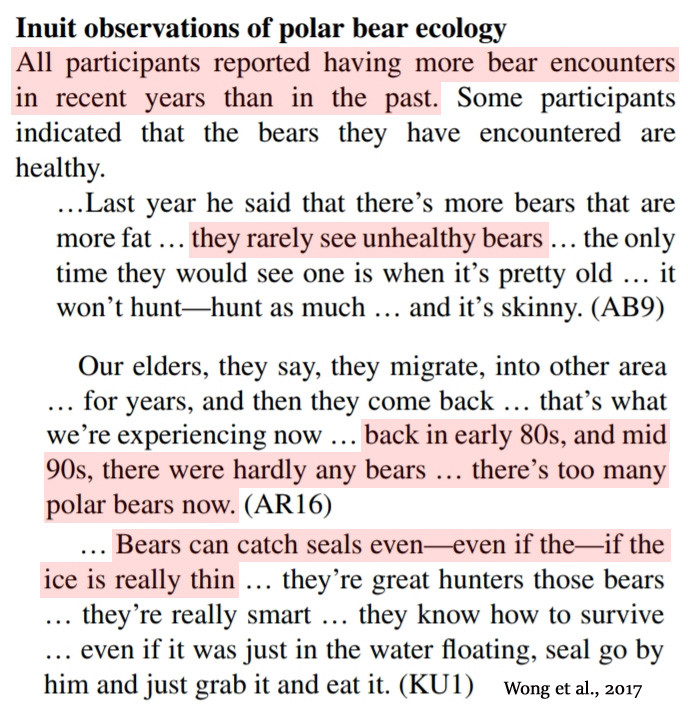
The report also looks at recent incidents when two Russian Arctic towns were visited by polar bears, and suggestions that 2019 was the year of the polar bear ‘invasion’. The lives of local residents were certainly threatened by the congregations of bears, which numbered more than 50.
And as Dr Crockford explains, such large congregations of polar bears are likely to be an on-going problem because there are now so many polar bears roaming the Arctic and because virtually all communities still have open garbage dumps:
There is no evidence these 2019 ‘invasion’ incidents were caused by a local lack of sea ice or because the polar bears were starving. Right now, Arctic residents and visitors face a much greater risk of having a deadly encounter with a polar bear at almost any time of year than they did decades ago because polar bear populations are so much larger.
“Predictions of future calamity do not change the present reality that polar bears are abundant and thriving,” Dr Crockford said.
Download the report here.
Key Findings
• Reports have yet to be published for polar bear population surveys of M’Clintock Channel and Viscount Melville (completed 2016 and 2014, respectively), Southern Beaufort and Gulf of Boothia (completed 2017) and Davis Strait (completed 2018), yet several were promised for 2019 or sooner.
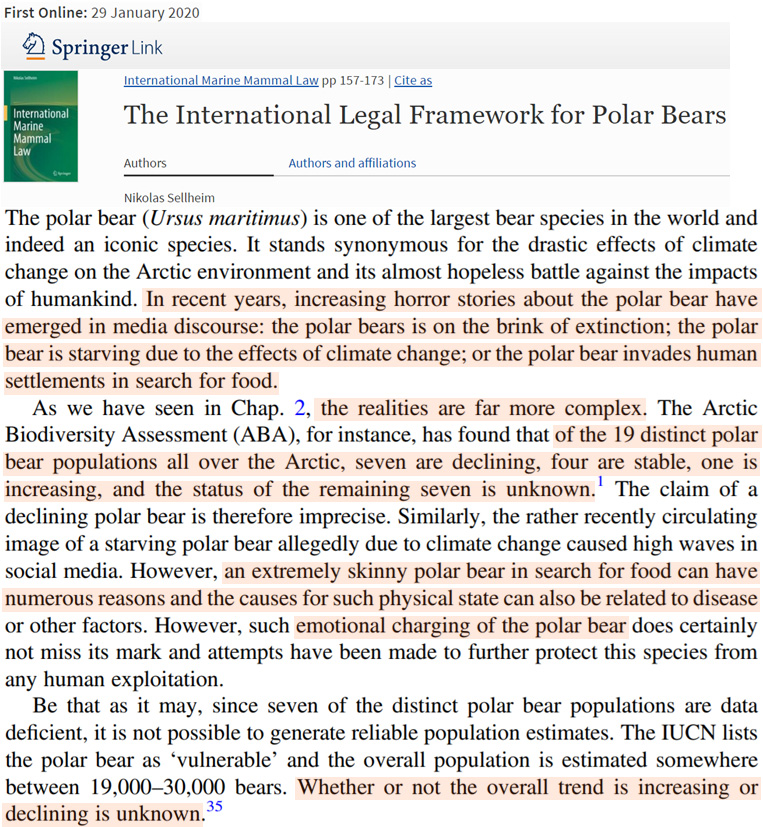
• At present, the official IUCN Red List global population estimate (2015) is 22,000–31,000 (average about 26,000), but surveys conducted since then might raise the average to about 29,500.
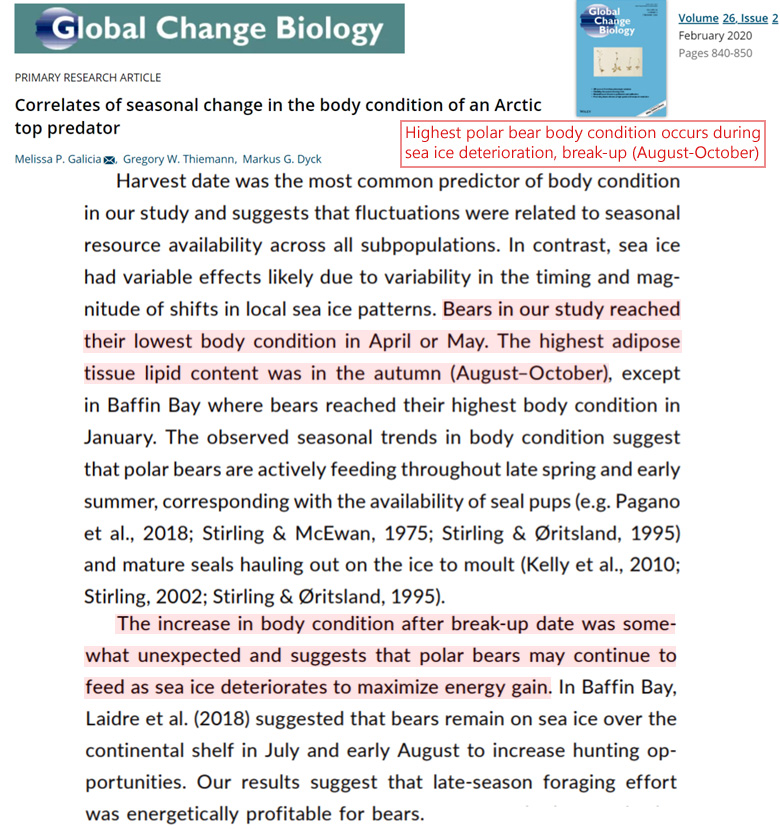
• Despite having to deal with changes in summer sea ice habitat greater than all other Arctic regions, according to Norwegian biologists polar bears in the Svalbard area of the Barents Sea showed few negative impacts from the low sea ice years of 2016 through 2019.
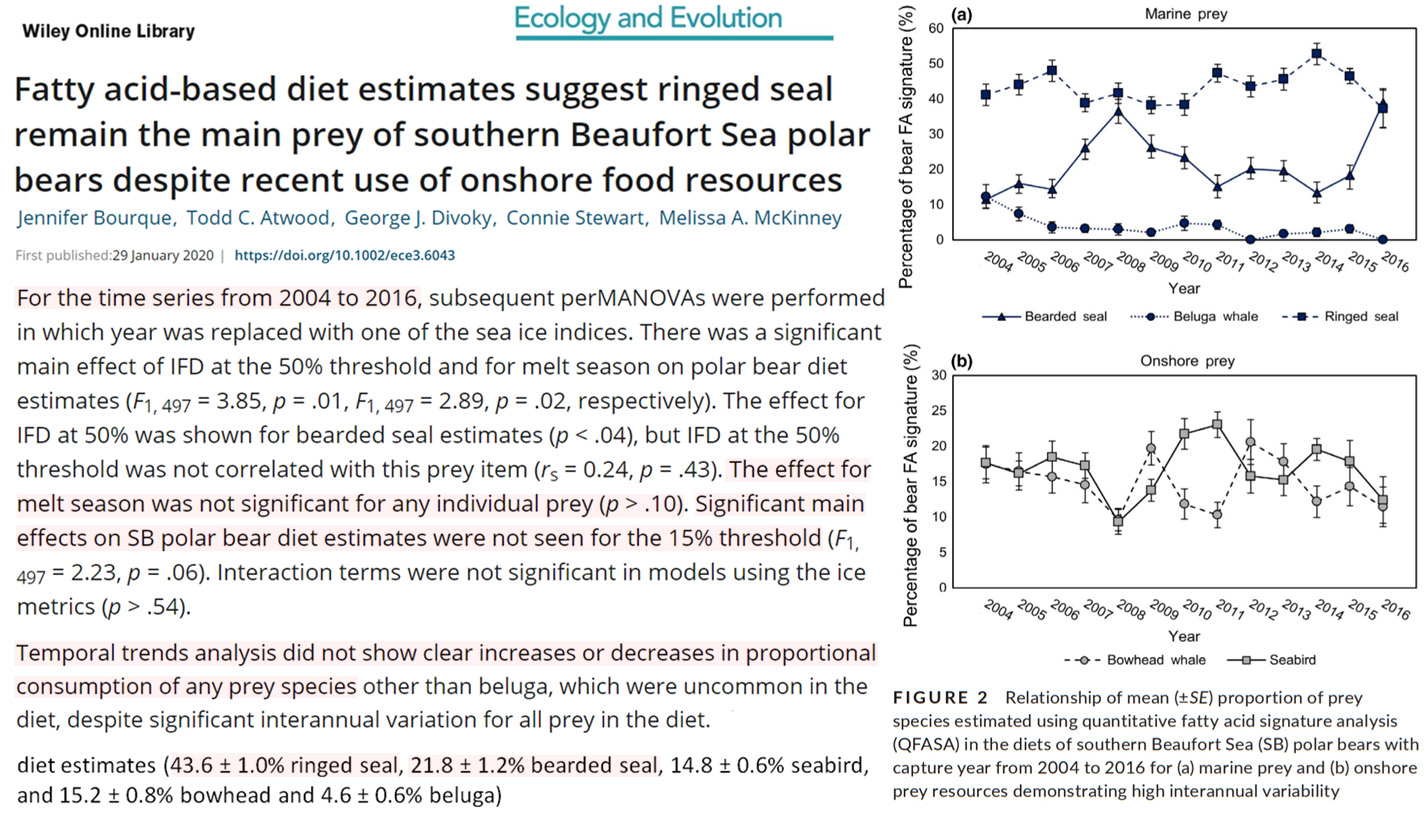
• Despite repeated claims that the Southern Beaufort subpopulation is declining and nutritionally stressed, a summer survey of the coast of Alaska in 2019 documented 31 fat healthy polar bears onshore in July compared to only three in 2017, when sea ice retreat had been similarly early.
• In 2019, and contrary to expectations, freeze-up of sea ice on Western Hudson Bay came as early in the autumn as it did in the 1980s (for the third year in a row); sea ice breakup in spring was like the 1980s too, with the result that polar bears onshore were in excellent condition.
• If the public are to take seriously repeated claims of harm to polar bear health and survival due to climate change, data collected since 2004 on cub survival and weights of female polar bears in Western Hudson Bay must be made available: it has now been more than 25 years since data has been published on cub survival and weights of female polar bears in Western Hudson Bay but polar bear specialists continue to cite decades-old data to support their statements that lack of sea ice is causing declines in body condition and population size.
• Since polar bear researchers acknowledge that there has been no negative trend in either freeze-up or breakup dates for sea ice in Western Hudson Bay since at least 2001, the failure to report current data on cub survival and weights of female bears suggests that body condition and cub survival have not declined over the last two decades as claimed.
• Two separate incidents at opposite ends of the Russian Arctic at the beginning and the end of 2019 made this the year of the polar bear ‘invasion’. Belushya Guba in the Barents Sea over the winter of 2018/2019 and Ryrkaypiy, Chukotka in December 2019 were each besieged by more than 50 bears, which terrified local residents. Although tragedy was ultimately averted, this is likely to be an on-going problem for Arctic settlements in the future: not because there is not enough sea ice but because there are now so many polar bears roaming Arctic coastlines.
Citation
Crockford, S.J. 2020. State of the Polar Bear Report 2019. Global Warming Policy Foundation Report 39, London. pdf here.
via polarbearscience
https://ift.tt/3958rlP
February 27, 2020 at 09:36AM



 Iowa Climate Science Education