By Paul Homewood
A dose of realism at long last!
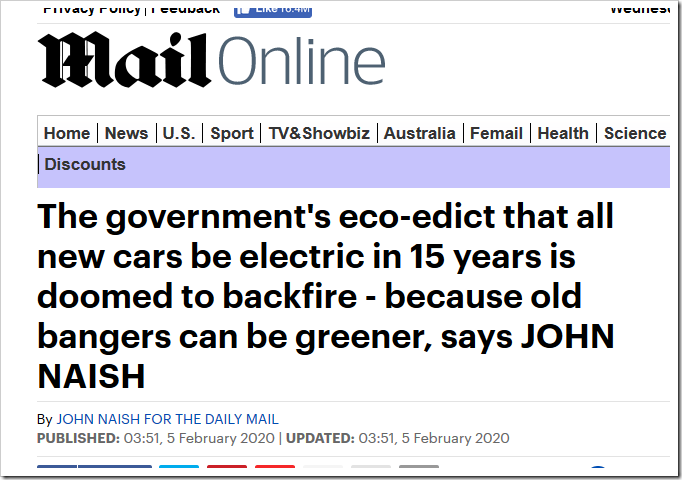
For those readers left scratching their heads over the Government’s ban on sales of all new petrol, diesel and hybrid cars from 2035, here’s what I — a former Fleet Street motoring editor — will be doing to help save the planet.
Our family car, a VW Golf, has at least a decade left in its petrol engine. Good care and servicing should stretch that to 2033. Then I’ll buy the very latest-technology petrol or diesel car, just before the pre‑ban sales scramble causes prices to spiral.
Why? Because I’m convinced it is the greenest thing to do all round.
Debacle
The government’s attempt to meet its near-zero carbon target by bringing forward by five years its ban on petrol, diesel and hybrid cars is well‑intentioned. Yet it is doomed to backfire as badly as a Model T Ford.
We all know well from the great diesel debacle what happens when politicians grab the steering wheel on eco policy.
John Naish says his VW Golf could have another 13 years left on the clock (pictured, a 2018 model)
Back in 2001, the then Chancellor Gordon Brown slashed road tax and fuel duty on diesel cars because some boffin in a white coat had told him they emit 15 per cent less CO2 greenhouse-gas carbon dioxide than petrol cars.
Sales rocketed as eco-minded drivers rushed to buy.
But then some other boffins discovered diesels spewed out vastly more damaging nitrogen oxide and nitrogen dioxide than petrol cars.
What’s more, their exhausts send asthma and heart disease rates soaring.
So punishing new taxes got slapped on diesels. Costs spiralled and re-sale prices plummeted. Those well-meaning motorists got taken to the cleaners.
Now we are experiencing the great electric car push — and that is set to be still more of a shocker, both for people and the planet. At a local level, we require massive amounts of new infrastructure to be built to support electric cars.
We will need at least 25 million new roadside charging points — the equivalent of installing 4,000 new ones a day, starting yesterday — with roads and pavements having to be ripped up in the process which will, of course, create plumes of emissions.
And where on earth will the electricity needed come from?
More than a third of Britons commute by car. Imagine, in 2035 and beyond, each of those motorists arriving home at night and hurriedly plugging in their vehicles at around the same time.
Malcolm McCulloch, head of Oxford University’s Energy and Power group, has warned that the National Grid will need another 20 gigawatts of generating capacity — double the amount currently generated by all the UK’s nuclear power stations — to cope.
The Engineer magazine says that charging an electric car at home with a medium-speed charger is like ‘leaving the electric shower on all night. If just a few people in a street decided to do that, it’d blow the local distribution fuse.’
Indeed, the whole system may fail.
Ofgem, Britain’s energy regulator, thinks this can be solved by making motorists pay more for peak-rate recharging. This would create a two-tier system in which lower-earning commuters would be penalised and effectively taxed out of work.
The government’s electric car dream wantonly ignores the other rapidly growing demands on our supply of ‘clean’ electricity, including Ofgem’s new drive to stop us using gas to heat our homes —and to use electric instead.
On top of this is our ever-spiralling use of internet streaming, downloading, phoning and texting. By 2025, it is predicted that the server ‘farms’ storing digital data from billions of devices will be using 20 per cent of all the world’s electricity.
So we’re going to need a lot more juice, or face regular blackouts such as the one last August that caused rush-hour chaos across the UK’s biggest train stations, railways, roads and airports, and left almost a million homes in the dark after two major generator outages.
The economic impact would be greater still if a third of Britain’s workforce couldn’t make it to work the next morning.
We can’t rely on wind-farms or solar power to meet such needs. We don’t have the technology to store large amounts of electricity, so it has to be generated on demand.
More power stations powered by fossil fuels or nuclear fission thus appear the only answer — at least, for the moment.
Another problem threatens to crash the electric party — sourcing the metals needed to make the car batteries.
The newer electric cars, like this VW Mk7 e-Golf, may not be greener overall than an old banger, says John Naish
Some experts fear that the planet’s available reserves of lithium are insufficient to make enough lithium-ion batteries to replace all of our petrol-driven vehicles.
Others say that the cobalt needed comes from the Democratic Republic of Congo, infamous for its use of child labour and human rights abuses.
Wanton
Most worrying of all is the need for rare-earth metals such as neodymium, essential for manufacturing the magnets that make electric car motors run. Mining neodymium releases such vast amounts of radioactive contamination and other murderous toxins such as sulphuric acid that only one nation allows it: China.
China controls about 80 per cent of the global market for rare earth metals and their export is tightly controlled.
Oil gave Arab nations power over the West for most of the 20th century; today neodymium may give China a similar energy weapon. Already the Chinese government is threatening to restrict supplies as retaliation against U.S. tariffs.
Some may feel that risking a trade war may be a fair price to pay for greener motoring, but swapping our petrol cars for electric ones is not guaranteed to deliver that for all the reasons outlined above.
What’s even more shocking are the figures I unearthed when our smug middle-class hippy neighbours began braying about how ‘green’ they’d been by trading their year-old petrol car for a new hybrid.
Radioactive
I discovered that manufacturing an average car generates more than 17 tonnes of CO2 — that’s almost the amount generated by gas and electricity use over three years in a typical UK home.
(That’s why it’s ‘often better to keep your old banger on the road than to upgrade to a greener model’, according to The Guardian newspaper’s green-living blog.)
The situation is even worse with electric cars. A Swedish-government report says that making the battery alone releases as much CO2 as eight years’ worth of driving a petrol vehicle.
So, to return to my opening point: all we need to do to make a green difference is use our existing cars sparingly and keep them going for longer.
Of course, that doesn’t suit the carmaking lobbyists who sit at the Government’s ear. They want us to keep buying new ones.
Come 2033, when I’m finally in the market for a new car, I predict that technological advances will have made fossil-fuel-engined motors significantly cleaner.
The signs are already there in the technical journals. One of the most promising developments is in the world of . . . wait for it . . . cleaner diesel engines with far fewer emissions.
You couldn’t make it up. But actually, that’s what the Government is doing with its ‘greener’ motoring policies.
https://www.dailymail.co.uk/debate/article-7968085/Eco-edict-new-cars-electric-15-years-doomed-backfire-says-JOHN-NAISH.html
via NOT A LOT OF PEOPLE KNOW THAT
https://ift.tt/39bJHIe
February 5, 2020 at 03:46AM


 Iowa Climate Science Education