MasterResource has chronicled the energy speeches of Donald Trump on the campaign trail and as president. Promises made, promises kept certainly applies.
While his tariff policies (see here, here, and here) have increased input costs for energy infrastructure (steel for pipelines, in particular), and biofuel subsidies stubbornly continue (what politician has been able to say no?), there are many bright spots for the nation with the free-market liberation of oil and gas exploration and production; pipeline projects; and other infrastructure refurbishment and expansion.
And in one of the greatest pro-liberty energy campaigns of all, President Trump has said “no” to Agenda 21 and global government in the name of addressing the hyped climate crisis. With the U.S. and other countries ignoring and violating even the aspirations and suggestions of the voluntary Paris Climate Accord of 2015, the hydrocarbon energy boom continues virtually unabated.
The Energy Information Agency (EIA) projects a growth in energy-based CO2 emissions of +0.6%/yr through 2050. But translating future emissions into atmospheric CO2 concentration requires a global carbon budget model, and we frequently accept the United Nations reliance on such models to tell us how much CO2 will be in the atmosphere for any given CO2 emissions scenario. Using a simple time-dependent CO2 budget model forced with yearly estimates of anthropogenic CO2 emissions and optimized to match Mauna Loa observations, I show that the EIA emissions projections translate into surprisingly low CO2 concentrations by 2050. In fact, assuming constant CO2 emissions after 2050, the atmospheric CO2 content eventually stabilizes at just under 2XCO2.
Introduction
I have always assumed that we are on track for a doubling of atmospheric CO2 (“2XCO2”), if not 3XCO2 or 4XCO2. After all, humanity’s CO2 emissions continue to increase, and even if they stop increasing, won’t atmospheric CO2 continue to rise?
It turns out, the answer is probably “no”.
The rate at which nature removes CO2 from the atmosphere, and what controls that rate, makes all the difference.
Even if we knew exactly what humanity’s future CO2 emissions were going to be, how much Mother Nature takes out of the atmosphere is seldom discussed or questioned. This is the domain of global carbon cycle models which we seldom hear about. We hear about the improbability of the RCP8.5 concentration scenario (which has gone from “business-as-usual”, to “worst case”, to “impossible”), but not much about how those CO2 concentrations were arrived at from CO2 emissions data.
So, I wanted to address the question, What is the best estimate of atmospheric CO2 concentrations through the end of this century, based upon the latest estimates of future CO2 emissions, and taking into account how much nature has been removing from the atmosphere?
As we produce more and more CO2, the amount of CO2 removed by various biological and geophysical processes also goes up. The history of best estimates of yearly anthropogenic CO2 emissions, combined with the observed rise of atmospheric CO2 at Mauna Loa, Hawaii, tells us a lot about how fast nature adjusts to more CO2.
As we shall see, it is entirely possible that even if we continued producing large quantities of CO2, it is possible for CO2 levels in the atmosphere to eventually stabilize.
In their most recent 2019 report, the U.S. Energy Information Agency (EIA) projects that energy-based emissions of CO2 will grow at 0.6% per year until 2050, which is what I will use to project future atmospheric CO2 concentrations. I will show what this emissions scenario translates into using a simple atmospheric CO2 budget model that has been calibrated with the Mauna Loa data. And we will see that the resulting remaining amount of CO2 in the atmosphere is surprisingly low.
A Review of the CO2 Budget Model
I previously presented a simple time-dependent CO2 budget model of global atmospheric CO2 concentration that uses (1) yearly anthropogenic CO2 emissions, along with (2) the central assumption (supported by the Mauna Loa CO2 data) that nature removes CO2 from the atmosphere at a rate in direct proportion to how high atmospheric CO2 is above some natural level the system is trying to ‘relax’ to.
As described in my previous blog post, I also included an empirical El Nino/La Nina term since El Nino is associated with higher CO2 in the atmosphere, and La Nina produces lower concentrations. This captures the small year-to-year fluctuations in CO2 from ENSO activity, but has no impact on the long-term behavior of the model.
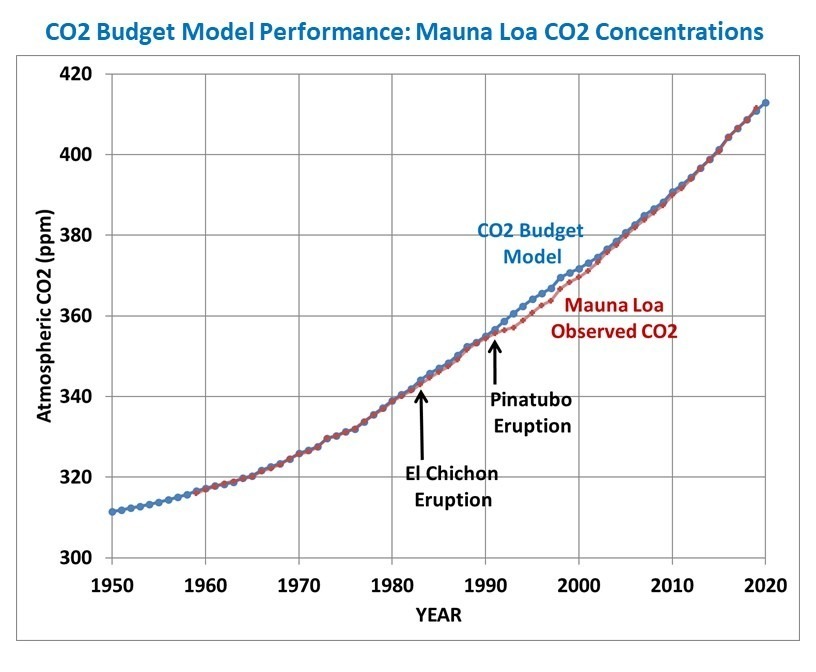
The model is initialized in 1750 with the Boden et al. (2017) estimates of year anthropogenic emissions, and produces an excellent fit to the Mauna Loa CO2 observations using the assumption of a baseline (background) CO2 level of 295 ppm and a natural removal rate of 2.33% per year of the atmospheric excess above that baseline.
Here is the resulting fit of the model to Mauna Loa data, with generally excellent results. (The post-Pinatubo reduction in atmospheric CO2 is believed to be due to increased photosynthesis due to an increase in diffuse sunlight penetration into forest canopies caused by the volcanic aerosols):
Fig. 1. Calibrated CO2 budget model compared to the Mauna Loa, Hawaii CO2 observations. The model is forced with the Boden et al. (2017) estimates of yearly anthropogenic CO2 emissions, and removes CO2 in proportion to the excess of atmospheric CO2 above a baseline value.
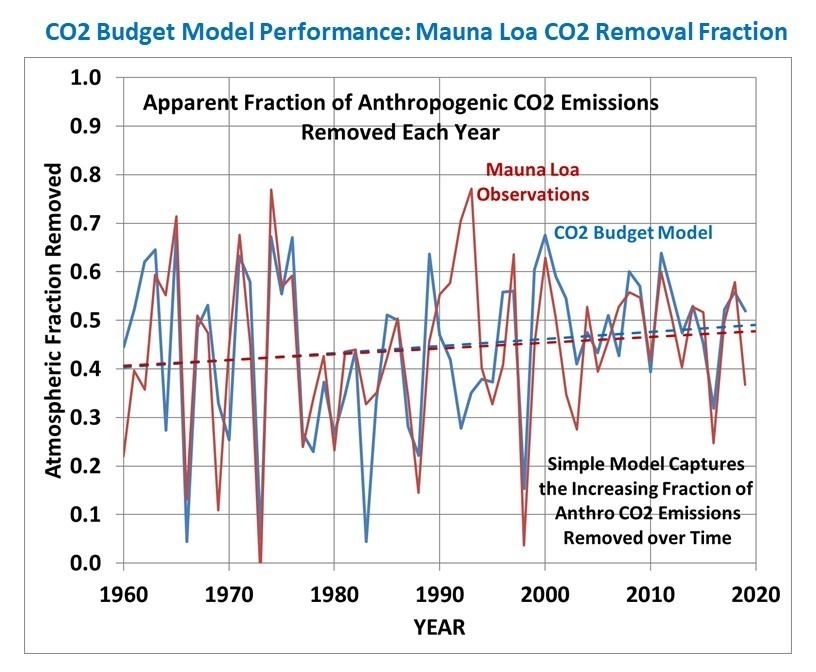
The model even captures the slowly increasing trend in the apparent yearly fractional removal of CO2 emissions.
Fig. 2. Yearly apparent fraction of anthropogenic emissions removed by nature, in the Mauna Loa observations (red) versus the model (blue).
Model Projections of Atmospheric CO2
I forced the CO2 model with the following two future scenario assumptions:
1) EIA assumption of 0.6% per year growth in emissions through 2050 2) Constant emissions from 2050 onward
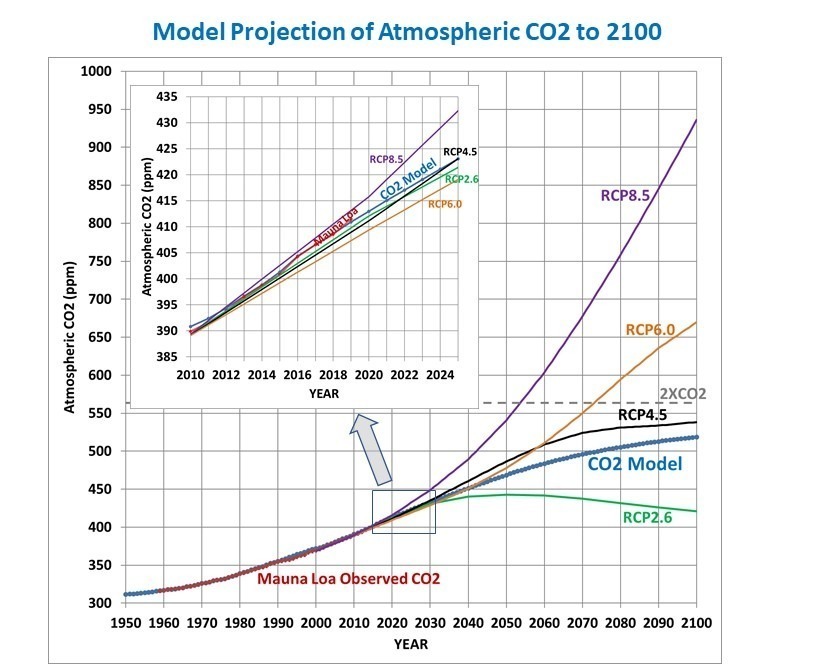
The resulting CO2 concentration is shown in Fig. 3, along with the CO2 concentration scenarios, RCP2.6, RCP4.5, RCP6.0, and RCP8.5, used in the CMIP5 climate model projections.
Fig. 3. CO2 model projection of atmospheric CO2 assuming EIA estimates of CO2 emissions growth through 2050, followed by constant CO2 emissions afterward.
Interestingly, with these rather reasonable assumptions regarding CO2 emissions, the model does not even reach a doubling of atmospheric CO2, and reaches an equilibrium CO2 concentration of 541 ppm in 2240.
Discussion
In my experience, the main complaint about the current model will be that it is “too simple” and therefore probably incorrect. But I would ask the reader to examine how well the simple model assumptions explain 60 years of CO2 observations (Figs. 1 & 2).
Also, I would recall the faulty predictions many years ago by the global carbon cycle modelers that the Earth system could not handle so much atmospheric CO2, and that the fraction which is removed over time would start to decrease. As Fig. 2 (above) shows, that has not happened. Maybe when it comes to photosynthesis, more life begets still more life, leading to a slowly increasing ability of the biosphere to remove excess CO2 from the atmosphere.
Given the large uncertainties in how the global carbon cycle responds to more CO2 in the atmosphere, it is entirely reasonable to hypothesize that the rate at which the ocean and land removes CO2 from the atmosphere is simply proportional to how high the atmospheric concentration gets above some baseline value. This simple hypothesis does not necessarily imply that the processes controlling CO2 sources and sinks are also simple; only that the net global rate of removal of atmospheric CO2 can be parameterized in a very simple form.
The Mauna Loa CO2 data clearly supports that hypothesis (Fig. 1 and Fig. 2). And the result is that, given the latest projections of CO2 emissions, future CO2 concentrations will not only be well below the RCP8.5 scenario, but might not even be as high as RCP4.5, with atmospheric CO2 concentrations possibly not even reach a doubling (560 ppm) of estimated pre-Industrial levels (280 ppm) before leveling off. This result is even without future reductions in CO2 emissions, which is a possibility as new energy technologies become available.
I think this is at least as important an issue to discuss as the implausibility (impossibility?) of the RCP8.5 scenario. And it raises the question of just how good the carbon cycle models are that the UN IPCC depends upon to translate anthropogenic emissions to atmospheric CO2 observations.
Canada is a great country crossing the desert of self-chosen and misguided leadership. There is no vision except platitudes and quixotry
Following the decisive defeat of the international left in the Cold War, the disintegration of the Soviet Union, the collapse of international communism and the defection of China to the virtues of a market economy (though still with a heavy command ingredient), the international left, evicted from power and even intellectual respectability, fetched up in the camp of the conservationists, those who cared most demonstratively for the environment. They shouldered aside the long-standing opponents of untreated effluent and advocates for natural habitats, and assaulted capitalism from a new quarter, waving the green flag of ecological radicalism rather than the red banner of Marx. Capitalism was not to be overthrown in favour of socialism, but rather the more incontestable goal of saving the planet. The left, for once, deserves high marks for improvisation.
In its way, it has been the most pure Leninism: the founder of the Soviet Union said “If you can’t get in the door, use the window.” This is what Marxist Naomi Klein was celebrating with her book “This Changes Everything,” claiming environmentalism would derail capitalism. And the affected militancy of generally respected figures of institutional finance, Mark Carney and Jim Leach and others, in turning themselves into a pressure group for green-friendly investment through the vacuous concept of sustainable finance (though Carney has reservations), are proving the truth of Lenin’s prediction that “The capitalists are so stupid they will sell us the rope we hang them with.” A green test of investment grade will be as complete a fiasco as was the spurious attempt to invest in companies according to the imputable quality of their corporate governance.
Fad follows fad; the only yardstick for measuring the quality of investments is capital appreciation, and those that don’t rise in value will not be sustainable.
Greta Thunberg, the tiresome Swedish teenage scold, has been sailing around the world reproaching the planet’s adult population for failing our progeny by mismanaging the planet environmentally. This is a demonstration of weakness by the environmentalists, not strength. Successive claims of imminent doom by the climate alarmists have consistently failed to materialize. Our oil and gas industries are not being strangled by the irresistible veracity of the climate change movement; the entire world except Western Europe and Canada are carrying on without any obvious sign of believing their carbon emissions are threatening human civilization.
In September, former U.S. vice-president Al Gore repeated that we have 12 years to prevent irreparable climatic damage to life; he said much the same thing a decade ago, and a decade before that. At least he got a Nobel Prize and became a centimillionaire for being so repetitive. Every informed person in the world has realized for over 50 years that we had to be careful to reduce environmental pollution and protect endangered areas and species. The sudden injection of far-left militancy drove the argument to anti-capitalist hysteria and hijacked a vehicle formerly filled with virtuous ecologically minded people. And useful idiots are telling resistant groups like the benighted province of Alberta to enjoy their martyrdom and adjust to impoverishment.
The chief meteorologist of Japan disembarked from the climatist movement several months ago, saying it was unclear what was happening to the climate, if anything unusual. The whole policy of dismantling and discouraging most of the energy industry except the hopelessly inadequate and horrendously costly solar and wind power boondoggles has been officially rejected as based on unproved suppositions by all major governments except the principal Western European countries and Canada. Since the science is divided and the proportions of the whole climate question are impossible to judge, Canada should devote itself to neutral and exacting research to seek, urgently, to ascertain what is happening, instead of singing our hearts out in the chorus of doom, like catechism students, as we strangle our greatest potential source of export revenue and greatest manufacturing cost advantage, our oil and gas industry.
Countries that are not defined by an exclusive culture, like Poland, Italy, Russia, Sweden, Japan and many others are, and cannot claim a unique secular-evangelical mission and mythos, as the United States claims as the redeemer, exemplar, champion and guardian of democratic government and the free market, must define a community of interest, amplify and equitably distribute prosperity, treat its different component regions and cultural groups fairly, and endow themselves with a distinct purpose. What is needed is a vision, without which, as is recorded in Proverbs and is engraved at the entrance to the Canadian House of Commons, “the people perish.”
The current federal government defines its first priority to be fighting climate change, which is nonsense, making a shambles of matters of gender, and inciting egregious myths and practices in native issues.
We are embracing a false national objective to oppress Alberta and Saskatchewan while encouraging charlatans and misfits to claim that there are more than two sexes and that the right of everyone to work out their own sexuality in perfect freedom is a matter for state coercion, and while inciting the inference that those of European ancestryinvaded, occupied and oppressed this country in a manner morally indistinguishable from what Hitler and Stalin did to Poland in 1939. There is no vision except platitudes and quixotry. We are driving Alberta to the consideration of extreme remedies and are stuck with the authors of this visionless miasma for four more years. Canada is a great country crossing the desert of self-chosen and misguided leadership. In a democracy, a people gets the government it deserves; we must solemnly consider what we did to deserve this.
US and Australia close borders and everyone outside China starts tracking contacts…
The official deaths tally has risen to 259, but for the first time the “total recovered” at 287 now exceeds the total deaths. Evidently it’s quicker to die than to recover.
Australia remains the “leader” of the Western nations with 12 confirmed cases. Thankfully, it and the US have finally got serious and both announced today that they would stop people from China from flying straight in. Citizens can return with a two week isolation or quarantine period, but foreigners cannot. This is very good news (as far as virus control goes). Now all the same nations will be furiously, laboriously tracking and tracing the hundreds of potential contacts. In a few weeks we’ll know how contagious it is, and how deadly. And maybe, with much money and dedication we’ll even stop it.
Though in a few weeks a host of secondary countries may develop their own epidemics and virus-free countries will need to block them too.
What’s really remarkable here is how useless, to the point of negligence, the World Health Organisation is.
US and Australia close borders to Chinese arrivals






/arc-anglerfish-tgam-prod-tgam.s3.amazonaws.com/public/YJH6CMGGWBA3XKYTYWNXWJTY24.jpg)


 Iowa Climate Science Education