Month: February 2020

Let’s Scrub Away Climate Change

Carbon Dioxide Scrubber

Ross McKitrick says Jeff Bezos has put enough money on the table to vanish climate change concerns, except for those who won’t let go. He writes at FinancialnPost: It’s never enough with climate activists — even a staggering $10 billion from Jeff Bezos. Excerpts in italics with my bolds.

Observers might conclude activists don’t care about the climate per se but instead want to impose a big-government central planning regime

Jeff Bezos, the mega-billionaire founder/owner of Amazon, just announced he will give US$10 billion to “fight climate change.” According to CNN, this followed immense pressure from his employees to take action. And, as is inevitable with this issue, as soon as he made the announcement his activist employees declared it wasn’t enough.

“We applaud Jeff Bezos’s philanthropy, but one hand cannot give what the other is taking away,” their group sniffed. “Will Jeff Bezos show us true leadership or will he continue to be complicit in the acceleration of the climate crisis, while supposedly trying to help?”

It is never enough with climate activists. Bezos’s US$10 billion is a staggering sum. But it’s also a drop in the bucket compared to what governments have spent over the past two decades on the climate issue. Yet activists keep complaining governments aren’t doing anything, either.

One begins to suspect they are not being up front about what they really want.

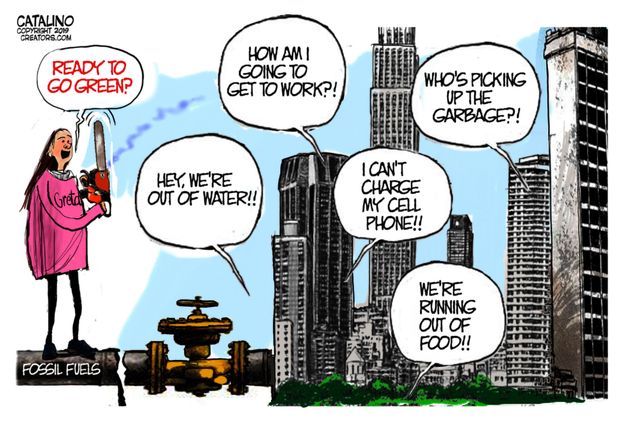
Politically minded observers might conclude activists do not care about the climate per se but instead want to impose a big-government central planning regime — for which the supposed climate emergency is merely a pretext. Any response to their demands that leaves the market system intact is therefore inadequate.

So where should Bezos direct his money? If he really wants to make the world a better place, he should fund the invention of a low-cost carbon scrubber. If ever someone could invent a device that filters carbon dioxide out of a smokestack or tailpipe and turns it into a stable solid that can be cheaply disposed of or even used for another purpose, all for under $5 or $10 per tonne, the entire climate change issue would vanish.

Such a scrubber would mean we could carry on using fossil fuels while decoupling them from greenhouse gas emissions. We would continue getting all the benefits of cheap fossil energy without any climate side-effects. This is what we did with sulphur dioxide. The invention of sulphur scrubbers meant we could keep enjoying the benefits of fossil energy without the harm of acid rain. Now let’s do the same with carbon dioxide.

The only reason climate change is such a big, intractable worldwide issue is precisely that we cannot currently decouple fossil fuel use from carbon dioxide emissions, so trying to achieve deep emission reductions means imposing harsh costs on the world economy. But if carbon dioxide could be cheaply reduced while we continued to burn fossil fuels, that problem would be resolved.

Once you realize this, you can then complete the thought-experiment by posing the question: Who would be the saddest people in the world if a cheap carbon-scrubber were invented? Answer: climate activists. They would almost certainly be bitterly crestfallen if ever an inexpensive technological fix resolved the climate issue. I say this because they so often give the impression their real motivation is not concern about the climate but rather a strange abhorrence of the modern world. The giveaway is their angry reaction to any information showing climate change isn’t a crisis — even though they of all people should be most cheered when such research appears.

Here is a useful litmus test for whether you or someone you know is an environmentally conscious person who wants to take a responsible stance on the climate issue.

Suppose Bezos funds a project that does invent a cheap carbon-scrubber and he gives away the technology so that overnight the need for climate policy vanishes (other than a requirement to use the scrubber). Our entire apparatus of climate policy would then become unnecessary. Ethanol mandates, electric vehicle subsidies, energy efficiency regulations, pipeline bans, the coal phaseout, natural gas bans for new homes, the oilsands emissions cap, et cetera — all of it could be eliminated and carbon dioxide emissions would plummet nonetheless. The Paris treaty would be redundant. There would be no more “conferences of the parties,” no more UN summits, and an end to the vast climate bureaucracies around the world — all of it replaced by quick, cheap and easy emission reductions. The litmus question:

Would that strike you as wonderful news or leave you bereft, your purpose in life lost?

“Wonderful news” is the correct answer. If you got it wrong, please stop blocking roads and railways and get some psychological help.

Ross McKitrick is a professor of economics at the University of Guelph.
via Science Matters

https://ift.tt/2uCh9cm

February 29, 2020 at 06:54AM

Extinction Rebellion Accused of Faking a Miners Protest

Extinction Rebellion Accused of Faking a Miners Protest

Extinction Rebellion ProtestorExtinction Rebellion Protestor
Extinction Rebellion “Miner”. Source Twitter

Guest essay by Eric Worrall

Miners are furious Extinction Rebellion successfully fooled a BBC reporter into believing XR protesters dressed in cardboard safety helmets were actually miners demanding the closure of their own pits.

BBC Claimed Extinction Rebellion Activists in Cardboard Helmets Were Real Miners

JAMES DELINGPOLE 28 Feb 2020921:28

Extinction Rebellion, the eco-fascist protest group, has successfully duped the BBC into believing that miners in the north of England support its campaigns to close down their pits. It did so by dressing up its activists in cardboard miners helmets.

But the BBC now accepts that it has no evidence of current or former miners attending the protests.

Read more: https://www.breitbart.com/europe/2020/02/28/bbc-claimed-xr-activists-in-cardboard-helmets-were-real-miners/

Read more of the article to see what a real miner thinks of this stunt.

I guess we can’t blame BBC reporter Jo Coburn for being fooled, she probably doesn’t know what a real worker looks like.

As for Extinction Rebellion, has anyone else noticed they seem to have this desperate need to be accepted as normal people? But they aren’t normal, or at least they seem to come from a very narrow demographic; they mostly seem to be a bunch of idle climate obsessed rich kids.

via Watts Up With That?

https://ift.tt/2I4Ntrz

February 29, 2020 at 04:37AM

The Heathrow decision is an assault on democracy–Ben Pile

By Paul Homewood


Ben Pile attacks the Heathrow decision, but also includes a pocket history of the Climate Change Act, which is ultimately to blame:

 image

Yesterday’s ruling in the Court of Appeal has seemingly resolved the decades-long wrangling over the future of Heathrow’s third runway. The court decided that the government had failed to take into consideration its own commitments to the 2015 Paris Agreement, and that therefore its Heathrow plans are ‘unlawful’. Transport minister Grant Shapps plunged the runway into more doom, by announcing on Twitter that the government will not appeal the decision. Heathrow’s operator, however, has said it will appeal.

But the realisation that has brought many down to Earth with a bump is that courts now seem to be making decisions that had hitherto been made by government. Yesterday’s events are very significant in terms of what they tell us about the threat posed by environmentalism to democracy and progress.

That a court has made a decision that overrides the wishes of elected politicians is not at all a trivial point. This isn’t just about the need to expand airport capacity – the court’s decision also puts a question mark over every future infrastructure project. As the BBC’s green correspondent reported shortly after the decision: ‘New roads face Heathrow-style court action threat.’

In short, well-funded campaigning organisations can use the nebulous Paris Agreement on climate change to close down anything they don’t like. With climate change being a theory of everything, everything from the planning of the economy to the planning of roads seems to fall under the remit of the Paris Agreement. And yet, while the Paris Agreement is a seemingly ‘global’ agreement that compels UK courts to obstruct the UK government’s strategic decisions, it places no such obligation on other signatories, many of which are expanding airport capacity. Why? Because it calls on governments to determine their own contributions to emissions reduction. So for governments, like ours, that have ‘ambitious’ climate-change policies, the agreement is an economic suicide pact.

Capturing the broader concern with what happened yesterday, former Conservative-turned-UKIP MP Douglas Carswell asked: ‘How did we end up in a situation where unelected judges decide airport policy?’ The answer to this question requires a long memory.

Full story here.

via NOT A LOT OF PEOPLE KNOW THAT

https://ift.tt/2I2MKar

February 29, 2020 at 04:00AM

The Netherlands faces pressure as global ‘test case’ for deep emissions cuts in 2020


They are up against it. Governments are now finding themselves increasingly boxed in by their own climate ideology. From the report below:
Richard Tol, professor of the economics of climate change at the Vrije Universiteit Amsterdam, said it is “highly unlikely” that the Netherlands will rise to the challenge, saying a [extra] 10% emissions reduction by the end of 2020 would “require shutting down a substantial part of the economy”.

But what options are there? Nuclear power is unpopular and can’t be built quickly anyway, while wind and solar power are part-time, intermittent, and relatively expensive. No viable ‘off-the-shelf’ way exists to store electricity on a massive scale. Awkward.
– – –
The Netherlands is under pressure to slash emissions in sectors such as power generation and agriculture in 2020 after a ruling by a top court made the government a reluctant ‘test case’ for tougher global climate policies, says Climate Home News.

The government of conservative Prime Minister Mark Rutte is working out new measures after the Dutch Supreme Court in December ordered it to cut greenhouse gas emissions by 25% by the end of 2020, compared with 1990 levels, as its fair share to combat climate change.

It is a daunting task – latest official figures showed only a 15% drop on 1990 levels by the end of 2018, meaning sharp cuts will be needed in an economy where major emission sources are manufacturing, energy generation, transport and agriculture.

The case marked the end of a six-year legal battle by the non-profit Urgenda Foundation and was seen as a landmark moment for climate justice. UN special rapporteur on human rights and the environment David Boyd called it the “most important climate change court decision in the world so far”.

The Supreme Court stressed that the Dutch government and parliament had a great deal of freedom to choose how to meet the 2020 goal. At 12 tonnes of CO2 equivalent per person in 2017, Dutch emissions per capita are one of the highest in the EU and have barely fallen over the past decade.

“It really is a test case for very rapid emission reductions,” said Christiana Figueres, an architect of the 2015 Paris Agreement and former head of the UN climate change secretariat. “Of course the Netherlands is actually quite vulnerable because quite a lot of the territory is below sea level. This is in their interest to do so.”

Figueres said other governments will be watching, even if they are not under the same legal pressure, because they are likely to have to take similar radical action if they are serious about limiting global temperature rise to 1.5C – the tougher goal of the Paris Agreement.

Full report here.

via Tallbloke’s Talkshop

https://ift.tt/3ad1UG2

February 29, 2020 at 03:24AM