

As noted in a previous post, March marks the moment of truth regarding the Arctic maximum extent. Now ten days later 2020 met the challenge.
For ice extent in the Arctic, the bar is set at 15M km2. The average in the last 13 years occurs on day 62 at 15.04M before descending. Six of the last 13 years were able to clear 15M, but recently only 2014 and 2016 ice extents cleared the bar at 15M km2; the others came up short.
As of yesterday, 2020 cleared 15M km2 as recorded both by MASIE and SII.
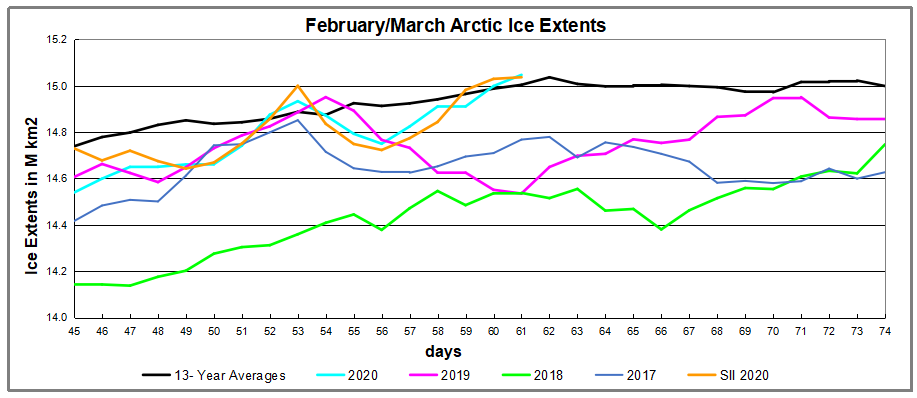
During February MASIE and SII both show ice extent hovering around the 13 year average, matching it exactly on day 52 at 14.85M km2. Then the ice cover shrank before growing strongly the last five days to overtake the 13 year average on day 61 at 15.05M km2.
| Region | 2020060 | Day 060 Average | 2020-Ave. | 2018060 | 2020-2018 |
| (0) Northern_Hemisphere | 14999007 | 14987840 | 11167 | 14535979 | 463028 |
| (1) Beaufort_Sea | 1070655 | 1070222 | 433 | 1070445 | 210 |
| (2) Chukchi_Sea | 965972 | 963804 | 2168 | 965971 | 1 |
| (3) East_Siberian_Sea | 1087137 | 1087039 | 98 | 1087120 | 18 |
| (4) Laptev_Sea | 897845 | 897824 | 21 | 897845 | 0 |
| (5) Kara_Sea | 919052 | 928455 | -9403 | 921526 | -2474 |
| (6) Barents_Sea | 735450 | 634497 | 100953 | 512601 | 222848 |
| (7) Greenland_Sea | 596926 | 621572 | -24646 | 518130 | 78796 |
| (8) Baffin_Bay_Gulf_of_St._Lawrence | 1464407 | 1544205 | -79798 | 1783076 | -318669 |
| (9) Canadian_Archipelago | 854282 | 853074 | 1209 | 853109 | 1174 |
| (10) Hudson_Bay | 1260887 | 1260890 | -2 | 1260838 | 49 |
| (11) Central_Arctic | 3247904 | 3211522 | 36382 | 3087802 | 160103 |
| (12) Bering_Sea | 746111 | 674028 | 72083 | 340789 | 405322 |
| (13) Baltic_Sea | 30173 | 103770 | -73598 | 134750 | -104577 |
| (14) Sea_of_Okhotsk | 1110709 | 1097753 | 12956 | 1079823 | 30886 |
As reported previously, Pacific sea ice is a big part of the story this year. Out of the last 13 years, on day 52 only two years had Okhotsk ice extent higher than 2020, and only four years had higher Bering ice. Those surpluses offset a small deficit in Greenland Sea ice. And on day 61, the last push came from Bering and Okhotsk.
Typically, Arctic ice extent loses 67 to 70% of the March maximum by mid September, before recovering the ice in building toward the next March.
What will the ice do this year? Where will 2020 rank in the annual Arctic Ice High Jump competition?

Drift ice in Okhotsk Sea at sunrise.

via Science Matters
March 2, 2020 at 01:11PM
 Iowa Climate Science Education
Time to get GeorgieBoy to get you a refund Greta.
And while you’ve got your handout, why not touch up
silly Al F Gore for a contribution to your slush fund, dear.
MikeR
LikeLike
Reblogged this on Rangitikei Environmental Health Watch.
LikeLiked by 1 person