
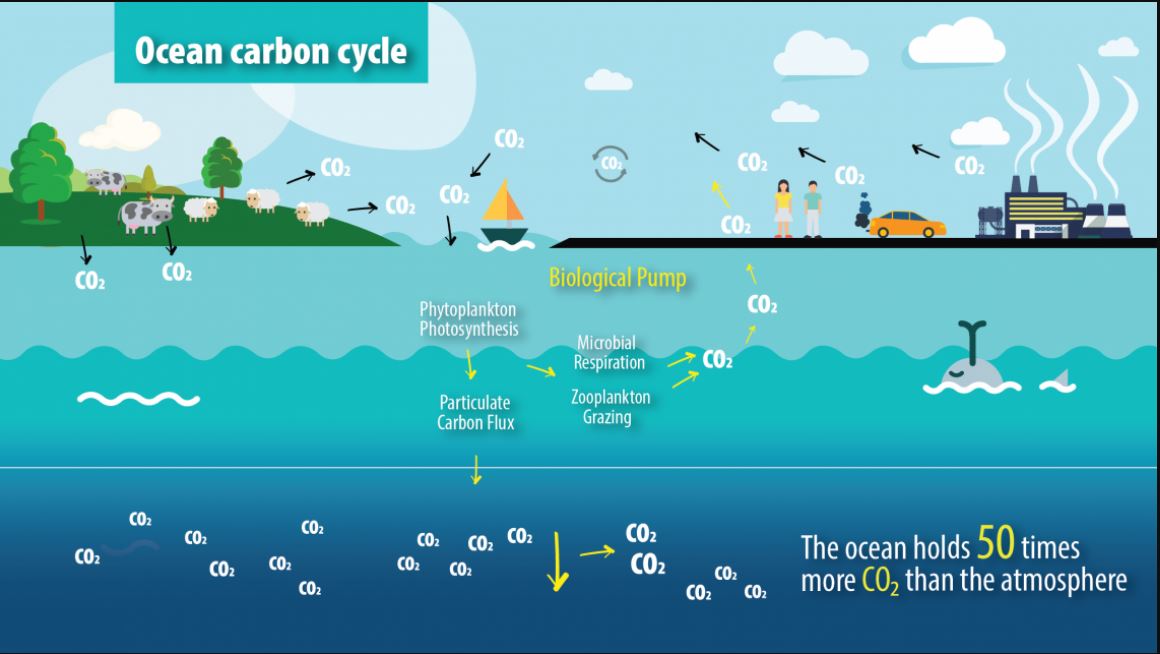
The ocean carbon cycle [credit: IAEA]
The Woods Hole researchers find ‘the efficiency of the ocean’s “biological carbon pump” has been drastically underestimated’, with inevitable implications for climate modelling and assessments. Given that the oceans hold 50 times more CO2 than the atmosphere, this must matter.
– – –
Every spring in the Northern Hemisphere, the ocean surface erupts in a massive bloom of phytoplankton, says Phys.org.
Like plants, these single-celled floating organisms use photosynthesis to turn light into energy, consuming carbon dioxide and releasing oxygen in the process.
When phytoplankton die or are eaten by zooplankton, the carbon-rich fragments sinks deeper into the ocean, where it is, in turn, eaten by other creatures or buried in sediments.
This process is key to the “biological carbon pump,” an important part of the global carbon cycle.
Scientists have long known that the ocean plays an essential role in capturing carbon from the atmosphere, but a new study from Woods Hole Oceanographic Institution (WHOI) shows that the efficiency of the ocean’s “biological carbon pump” has been drastically underestimated, with implications for future climate assessments.
In a paper published April 6 in Proceedings of the National Academy of Sciences, WHOI geochemist Ken Buesseler and colleagues demonstrated that the depth of the sunlit area where photosynthesis occurs varies significantly throughout the ocean.
This matters because the phytoplankton’s ability to take up carbon depends on amount of sunlight that’s able to penetrate the ocean’s upper layer.
By taking account of the depth of the euphotic, or sunlit zone, the authors found that about twice as much carbon sinks into the ocean per year than previously estimated.
The paper relies on previous studies of the carbon pump, including the authors’ own. “If you look at the same data in a new way, you get a very different view of the ocean’s role in processing carbon, hence its role in regulating climate,” says Buesseler.
“Using the new metrics, we will be able to refine the models to not just tell us how the ocean looks today, but how it will look in the future,” he adds. “Is the amount of carbon sinking in the ocean going up or down? That number affects the climate of the world we live in.”
In the paper, Buesseler and his co-authors call on their fellow oceanographers to consider their data in context of the actual boundary of the euphotic zone.
Full article here.
via Tallbloke’s Talkshop
April 7, 2020 at 08:45AM
 Iowa Climate Science Education