
By Christopher Monckton of Brenchley
The ineptitude of Western governments when keeping crucial statistics about the Chinese virus is becoming culpable. For a start, they are not even counting deaths either consistently or competently. In Britain, for instance, total reported deaths to April 17, 2020, were 14,576. However, a report issued April 16 by the Office for National Statistics points out that deaths are registered up to five days after they occur, and that the numbers given in HM Government’s daily briefings carefully exclude all deaths that do not occur in hospitals.
Correcting for these two serious errors indicates that the true number of deaths is about 50% greater than the Government’s cited figures, implying that in the UK the deaths from this dangerous pathogen are already approaching 22,000.
The regime in China has finally bowed a little before the gale of international criticism of its failure to provide the correct daily case-counts and death-counts required by its obligations at international law in terms of the World Health Organization treaty. After having reported only a tiny handful of deaths each day over recent weeks, it has suddenly admitted to more than 1000 hitherto-undisclosed deaths in Wuhan. Even now, it is very doubtful whether this admission represents anything more than a tiny fraction of the true count.
In China’s north-easternmost province, there have been very long lines outside the district hospital. Unconfirmed reports suggest an outbreak no less severe than that in Wuhan.
Not only are deaths not being recorded or reported correctly or timeously: recovered cases are also not being properly kept. The United Kingdom, whose civil service has become so used to everything being done for it by the European tyranny-by-clerk, has proven wholly unable to keep a tally of those who, having shown symptoms of the infection, have recovered from it. HM Government has altogether abandoned its daily reporting of recovered cases.
During the early stages of any pandemic, it is essential to keep a careful tally both of deaths and of recoveries, since the ratio of deaths to closed cases (i.e., to deaths plus those who have recovered) is a not unreliable indicator of the true case-fatality rate.
As the pandemic enters its middle stages – which is about where we are now – it is still more important to know how many have recovered, since the crucial number which tells governments whether they need to tighten or loosen control measures is the mean daily compound growth rate in currently-active cases, for those who have either recovered or died are no longer capable of transmitting the infection.
But it is impossible to calculate the number of currently-active cases, because governments are not correctly counting those who have recovered. Nor, for that matter, are they yet able to form a mature view of what fraction of the population have contracted the infection but are either asymptomatic or are showing such mild symptoms that they do not – for now, at any rate – require hospitalization.
Frankly, the record-keeping has been abysmal. Yet another lesson to be learned from South Korea is that proper, careful, up-to-date, case-by-case records absolutely must be maintained. Without them, governments are simply guessing what they should do.

Fig. 1. Mean compound daily growth rates in cumulative confirmed cases of COVID-19 for the world excluding China (red) and for several individual nations averaged over the successive seven-day periods ending on all dates from March 28 to April 16, 2020.
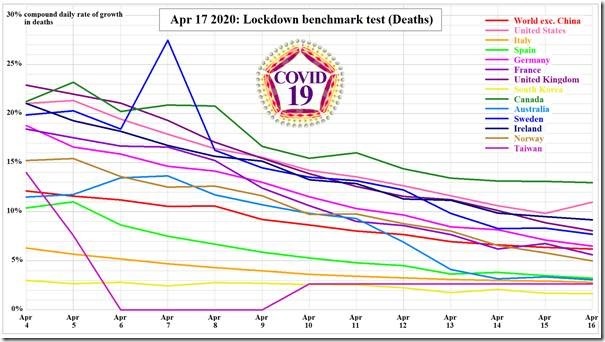
Fig. 2. Mean compound daily growth rates in cumulative COVID-19 deaths for the world excluding China (red) and for several individual nations averaged over the successive seven-day periods ending on all dates from April 4 to April 16, 2020.
In the meantime, the case-growth and death-growth graphs, based on such woefully inadequate data as are published, show very clearly that those who have tried to maintain that this pandemic is no worse than the seasonal flu are flat wrong.
In Ireland, growth in cumulative cases remains dangerously high at 13% compound every day. In the United States, though, that growth is now about 5.5% compound every day.
In Canada, growth in cumulative deaths is 13% compound every day; in the United States, 11%. Mr Cuomo, at his press conference in New York, says that the growth rate in new cases is now negative. However, it is not just the new cases but the active cases – those that are currently infections – that will determine the rate of growth in future. It is good that the number of new cases is declining, but one cannot say the worst is over until one knows that the number of active cases is declining. And one cannot know that if one does not count not only deaths but also recovered cases properly.
High-resolution images of the two graphs are here.
via Watts Up With That?
April 18, 2020 at 12:08AM
 Iowa Climate Science Education