
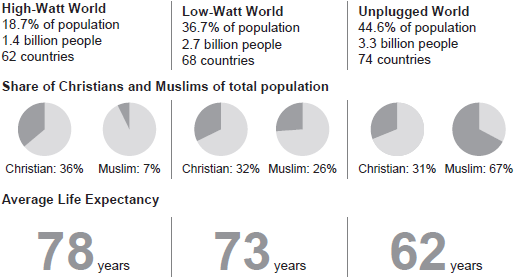
Roughly 3.3 billion people—about 45 percent of all the people on the planet—live in places where per-capita electricity consumption is less than 1,000 kilowatt-hours per year, or less than the amount used by my refrigerator.
By 2017, more than 6,600 coal-fired power plants, with a combined capacity of about 2,000 gigawatts, were operating around the globe…. Not only that, coal’s share of global electricity production has remained nearly constant, at about 40 percent, since the mid-1980s. Why is this? For the simple reason that coal is cheap and widely available.
Americans are currently facing significant uncertainty over how the drop in oil prices, the COVID-19 virus, and governments’ response to both will harm the economy and their long-term prosperity.
However, the harm caused
by governments that limit access to affordable and reliable electricity is well
understood.
That’s one of my big takeaways
from Robert Bryce’s excellent new book, “A Question of Power.”
Throughout history most humans
have lived on the edge of subsistence, almost completely dependent on how much sun
and rain came their way. And while for many life is much better today because of
electricity, others living in what Bryce calls “Unplugged” countries, like El Salvador,
the Philippines, Bolivia, Pakistan, and India, still living in the past:
Roughly 3.3 billion people—about
45 percent of all the people on the planet—live in places where per-capita electricity
consumption is less than 1,000 kilowatt-hours per year, or less than the amount
used by my refrigerator.
That consumption is less
than a quarter of the 4,000 kilowatt-hours per year per capita electricity use that
Bryce suggests is “considered the minimum for living a long, high-quality life.”
Bryce adroitly marshals the
facts to clearly show the connection between increased electricity use and increased
health and prosperity. For instance, he examined a number of studies that
found “unidirectional causality
between electricity consumption and economic growth.” That is, electricity use drives
economic growth. While electricity drives economies, it is also clear that greater
wealth increases electricity consumption. That makes sense. As people get wealthier,
they consume more electricity because they can afford more electrical devices.
He also points out that the
“close correlation between electricity use and human health and economic growth
has become so obvious that international investment bankers have adopted electricity
use as a measure of economic activity.”
He continues: “By using hydrocarbons
(at first coal, then later oil and natural gas) humans were able to harness ever
increasing quantities of power and do so in ever-denser packages. In place of animal
power, sun power, and wind power, factories began using advanced waterwheels and
coal-fired steam engines.”
So why is it that almost
half of the world’s population are living in Unplugged countries where they “are
using about the same amount of electricity as an average resident of Chicago did
back in 1925?”
Source: A Question of
Power
It is because the progress
of the last 200 years has not taken place uniformly. Bryce explains that the three
critical components to an affordable and reliable supply of electricity—integrity,
capital, and fuel—have often been in short supply in many parts of the world.
By integrity Bryce means
that the system must not “leak,” either because of poor design, poor maintenance,
or theft. “People who operate the grid, as well as the people who rely on it, need
to have some sense of responsibility for it. Or, if they don’t feel responsible
for the grid, they have to fear getting caught and punished for stealing electricity.”
This often doesn’t happen,
however, in impoverished countries operating without the rule of law because the
elites have “organized society for their own benefit at the expense of the vast
mass of people.” In countries where the elites are best at oppressing their citizens,
corruption is rife, black markets abound, and grids leak.
That is, to the extent they
have grids in the first place. To build those, societies also need capital, the
second component. “Keeping theft and corruption at a minimum is imperative because
theft robs the grid of the capital it needs,” say Bryce. In fact, it robs entire
countries of the capital they need to prosper. Particularly when the theft comes
from oppressive governments through high taxes, heavy regulation, confiscation of
property, and inflation of the money supply. People in countries like this often
can’t afford to build a reliable grid, or much of anything else.
The last of the three “key
determinants of the quality, cost, and cleanliness of the electricity” that we consume
is fuel: “Without fuel, you can’t make electrons move.” Bryce makes it clear that
the fuel of choice around most of the world is coal.
By 2017, more than 6,600 coal-fired power plants, with a combined capacity
of about 2,000 gigawatts, were operating around the globe. That coal-fired capacity
accounted for nearly one-third of all global generation capacity. Not only that,
coal’s share of global electricity production has remained nearly constant, at about
40 percent, since the mid-1980s.
Why is this? For the simple
reason that coal is cheap and widely available:
The world has gargantuan
coal deposits. At current rates of consumption, global coal reserves are projected
to last another 134 years. The United States and Australia both have more than three
hundred years’ worth of coal reserves in the ground. Russia has nearly four hundred
years’ worth. The large number of countries that produce and export coal allows
buyers to compare prices from a number of suppliers and therefore get the best quality
and price.
Add natural gas to coal,
and it is clear that (in contrast to integrity and capital), over the last 200 years
there has not been a general shortage of the affordable fuel we need to generate
electricity.
At least not yet. But that
is changing as the political leaders of the High-Watt World are doing their very
best to make fuel more expensive and less available. In three ways.
First, they are imposing
draconian controls on the use of carbon-based and nuclear fuels, controls that do
nothing to improve human health. Whether it is micromanaging every aspect of the
design of nuclear generators or requiring levels of particulate emissions that are
below the natural levels, the government has dramatically and artificially increased
the cost of electric generation from these fuels.
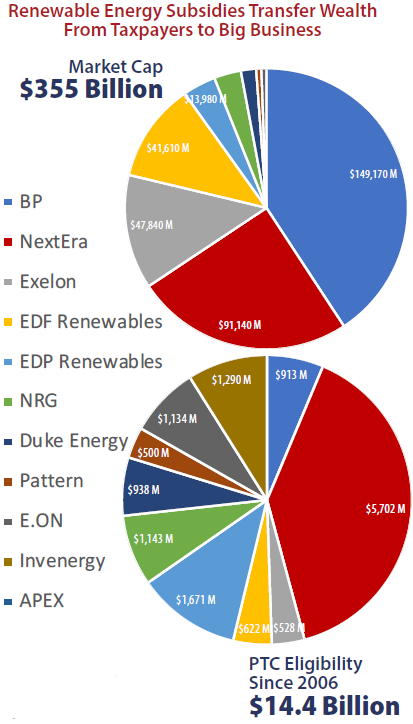
Second, they are taking billions
of dollars from taxpayers and giving it to corporations with markets caps totaling
into the hundreds of billions to subsidize wind and solar generation. In the U.S.
alone, my calculations show, taxpayers have ponied up more than $80 billion since
2006.
Top
11 Recipients of Federal Tax Credits for Wind
Source: Angela Erickson and the Texas Public Policy Foundation
All this money is going to
unreliable and inefficient sources of energy that can never supply us with the energy
we need at any cost. Wind and solar generate electricity only when the wind is blowing
or the sun is shining. Because of this, they require battery storage so that we’ll
have electricity when we need it. Yet Bryce calculates “storing the 9.6 terawatt-hours
of electricity needed for California to get 80 percent of its electricity from renewables
would require the state to install more than seven hundred million Power walls”
(Tesla’s latest battery). The truth is that every penny spent on renewable energy
is being wasted.
Third. they are seeking to
completely eliminate the use of coal as a fuel because of concern about climate
change. Bryce notes that even as coal use around the world is thriving, in the U.S.
“more than half of all coal plants have announced planned closures since 2010.”
If I had one nit to pick
with A Question of Power, it would be that it takes more or less as a given
that the world needs to do something to address CO2 emissions to reduce man’s effect
on the climate. On this topic, there is little of the insightful analysis used elsewhere
in the book to challenge the conventional wisdom.
Yet there is plenty to challenge,
as Patrick Michaels and Caleb Stewart Rossiter
explain:
Computer models of the climate
are at the heart of calls to ban the cheap, reliable energy that powers our thriving
economy and promotes healthier, longer lives. For decades, these models have projected
dramatic warming from small, fossil-fueled increases in atmospheric concentrations
of carbon dioxide, with catastrophic consequences. Yet, the real-world data aren’t
cooperating. They show only slight warming, mostly at night and in winter.
They go on to cite atmospheric
scientist John Christy, an author for a previous edition of the U.N. report on climate
change, who “recently concluded that, on average, the projected heating by the models
is three times what has been observed.”
The story told in a Question
of Power (through my lens) is one of scientists, politicians, and activists
holding themselves out as experts and telling us how to power the world while taking
our money to make us pay for their ideas.
This is not unrelated to
the current COVID-19 situation where the models developed by the experts have failed
even faster than the climate change models, yet politicians all across the world
are taking advice from these experts about how deal with this pandemic.
Bryce doesn’t focus as much
on the elite and government in his book as I do here, but he does give us plenty
to think about when it comes to the future of powering this world. In particular,
he shows us through discussions of the high tech and financial industries that the
electrification of the world that began less than 200 years ago has shown no sign
of slowing. He makes a compelling case that the demand for electricity is going
to continue to grow and displays his optimism that we’ll succeed in our efforts
to meet this demand:
Electricity has conferred
on us a bit of the creative power that God showed in Genesis. With the flip of a
switch, we can kill the anti-God and banish darkness. With a touch of our mobile
phones we can ensure safe passage through a strange hotel or garage at night. With
quadrillions of electrons at our beck and call, we can create as much light as we
want.
I join him in that optimism,
with one caveat: the path to increased electrification and protection from disease–and
everything else–will continue to be hindered until voluntary exchange through free
markets usurp overregulation by the governing elite.
The post Bryce’s “A Question of Power” appeared first on Master Resource.
via Master Resource
April 21, 2020 at 01:12AM
 Iowa Climate Science Education