
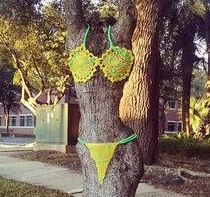
 You’re probably thinking my interest in this lady’s arboreal love life is just prurient. No, because Ms Belleveau from far off Minnesota picked up on my Quadrant tribute to Melbourne’s Ecosexual Bathhouse in 2016, run by Perth’s Pony Express with $80,000 tax and ratepayer funding.[3] The Bathhouse, like the MSSI-backed symposium, offered a route for surviving the Anthropocene from the “devastating forces unleashed by global capital”. Among the Bathhouse’s attractive dances were
Slug Sex: The dominatrix uses UV light “to illuminate a trail of goo, which she produces in a graceful, entwining dance. Music is a lugubrious, downbeat, sensual song. Projector displays video of the phenomenal slug copulatory behavior.”
Cuttlefish: The dominatrix slowly approaches audience “and fans them with undersea-like movements, before encircling them in her wings then darting away.”
Getting back (with some reluctance) to Auckland’s artist Orjis, he explained that “bttming is a methodology for exploring power dynamics, kinship, relationality and passivity as an active resistance to capitalist, colonial and patriarchal reproductive impulses.” He earlier/later ran a Melbourne Sustainable Society Institute workshop on “How can we privilege ‘arse end of the world’, or southern antipodean orientations? And how might this dismantle dominant epistemologies of the north (rational, Eurocentric, Judeo-Christian)? And how can methods of passive resistance operate in response to colonial, capitalist and patriarchal hegemony?” He advertised that his workshop “will invite participants to engage with these ideas through sitting, thinking, making and talking, or not sitting, not thinking, not making or not talking.” That seems to cover the field.
In 2018 Orjis ran an exhibition in Basement Adult Shop & Cruise Club, one of the longest-running owner-operator sex stores and cruise clubs in Aotearoa New Zealand. The show was called, “Under your skin you look divine”. He wrote that it “realises the important role sex stores and cruise clubs play in contributing to queer culture and identities” and invited “locally based artists to take over the store in a one-night flirtatious digital queer mess of an exhibition.”
Melbourne University’s Hacking the Anthropocene was not just the Convent seminar but a series of workshops and events over months of “challenging the toxic and corrosive logics of racial and extractive capitalism.”
One seminar was to help educators get their message into school classrooms. As convenor Blanche Verlie put it, pre-Wuhan of course:
Climate vulnerability-and-complicity, white fragility and supremacy,CIS entitlement and speciesism each present particularly challenging conditions for educators and other pedagogues to navigate in contemporary educational settings.
How can we effectively engage people in discussions and responses to what might feel for them – and us – like an existential crisis? As educators, communicators, artists, activists, scholars, facilitators, parents, children or others, what are the strategies we are using to engage people with issues such as (but not limited to) climate change, the ongoing colonisation of Indigenous peoples, xenophobia or homophobia, or mass extinction? What are the specific characteristics of how such issues play out in classrooms (or other spaces)?
The take-away from all the detail above is that the welfare, sanity and usefulness to society of the student generation is in safe hands with Melbourne University academics and their colleagues.[4] No matter who else in the Australian workforce is losing their jobs, the government must support as providers of “essential services” the academics delivering Anthropocene Hacks, Feminist Composting and tree humping.
Tony Thomas’ new book Come to think of it – essays to tickle the mind, can be purchased here
[1] The Melbourne Sustainable Society Institute, with its close ties to watermelons, Extinction Rebellion and Greta Thunberg, needs to be renamed “Comedy Central”. For my earlier anatomising start here. I have achieved a rich haul in recent months, start here and here.
[2] She is particularly interested in decolonising the sciences with a focus on evolution and the ecological imagination.
[3] I make this claim because she adds a reference to sex exhibitionists Annie Sprinkle and Beth Stevens who I also cited in my piece.
[4] Melbourne University is ranked first in Australia and 32nd in the world (“THE” rankings). One has to wonder what goes on in lesser Australian universities.
via Climate Scepticism
April 22, 2020 at 06:41AM
 Iowa Climate Science Education