
Fires? The only Willagee fire I can remember is when some lousy brats lit our Guy Fawkes’ bonfire and ran off laughing. Drought? Our sprinklers doused the back lawn all morning in the Fifties and Sixties. For dam shortages since, blame The Greens.
The professor’s project also embraces Willagee’s near-neighbour, Attadale, a riverside joint once home to Heath Ledger and cricketers Mitchell and Shaun Marsh. Not much flood, fire and drought there either.
Her third suburb, Kelmscott, did suffer a bushfire in 2011, lit by some idiot on his private block in defiance of a windy fire-ban day. There’d been drought-fuelled build-up of grass and dry bush — nothing whatsoever to do with global warming. Ex-Resources Minister Matt Canavan last March forced sheepish CSIRO top brass to admit they had no studies demonstrating a link between climate change, fire weather and bushfires. Likewise, top climate crusader Dr Andy Pitman, of UNSW, publicly let slip last June there was no reason why global warming should worsen droughts, rather the contrary.[1] Since both Pitman and Tschakert are IPCC top lead authors. It’s time they got their stories aligned.
I don’t really understand Willagee’s climate grief because the latest HadCrut global temp trend shows a mere 0.8degC rise in the past 80 years. For most Willagee veterans, the priority is flogging their blocks in a dud real estate market.
As for the professor’s concern for safeguarding our values, my Willagee family know a lot about values. We got kicked out of our rented home on Stirling-highway, Nedlands in 1953 and wound up in “Mulberry Farm”, a decrepit ex-air force camp near Fremantle. Mum has written of it as
this pinched little settlement where the homeless and dispossessed of the city were herded … Nights erupted into fights, the crash of breaking bottles, torrents of abuse between couples run ragged by the tension of waiting [for a Commission home], dogs barking in sympathy, an altercation that took a serious turn, a burly axe-wielder chasing a woman shouting, ‘Don’t you try that trick again, you bitch!’ followed by the shriek of a police car siren.[2]
Stepfather Vic lumped sacks “down hold”, the wharf’s most dangerous and dirty work: “Bags of asbestos sometimes broke in the sling hanging from the high crane and showered men with the stuff. Only later did they know it to be deadly, even to women washing their overalls.” Bad as the job was, it was worse when Vic caught the bus to Freo and got no job at the morning pickup, wasting his morning and his fares.
Finally came the letter offering us a cottage in Willagee (nicknamed “White-ant City”). We lived a week inside by candlelight until the electricity came on from Collie fossil fuel, but we didn’t mind that.
 Our neighbours comprised a man prone to beating his slatternly wife. Their feral kids and dogs all had fleas. The wife would lament to us that her oldest was “a ba-a-a-d boy!” hinting at misfortunes involving his sister and even herself. The least of his bad habits was throwing fire-crackers into the dunny where his mother sat screaming.
Mum at some point in exasperation told the husband to “drop dead”. Two days later he and I were walking to the bus stop and a snappy mongrel jumped at him. He slid to the ground dead of a heart attack or stroke. Mum went in to console the widow. “’e was the breadwinner,” she sobbed.
Their youngest boy grew up to serve a long stretch for rape. Mum provided the judge a character reference based on his hopelessly compromised Willagee upbringing.
Opposite our house was a newly-planted pine plantation on land owned by the incredibly wealthy University of Westerm Australia. We watched it grow for 40 years. It was cut down for suburban plots about the same year my folks paid off their mortgage.
Willagee today is gentrifying fast, swanky bungalows replacing the fibro-clad Commission homes. But pockets of old Willagee remain, including a cohort that forced the Butler Street liquor outlet to become a steel-clad fortress against break-ins.
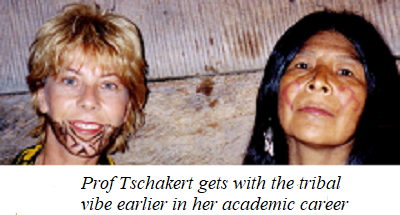
Dr Tschakert can use any of this in her peer-reviewed report, free of charge. I fancy it’s as good as her own output.[3]
For example, she thinks recent bushfires, floods and cyclones are uniquely extreme. They ain’t. Not a climate modeller herself, she expresses touching faith in the mainstream IPCC models, of which 111 of 114 runs exaggerated the warming trends, according to the IPCC itself.[4] She thinks it “reckless” to ignore the models’ forecasts and worst-case scenarios, which the IPCC in 2001 said must by definition be bogus.[5][6] She needs to read the devastating critiques of climate forecasting models by oceanic modeller Dr Mototaka Nakamura (MIT, Duke, Jet Propulsion Laboratory):
These models completely lack some critically important climate processes and feedbacks, and represent some other critically important climate processes and feedbacks in grossly distorted manners to the extent that makes these models totally useless for any meaningful climate prediction. [7]
Professor Tschakert specialises in people’s “anticipatory” grief over global warming, ie., stuff that hasn’t happened yet and might never happen: “There is fantastic research that shows how to embrace grief and loss in an anticipatory way. A term that is used is anticipatory history.”[8]
She also appears to disparage individual resilience to climate because the nanny state ought to fix things:
… the Australian states would like to see their citizens ideally as resilient citizens that can adapt by themselves, that can make the right choices but on their own, (they) ought to be reinventing themselves to take care of something which, really, truthfully, ought to be the responsibility of the state.
Dr Tschakert seems unduly lugubrious, writing papers like “One thousand ways to experience loss: A systematic analysis of climate-related intangible harm from around the world.”[9] She needs to look up tangibles like global agricultural yields. After a half-century of warming and extra CO2, yields for wheat, barley, rice, soybeans, spuds, and bananas continue to rise. On just about any indicator of health and well-being, the globe’s population has never been better off (ChiCom virus and ChiCom threats excepted).
 In another co-authored paper called “A science of loss” she also plumbs “strategies for embracing and managing grief”.[10] A co-author was Melbourne Uni’s Jon Barnett who had enough common sense to call b/s on Extinction Rebellion zealots at Melbourne University last December, much to their indignation. I clearly recognise Barnett’s hand in this minatory paragraph:
Predictions of loss may themselves contribute to loss. Dramatic narratives about future crises have been shown to influence the risk of crises occurring. Several studies explain how talk of catastrophic climate futures rarely leads to mitigation and adaptation but instead results in fatalism, self-blame, underinvestment in vulnerable places, and even accelerated degradation of natural resources.
I did some “anticipatory history” of my own by attending Tschakert’s lecture at Sydney University next August titled “Epistemic Violence and Slow Emergencies in Today’s Climate Justice: A Provocation”.[11] The problems of time travel compounded when the lecture was virus-postponed indefinitely but I still caught the gist of it, Captain Kirk-style.[12] She asked,
How do we find our ways within these emerging dilemmas [re basic climate justice] without losing track of core development goals in the Anthropocene and our commitment to decolonizing development and disaster scholarship?
It does all really make sense, or would if there actually was any “Anthropocene”.
The $64 question is how much Willagee temperatures have actually risen in the past century or so. The answer is 1degC, or nearly that. I can’t see how this small increase over 100 years can cause anyone much inconsolable grief and loss.[13] I wouldn’t notice 1decC change over five minutes, let alone 70 years.
In any case my sister and I can now buy ample Kleenex at Willagee’s Butler Street IGA to mop our climate tears.
Tony Thomas’s new book,Come to think of it – essays to tickle the brain, is available as book ($34.95) or e-book ($14.95)here.
[1] “…as far as the climate scientists know there is no link between climate change and drought…there is no reason a priori why climate change should make the landscape more arid…this may not be what you read in newspapers.”
[2] Williams, Justina, Anger & Love, Fremantle Arts Centre Press, 1993, p164. Also p180.
[3] A little coincidence: our first home from ca 1942 was at Number 30, Stirling Highway, Nedlands. Professor Tschakert now works at No. 35.
[4] “… an analysis of the full suite of CMIP5 historical simulations [computer models] reveals that 111 out of 114 realisations show a [temperature] trend over 1998–2012 that is higher than the entire HadCRUT4 trend [actual temperatures] ensemble. This difference between simulated and observed trends could be caused by some combination of (a) internal climate variability, (b) missing or incorrect radiative forcing, and (c) model response error.” [chapter 9, text box 9.2, page 769]
[5] IPCC: “In climate research and modelling, we should recognize that we are dealing with a coupled non-linear chaotic system, and therefore that the long-term prediction of future climate states is not possible.” (Chapter 14, Section 14.2.2.2. )]
[6] MURRAY-DARLING BASIN ROYAL COMMISSION, Tschakert evidence, p3451
[7] Nakamura: The take-home message is (that) all climate simulation models, even those with the best parametric representation scheme for convective motions and clouds, suffer from a very large degree of arbitrariness in the representation of processes that determine the atmospheric water vapor and cloud fields. Since the climate models are tuned arbitrarily …there is no reason to trust their predictions/forecasts. With values of parameters that are supposed to represent many complex processes being held constant, many nonlinear processes in the real climate system are absent or grossly distorted in the models. It is a delusion to believe that simulation models that lack important nonlinear processes in the real climate system can predict (even) the sense or direction of the climate change correctly.
[8] MURRAY-DARLING BASIN ROYAL COMMISSION, Tschakert evidence, p3457.
[9] The professor also ran an undergraduate unit last year called, simply, “Disasters”.
[10] Nature Climate Change; London Vol. 6, Iss. 11, (Nov 2016): 976-978. DOI:10.1038/nclimate3140
[11] If Professor Tschakert is a top-level UWA salaried professor she’s on a base pay of $188,708 plus masses of perks starting with 17% super. A nice. little 2.6% pay rise for all UWA academics is scheduled next January.
[12] Commander of starship USS Enterprise
[13] Perth temp data from 12km away are all we’ve got. The Bureau of Meteorology (BoM) ships temp data for Perth to the UK as inputs to the HadCRUT global temp series. For some reason the Met mobilises two data sets, one called “Perth Regional Office”, and one called “Perth”, from slightly different site locations. Both start at 1910 but the first stops at 1992 and the other is on-going. I know “the science is settled” but the two nearby sites have differed by as little as 0.4degC and as much as 1.4degC, with strange jumps perhaps suggesting data faults. The past century’s temp trend is either 0.8degC (“Regional Office”) or 1degC (“Perth”).
via Climate Scepticism
May 12, 2020 at 03:12AM
 Iowa Climate Science Education