
“The Paris agreement signals that deniers have lost the climate wars,” read the headline on December 14, 2015. The subtitle to Dana Nuccitelli’s Guardian article: “195 world nations have agreed to ignore climate science denial and cut carbon pollution as much as possible.”
That was then, reminding climate debate veterans of the hyperbole following the Kyoto Protocol in late 1997. (“We’ve bet on the future, while others have bet on the past,” proclaimed Enron lobbyist John Palmisano from Kyoto, Japan.)
In stark contrast to the shortcomings of previous international climate negotiations, the Paris COP21 talks have ended with an agreement stronger than most expected. Graham Readfearn summarized the agreement for The Guardian.
The guts of the agreement hang off the so-called “long-term goal” that commits almost 200 countries to hold the global average temperature to “well below 2°C” above pre-industrial levels and to “pursue efforts to limit the temperature increase to 1.5°C”.
The long-term goal also states that “in accordance with best available science” that “in the second half of this century” the world should get to a point where the net emissions of greenhouse gases should be zero.
The deal also puts into the agreement the 186 pledges submitted to the United Nations to stop the growth of greenhouse gas emissions, mainly from burning fossil fuels.
Those pledges on their own will miss the 1.5C target by a long way, but the agreement also includes a rule where nations must renew their pledges every five years. Each pledge “will represent a progression”.
In short, leaders from around the world have agreed that we must do everything we can to slow global warming as much as we can, submitted pledges to begin the process of cutting carbon pollution, and created a framework by which those pledged cuts can be expanded and strengthened to achieve the goal of limiting the damages of human-caused climate change. There was unanimous agreement about this including from Saudi Arabia, China, India, and the USA. President Obama hailed the agreement at the White House.
Facebook Twitter Pinterest President Obama discusses the COP21 agreement at the White House.
While the Paris talks were ongoing, a group of fossil fuel-funded climate contrarians held their own sparsely-attended movie event and “counter-conference.” Their ringleader Marc Morano complained of the COP21 conference, “They haven’t been too friendly to sceptics this year.”
Indeed, those who deny the scientific evidence were ignored; instead, scientific arguments in favor of an even more stringent target of limiting global warming to 1.5°C above pre-industrial temperatures won the day.
If we’re honest, the climate “debate” and science denial are not actually about science. Most who reject the consensus of 97% of climate experts do so because they prefer the status quo and object to the proposed solutions. This was made clear by a 2014 study showing that Republicans are far more likely to reject the science when told the solution involves government regulation than when they’re told free market solutions are available. It’s ideology, not science.
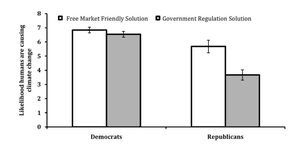
Facebook Twitter Pinterest From Campbell and Kay, “Solution Aversion: On the Relation Between Ideology and Motivated Disbelief,” Journal of Personality and Social Psychology, 2014, Vol. 107, No. 5, 809–824. Published by the American Psychological Association.
Thus the climate wars have been about policy, not science, and international climate negotiations are the ultimate battlefield. To this point, contrarian efforts to undermine these negotiations have succeeded, but in Paris they failed. The whole world agreed, we need to stop delaying and start getting serious about preventing a climate crisis. We’ve turned the corner; climate denial is no longer being taken seriously. The world has moved on, and contrarians have become irrelevant relics of the fossil fuel age.
Advertisement
The good news is that while the Paris agreement didn’t include specific policies, there are indeed free market solutions available. For example, there’s a consensus among economists that a carbon tax is the most efficient way to cut carbon pollution, and if made revenue-neutral, represents a small government solution that many conservatives support, with studies showing it would be good for the economy even without considering the economic benefits of minimizing climate damages.
In the wake of the Paris negotiations, we now need a real policy debate to decide how we’re going to most efficiently cut carbon pollution. For example, in the United States should we stick with EPA greenhouse gas regulations, or replace them with a free market solution, as President Obama would prefer? Should that solution be a carbon cap and trade system or a tax? What should be done with the revenue that would be generated?
These policy questions entail the global warming debate we should have been having all along. Denying the scientific evidence has successfully delayed the policy debate so far, but with the successes of the Paris COP21 negotiations, the days of denial are over. It’s time to get serious and figure out the best way to tackle the problem that the entire world now agrees urgently needs to be solved.
There’s another global emergency…
… that the media can’t afford to stop covering. Even as a pandemic terrorizes the world, the climate emergency continues to present a grave threat to the planet. The Guardian has long recognized that the climate crisis is the defining issue of our time. We need your help to keep it front and center.
This week, the Guardian is joining forces with more than 400 news organizations from around the world as part of Covering Climate Now, a global initiative to increase nationwide media coverage of the climate emergency. We will be sharing our climate coverage with newsrooms all over the world in the hope that outlets without dedicated environment desks will have the opportunity to provide in-depth reporting on this issue. By increasing the reach of our climate coverage, our goal is to spark action from our leaders, inspire citizens and point to systematic change.
Earlier this year, we decided to renounce fossil fuel advertising, becoming the first major global news organisation to institute an outright ban on taking money from companies that extract fossil fuels. Even in a particularly challenging news environment, with advertising revenue plummeting fast, we will continue to be guided by our values.
You’ve read more than 17 articles in the last six months. Our journalism relies on our readers’ generosity – your financial support has meant we can keep investigating, disentangling and interrogating. It has protected our independence, which has never been so critical. We are so grateful.
The post Remembering the Hype About the Paris Climate Accord (who’s winning now?) appeared first on Master Resource.
via Master Resource
May 13, 2020 at 01:13AM
 Iowa Climate Science Education