
Guest “BINGO!” by David Middleton
No Oil Bailout Is Worth the Green New Deal
By KEVIN D. WILLIAMSON
May 14, 2020‘Stop trying to help us,’ the industry says
‘Oil is dead.” So goes the wishful thinking of the Left in Canada. And not just in Canada.Canada’s oil industry, like others around the world, has taken a beating: Before the coronavirus epidemic, prices already were low and declining, with U.S. shale producers fracking the world into oil abundance, sending prices down from over $100 a barrel in 2014 to less than $30 a barrel just two years later. The failure of the joint Saudi–Russian effort to cut production sent prices down even more, and then came the coronavirus epidemic, which cut demand off at the legs and sent oil prices all the way down to $0.00 and then briefly into negative territory as oil traders looked to escape paying storage costs for the unprofitable commodity.
[…]
Unlike their Canadian colleagues, the leaders of the U.S. oil industry aren’t really looking for help. They’ve been through a price crash before — it was the stupendous output enabled by the shale revolution, not the epidemic, that brought down oil prices to begin with — and they learned to adjust. The big oil companies have diversified operations, and they do not live or die by the daily price of crude.
“Any effort by government will come with a very high price from the Democrats,” says Thomas Pyle of the American Energy Alliance. “They’ll want to trade that for parts of the Green New Deal, which is a bad deal for us.” Pyle says that some producers, especially smaller firms, might benefit from the same sort of assistance offered to businesses in any other industry, but that protectionist measures such as tariffs and subsidies are help that’s not wanted. Any help that is offered, he argues, should be general rather than industry-specific.
[…]
Conservatives have pointed to the suffering and economic ruination of the coronavirus quarantine as a preview of the so-called Green New Deal, which is less a legislative proposal than a slop bucket into which almost any left-wing priority can be poured. It may be necessary, conservatives say, for government simply to mandate that important economic activities come to a halt, but this is what it looks like.
[…]
The political opportunism here is impossible to miss. Helen Mountford of the World Resources Institute told Bloomberg that the current crisis presents “a great opportunity now to transition more quickly.” The political strategy is to present the coronavirus epidemic and climate change as a continuity of crisis.
[…]
Beating back Green New Deal shenanigans and affirming the role of the oil-and-gas industry ought to be a political dunk for the Trump-era Republican Party. Setting aside the complicating fact that U.S. energy independence is really North American energy independence — Canada and Mexico are our top two national suppliers of petroleum, which the United States continues to import because many of our refineries still are optimized for relatively high-sulfur imported oil rather than the “light sweet” stuff from Texas — this is an opportunity so simple and clear that even Republican candidates for public office should not be able to get it entirely wrong. It pits a successful real-world industry creating and sustaining hundreds of thousands of jobs — many of them in swing states such as Ohio and Pennsylvania — with real-world names and faces attached to them against a pet project of the Davos set, one that has achieved quasi-religious status among affluent elites but hardly registers at all in the polls: In the January Gallup survey of top issues informing voters’ choices in the 2020 election, climate change was second from last, ahead only of gay rights and far behind such concerns as the budget deficit, taxes, and immigration. The question of energy vs. the Green New Deal is a question of real things you can see vs. possible things someone might imagine, your warm house vs. the warm fuzzy feeling of self-righteousness, people you know vs. people you don’t.
“We think these decisions should be made on the basis of financial accounting, not ideological,” says Frank Macchiarola of the American Petroleum Institute.
[…]
The current situation is painful, but the U.S. oil industry believes that in the long term the numbers are on its side: With a growing world population and a growing global middle class, energy consumption is expected to increase by as much as 20 percent in the next 20 years — and half of that energy will come from oil and gas. That matters for the cost of filling up your F-150, but it also matters for the diplomatic, security, and trade position of the United States. The day before yesterday, the big worry was our “dependence on” or “addiction to” despised “foreign oil.” Technological innovations have made the United States the biggest oil and gas producer around, and our short-term problem right now is that we have more oil than anybody wants and nowhere to put it. The problem of depletion has become the problem of superabundance. That’s a better problem to have.
[…]
Even after the long-term decline in prices from the shale boom, the shock of the Saudi–Russian price war, and the cratering demand from the coronavirus shutdown, the major oil producers in the United States are, for the most part, asking to be left alone, or for oil businesses to be treated like any other businesses. There is value in that kind of resilience, which should be even more obvious in uncertain times such as these.
This article appears as “‘Stop Trying To Help Us,’ Says Oil Business” in the June 1, 2020, print edition of National Review.
KEVIN D. WILLIAMSON is the roving correspondent for National Review and the author of THE SMALLEST MINORITY: INDEPENDENT THINKING IN AN AGE OF MOB POLITICS.

While there are a lot of things government could do to help the US oil industry weather this storm (like expanding the Strategic Petroleum Reserve), there is nothing government could do, that would be worth accepting any part of the Green New Deal in a compromise. The best thing government can do is to get out of the way of the economy.
EIA expects US tight/”shale” oil production to decline by nearly 200,000 bbl/d from May to June and a total decline of about 1.3 million bbl/d in 2020-2021.

Interestingly, EIA foresees no decline in Gulf of Mexico or Alaska production, as these play types aren’t as sensitive to short term price swings. Nor, does EIA foresee the cancellation of any announced development projects.
EIA forecasts GOM production to remain relatively flat, averaging 1.9 million b/d in 2020 and 2021, nearly unchanged from its 2019 average. In addition, EIA expects no cancellation in announced GOM projects for 2020 and 2021. EIA forecasts that crude oil production from Alaska will remain at an average of 460,000 b/d in 2020 and that it will increase slightly in 2021.
EIA forecasts U.S. crude oil production to fall in 2020 and 2021
Production cuts, coupled with increasing demand as the economy reopens will drive prices back up. Due to the deeper than previously expected production cuts…


EIA is now forecasting $50/bbl by the end of 2021.

This is up from about $42/bbl in the April STEO.

As prices recover, EIA expects drilling activity to recover in 2021 and for production growth to resume in late 2021.
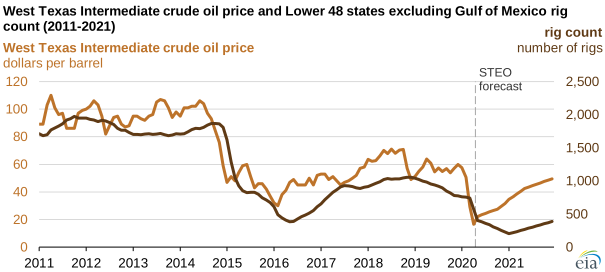
The improving oil price forecast is currently being driven almost entirely by production cuts. And, oddly enough, the stock market is digging it!
Surging Crude Prices Send Oil Stocks Soaring Today
Crude oil prices in the U.S. rallied back above $30 a barrel.Matthew DiLallo
May 18, 2020What happened
Oil prices started this week with a bang. WTI, the primary U.S. oil price benchmark, had rallied more than 10% by 10:30 a.m. EDT on Monday, to around $32.50 a barrel, while Brent, the global oil price benchmark, jumped more than 7% to nearly $35 a barrel.
The surge in crude prices buoyed most oil stocks. Several rallied by double-digit percentages in early morning trading today, including Apache (NYSE:APA), Callon Petroleum (NYSE:CPE), and Cenovus Energy (NYSE:CVE). Meanwhile, even oil giant ExxonMobil (NYSE:XOM) was in rally mode as its shares surged 5% by midmorning, adding about $10 billion to its market capitalization.
So what
Oil prices in the U.S. rebounded to a two-month high on Monday. Fueling the rally was optimism that demand is beginning to improve as more states reopen their economies now that the COVID-19 pandemic has started waning. On top of that, oil supplies are falling fast because producers trimmed output to combat weaker pricing. Adding to the day’s bullishness was promising data on a leading vaccine candidate and positive commentary by the Federal Reserve chairman over the weekend.
The surge in oil prices was the main factor driving oil stocks higher on Monday. The improved pricing will benefit financially challenged producers like Apache, Callon, and Cenovus. All three have had to make significant spending cuts over the past couple of months to realign their businesses with lower prices.
For example, Apache slashed its dividend 90% and cut capital spending by 40% to conserve cash during the downturn. The company made thosemoves to ensure it had the liquidity to manage $937 million of bonds coming due in 2021 and 2023. Apache might not be able to refinance that debt if market conditions don’t improve because a credit rating agency slashed its debt rating to junk territory. But with oil prices bouncing back today, investors are optimistic that the worst might be over for the oil market, which bodes well for Apache.
[…]
So… To borrow a phrase from the classic movie, The Treasure of the Sierra Madre…


via Watts Up With That?
May 20, 2020 at 08:21AM
 Iowa Climate Science Education