
We met some people from Colorado, on top of a mountain at 12,000 feet in Wyoming yesterday. Apparently they didn’t feel safe hiking in Colorado, so they came up here.
via Real Climate Science
July 13, 2020 at 08:26AM
We met some people from Colorado, on top of a mountain at 12,000 feet in Wyoming yesterday. Apparently they didn’t feel safe hiking in Colorado, so they came up here.
via Real Climate Science
July 13, 2020 at 08:26AM
We live next to a 1,500 ft tall TV tower which frequently gets hit by lightning. We are so close, in fact, that it is difficult to get good photographs because the area just above the tower top is at an elevation angle of 70 deg. viewed from our yard, which is too steep to take pictures through a window, and for outdoor photos will cause rain to fall on the camera lens.
So, despite thousands of lightning strikes we have witnessed and heard over the years, I seldom attempt photos or video. Yesterday was one of the rare instances where the thunderstorm anvil trailing downwind of the approaching storm was sending out lightning strokes at regular, ~2 minute intervals before the rain began. This is the best time to watch the lightning for us, usually by lying down on an outdoor lounge chair and looking almost straight up.
My camera equipment was still in the car from a short trip to take photos of Comet NEOWISE the previous morning. Sensing this was a chance to capture some good video, I ran out to the car, retrieved my camera backpack and a tripod, and ran to the backyard. I set up the camera and tripod in record time, quickly adjusted the focus manually, and hit the record button.
In literally less than 1 second after pressing the record button, the best strike of the storm occurred. Here’s an animated GIF of the event… 20 video frame captures at 1/24 sec intervals (the vertical scale is exaggerated because I forced WordPress to load the full-resolution file… click on the video to see the proper perspective):

There are a lot of interesting features that I won’t go into here, except I especially like how the ionized channel breaks up into pockets of glowing air during dissipation, here’s one of the frames showing that structure:
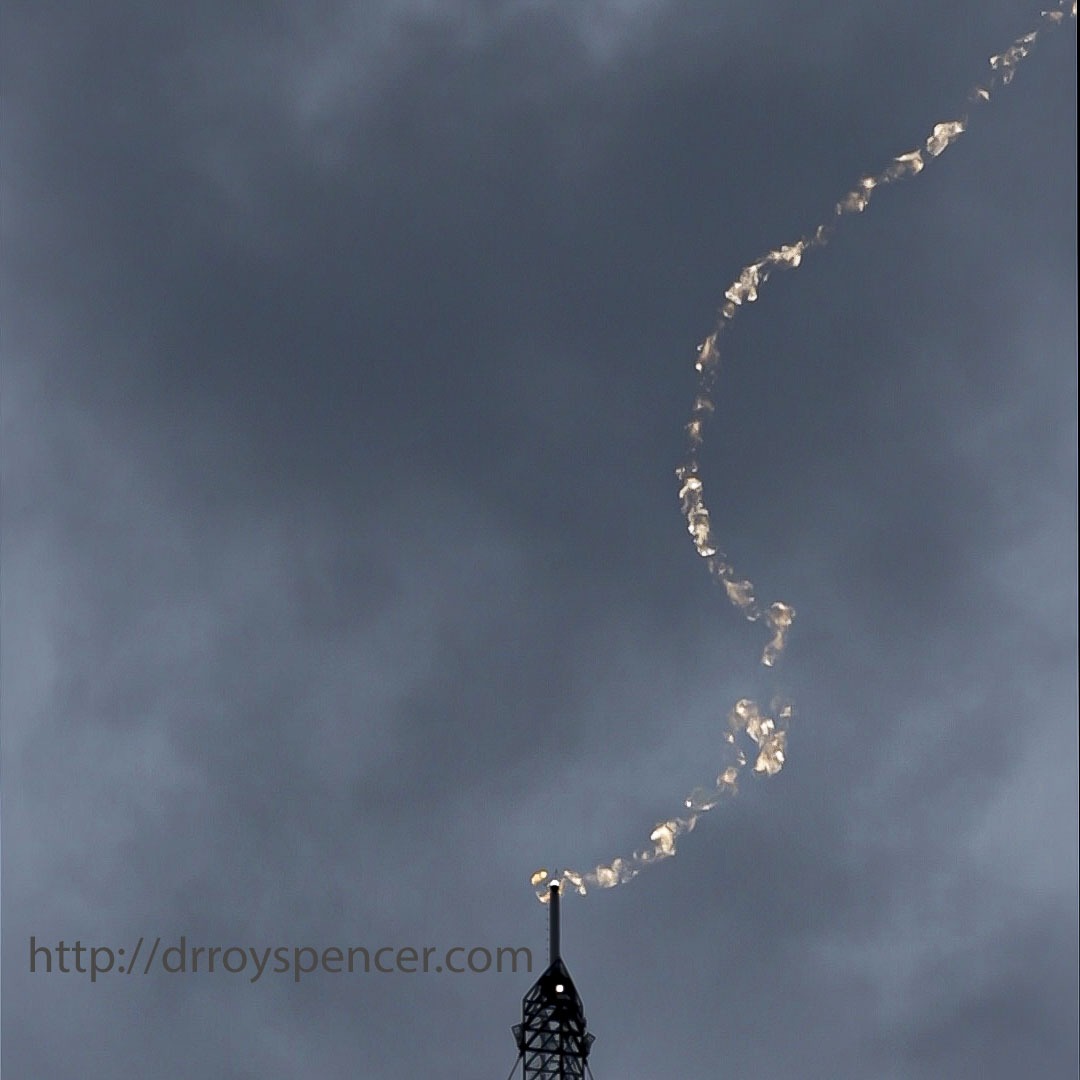
via Roy Spencer, PhD.
July 13, 2020 at 08:17AM

The news comes from the UK National Oceanography Centre article SNAP-DRAGON project funded to study the changing subpolar North Atlantic Ocean. Excerpts in italics with my bolds.
Funding has been announced for a major project aimed at improving understanding of an ocean region important for climate predictability.
The SNAP-DRAGON project will see NOC scientists work alongside colleagues from Oxford, Southampton, Reading, Liverpool, Oban, and the US, to study the subpolar North Atlantic Ocean, which stretches between the UK, Greenland and Canada. The project is funded by the Natural Environment Research Council (NERC) and National Science Foundation (NSF).
Heat released from the subpolar North Atlantic influences the storm track that determines weather in Europe. Furthermore, the sinking of ocean water in this region carries heat and carbon down into the ocean interior, away from the atmosphere.
The SNAP-DRAGON project will provide new knowledge of the subpolar North Atlantic, which will help to improve predictions of ocean and climate variability.
SNAP-DRAGON will build on the results of the Overturning in the Subpolar North Atlantic Programme (OSNAP), which has recently made the first ever sustained observations of the large-scale subpolar North Atlantic circulation. SNAP-DRAGON scientists will use these observations, together with numerical models of the ocean, to understand what causes the large variability observed in the circulation of this region. The researchers will also establish what the variations in temperature and circulation tell us about future ocean and climate conditions. By figuring out how the subpolar North Atlantic circulation works and which physical processes are important, SNAP-DRAGON scientists will be able to assess the performance of climate models and suggest improvements.
Associate Professor Helen Johnson from Oxford Earth Sciences, who is leading the project, said “This is a really exciting project which should help us to properly get to grips with how the circulation in the subpolar North Atlantic works, and the role it plays in the climate system.”
Scientists at the NOC will lead the analysis of the OSNAP and other observations. A team at Oxford University will take the lead on using state-of-the art numerical models to probe the ocean physics responsible for variability and change. The SNAP-DRAGON team includes scientists at several US institutions and partners from a range of European institutions. It will bring observations and models together in a range of innovative ways to produce a step change in our understanding of the causes of subpolar ocean variability, their implications for ocean and climate predictability in this region, and the degree to which we can trust their representation in climate models.
[Note: While this announcement recognizes the unsettled science, it concerns me to hear about innovative use of models applied to observations. In the past, that has meant twisting the data to fit the modelers’ presuppositions in service of alarmism. Let’s trust these scientists, but verify they really want the truth and not just pushing an agenda. I am somewhat reassured that Gerald McCarthy, (head of the RAPID project referenced later on) spoke truth to the climatists in the past, though they protested against him for his honesty.]
Background from Previous Post Feb.1, 2019 New Publication from M.S. Lozier et al.
A Feb.1, 2019 publication from M.S. Lozier et al. is A sea change in our view of overturning in the subpolar North Atlantic which is reporting on the first 21 months of observations from the newly installed OSNAP array described in a previous post from a year ago (reprinted below). The article is paywalled, but the main findings are provided at a Science Daily article European waters drive ocean overturning, key for regulating climate. Excerpts in italics with my bolds.
Summary:
An international study reveals the Atlantic meridional overturning circulation, which helps regulate Earth’s climate, is highly variable and primarily driven by the conversion of warm, salty, shallow waters into colder, fresher, deep waters moving south through the Irminger and Iceland basins. This upends prevailing ideas and may help scientists better predict Arctic ice melt and future changes in the ocean’s ability to mitigate climate change by storing excess atmospheric carbon.

In a departure from the prevailing scientific view, the study shows that most of the overturning and variability is occurring not in the Labrador Sea off Canada, as past modeling studies have suggested, but in regions between Greenland and Scotland. There, warm, salty, shallow waters carried northward from the tropics by currents and wind, sink and convert into colder, fresher, deep waters moving southward through the Irminger and Iceland basins.
Overturning variability in this eastern section of the ocean was seven times greater than in the Labrador Sea, and it accounted for 88 percent of the total variance documented across the entire North Atlantic over the 21-month study period.
“Overturning carries vast amounts of anthropogenic carbon deep into the ocean, helping to slow global warming,” said co-author Penny Holliday of the National Oceanography Center in Southampton, U.K. “The largest reservoir of this anthropogenic carbon is in the North Atlantic.”
“Overturning also transports tropical heat northward,” Holliday said, “meaning any changes to it could have an impact on glaciers and Arctic sea ice. Understanding what is happening, and what may happen in the years to come, is vital.”
MIT’s Carl Wunsch and other outside experts said the study was helpful, but pointed out that 21 months of study is not enough to know if this different location is temporary or permanent.
[Note: The comment about oceans taking up CO2 could be misleading. The ocean contains dissolved CO2 amounting to 50 times atmospheric CO2. Each year about 20% of all CO2 in the air goes into the ocean, replaced by outgassing CO2. The tiny fraction of atmospheric CO2 from humans is exchanged proportionately. Henry’s law applies to the water/air interface, so that a warmer ocean absorbs slightly less, and a colder ocean absorbs slightly more CO2. The exchange equilibrium is hardly disturbed by the little bit of human produced CO2. Thus the ocean serves as a massive buffer against human emissions.]
Previous Post: AMOC 2018: Not Showing Climate Threat

The AMOC is back in the news following a recent Ocean Sciences meeting. This update adds to the theme Oceans Make Climate. Background links are at the end, including one where chief alarmist M. Mann claims fossil fuel use will stop the ocean conveyor belt and bring a new ice age. Actual scientists are working away methodically on this part of the climate system, and are more level-headed. H/T GWPF for noticing the recent article in Science Ocean array alters view of Atlantic ‘conveyor belt’ By Katherine Kornei Feb. 17, 2018 . Excerpts with my bolds.
The powerful currents in the Atlantic, formally known as the Atlantic meridional overturning circulation (AMOC), are a major engine in Earth’s climate. The AMOC’s shallower limbs—which include the Gulf Stream—transport warm water from the tropics northward, warming Western Europe. In the north, the waters cool and sink, forming deeper limbs that transport the cold water back south—and sequester anthropogenic carbon in the process. This overturning is why the AMOC is sometimes called the Atlantic conveyor belt.

Last week, at the American Geophysical Union’s (AGU’s) Ocean Sciences meeting here, scientists presented the first data from an array of instruments moored in the subpolar North Atlantic. The observations reveal unexpected eddies and strong variability in the AMOC currents. They also show that the currents east of Greenland contribute the most to the total AMOC flow. Climate models, on the other hand, have emphasized the currents west of Greenland in the Labrador Sea. “We’re showing the shortcomings of climate models,” says Susan Lozier, a physical oceanographer at Duke University in Durham, North Carolina, who leads the $35-million, seven-nation project known as the Overturning in the Subpolar North Atlantic Program (OSNAP).

The research and analysis is presented by Dr. Lozier et al. in this publication Overturning in the Subpolar North Atlantic Program: A New International Ocean Observing System Images above and text excerpted below with my bolds.
For decades oceanographers have assumed the AMOC to be highly susceptible to changes in the production of deep waters at high latitudes in the North Atlantic. A new ocean observing system is now in place that will test that assumption. Early results from the OSNAP observational program reveal the complexity of the velocity field across the section and the dramatic increase in convective activity during the 2014/15 winter. Early results from the gliders that survey the eastern portion of the OSNAP line have illustrated the importance of these measurements for estimating meridional heat fluxes and for studying the evolution of Subpolar Mode Waters. Finally, numerical modeling data have been used to demonstrate the efficacy of a proxy AMOC measure based on a broader set of observational data, and an adjoint modeling approach has shown that measurements in the OSNAP region will aid our mechanistic understanding of the low-frequency variability of the AMOC in the subtropical North Atlantic.

Finally, we note that while a primary motivation for studying AMOC variability comes from its potential impact on the climate system, as mentioned above, additional motivation for the measure of the heat, mass, and freshwater fluxes in the subpolar North Atlantic arises from their potential impact on marine biogeochemistry and the cryosphere. Thus, we hope that this observing system can serve the interests of the broader climate community.

In summary, while modeling studies have suggested a linkage between deep-water mass formation and AMOC variability, observations to date have been spatially or temporally compromised and therefore insufficient either to support or to rule out this connection.
Current observational efforts to assess AMOC variability in the North Atlantic.
The U.K.–U.S. Rapid Climate Change–Meridional Overturning Circulation and Heatflux Array (RAPID–MOCHA) program at 26°N successfully measures the AMOC in the subtropical North Atlantic via a transbasin observing system (Cunningham et al. 2007; Kanzow et al. 2007; McCarthy et al. 2015). While this array has fundamentally altered the community’s view of the AMOC, modeling studies over the past few years have suggested that AMOC fluctuations on interannual time scales are coherent only over limited meridional distances. In particular, a break point in coherence may occur at the subpolar–subtropical gyre boundary in the North Atlantic (Bingham et al. 2007; Baehr et al. 2009). Furthermore, a recent modeling study has suggested that the low-frequency variability of the RAPID–MOCHA appears to be an integrated response to buoyancy forcing over the subpolar gyre (Pillar et al. 2016). Thus, a measure of the overturning in the subpolar basin contemporaneous with a measure of the buoyancy forcing in that basin likely offers the best possibility of understanding the mechanisms that underpin AMOC variability. Finally, though it might be expected that the plethora of measurements from the North Atlantic would be sufficient to constrain a measure of the AMOC within the context of an ocean general circulation model, recent studies (Cunningham and Marsh 2010; Karspeck et al. 2015) reveal that there is currently no consensus on the strength or variability of the AMOC in assimilation/reanalysis products.

In addition we have a recent report from the United Kingdom Marine Climate Change Impacts Partnership (MCCIP) lead author G.D. McCarthy Atlantic Meridional Overturning Circulation (AMOC) 2017.

Figure 1: Ten-day (colours) and three month (black) low-pass filtered timeseries of Florida Straits transport (blue), Ekman transport (green), upper mid-ocean transport (magenta), and overturning transport (red) for the period 2nd April 2004 to end- February 2017. Florida Straits transport is based on electromagnetic cable measurements; Ekman transport is based on ERA winds. The upper mid-ocean transport, based on the RAPID mooring data, is the vertical integral of the transport per unit depth down to the deepest northward velocity (~1100 m) on each day. Overturning transport is then the sum of the Florida Straits, Ekman, and upper mid-ocean transports and represents the maximum northward transport of upper-layer waters on each day. Positive transports correspond to northward flow.
The RAPID/MOCHA/WBTS array (hereinafter referred to as the RAPID array) has revolutionized basin scale oceanography by supplying continuous estimates of the meridional overturning transport (McCarthy et al., 2015), and the associated basin-wide transports of heat (Johns et al., 2011) and freshwater (McDonagh et al., 2015) at 10-day temporal resolution. These estimates have been used in a wide variety of studies characterizing temporal variability of the North Atlantic Ocean, for instance establishing a decline in the AMOC between 2004 and 2013.
Summary from RAPID data analysis
MCCIP reported in 2006 that:
And also that:
Conclusions
Background:
Evidence is Mounting: Oceans Make Climate
via Science Matters
July 13, 2020 at 08:16AM
MasterResource has previously posted on the work of the Climate Intelligence Foundation, an independent charitable group that focuses on climate-change science and climate policy. CLINTEL, founded in 2019 by emeritus professor of geophysics Guus Berkhout and science journalist Marcel Crok, has grown in stature with great promise for the future.
CLINTEL’s policy positions, communicated at the highest levels of government, begin with a World Climate Declaration, “There is No Climate Emergency.”
Climate science should be less political, while climate policies should be more scientific. In particular, scientists should emphasize that their modeling output is not the result of magic: computer models are human-made. What comes out is fully dependent on what theoreticians and programmers have put in: hypotheses, assumptions, relationships, parameterizations, stability constraints, etc. Unfortunately, in mainstream climate science most of this input is undeclared.
To believe the outcome of a climate model is to believe what the model makers have put in. This is precisely the problem of today’s climate discussion to which climate models are central. Climate science has degenerated into a discussion based on beliefs, not on sound self-critical science. We should free ourselves from the naïve belief in immature climate models. In future, climate research must give significantly more emphasis to empirical science.
Recently, CLINTEL updated their Scientific Manifesto, one of the most important climate documents in the debate today, which guides the Global Climate Intelligence Council (see below). It is reproduced, beginning with the introduction, in its entirety.
On 11 June 2020 the undersigned, Professor Guus Berkhout, sent an open letter to the President of the Royal Netherlands Academy of Arts and Sciences (KNAW), as well as an English version to the European (EASAC) and global (IAP) umbrella organisations of the Academies of Sciences. This letter (attached) expresses concern that academic freedom has largely disappeared in climate science.
The letter is based on CLINTEL’s scientific manifesto, AVDIATVR ET ALTERA PARS (“Let both sides be heard”, one of the two fundamental principles of natural justice recognized by the law of civilized nations). The manifesto comprises ten propositions governing independent scientific research. All scientific research ought to comply with these propositions. Bad scientific practice inevitably leads to bad scientific results.
The ten propositions are presented below, with a brief examination of the extent to which current climate research complies with them.
1. The complexity of multi-factor, multi-scale systems demands close co-operation between a wide range of scientific fields and disciplines
Climate change has a wide variety of causes, natural as well as anthropogenic. Integration of knowledge from many scientific disciplines, such as astronomy, geology, archaeology, meteorology, oceanography and biology, is indispensable to a full understanding of the complex causal relationships that underlie climate change. At the same time, the integration of theoretical knowledge with measurement technology should have a high priority. This is hardly the case in today’s mainstream climate research.
2. Sound scientific research is open-minded and characterized by a wide variety of viewpoints without dogmas and prejudices
Within established climate science, curiosity and diversity are being suppressed and the anthropogenic global warming (AGW) dogma is ruthlessly enforced. Think of IPCC’s extreme scenario RCP 8.5, being widely presented in the literature as ‘business as usual’. Despite pressing scientific, economic and social grounds for questioning that dogma, any scepticism is presented as unscientific. However, science is neither a religion nor a political faction. Science advances not by chanting “I believe!” but by asking “I wonder?” Funding for climate-sceptical research is non-existent today. Censorship complicates and all too often prevents the publication of critical articles in peer-reviewed scientific journals.
3. Faith in scientific models is faith in the underlying assumptions; only correct assumptions lead to correct answers
What computer models tell us depends entirely on what model-makers have input to them: hypotheses, relationships, parameterizations, arithmetical simplifications, boundary conditions, etc. Unfortunately, mainstream climatologists seldom discuss these choices in their complex climate models. For instance, how sensitive are the modelling results to the biased assumptions of modelling groups? We still know very little about it.
4. With enough model parameters it is always possible to reconstruct measurements from the past; it says, however, little about the models’ validity
The famous mathematician John von Neumann (1903 – 1957) said: “With four parameters I can fit an elephant: with five I can make him wiggle his trunk.” The real test of models is whether they can accurately predict future measurements. But that is where climate models go wrong. For 30 years, the IPCC has falsely predicted alarming high temperatures in its reports. Considering its failure, why does it still continue to publish its speculative long-term climate predictions?
5. In scientific progress sound measurements are decisive; breakthroughs in science are initiated by the availability of better measurements
Think of the spectacular improvements in microscopy and the capability of modern telescopes. Think of the Dutch LOFAR antenna network, which has already discovered thousands of new galaxies. Unfortunately, mainstream climate science is less interested in measurements than in mere models. Particularly in the extremely complex climate issue, new measuring systems should have the highest priority as a yardstick to verify the validity of IPCC’s model assumptions.
6. The history of science shows time and again that new insights do not come from followers but from dissenters; doubters and dissenters make history in science
Copernicus, Galilei, Newton, Gauss, Curie, Einstein, Watson, Crick, Wilkins and Hawking all looked critically at the prevailing consensus and dared to take a different path. Progress would not have been possible without them. In contrast, the mainstream climate community have produced few advances. They have diverted themselves into an ever-bitterer defence of the narrow CO2-warming hypothesis. Doubters and dissenters are not tolerated.
7. Separation of science and politics is a great good; Academies of Sciences should protect scientists from political ideologies
When political ideologues proclaim “consensus”, critical scientists are sidelined, excluded from the scientific discourse or even dismissed. For instance, Professor Peter Ridd, an expert on coral reefs, exposed several unsound peer-reviewed scientific papers falsely asserting that climate change is killing the Great Barrier Reef. His university dismissed him after decades of service. The courts have declared his dismissal improper and have ordered the university to compensate him.
Not only was the university’s misconduct a flagrant violation of academic freedom: it has also sent a dangerous signal to young scientists: do not dare to defy dogma or you will be driven out. Climate censorship brings us back to the Middle Ages. AGW dissenters are excommunicated.
8. Academies of Sciences have a moral responsibility to warn society of senseless conclusions that follow from naïve belief in scientific models
So far, climate models have proven unable to make reliable predictions of global warming. Therefore, their predictions are not a sound basis for making government policy. Climate policies are costly. They have major consequences for society. For example, IPCC’s predictions about extreme warming and sea-level rise have caused much fear and unrest in the world. As today’s climate policy is based on these alarming model predictions, the existing energy infrastructure is unnecessarily being demolished with imprudent haste. A typical example of climate stupidity is spending billions of dollars on dirty, wood-fired power stations. For this supposedly “green” solution, forests with unique ecosystems are being destroyed.
9. The scientific community should be more honest about the limits on the power of mankind to subdue natural variability
Science should start to resist the absurd green engineering agendas of supranational organisations. To think that we can always control the complex processes from weather and climate in the macro world to the mutation of pathogens in the micro world is as naïve as it is arrogant. Let us not behave as though we were present-day Don Quixotes. In climate research, we should focus not on mitigation but on adaptation to the many consequences of natural variability ahead of us – changes that we are powerless to control.
10. The science is settled is a consensus statement that will never be used by scientists of integrity
Argument from consensus conflates two ancient logical fallacies – of headcount and of appeal to imagined authority (argumentum ad populum and ad verecundiam). The statement that “the science is settled” is an assertion of imagined consensus deployed by climate activists as a substitute for science. Quoting Michael Crichton (1942 – 2008) on this subject: “Science is not consensus and consensus is not science”. The Paris Climate Accord of 2015, which set the climate agenda for decades, is based on this statement. However, the truth is that the science is not settled at all. We have little idea how much or how little mankind is contributing to global warming. We also do not know whether or to what extent warmer worldwide weather will be net-harmful or net-beneficial.
Mainstream climate science does not meet any of these ten propositions. Climate research had taken a direction which, however profitable to its practitioners, is unworthy of science. The interests of science and politics have become strongly intertwined. As a result, the search for the objective scientific truth has been abandoned for decades. History will blame the scientists, administrators and politicians who initiated, fostered and furthered this scientific scandal.
In 2015, the Academies of Sciences should have warned world leaders loud and clear that the science is not settled at all. By their negligence, the Academies made themselves complicit in the absurdity of the Parish Agreement.
The Academies of Sciences see themselves (rightly or wrongly) as guardians of science. If so, should they not at last creak into action? On the basis of immature scientific models, an absurdly costly climate policy is being imposed on the world. In the name of science, vital infrastructures are being destroyed. Worse, poor people are dying in their millions every year because they cannot afford costly “renewable” electricity.
Dr. A.J. (Guus) Berkhout Emeritus Professor of Geophysics Member, KNAW President, Climate Intelligence Group (CLINTEL)
————
The CLINTEL Council is composed of the following individuals:
World Climate Declaration AMBASSADORS
NOBEL LAUREATE PROFESSOR IVAR GIAEVER NORWAY/USA
PROFESSOR GUUS BERKHOUT / THE NETHERLANDS
KEES LEPAIR / THE NETHERLANDS
PROFESSOR REYNALD DU BERGER / FRENCH SPEAKING CANADA
TERRY DUNLEAVY / NEW ZEALAND
VIV FORBES / AUSTRALIA PROFESSOR
PROFESSOR JEFFREY FOSS / ENGLISH SPEAKING CANADA
JENS MORTON HANSEN / DENMARK
MORTEN JØDAL / NORWAY
PROFESSOR DEMETRIS KOUTSOYIANNIS / GREECE
ROB LEMEIRE / DUTCH SPEAKING BELGIUM
PROFESSOR RICHARD LINDZEN / USA
HENRI A. MASSON / FRENCH SPEAKING BELGIUM
PROFESSOR INGEMAR NORDIN / SWEDEN
JIM O’BRIEN / REPUBLIC OF IRELAND
PROFESSOR IAN PLIMER / AUSTRALIA
DOUGLAS POLLOCK / CHILE
PROFESSOR ALBERTO PRESTININZI / ITALY
PROFESSOR BENOÎT RITTAUD / FRANCE
DR. THIAGO MAIA / BRAZIL
PROFESSOR FRITZ VAHRENHOLT / GERMANY
THE VISCOUNT MONCKTON OF BRENCHLEY / UNITED KINGDOM
The post Update: Climate Intelligence Foundation (Clintel) Manifesto appeared first on Master Resource.
via Master Resource
July 13, 2020 at 08:10AM
 Iowa Climate Science Education