Month: July 2020

Hydroxychloroquine lowers Covid-19 death rate “significantly”, study finds

Looks like Trump was right after all. In an analysis of more than 2,500 patients hospitalized between March 10 and May 2, 2020, the Henry Ford Health system in Detroit found that:

  • Twice as many patients survived when given hydroxychloroquine
  • There were no heart-related side effects reported
  • Early treatment (within 24 hours of admission) appears to be key

___________

A media release just two days ago from the Henry Ford Health System  trumpeted a new study showing that “treatment with hydroxychloroquine cut the death rate significantly in sick patients hospitalized with COVID-19 – and without heart-related side-effects.”

Here’s the rest of that press release (I have bolded the parts that really stand out to me):

In a large-scale retrospective analysis of 2,541 patients hospitalized between March 10 and May 2, 2020 across the system’s six hospitals, the study found 13% of those treated with hydroxychloroquine alone died compared to 26.4% not treated with hydroxychloroquine. None of the patients had documented serious heart abnormalities; however, patients were monitored for a heart condition routinely pointed to as a reason to avoid the drug as a treatment for COVID-19.

The study was published today in the International Journal of Infectious Diseases, the peer-reviewed, open-access online publication of the International Society of Infectious Diseases (ISID.org).

Patients treated with hydroxychloroquine at Henry Ford met specific protocol criteria as outlined by the hospital system’s Division of Infectious Diseases. The vast majority received the drug soon after admission; 82% within 24 hours and 91% within 48 hours of admission. All patients in the study were 18 or over with a median age of 64 years; 51% were men and 56% African American.

“The findings have been highly analyzed and peer-reviewed,” said Dr. Marcus Zervos, division head of Infectious Disease for Henry Ford Health System, who co-authored the study with Henry Ford epidemiologist Dr. Samia Arshad. “We attribute our findings that differ from other studies to early treatment, and part of a combination of interventions that were done in supportive care of patients, including careful cardiac monitoring. Our dosing also differed from other studies not showing a benefit of the drug. And other studies are either not peer reviewed, have limited numbers of patients, different patient populations or other differences from our patients.”

Zervos said the potential for a surge in the fall or sooner, and infections continuing worldwide, show an urgency to identifying inexpensive and effective therapies and preventions.

“We’re glad to add to the scientific knowledge base on the role and how best to use therapies as we work around the world to provide insight,” he said. “Considered in the context of current studies on the use of hydroxychloroquine for COVID-19, our results suggest that the drug may have an important role to play in reducing COVID-19 mortality.”

The study also found those treated with azithromycin alone or a combination of hydroxychloroquine and azithromycin also fared slightly better than those not treated with the drugs, according to the Henry Ford data. The analysis found 22.4% of those treated only with azithromycin died, and 20.1% treated with a combination of azithromycin and hydroxychloroquine died, compared to 26.4% of patients dying who were not treated with either medication.

Our analysis shows that using hydroxychloroquine helped saves lives,” said neurosurgeon Dr. Steven Kalkanis, CEO, Henry Ford Medical Group and Senior Vice President and Chief Academic Officer of Henry Ford Health System. “As doctors and scientists, we look to the data for insight. And the data here is clear that there was benefit to using the drug as a treatment for sick, hospitalized patients.”

Overall, hospital system patients in the study experienced an 18.1% in-hospital mortality rate. Regardless of treatment, mortality was highest in:

  • Patients older than 65,
  • Patients who identified as Caucasian,
  • Patients admitted with reduced oxygen levels,
  • Patients who required ICU admission.

Patients who died commonly had serious underlying diseases, including chronic kidney and lung disease, with 88% dying from respiratory failure. Globally, the overall mortality from SARS-COV-2 is estimated to be approximately 6% to 7%, with mortality in hospitalized patients ranging between 10% and 30%, according to the study. Mortality as high as 58% has been seen among patients requiring ICU care and mechanical ventilation.

According to the U.S. Centers for Disease Control & Prevention, hydroxychloroquine (also known as hydroxychloroquine sulfate) is a U.S. Food & Drug Administration (FDA)-approved arthritis medicine that also can be used to prevent or treat malaria. It is available in the United States by prescription only. The drug is sold under the brand name Plaquenil and it is also sold as a generic medicine. It is commonly used by patients with arthritis, lupus or other rheumatic conditions.

Dr. Zervos also pointed out, as does the paper, that the study results should be interpreted with some caution, should not be applied to patients treated outside of hospital settings and require further confirmation in prospective, randomized controlled trials that rigorously evaluate the safety and efficacy of hydroxychloroquine therapy for COVID-19.

“Currently, the drug should be used only in hospitalized patients with appropriate monitoring, and as part of study protocols, in accordance with all relevant federal regulations,” Dr. Zervos said.

Henry Ford Health System, as one of the region’s major academic medical centers with more than $100 million in annual research funding, is involved in numerous COVID-19 trials with national and international partners.

Henry Ford Health System is currently also involved in a prophylactic hydroxychloroquine study: “Will Hydroxychloroquine Impede or Prevent COVID-19,” or WHIP COVID-19. The study is a 3,000-person, randomized, double-blinded look at whether hydroxychloroquine prevents healthcare and frontline workers from contracting the COVID-19 virus. The WHIP COVID-19 team is working on expanding study sites while there is a lull in the number of COVID-19 cases in Southeast Michigan. This is in preparation for a potential increase of COVID-19 cases as Fall flu season approaches, with additional sites available for convenient enrollment of healthcare workers and first responders. The WHIP COVID-19 team is also taking this gift of time to reach out to other areas of the world that are seeing a blossoming of cases: Brazil and Argentina. There are currently 619 people enrolled in the study, out of a target of 3,000.

###

Henry Ford Health System is a $6.5 billion integrated health system comprised of six hospitals, a health plan, and 250+ sites including medical centers, walk-in and urgent care clinics, pharmacy, eye care facilities and other healthcare retail. Established in 1915 by auto industry pioneer Henry Ford, the health system now has 32,000 employees and remains home to the 1,900-member Henry Ford Medical Group, one of the nation’s oldest physician groups. An additional 2,200 physicians are also affiliated with the health system through the Henry Ford Physician Network.

https://www.henryford.com/news/2020/07/hydro-treatment-study

Thanks to Stephen Bird and Laurel for this link


The post Hydroxychloroquine lowers Covid-19 death rate “significantly”, study finds appeared first on Ice Age Now.

via Ice Age Now

https://ift.tt/2ZBnDDY

July 4, 2020 at 11:18AM

Massive number of hospital beds available in California

Compared to “regular” patients, very few hospital beds in California are occupied by Covid-19 patients.

The light blue at the bottom of each column shows how many hospital beds are occupied by Covid-19 patients.

The mustard yellow indicates how many hospital beds are occupied by regular patients.

The green indicates how many hospital beds are still available across the state. Looks like more than half of the beds are empty!

So why is California still on modified lockdown?

Thanks to Jimmy Walter for this graph

The post Massive number of hospital beds available in California appeared first on Ice Age Now.

via Ice Age Now

https://ift.tt/2DamNXf

July 4, 2020 at 10:29AM

Hot Summer Epic Fail: New Climate Models Exaggerate U.S. Midwest Warming by 6X

What I find particularly troubling is that the climate modelers are increasingly deaf to what observations tell us. 

For the last 10 years I have consulted for grain growing interests, providing information about past and potential future trends in growing season weather that might impact crop yields. Their primary interest is the U.S. corn belt, particularly the 12 Midwest states (Iowa, Illinois, Indiana, Ohio, Kansas, Nebraska, Missouri, Oklahoma, the Dakotas, Minnesota, and Michigan) which produce most of the U.S. corn and soybean crop.

Contrary to popular perception, the U.S. Midwest has seen little long-term summer warming. For precipitation, the slight drying predicted by climate models in response to human greenhouse gas emissions has not occurred; if anything, precipitation has increased. Corn yield trends continue on a technologically-driven upward trajectory, totally obscuring any potential negative impact of “climate change”.

What Period of Time Should We Examine to Test Global Warming Claims?

Based upon the observations, “global warming” did not really begin until the late 1970s. Prior to that time, anthropogenic greenhouse gas emissions had not yet increased by much at all, and natural climate variability dominated the observational record (and some say it still does).

Furthermore, uncertainties regarding the cooling effects of sulfate aerosol pollution make any model predictions before the 1970s-80s suspect since modelers simply adjusted the aerosol cooling effect in their models to match the temperature observations, which showed little if any warming before that time which could be reasonably attributed to greenhouse gas emissions.

This is why I am emphasizing the last 50 years (1970-2019)…this is the period during which we should have seen the strongest warming, and as greenhouse gas emissions continue to increase, it is the period of most interest to help determine just how much faith we should put into model predictions for changes in national energy policies. In other words, quantitative testing of greenhouse warming theory should be during a period when the signal of that warming is expected to be the greatest.

50 Years of Predictions vs. Observations

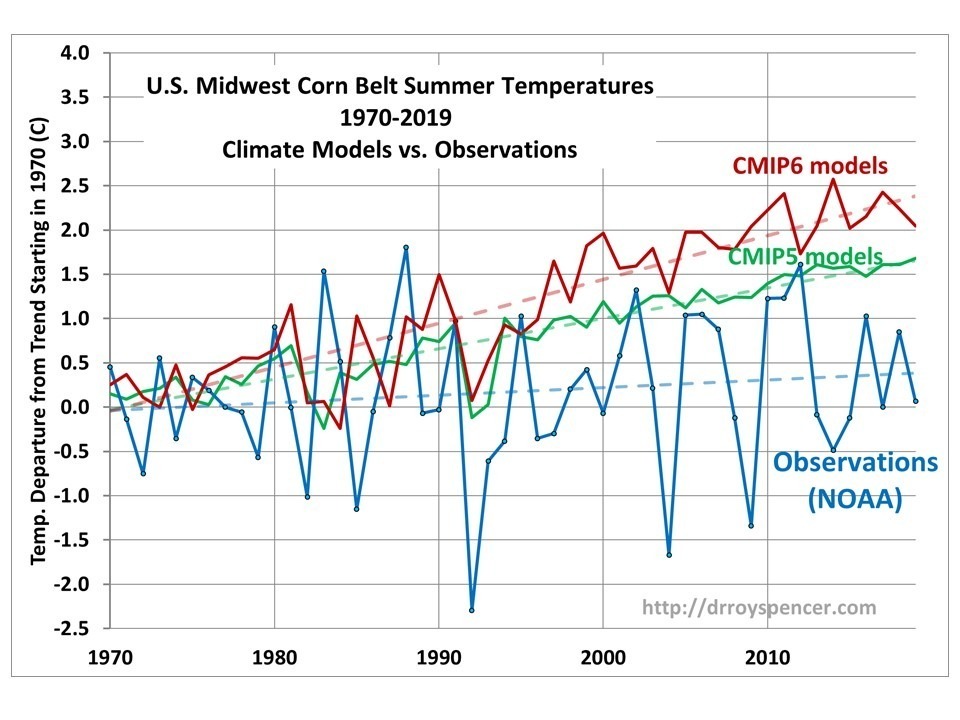
Now that the new CMIP6 climate model experiment data are becoming available, we can begin to get some idea of how those models are shaping up against observations and the previous (CMIP5) model predictions. The following analysis includes the available model out put at the KNMI Climate Explorer website. The temperature observations come from the statewide data at NOAA’s Climate at a Glance website.

For the Midwest U.S. in the summer (June-July-August) we see that there has been almost no statistically significant warming in the last 50 years, whereas the CMIP6 models appear to be producing even more warming than the CMIP5 models did.

Fifty years (1970-2019) of U.S. corn belt summer (JJA) warming since 1970 from observations (blue); the previous CMIP5 climate models (42 model avg., green); and the new CMIP6 climate models (13 model avg., red). The three time series have been vertically aligned so their trend lines coincide in the first year (1970), which is the most meaningful way to quantify the long-term warming since 1970.

The observed 50-year trend is only 0.086 C/decade (barely significant at the 1-sigma level), while the CMIP5 average model trend is 4X as large at 0.343 C/decade, and the CMIP6 trend is 5.7X as large at 0.495 C/decade. While the CMIP6 trend will change somewhat as more models are added, it is consistent with the report that the CMIP6 models are producing more average warming than their CMIP5 predecessors.

I am showing the average of the available models rather than individual models, because it is the average of the models which guides the UN IPCC reports and thus energy policy. It is disingenuous for some to claim that “not all IPCC models disagree with the observations”, as if that is some sort of vindication of all the models. It is not. If there are one or two models that agree the best with observations, why isn’t the IPCC just using those to write its reports? Hmmm?

Full post & comments

The post Hot Summer Epic Fail: New Climate Models Exaggerate U.S. Midwest Warming by 6X appeared first on The Global Warming Policy Forum (GWPF).

via The Global Warming Policy Forum (GWPF)

https://ift.tt/31GjK3j

July 4, 2020 at 10:03AM

Chancey Biden

For those who are unfamiliar with either the book or the 1979 movie starring Peter Sellers, “Being There” is an allegory about a simple-minded man — Chance, the gardener — whose world is defined by what he has seen in the garden and on TV. Through various twists of fate, Chance the gardener becomes Chauncey Gardiner, and is catapulted to the upper echelons of society, business and government.

His advice is sought by the president and other world leaders, who interpret Chauncey’s simple statements about the garden as pithy metaphors about the economy.

For example, asked if the government can stimulate economic growth with temporary incentives, Chauncey replies: “As long as the roots are not severed, all is well. And all will be well in the garden.”

He explains that “growth has its seasons.” And, yes, “there will be growth in the spring.”

Compare those comments with these Bidenisms:

“As my father says, Don’t tell me what you value, show me your budget. I’ll tell you what you value.”

“My wife has an expression: Any country that out educates us will out compete us.”

“If my mother were here, she’d say, ‘Joe, hush up and start taking some questions.’ ”

“Without your word, you’re not a man” (his dad); “As long as a person’s alive, they have the obligation to strive” (his mom); or “The greatest gift God gave to mankind was the ability to forget” (his first wife, who died in a car accident).

‘Joey, don’t compare me to the Almighty, compare me to the alternative.’ ’’

“I shouldn’t have started this because it was too complicated, I know”

My dad would “say, ‘Joe, remember, never argue with your wife about anything that is going to happen more than a year from now.’ ”

Those anecdotes from Chancey Joe are folksy, for sure, but other ones are more disturbing:

“Unless we do something about this, my children are going to grow up in a racial jungle, with tensions so high that it is going to explode.

“If you have a problem figuring out if you’re for me or Trump, then you ain’t black.”

I know nothing about those moves to investigate Michael Flynn,”

“I told Ukraine, if the prosecutor is not fired, you’re not getting the billion dollars.”

If Trump loses and won’t leave, I’m convinced the Military will escort him from the White House with great dispatch.”

“We would make sure Coal and Fracking are eliminated, and no more subsidies for either one of those, period.’”

“I would immediately rejoin the Paris climate accord, which I helped put together.”

When a woman comes forward with claims of sexual violence “at least the essence” of what she is saying should be presumed true.

“I would do everything possible to make it required that people have to wear masks in public.

via Science Matters

https://ift.tt/2ZDgwux

July 4, 2020 at 09:46AM