Month: July 2020

Snow expected the next 7 days at Mt Baker, WA

In July!

Today
Snow. Snow could be heavy at times. High near 30. Chance of precipitation is 90%. Total daytime snow accumulation of 7 to 11 inches possible.

Tonight
Chance of precipitation is 80%. New snow accumulation of 3 to 7 inches possible.

Thursday
Snow.  Chance of precipitation is 80%. New snow accumulation of 1 to 3 inches possible.

Thursday Night
A 50 percent chance of snow. New snow accumulation of 1 to 2 inches possible.

Friday
A 30 percent chance of snow. New snow accumulation of less than a half inch possible.

Friday Night
Partly cloudy, with a low around 26.

Independence Day
A 20 percent chance of snow after 11am. Mostly sunny, with a high near 38.

Saturday Night
Mostly cloudy, with a low around 27.

Sunday
A chance of snow after 11am. Mostly sunny, with a high near 38.

Sunday Night
A slight chance of snow before 11pm. Partly cloudy, with a low around 28.

Monday
A chance of snow. Mostly sunny, with a high near 39.

Monday Night
A chance of snow. Partly cloudy, with a low around 29.

Tuesday
A chance of snow. Mostly sunny, with a high near 38.

https://forecast.weather.gov/MapClick.php?lat=48.77429274267508&lon=-121.81640625&site=sew&unit=0&lg=en&FcstType=text#.Xvyaj1VKiUk

Thanks to Kenneth Lund for this link

The post Snow expected the next 7 days at Mt Baker, WA appeared first on Ice Age Now.

via Ice Age Now

https://ift.tt/3gf6C9c

July 2, 2020 at 12:59PM

“Keeping some lockdown changes”: Climate Activists Celebrate Covid-19 CO2 Emissions Drop

Green LockdownGreen Lockdown
Green Lockdown (image modified). Officer Bimblebury / CC BY-SA

Guest essay by Eric Worrall

More evidence some climate activists celebrated the lockdown loss of freedom as a step in the right direction.

Climate explained: will the COVID-19 lockdown slow the effects of climate change?

July 1, 2020 5.11am AEST
Simon Kingham
Professor, University of Canterbury

The COVID-19 lockdown has affected the environment in a number of ways. 

The first is a reduction in air travel and associated emissions. Globally, air travel accounts for around 12% of the transport sector’s greenhouse gas emissions and this was predicted to rise. An ongoing reduction in air travel would lead to lower greenhouse gas emissions.

Keeping some lockdown changes

In many parts of the world, governments are implementing plans to lock in some of the reductions in traffic caused by the pandemic. 

This includes allocating road space to walking and cycling and incentives for people to buy or maintain bikes (such as in Franceand the UK). 

There are also initiatives to decarbonise the car fleet by replacing fossil fuelled vehicles with electric ones. In New Zealand, electric vehicles are exempt from road user charges and the government is investigating ways to increase the uptake of alternative fuels in the road freight industry.

These measures are important and reduce greenhouse gas emissions, but they are not designed to reduce the number of people travelling, or the mode they use. Congestion is an ongoing issue in Auckland and is now estimated to cost more than NZ$1 billion per year.

Encouraging some of the lockdown behavioural changes could have additional benefits and reduce greenhouse gas emissions at the same time.

Read more: https://theconversation.com/climate-explained-will-the-covid-19-lockdown-slow-the-effects-of-climate-change-141604

Professor Kingham claims people will still have the same freedom to travel.

But not everyone can get about by bicycle, and electric vehicles will remain too expensive for many people for the foreseeable future, especially if renewable energy is used to process the raw material for all those batteries.

Like this:

Like Loading…

Related

via Watts Up With That?

https://ift.tt/38mVpRb

July 2, 2020 at 12:47PM

New Study: ‘The Most Suitable Place In The World For Temperature Reconstruction’ Shows Net Cooling Since The 1930s

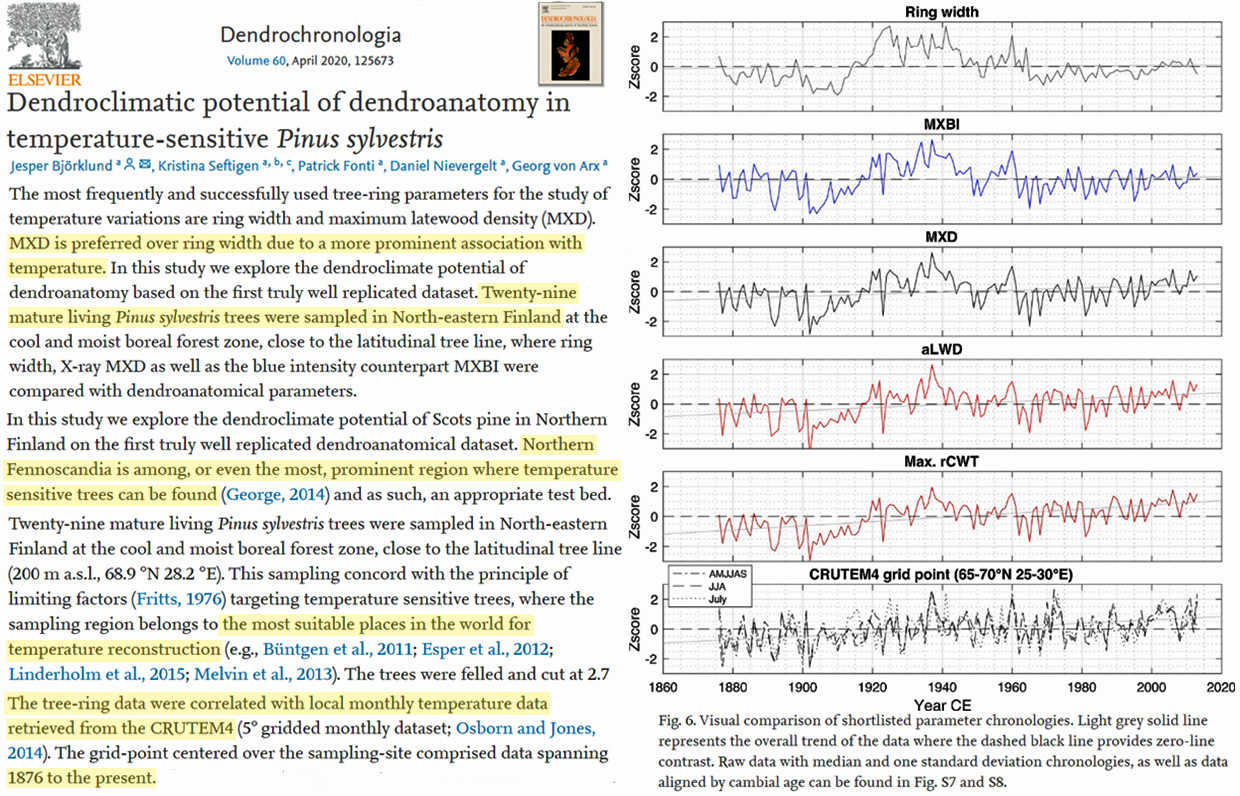
A new 1876-present temperature reconstruction for Northern Finland shows the 1930s were the warmest period of the last 140 years. And there has been no net warming since.

Tree density analysis, MXD, has a “more prominent association with temperature” than measuring tree ring widths because it can more clearly separate precipitation factors affecting tree growth from temperature-limiting factors (Bjorklund et al., 2020).

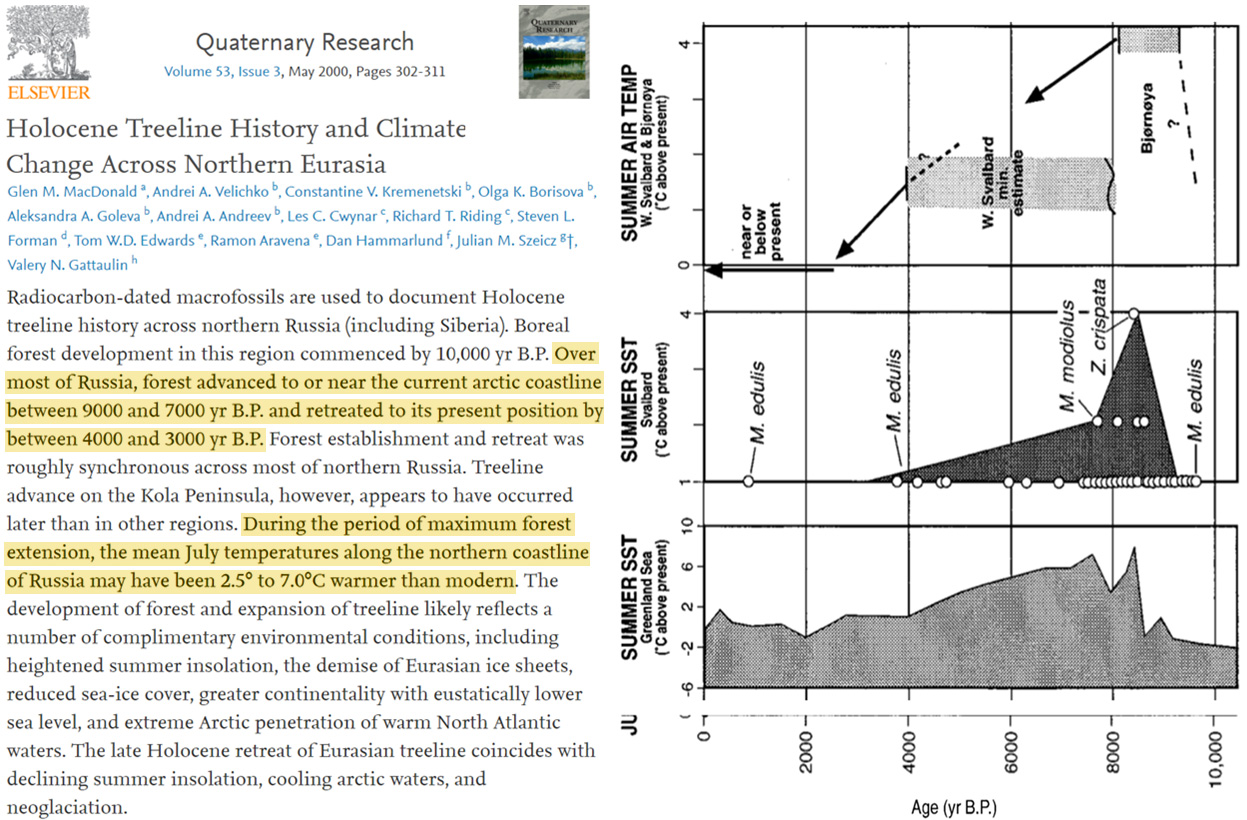
Northern Finland is characterized as “the most suitable place in the world for temperature reconstruction” because it sits on the edge of where trees can or cannot grow (or survive) due to clearly defined temperature limits on growth. (For example, forests used to extend to the coast of the Arctic Ocean during the Early Holocene, indicating the Arctic region needed to have been 2.5 to 7°C warmer to accommodate such tree growth.)

Pinus sylvestris (29 trees) from northeastern Finland indicate the warmest interval since 1876 occurred in the 1930s, and since then there has been no net warming. This is visible in both tree ring width (RW) and density (MXD) analysis.

Image Source: Bjorklund et al., 2020

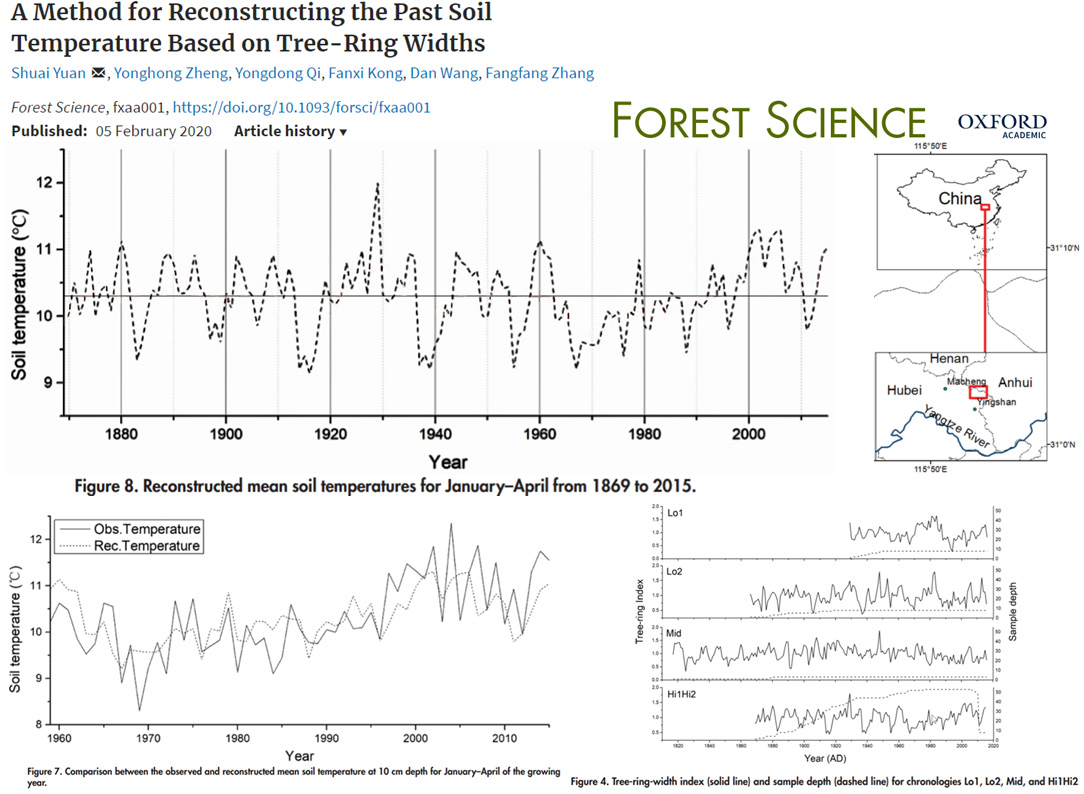
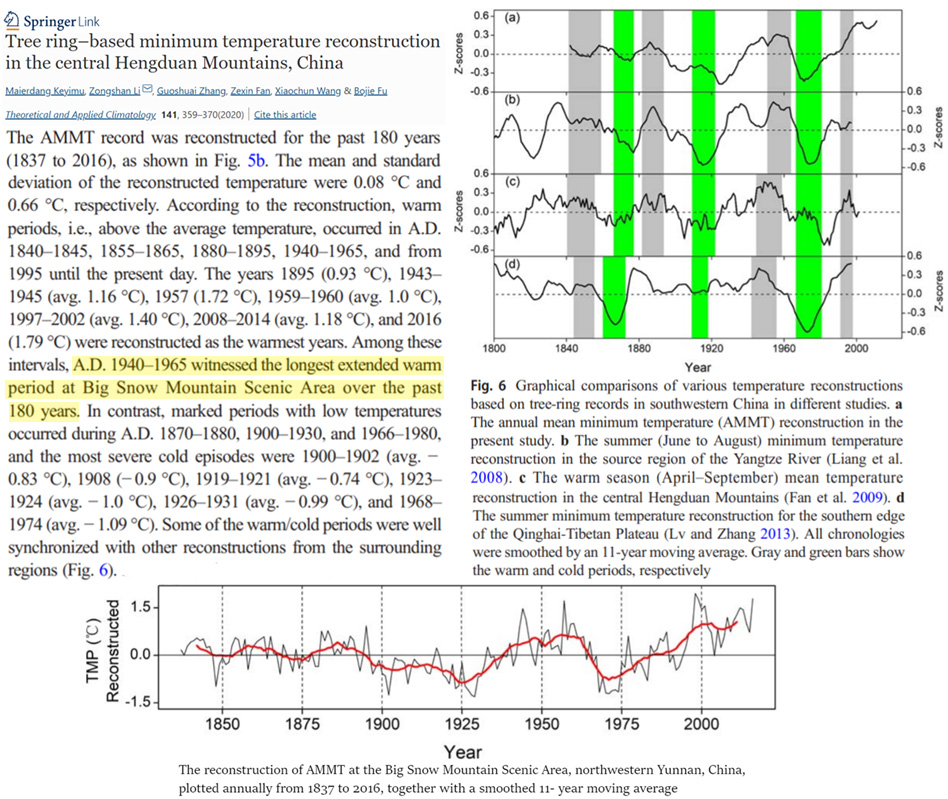
Other new “dendroclimatic” studies also show a similar temperature pattern of a warm early/mid-twentieth century and a subsequent cooling in the 1960s and 1970s prior to another warming in the 1990s-2000s. For example, in China, tree ring evidence suggest such a pattern for soil temperatures (Yuan et al., 2020), and Keyimu et al. (2020) find “A.D. 1940–1965 witnessed the longest extended warm period at Big Snow Mountain Scenic Area over the past 180 years”.

Image Source: Yuan et al., 2020

Image Source: Keyimu et al. (2020)

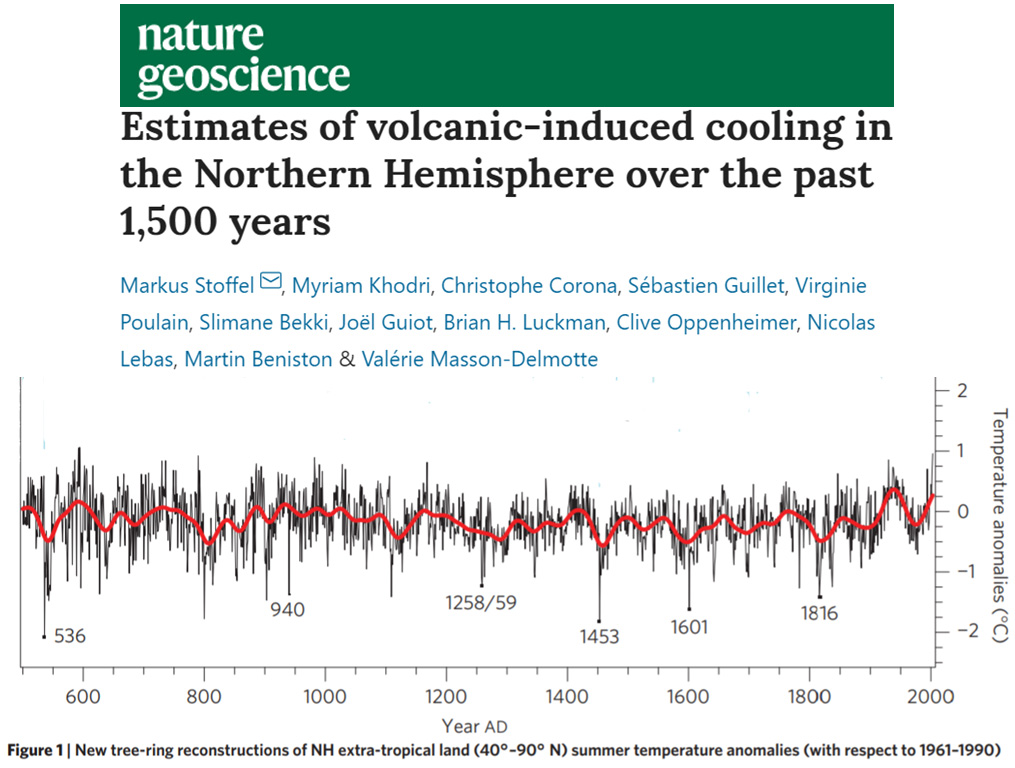
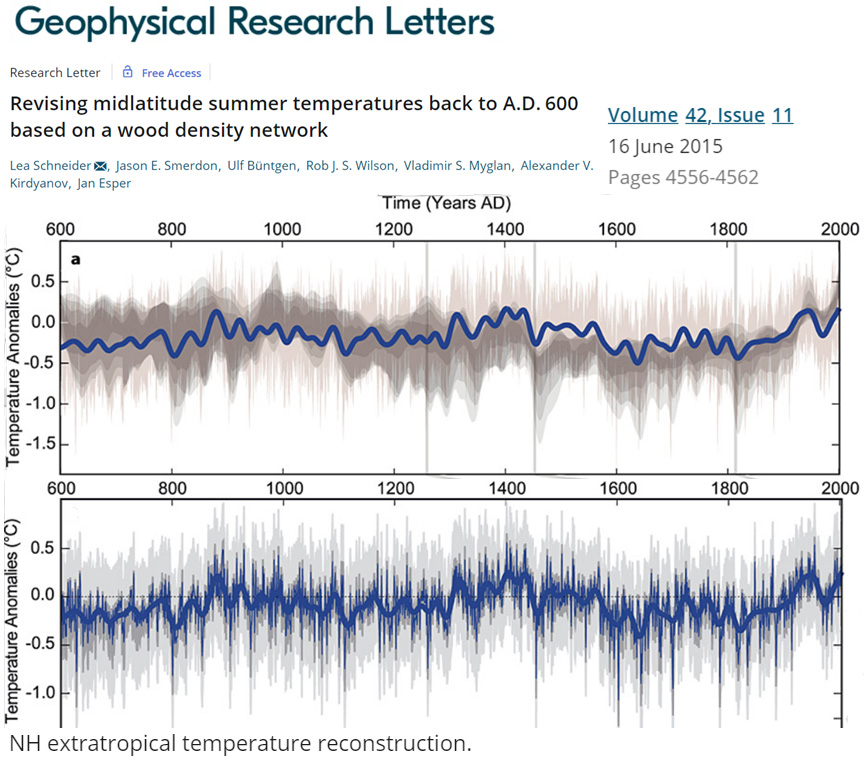
Proxy evidence from across the Northern Hemisphere may also show this same warming-cooling-warming temperature pattern. They also show the modern period is not climatically unusual relative to past ~1,500 years (Stoffel et al., 2015, Schneider et al., 2015).

Image Source: Stoffel et al., 2015

Image Source: Schneider et al., 2015

via NoTricksZone

https://ift.tt/2NP8zNt

July 2, 2020 at 12:08PM

Down With Eco-Censorship

Forbes has censored Michael Shellenberger’s sensible critique of eco-alarmism.

Michael Shellenberger, a lifelong climate activist and Time magazine ‘Hero of the Environment’, this week issued an ‘apology’ for 30 years of climate alarmism. 

‘On behalf of environmentalists everywhere, I would like to formally apologise for the climate scare we created over the last 30 years’, he wrote. ‘Climate change is happening. It’s just not the end of the world. It’s not even our most serious environmental problem.’

Shellenberger’s apology was initially published in Forbes, where he is a regular contributor on energy and environmental matters. But on the same day, Forbes censored the article without explanation.

The article summarised the claims made in Shellenberger’s upcoming book, Apocalypse Never: Why Environmental Alarmism Hurts Us All. These include the well-evidenced facts that ‘humans are not causing a “sixth mass extinction”’ and that ‘climate change is not making natural disasters worse’. (You can read his censored piece at Environmental Progress.)

Full Post

The post Down With Eco-Censorship appeared first on The Global Warming Policy Forum (GWPF).

via The Global Warming Policy Forum (GWPF)

https://ift.tt/2ZysoxR

July 2, 2020 at 10:35AM