Month: July 2020

Six good years in a row for the polar bear subpopulation used to predict species demise

In something resembling a new pattern for Western Hudson Bay polar bears, most of the animals are still out on the ice in late July this year, just like they were in the 1980s. The same thing happened last year but was brushed off as a happy anomaly. However, after last fall’s 1980s-like early freeze-up, this makes the sixth year in a row of good to very good sea ice conditions for Western Hudson Bay polar bears. No wonder polar bear experts haven’t published these data: good sea ice conditions along with polar bears coming ashore fat and healthy are not just inconvenient – they threaten to destroy the extinction panic narrative that depends on Western Hudson Bay bears showing evidence of harm from reduced sea ice.

WH 18 Sat July 2020 noon PT Cape East fat mother and cub_Wakusp NP explore dot org livecam
Fat mother and cub onshore at Wakusp National Park, Western Hudson Bay 18 July 2020, one of the first of the season.

Perhaps the first bear off the Western Hudson Bay ice came ashore just south of Churchill in Wakusp National Park (at ‘Cape East’), 13 July 2020, courtesy Explore.org livecam and was in very good condition.

The first of polar bear researcher Andrew Derocher’s collared bears was reported off the ice on 17 July. A week later (24 July), he reported that only three of his 14 collared WH females had come ashore (see map below).

Derocher WHB bears at 24 July 2020 from his tweet 25 July_3 bears onshore

There was actually far more ice over Hudson Bay on 24 July than the map Derocher presents above because he uses ice charts that display only ice >50% concentration. The Canadian Ice Service extent of ice cover (below) shows ice >15% concentration and explains the tagged bears that appear on Derocher’s map to be in open water:

Sea ice Canada 2020 July 24

Stage of development charts for the NW sector below show that the remaining ice is thick first year ice > 1.2m thick (dark green):

Hudson Bay North daily stage of development 2020 July 24

The pattern of ice retreat over Hudson Bay this year is remarkably similar to the average for 1971-2000 (see below) calculated by Ian Stirling and colleagues in support of their claim that earlier breakup of sea ice caused by global warming threatens the future survival of Western Hudson Bay polar bears (Stirling et al. 2004):

Stirling et al 2004 HB ice and boundaries

Below is the mid-July weekly sea ice thickness chart for 2020 showing the overall pattern of ice comparable to the medium grey area in the above figure (note the CIS chart below is rotated clockwise relative to the figure above), where the dark green is thick first year ice >1.2m:

Hudson Bay weekly stage of development 2020 July 13

Not since 2009 has there been quite so much thick ice so close to shore at mid-July (below). Polar bears were not off the ice until August in 2009 and were reportedly in good condition and abundant in the area around Churchill.

Hudson Bay weekly stage of development 2009_July 13

Except perhaps for 2019, which had almost as much:

Hudson Bay weekly stage of development 2019 July 15

In 2018, there was still quite a bit of ice but it was more centrally located:

Hudson Bay weekly stage of development 2018 July 16

A search of the CIS archives shows there was enough for some bears to stay on the ice into July from at least 2015.  In 2019, Derocher’s collared bears were as late coming off the ice as they have been this year, with many still on the ice as of 27 July (see below).

Derocher 2019 WHB 12 pbs ashore 12 still on ice with some unaccounted for at 27 July chart

In other words, this is not the first 1980s-like breakup year for Western Hudson Bay polar bears in recent years (Crockford 2020), as Derocher claimed in his tweet on Saturday (25 July: “Climate change remains the long term threat: 1 normal year doesn’t alter the trends“):

In fact, he admitted last year (in August 2019) that the Hudson Bay ice had been “similar to the 80s” and that Western Hudson Bay polar bears had had a “good year” – but then insisted it was the first such good year in decades and thus didn’t count for much.

Derocher 2019 Hudson Bay melt season good for pbs_but need 4 good years_29 Aug

However, up to the summer of 2019, ice conditions for Western Hudson Bay bears had already been relatively good for the last five years and this year makes it six, since freeze-up in the fall of 2019 was earlier than the 1980’s average for the third year in a row.

How many recent years of sea ice data that does not support the ‘long term trend’ for Western Hudson Bay will change the mind of polar bear biologists? Already, the breakup and freeze-up data has not supported the assumed ever-declining trend if you looked at what’s happened since the late 1990s: the trend was found to be flat between 2001 and 2010 (Lunn et al. 2016) and from 1995-2015 (Castro de la Guardia et al. 2017). Add the unpublished data since 2015 and the slight declining trend since 1979 for the ice-free period (see below) used to support climate change extinction predictions (e.g. Stern and Laidre 2016; Regehr et. al. 2016) and the trend is likely to disappear altogether.

Regehr et al. 2016 Figure 2 WH

No wonder polar bear researchers have not published the breakup/freeze-up data and associated dates onshore/offshore for polar bears for Western Hudson Bay since 2015. They know it would utterly destroy the public narrative of a catastrophic future for polar bears that’s been pushed for almost two decades despite strong evidence to the contrary, as my most recent book describes.

Book graphics for promotion updated March 2020

References

Castro de la Guardia, L., Myers, P.G., Derocher, A.E., Lunn, N.J., Terwisscha van Scheltinga, A.D. 2017. Sea ice cycle in western Hudson Bay, Canada, from a polar bear perspective. Marine Ecology Progress Series 564: 225–233. http://www.int-res.com/abstracts/meps/v564/p225-233/

Crockford, S.J. 2020. State of the Polar Bear Report 2019. Global Warming Policy Foundation Report 39, London. pdf here.

Lunn, N.J., Servanty, S., Regehr, E.V., Converse, S.J., Richardson, E. and Stirling, I. 2016. Demography of an apex predator at the edge of its range – impacts of changing sea ice on polar bears in Hudson Bay. Ecological Applications 26(5):1302-1320. DOI: 10.1890/15-1256

Regehr, E.V., Laidre, K.L, Akçakaya, H.R., Amstrup, S.C., Atwood, T.C., Lunn, N.J., Obbard, M., Stern, H., Thiemann, G.W., & Wiig, Ø. 2016. Conservation status of polar bears (Ursus maritimus) in relation to projected sea-ice declines. Biology Letters 12: 20160556. http://rsbl.royalsocietypublishing.org/content/12/12/20160556 Supplementary data here.

Stern, H.L. and Laidre, K.L. 2016. Sea-ice indicators of polar bear habitat. Cryosphere 10: 2027-2041.

Stirling, I., Lunn, N.J., Iacozza, J., Elliott, C. and Obbard, M. 2004. Polar bear distribution and abundance on the southwestern Hudson Bay coast during open water season, in relation to population trends and annual ice patterns. Arctic 57: 15–26.

via polarbearscience

https://ift.tt/2D5jksV

July 27, 2020 at 10:29AM

Florida Covid Facts Missing in the Media

Issues and Insights editorial board exposes the media disinformation in an article Florida Is A Case Study In Media-Induced COVID-19 Panic.  Excerpts in italics with my bolds.

What do all these news accounts have in common?

“Florida Sets Yet Another Coronavirus Record: 173 Deaths In A Day.”

“A record 173 Floridians died from the virus Thursday, an average of more than one every eight minutes.”

“The 134 new confirmed deaths is the second-largest increase on record, coming five days after the largest one-day jump of 156 last week.”

“COVID-19 has ravaged Florida, with more than 237,000 people testing positive and 2,013 dying from the virus in July alone.”

So what characteristic do all of the reports share? They are all false.

It is not true that 173 people died from COVID-19 “in a day” in Florida. Nor did 134, or 156 on previous days.

It is also untrue than 2,013 had died in July when that story was published.

All of these scary headlines are based on the number of deaths reported by the state on any given day. This is not the same as the number of deaths that occurred on those days.

The difference might seem trivial. But it’s crucial because the press is using the timing of Florida’s death reports to whip up a frenzy about COVID-19 running riot in the state.

Take a look at the chart below. The blue bars are the number of deaths reported in four days last week. Notice the sharp uphill climb? That’s the story the press has been telling.

But those deaths didn’t occur on those days. In fact, the vast majority of them occurred days, or even weeks, before. The actual date of these deaths is indicated by the orange bars.

In fact, as of Sunday, the biggest one-day death toll so far in the state happened back on July 16, when 114 are known to have died. And when the press was claiming that 2,013 had died in July, the actual number of known deaths was 1,847.

As we noted in this space last week, this distortion is being repeated by the media in state after state that has seen a recent spike in coronavirus cases. While deaths attributed to coronavirus have increased, the “surge” is a fiction because many of those deaths happened earlier.

This is only one of the problems with the death counts being shouted from the media rooftops.

Here again, Florida serves as a model of how to sow fear.

First there’s the missing context.

Another way to look at it is that the death rate in Florida at the moment is 273 per million residents. In New York, it’s 1,680 and in New Jersey it’s 1,785.

In other words, the current situation in Florida is nothing at all like what happened in the northeast in the spring. Yet that critical information never gets conveyed by the press.

Another bit of missing context is where these deaths are occurring.

Of the more than 5,000 coronavirus deaths in Florida, 45% of them involved residents and staff at long-term care facilities.

That’s not to say these deaths are less important. But it does provide a needed backdrop for everyone else in the state. Their risk is tiny by comparison.

This finding also shows that what’s needed most is to protect at-risk populations, something that the generalized lockdowns failed to do. Pretending that coronavirus “doesn’t discriminate” is a dangerous fiction.

Then there’s the fact that Florida’s death count is almost certainly inflated because the state is counting people who died with the virus, not just those who died because of it.

A report by CBS-12 in West Palm Beach, for example, found that the state has counted as coronavirus deaths:

    • A 60-year-old man who died from a gunshot wound to the head.
    • A 90-year-old man who fell and died from complications of a hip fracture.
    • A 77-year-old woman who died of Parkinson’s disease.

Out of 581 deaths attributed to coronavirus in that county, “The I-Team found eight cases in which a person was counted as a COVID death, but did not have COVID listed as a contributing cause of death.”

What’s more, only 169 deaths were listed as due to coronavirus without any other contributing factors.

(As a side note, why is a local TV news team digging into the numbers, while the national media are content to repeat whatever the government tells them?)

As we’ve said before, this sort of overcounting is going on nationwide, largely because the CDC has told states to report deaths this way.

The question that deserves to be answered is why the mainstream press seems so willing and eager to whip up fear, rather than provide all the relevant facts, in context, so the public can make its own informed decisions about how to respond to this disease.


via Science Matters

https://ift.tt/30Q4VZU

July 27, 2020 at 09:37AM

Mediterranean Sea was 2 degrees hotter during Roman Empire

From the Archaeology News Network

The greatest time of the Roman Empire coincided with the warmest period of the last 2,000 years in the Mediterranean, according to a study published in the journal Scientific Reports. The climate conditions derived progressively towards arid conditions and later colder ones coinciding with the historical fall of the empire, as stated in the new study, whose principal researchers are Isabel Cacho, Giulia Margaritelli and Albert Català, from the Faculty of Earth Sciences and the Consolidated Research Group on Marine Geosciences of the University of Barcelona. The study also counts on the participation of the experts from the Research Institute for Geo-hydrological Protection of the National Research Council (CNR-IRPI), the National Institute of Marine Sciences (CNR-ISMAR), the University of Campania Luigi Vanvitelli and the University of Perugia in Italy.

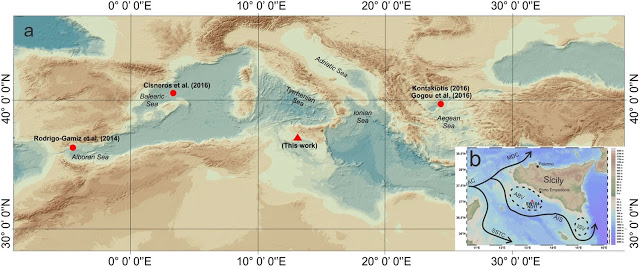
(a) Bathymetric map of the central-western Mediterranean Sea. Red triangle: location of SW104 ND11 core; red circles: marine records used for the comparison; (b) Bathymetric map of the Sicily Channel showing surface oceanographic circulation and core location. Black lines follow the path of surface water circulation. Major currents are illustrated [Credit: Margaritelli et al. 2020]

Previous studies had related the fall of the Roman Empire to some natural factors (climate change, volcanic eruptions, etc.). With a large-scale regional view, the study provides high resolution and precision data on how the temperatures evolved over the last 2,000 years in the Mediterranean area. “For the first time, we can state the roman period was the warmest period of time of the last 2,000 years, and these conditions lasted for 500 years”, notes Isabel Cacho, professor at the Department of Earth and Ocean Dynamics of the UB.

The Mediterranean Sea is a semi-closed sea –extremely vulnerable to modern and past climate changes – with a strategic location. Home to many civilizations over the years –with a tradition for historical and archaeological studies – Mare Nostrum is a model to study the periods of climate variation and climate potential influence in civilizations.


In particular, the Roman Empire period is hard to study, “since it coincided with important cultural changes that took place around the Mediterranean. The study of the climate of the past is now the only tool to analyze the dynamics of the climate System of the Earth in different conditions from the current ones, and it is essential to test the validity of the mid and long term prediction models”, note the experts Giulia Margaritelli (also member of the CNR-IRPI) and Fabrizio Lirer (CNR-ISMAR).

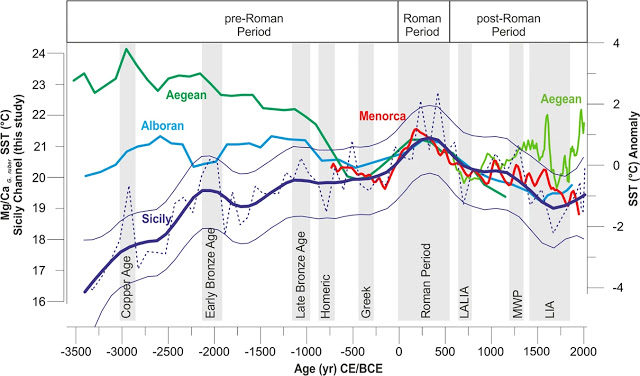
The study identifies for the first time a warming phase which is different during the Roman period in the Mediterranean area and is focused on the reconstruction of the sea surface temperature (SST) over the last 5,000 years.  These new records were correlated to data from other areas of the Mediterranean (Alboran Sea, Menorca basin and Aegean Sea) to show a regional signal of the basin to identify the Roman period (1-500 AD) as the warmest period of the last 2,000 years, 2ºC warmer than the average values at the end of the century. The experts also comment on the impact of the rainfall regime during this period –marked by a great regional variation of the most wet and arid phases- in the evolution of the Roman Empire.

Comparison of the Sea Surface Temperature (SST) records from Sicily Channel (thick dark blue line), Alboran Sea (thick light blue line), Minorca Basin (thick red line) and Aegean Sea (thick dark and light green lines) expressed as SST anomalies in relation with the reference period from 750 BCE to 1250 CE (the only period shared by all the records) in order to better compare the amplitude of the changes across the Mediterranean Credit: Margaritelli et al. 2020]

According to the authors, this phase coincides with the development of the expansion of the Roman Empire, which suggests a potential relation between favouring climate conditions and the change into the great empire founded by Octavius Augustus in 27 BC. According to the hypotheses of the authors, a climate transition from wet to arid conditions could have market its following decline.

Read the full article here.

HT/John T

Like this:

Like Loading…

Related

via Watts Up With That?

https://ift.tt/3g53qxn

July 27, 2020 at 08:24AM

What Has Justin Been Smoking?

By Paul Homewood


h/t Mr GrimNasty


Justin Rowlatt has now completely lost the plot!


 image

If you have ever doubted whether solar power can be a transformative technology, read on.

This is a story about how it has proved its worth in the toughest environment possible.

The market I’m talking about is perhaps the purest example of capitalism on the planet.

There are no subsidies here. Nobody is thinking about climate change – or any other ethical consideration, for that matter.

This is about small-scale entrepreneurs trying to make a profit.

It is the story of how Afghan opium growers have switched to solar power, and significantly increased the world supply of heroin.

Richard Brittan is hunched over his computer in a nondescript office on an industrial estate just outside Guildford, in the south of England.

He is reviewing the latest cache of satellite images from Afghanistan.

Mr Brittan is a former British soldier whose company, Alcis, specialises in satellite analysis of what he calls "complex environments".

That’s a euphemism for dangerous places. Among other things, Mr Brittan is an expert on the drugs industry in Afghanistan.

He zooms in on an area way out in the deserts of Helmand.

A few years ago there was nothing here. Now there is a farm surrounded by fields.

Zoom in a bit more and you can clearly see an array of solar panels and a large reservoir.

Over to the right a bit there is another farm. The pattern is the same: solar panels and a reservoir.

We scroll along the image and it is repeated again and again and again across the entire region.

"It’s just how opium poppy is farmed now," Mr Brittan tells me. "They drill down 100m (325ft) or so to the ground water, put in an electric pump and wire it up to a few panels and bingo, the water starts flowing."

Take-up of this new technology was very rapid.

The first report of an Afghan farmer using solar power came back in 2013.

The following year traders were stocking a few solar panels in Lashkar Gah, the Helmandi capital.

Since then growth has been exponential. The number of solar panels installed on farms has doubled every year.

By 2019 Mr Brittan’s team had counted 67,000 solar arrays just in the Helmand valley.

It is easy to understand why trade has been so brisk.

Solar has transformed the productivity of farms in the region.

I’ve got a video shot a couple of weeks ago on an opium farm in what used to be desert.

The farmer shows us his two arrays of 18 solar panels. They power the two electric pumps he uses to fill a large reservoir.

He films the small canal that allows him to use the water to irrigate his land. All around, his fields seem to be flourishing.

He harvested his opium crop in May; now he is growing tomatoes.

https://www.bbc.co.uk/news/science-environment-53450688


I have no doubt that the huge profits available from the opium trade quickly pay back the thousands of dollars spent on solar panels. And out in the desert, there is very little alternative. Electricity supply is probably non existent in many areas, and shipping diesel is a long and costly process.

I doubt though whether it would have been cost effective for just for his tomatoes.

And because the solar power is only used for irrigation, it does not need to be available 24/7, or on demand.

Solar power may have a niche use in Afghanistan, but that does not mean it will be of any use elsewhere.


FOOTNOTE

Rowlatt goes on to describe how he has seen evidence of climate change everywhere:

image


I await his evidence for such a preposterous statement.

via NOT A LOT OF PEOPLE KNOW THAT

https://ift.tt/3g53q0l

July 27, 2020 at 08:06AM