Month: July 2020

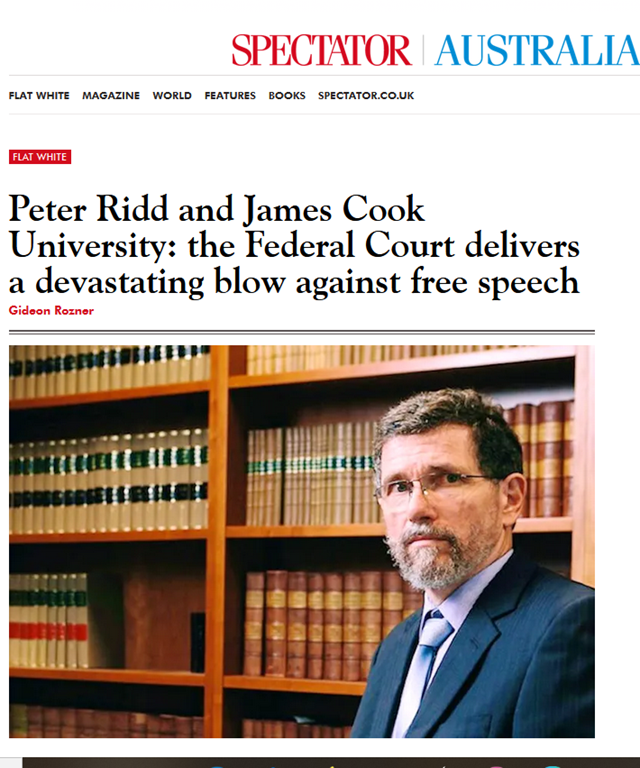
Peter Ridd and James Cook University: the Federal Court delivers a devastating blow against free speech

By Paul Homewood

image

The Federal Court has devastating blow against mainstream Australians, against freedom of speech and against freedom of speech on climate change by overturning the earlier decision in the Federal Circuit Court which held that Dr Peter Ridd was unlawfully dismissed by James Cook University.

Alarmingly, this decision shows that contractual provisions guaranteeing intellectual freedom do not protect academics against censorship by university administrators. The time has come for the Morrison Government to intervene.

This has been Australia’s David vs Goliath battle, with Peter Ridd on one side, backed by thousands of ordinary Australians, and JCU on the other side who secured some of the most expensive legal representation in the country in Bret Walker SC to stifle the free speech of one of its own staff.

Dr Ridd, a professor of physics at JCU, was sacked by the university for misconduct for questioning in the IPA’s publication Climate Change: The Facts 2017 the climate change science around the Great Barrier Reef and for public statements made on the Jones & Co Sky News program.

He is now apparently considering his legal options in relation to a challenge in the High Court of Australia. If he does decide to take up that fight, the Institute of Public Affairs – as well as thousands on mainstream Australians – will continue to support his fight for freedom of speech on climate change.

JCU has engaged some of the most expensive legal representation in the country to stifle the free speech of one of its own staff, despite crying poor about university funding in the wake of coronavirus. It creates a massive chilling effect for any academic engaging in public debate in Australia.

The University’s shameful actions prove without doubt there is a crisis of free speech at Australian universities. Many academics are censured, but few are prepared to speak out and risk their career, particularly if faced with the prospect of legal battles and possible bankruptcy.

The case has identified a culture of censorship when it comes to challenging claims surrounding climate change and the Great Barrier Reef. JCU to this date has never attempted to disprove claims made by Dr Ridd about the Great Barrier Reef.

https://www.spectator.com.au/2020/07/peter-ridd-the-federal-court-delivers-a-devastating-blow-against-free-speech/


That last sentence says it all.


UPDATE


Peter Ridd has issued this statement:


Dear All,
Very bad news. JCU succeeded on appeal. We need to read the details but for the moment I would like to say the following.
Universities are different from other workplaces because it is expected that, on occasions, there will be vigorous debates on important and controversial issues. It is essential that academics can engage in these debates without fearing that a wrong word could end their career.
Among my crimes was saying that universities in general were “Orwellian” because they only pretended to value free speech. I also said, based upon years of evidence, that another institution’s work was untrustworthy because of systemic deficiencies in their quality assurance processes. I “satirised” the university’s disciplinary processes against me by implying it was “amusing”.
If universities can crush any robust debate by deciding there is a lack of respect or collegiality, where does this leave an academic who might want to say something of which the administration might disapprove? Better to remain silent.
This case is not an isolated incidence of a university acting to stifle debate. Universities claim that Academic Freedom is “in their DNA” but their actions indicate otherwise. And yet both State and Commonwealth governments continue to fund the universities and fail to insist on traditional standards of decency, academic freedom, and freedom of speech. This is a failure of government as much as a failure of a university.
While JCU had its knee on the neck of free speech – our governments looked on and did nothing.
Fundamental concepts such as academic freedom of speech should not be decided by a few words in a work contract of a malignant university. Higher protection is necessary.
This has always been a battle between the little people and the establishment. I was fired for calling for better quality assurance of science of the GBR and climate change. This science has been used to make government regulations causing major economic damage to Farmers and many other workers of the industries in North Queensland.
I was supported by donations from thousands of people. I thank them all. Also, thanks to my legal team.
I am very sorry that your donation has so far not resulted in a better outcome.
I respect the decision of the Court. I will be seeking legal advice as to my next steps.

https://www.gofundme.com/f/peter-ridd-legal-action-fund

via NOT A LOT OF PEOPLE KNOW THAT

https://ift.tt/2CGGk1p

July 23, 2020 at 05:18AM

RE Reckoning: Solar Powered Households Forced to Pay For The Grid Chaos They Cause

Australia’s obscenely generous subsidies and Feed-in-Tariffs for domestic solar resulted in millions of households blanketed in panels. The consequences for the power grid have been diabolical; its management is now a daily nightmare. Western Australia’s fixation with heavily subsidised solar power is threatening to destroy its once wholly reliable electricity grid, thanks to its sporadic and […]

via STOP THESE THINGS

https://ift.tt/3hx6y5x

July 23, 2020 at 02:31AM

Climate Hysteria Has Killed Academic Freedom

Peter Ridd loses, we all lose

On 2 May 2018, Professor Peter Ridd was sacked by James Cook University for serious misconduct. It all started when he called-out his colleague Terry Hughes for falsely claiming healthy inshore coral reefs were dead from climate change and deteriorating water quality.

Ignoring the first censure in April 2016, Professor Ridd went on television in August 2017 and explained in an interview with Alan Jones and Peta Credlin why so much said and written about the Great Barrier Reef, including by scientists at the Australian Institution of Marine Science, is ‘untrustworthy’.

The interview was to promote a book that I edited, Climate Change: The Facts 2017. The book, published by the Institute of Public Affairs, begins with a chapter about the Great Barrier Reef in which the orthodoxy on Great Barrier Reef science is challenged, in particular reporting on coral calcification rates. In that interview – that contributed directly to Peter Ridd’s sacking – the main argument was, and continues to be, for better quality assurance of coral reef science.

It is a fact that the Australian Institute of Marine Science refuses to release 15 years of coral growth data – because it contradicts the claims of high-profile activists that coral growth rates are in decline. They are not. But the false claims are central to their fundraising strategy. Never mind the truth.

The first finding handed down by Judge Salvatore Vasta back in April last year case concerned the photographs taken in 1994 that Terry Hughes used to falsely claim Acropora corals that were alive in 1890 are now all dead. Peter Ridd had photographs taken in 2015 showing live Acropora and the need for quality assurance of Hughes’ claims.

Judge Vasta found in favour of Peter Ridd and ordered that the 17 findings made by the University, the two speech directions, the five confidentiality directions, the no satire direction, the censure and the final censure given by the University and the termination of employment of Professor Ridd by the University were all unlawful.

It was very significant that Peter Ridd won on the issue of academic freedom: that he did have a right to ignore the university administrators and continuing to speak out about the lack of quality assurance and explain how and why important scientific institutions had become so untrustworthy.

The University never accepted that decision by the Federal Circuit Court, and they have never conceded that Terry Hughes was wrong to suggest all the corals were dead, when a documentary has since been made showing them to be alive. Further, they have never supported any calls for the coral growth data to be made public.

Instead, the University appealed, and today the University won in the Federal Court. In the judgement, Peter Ridd’s academic freedom is portrayed as his ‘personal opinion’.

It is not Peter Ridd’s personal opinion that the corals are alive, and the Great Barrier Reef resilient to climate change. It is fact. I’ve seen the coral reefs whose health is contested with my own eyes: they are very much alive.

What is dead is academic freedom in Australia.

Universities should be understood by the judiciary as different from other workplaces because it is expected by the ordinary Australian that, on occasions, there will be vigorous debates on important and controversial issues. It is essential that academics can engage in these debates without fearing that the use of plain and colloquial English could end their careers.

Yet today, the university’s appeal was upheld on the basis Peter Ridd was un-collegial in stating plainly that his own university and the Australian Institute of Marine Science are ‘untrustworthy’ because of systemic deficiencies in their quality assurance processes. Further, it was mentioned that Peter Ridd did ‘satirise’ the university’s disciplinary processes in a personal email.

Today’s decision means that James Cook University, and other Australian universities, will continue to crush dissent and sack academics who campaign for the truth.

Full post

The post Climate Hysteria Has Killed Academic Freedom appeared first on The Global Warming Policy Forum (GWPF).

via The Global Warming Policy Forum (GWPF)

https://ift.tt/2WP14en

July 23, 2020 at 01:42AM

W. S. Jevons on Energy Efficiency (Memo to Biden, Part IV)

It is wholly a confusion of ideas to suppose that the economical use of fuel is equivalent to a diminished consumption. The very contrary is the truth. As a rule, new modes of economy will lead to an increase of consumption, according to a principle recognized in many parallel instances. (Jevons, below)

The long-ago insights of William Stanley Jevons profoundly inform the current debate over energy efficiency and energy-conservation policy, not just to the debate over the role of renewable energy in modern society.

Jevons’s The Coal Question (London: Macmillan and Co., 1865) made the case that renewables (windpower; waterpower, biomass, and geothermal) could not substitute for coal. (Jevons underestimated the possibilities of crude oil and natural gas as substitutes for coal, but that is another story.)

The utility of coal raised concerns over its future availability, particularly in the United Kingdom, where domestic coal satisfied all needs and was a major export.

Could efficiency come to the rescue, Jevons asked, doing on the demand side what renewables could not do on the supply side?

His answer was no. His insight was that improving efficiency in coal’s use would not significantly reduce demand but, in fact, could increase it by enlarging the range of its economical use.

Here is Jevons’s statement of what today is known as Jevons Paradox (p. 103):

It is wholly a confusion of ideas to suppose that the economical use of fuel is equivalent to a diminished consumption. The very contrary is the truth. As a rule, new modes of economy will lead to an increase of consumption, according to a principle recognized in many parallel instances.

And (p. 105):

Civilization … is the economy of power, and our power is coal. It is the very economy of the use of coal that makes our industry what it is, and the more we render it efficient and economical, the more will our industry thrive, and our works of civilization grow.

He gave specific examples to support his conclusion:

In less than one hundred years … the efficiency of the engine has been increased ten- or fifteen-fold; and it need hardly be said that it is the cheapness of the power it affords that allows us to draw rivers from our mines, to drive our coal-pits in spite of floods and quicksands, to drain our towns and lowlands, and to supply with water our highest places; and, finally to put in motion the great system of our machine labour, which may be said, as far as any comparison is possible, to enable us to do as much as all the other inhabitants of the world together could effect by their unaided labours (p. 108).

And:

The reduction of the consumption of coal, per ton of iron, to less than one-third of its former amount, has been followed, in Scotland, by a ten-fold total consumption, not to speak of the indirect effects of cheap iron in accelerating other coal-consuming branches of industry (p. 114).

Jevons was not the first to realize that the sum of energy usage could grow from improved efficiency, even if an individual application might require less.  Jevons (p. 107) quoted C. W. Williams, who wrote in The Combustion of Coal (1841, p. 9):

The economy of fuel is the secret of the economy of the steam engine; it is the fountain of its power, and the adopted measure of its effects. Whatever, therefore, conduces to increase the efficiency of coal, and to diminish the cost of its use, directly tends to augment the value of the steam-engine, and to enlarge the field of its operations.

Expect improving technology to reduce energy use per application. But don’t expect total demand to fall. What Thomas Edison said a century ago remains true:

I am ashamed at the number of things around my house and shops that are done by animals—human beings, I mean—and ought to be done by a motor without any sense of fatigue or pain. Hereafter a motor must do all the chores. (Edison in 1910, quoted in Theresa Collins and Lisa Gitelman, Thomas Edison and Modern America. New York: Bedford/St. Martin’s, 2002, p. 60.)

Conclusion

This concludes our four-part series bringing the ‘wisdom of the ages’ to the contemporary energy debate. Carbon-based energies are unique in their density and reliability and affordability and portability compared to the energies of old (wind, water, plants, trees, earthen heat).

Biden’s energy handlers are running uphill with their preferred options; consumers and taxpayers are running downhill with theirs.

The post W. S. Jevons on Energy Efficiency (Memo to Biden, Part IV) appeared first on Master Resource.

via Master Resource

https://ift.tt/2WK0AGb

July 23, 2020 at 01:08AM