This post gives us the details of what has been happening in Australia. No doubt this is a very important case for freedom of speech, and yet it has not figured at all in the mainstream UK media. The fact that the professor has lost in the High Court is a severe blow, but the good news is he is going to try to appeal it in the Supreme Court.
Why should the courts be left to decide on such fundamental freedom issues? It is simply because the political leaders do not want to get involved.
The BBC’s Climate Check focusses on the Arctic this month. I did not even have to watch it to know exactly what they would say:
Fastest warming
Arctic heatwaves
Wildfires
Permafrost
Sea ice melt
Albedo
She begins by talking about “Unprecedented temperatures in the world’s fastest warming region at the poles” homing in on the heatwave in Siberia, with the record temperature of 38C set at Verhojansk, and eleven days above 30C there.
In fact temperatures above 30C there are perfectly common events, and June 2020 was not even as hot as June 1912. As we also know, the new record temperature was only 0.7C higher than the previous record set in 1988, hardly a cause for alarm.
The hot weather last month in Siberia was to the set up of the jet stream, not climate change. The same meteorological factors have brought one of Greenland’s coldest Junes for years, something the BBC are not so keen for people to know:
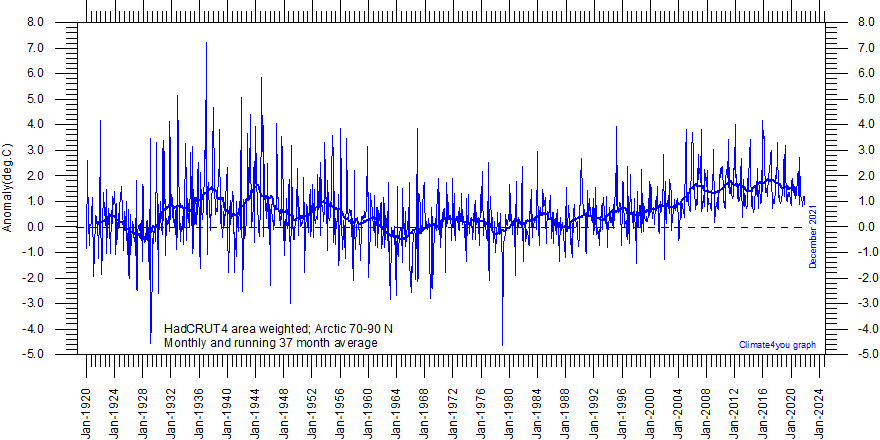
And when they claim that the Arctic is one of the “fastest warming regions on earth”, they don’t tell you that it was just as warm there back in the 1930s:
Neither are wildfires anything new in Arctic regions. In fact they are vital for the spread of larches and other trees which benefit from fire suppression of monolithic pine and fir.
As for summer sea ice, it has been stable since 2007:
The BBC refer to the albedo effect, whereby sunlight reflects away from sea ice, claiming that reduced sea ice extent allows sunlight to warm the seas. However, it is equally true that by September loss of heat from open seas more than outweighs the rapidly declining effect of the sun.
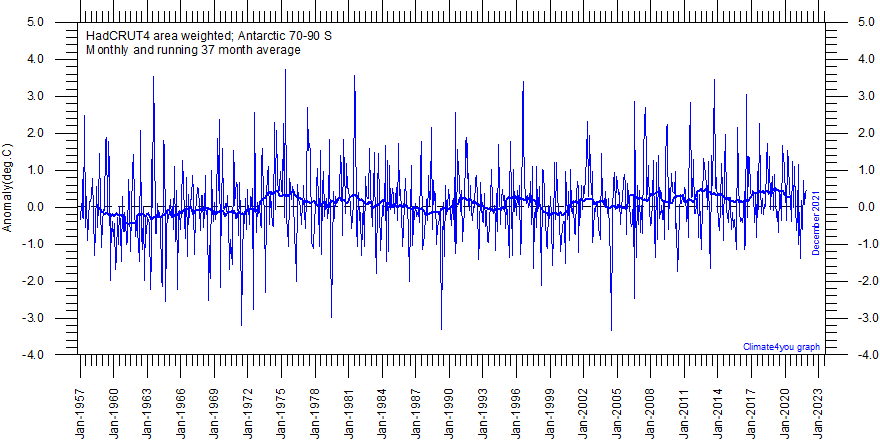
Finally she also refers to the South Pole, curiously claiming temperatures are rising at three times the global rate. There is no evidence for this whatsoever, with HADCRUT4 showing little increase at all since the 1970s:
IMAGE: NARES STRAIT, BETWEEN GREENLAND AND CANADA, AS SEEN FROM SPACE. view more CREDIT: MODIS LAND RAPID RESPONSE TEAM, NASA GSFC
New, first-of-its-kind research from the University of Colorado Boulder shows that climate change is driving increasing amounts of freshwater in the Arctic Ocean. Within the next few decades, this will lead to increased freshwater moving into the North Atlantic Ocean, which could disrupt ocean currents and affect temperatures in northern Europe.
The paper, published July 27, 2020 in Geophysical Research Letters, examined the unexplained increase in Arctic freshwater over the past two decades and what these trends could mean for the future.
“We hear a lot about changes in the Arctic with respect to temperature, how ecosystems and animals are going to be affected,” said Rory Laiho, co-author and PhD student in atmospheric and oceanic sciences. “But this particular study gives an added perspective on what’s happening physically to the ocean itself, which then can have important implications for ocean circulation and climate.”
Since the 1990s, the Arctic Ocean has seen a 10% increase in its freshwater. That’s 2,400 cubic miles (10,000 cubic kilometers), the same amount it would take to cover the entire U.S. with 3 feet of water.
The salinity in the ocean isn’t the same everywhere, and the Arctic Ocean’s surface waters are already some of the freshest in the world due to large amounts of river runoff.
This freshwater is what makes sea ice possible: it keeps cold water at the surface, instead of allowing this denser liquid to sink below less dense, warm water. In this way, the Arctic Ocean is much different than other oceans. But as more freshwater exits the Arctic, this same stabilizing mechanism could disrupt the ocean currents in the North Atlantic that moderate winter temperatures in Europe.
Such disruptions have happened before, during the “great salinity anomalies” of the 1970s and 80s. But these were temporary events. If too much cold freshwater from the Arctic continuously flows into the North Atlantic, the ocean turnover could be disrupted more permanently.
Ironically, this would mitigate the impacts of global warming during winter in northern Europe for a while. But disrupting the ocean currents could have negative effects for climate long-term and on the North Atlantic’s ecosystems.
A signal in the noise
The main mission of the research for Alexandra Jahn, lead author of the new study and assistant professor in the Department of Atmospheric and Oceanic Sciences and the Institute of Arctic and Alpine Research, and her graduate student, Laiho, was to differentiate between natural variability cycles in Arctic freshwater amounts and climate change’s impact. They examined the results from an ensemble of models run from 1920 to 2100.
“When we look at all the simulations together, we can see if they all do the same thing. If so, then that’s due to a forced response,” said Jahn. “If those changes are big enough so they could not occur without increasing greenhouse gases in the model simulations, that’s what we call the emergence of a clear climate change signal. And here we see such clear climate change signals for the Arctic freshwater during the current decade.”
Their results showed that Nares Strait, which runs between Greenland and Canada and is the most northern gateway between the Arctic and more southern oceans–will be the first place to see a freshwater export increase attributable to climate change in the next decade. Other straits farther south and east, including Davis and Fram straits, will be next to show this signal.
The researchers also ran the models through different emissions scenarios to see if these changes will be affected by humans’ emissions choices in the next few decades. They looked at the “business as usual” (over 4 degrees Celsius warming by the end of the century) scenario and what would happen if humans limited warming to 2 degrees Celsius, the upper end of IPCC (Intergovernmental Panel on Climate Change) targets for this century.
They found that the change in freshwater in the Arctic Ocean and the amounts moving through the northern straits were unaffected since they will be subject to an increase in freshwater before the 2040s–and the decisions made globally in the next few decades will not influence them, as these climatic changes are already in motion. But in the second half of this century, the two scenarios diverged, and increases in freshwater amounts were seen in more places in the high-warming scenario than in the low-warming scenario.
“What this work is showing us is that we’re probably already experiencing the first of these changes, we just can’t tell from the direct observations yet,” Jahn said.
All water from the Arctic Ocean eventually ends up in the North Atlantic. But timing is everything. Being able to predict the timing of the emergence of climate change signals will allow scientists to monitor upcoming changes in real time, and better understand how changes in the Arctic Ocean can impact climate worldwide.
“It fills a gap in our current understanding, and helps us ask new questions about what physically is happening in the Arctic,” said Jahn.
July 29, 2020: Don’t let Solar Minimum fool you. The sun can throw a major tantrum even during the quiet phase of the 11-year solar cycle. That’s the conclusion of a new study published in the July 1st edition of the Astrophysical Journal Letters.
“In late October 1903, one of the strongest solar storms in modern history hit Earth,” say the lead authors of the study, Hisashi Hayakawa (Osaka University, Japan) and Paulo Ribeiro (Coimbra University, Portugal). “The timing of the storm interestingly parallels where we are now–near Solar Minimum just after a weak solar cycle.”
Above: The red line marks the 1903 solar superstorm in a plot of the 11-year solar cycle. [ref] The 1903 event wasn’t always recognized as a great storm. Hayakawa and colleagues took an interest in it because of what happened when the storm hit. In magnetic observatories around the world, pens…





 Above: The red line marks the 1903 solar superstorm in a plot of the 11-year solar cycle. [
 Iowa Climate Science Education