By Paul Homewood

The GWPF have just published their latest factsheet about UK flooding. Written by Harry Wilkinson and me, it can be read here.
via NOT A LOT OF PEOPLE KNOW THAT
July 17, 2020 at 12:36PM
By Paul Homewood
The GWPF have just published their latest factsheet about UK flooding. Written by Harry Wilkinson and me, it can be read here.
via NOT A LOT OF PEOPLE KNOW THAT
July 17, 2020 at 12:36PM
By Kirye
and Pierre Gosselin
It’s well known that the United States suffered severe drought and record high temperatures back in the 1930s, which we know resulted in the famous Dust Bowl and economic hardship across North America.
But now, from a climate point of view, that period has become an embarrassment to the scientists who propose the anthropogenic global warming theory. Atmospheric CO2 concentrations were much lower back then, and so according to their theory, it should have been cooler than it is today. But it wasn’t.
But instead of questioning CO2’s role in driving global temperature, NASA GISS has decided to just rewrite the historical data so that it fits their flakey theory. This of course is scientific fraud.
Today we examine NASA GISS data for the Wellsboro station in Pennsylvania. First we look at the Version 4 “unadjusted” annual mean temperature data and compare it to the new Version 4 “homogenized” data:
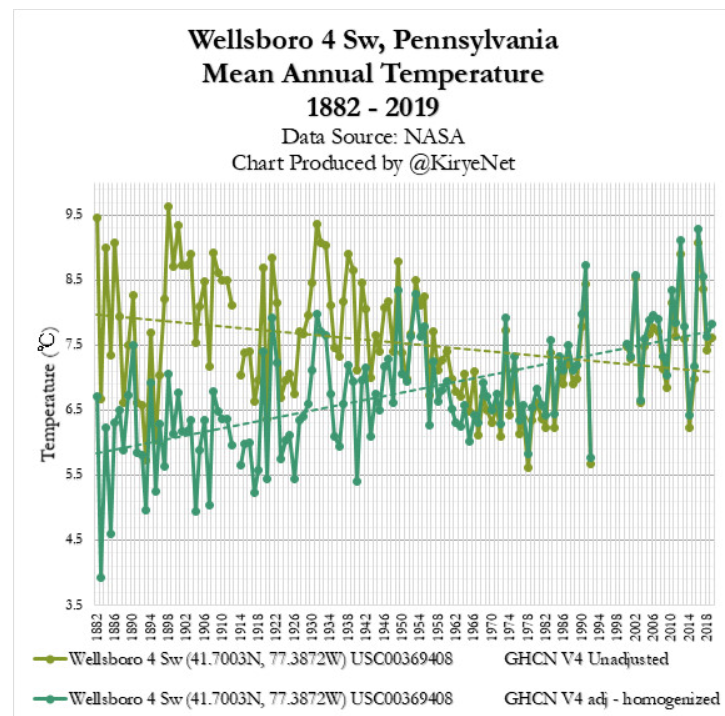
Data: NASA GISS
Above we see how NASA scientists simply went back in the old datasets and simply rewrote them so that the hot years of the early 20th century are cooled tremendously – by over two degrees in many years.
Earlier Wellsboro saw a cooling trend. But now since NASA scientists have fiddled with the data, the trend has been forged to fit the AGW theory.
Next is a chart comparing version 3, which starts in 1883 and ends in 2019, to Version 4, which starts in 1882:
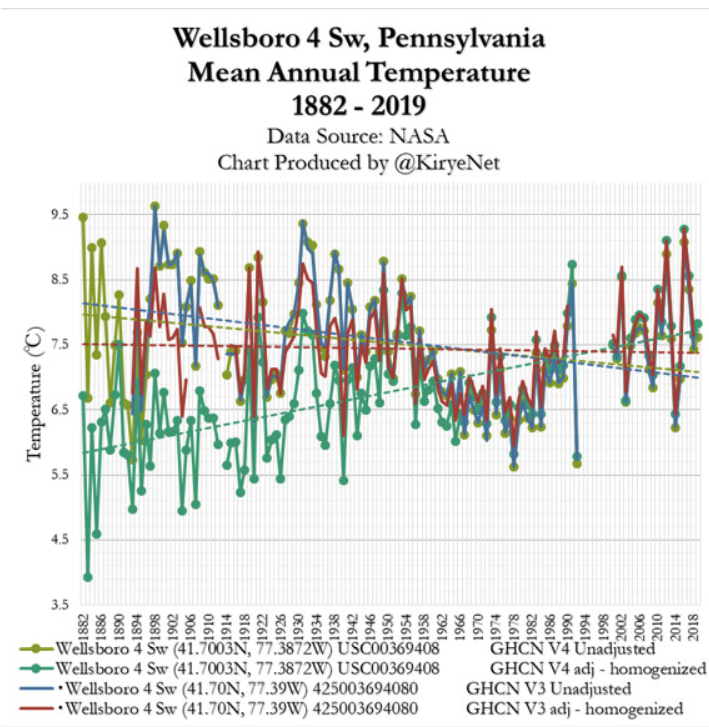
Data source: NASA GISS.
The earlier Version 3 also showed cooling before NASA rewrote the data and wiped it out. The current Version 4 used to show cooling, but was that too was tampered with and now it shows strong warming.
Many would argue that this is not science, but outright Orwellian scientific fraud.
Donate – choose an amount
via NoTricksZone
July 17, 2020 at 12:32PM
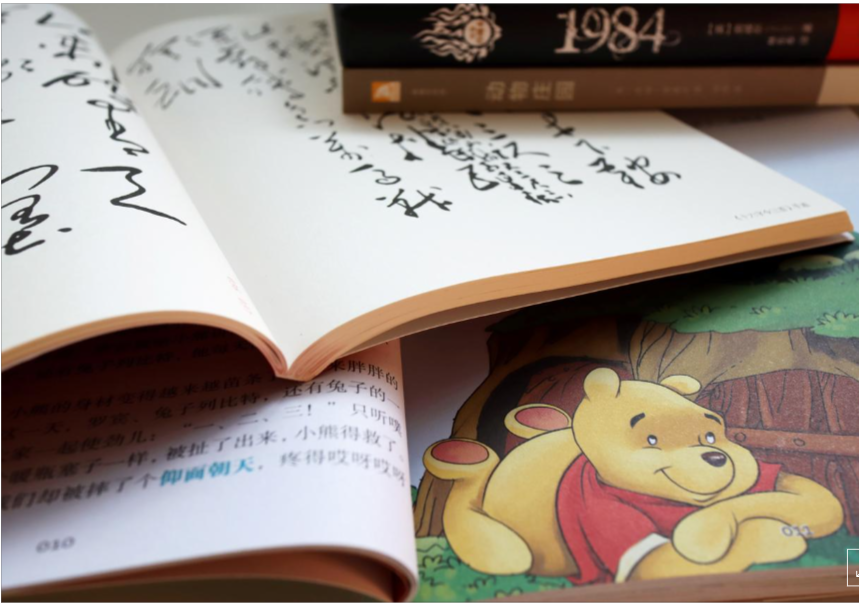
The protests in city streets of developed countries are coordinated and led by Social Justice Warriors indoctrinated in Western academies of higher education, after elementary school slanted teaching. If neo-Marxist progressive post-moderns take pride in this as accomplishing their agenda, consider what happened in China’s cultural revolution in the 1960s and is repeating itself in 2020.
It all started in China with educational reform implemented by teachers and administrators. That history is summarized in an article China’s Cultural Revolution: Reforms in the Education System at UK Essays. Excerpts in italics with my bolds.
The implementation of educational reforms was carried out via a decentralized process, as most schools were placed under local management. In fact each school had its own “Revolution in Education’ Committee responsible not only for implementing reforms but also for part of the planning process within its own institution.”[7] So it would seem that local experimentation within the general framework of the new educational policies was encouraged. Experimentation was seen as necessary primarily because of the emphasis on adopting flexible methods to meet the diverse needs of different schools and regions. We will identify below the major guidelines regarding the implementation of the educational reforms, as well as describe some of the different ways the reforms were implemented.
In order to elevate the “political consciousness” of the students, the curriculum was heavily stocked with political education courses. The major texts used were drawn from the works of Mao. Aside from increasing the number of political course, other courses also drew upon Mao’s thoughts to explain various approaches to the analysis of whatever phenomenon was involved.[8] This reliance on Mao’s thoughts was essentially the concept of “putting politics in command of knowledge.” At the same time, “revolutionary mass criticism” and “class struggles” were actively promoted to bring into sharp relief the various contradictions in society from a more personal perspective. The principal means of linking theory and practice in the educational process were to make production labor a major part of the students’ curriculum and to direct research to meet local needs. These methods were based on the concept of “practical training,” although their implementation in China seems to have gone far beyond that practiced by other countries.
The fate of the teachers is revealed in research conducted by Youqin Wang In her paper Student Attacks Against Teachers: The Revolution of 1966. Excerpts in italics with my bolds.
The author investigated the so-called “Red August” of 1966, the start of large-scale violent persecution during China’s Cultural Revolution. She interviewed hundreds of teachers and students from ninety-six schools and reviewed all available written materials. This article provides a detailed description of how educators were insulted, tortured, and even killed by their students. Mobilized as members of a new youth organization named “Red Guards,” the students attacked the educators for being “capitalist intellectuals.” In those schools, twenty-seven educators were murdered; more committed suicide subsequent to torture. Cruel oppression silenced resistance. Stories about bloody campus persecutions were too politically sensitive following the Cultural Revolution, so have heretofore received scant attention in the historical narrative. As the author shows, given the high regard China has traditionally held for education, the brutalizing of educators in China was an unprecedented act. The objective of this article is to reveal the texture and significance of this underreported and underappreciated part of China’s history.
Not only were the stories of violence not reported by the media at the time of their occurrence, but thirteen years later, in 1979, with the repudiation of the Cultural Revolution reaching the highest circles of the Chinese Communist Party (CCP), the Chinese media only cautiously began to mention the victims as a way of “restoring” their reputation. This sort of publicity was limited to a small number of purged high-ranking cadres, victimized celebrities, and a few ordinary people who were considered “heroes” or “heroines” for resisting the “Gang of Four” (四人幫). The teachers who were victimized in 1966 were not so much as mentioned. None of the three published general histories of the Cultural Revolution (printed in 1986, 1988, and 1995 respectively) covers the brutality against teachers in the summer of 1966.
In general, the brutality of students in colleges and in elementary schools was not as severe as in middle schools, but it was nevertheless serious. At Beijing University, hundreds of people on the “labor reform team of ox-ghosts and snake-demons” were forced to clean the campus with irregularly shaved heads, while wearing boards with their name and title (such as “member of the black gang” or “reactionary academic authority”) around their necks and receiving gratuitous insults from many students who came to “learn revolutionary experiences from Beijing University.”
On August 24, 1966, the Red Guards of the Middle School attached to Qinghua University transported truckloads of Red Guards from twelve middle schools to Qinghua campus, where they beat the administrators and professors. After several persons at the Department of Electronic Engineering were beaten, their blood stained the ground. Someone marked a circle around the blood and wrote “dog blood.” That day Red Guards ordered those on the “ox-ghost and snake-demon team,” under the lashes of whip, kicks, and punches, to pull down a white marble monument which was built in 1905 to commemorate the founding of the school. That night, all school-level cadres at both the university and the attached middle school were detained in the Science Building, and there in a small room, a beating was inflicted upon each of them. No one escaped without serious injury.
Even kindergarten teachers could not escape the violence. Some teachers of Beijing Zhongshan Gongyuan Kindergarten and several kindergartens in Beijing’s Dongcheng District (東城區) were denounced and beaten in the Zhongshan Concert Pavilion; there, students from middle schools beat them and shaved their heads
The “working groups” organized sessions to expose and to criticize teachers and divided all teachers into four categories: good, fair, those with serious errors, and anti-party/anti-socialist “rightists” (右派份子). For example, the working group at the Girls Middle School attached to Beijing Teachers University led an “exposing and denouncing meeting” against vice-principal Bian Zhongyun on June 21 at which all students attended. According to the working group’s record of July 3, 1966, the group put two out of six leading cadres of this school into category IV (the worst one), two in category III, and two in category II. Some teachers, unable to bear the pressure and insults, committed suicide.
When their parents were denounced by the new student organizations, the Red Guards fell victim to the movement that they had started. However, the decline of the original Red Guards did not mean the end of the philosophy of violent attacks. On the contrary, the massive violent persecution that the Red Guards promoted in the so-called “Red August” (紅八月) period of 1966 continued in the following years. In late 1966 and 1967, students in the mass organizations that had dominant status during that period physically attacked the “capitalistroaders with powerful positions in the party.” For example, students beat Peng Dehuai (彭德 懷), the former defense minister, at the “struggle meeting” in Beijing in July of 1967. Two of Peng’s ribs were broken during the beating.47
On June 18, 1968, at Beijing University, about two hundred teachers and cadres, who had been imprisoned on campus for months, were beaten and tortured in very brutal ways during a school-wide action. This date was chosen to celebrate the violent event that had occurred two years previous, on June 18 of 1966, mentioned twice above. In the attack of June 18, 1968, more educators were beaten more viciously than in the previous attack of June 18, 1966. From 1966 to 1968, it was in part this increasing violent persecution that fueled enthusiasm for the Cultural Revolution.
The present direction in China is not encouraging as reported at Reuters(Beijing) by Huizhong Wu
In echo of Mao era, China’s schools in book-cleansing drive. Excerpts in italics with my bolds.
As schools reopened in China after the COVID-19 outbreak, they have thrown themselves into a nationwide exercise to remove books deemed politically incorrect, deepening Chinese President Xi Jinping’s push to instill patriotism and ideological purity in the education system.
A directive from the Ministry of Education last October called on elementary and middle schools to clear out books from their libraries including “illegal” and “inappropriate” works. Now teachers have removed books from schools in at least 30 of mainland China’s 33 provinces and municipalities, according to a Reuters review of social media posts, publicly available school and local government documents, and interviews with teachers.
From western Gansu province to Shanghai, the review of publicly announced measures pointed to books being cleared by the hundreds of thousands.
Censorship in China has been intensifying under Xi, but analysts say this is the first national campaign aimed at libraries in decades. It comes as government employees in Hong Kong last week removed books by pro-democracy activists from public libraries to see whether they violate a new national security law.
“This is the first movement targeted at libraries since the Cultural Revolution,” said Wu Qiang, a political analyst based in Beijing and former political science lecturer at Tsinghua University. In the late 1960s, zealous teenagers driven by Mao Zedong carried out a nationwide campaign targeting libraries and destroying or burning what they could get their hands on, as part of a wider destruction of traditional culture.
An old Soviet joke has an university professor of history addressing his students at the end of the term. “Regarding the final exam, I have good news and bad news. The good news is that all the the questions are the same as last year. The bad news: Some of the correct answers have changed.”
The story was shared among the proles in reaction to the slogan of the times: The future is certain; only the past keeps changing. I never thought we’d see such thought control appearing in Western democracies in the 21st century. But here it is, demonstrated by the 1619 project promoted the New York Times, former newspaper of record in the USA. Further the Red Guard, now wearing Black, are roaming and destroying monuments honoring heroes of the past, who though flawed paved the way for our freedoms and prosperity. People guilty of wrongthink are insulted, their reputations denigrated and driven from their livelihoods, just a shade from beatings and murders.
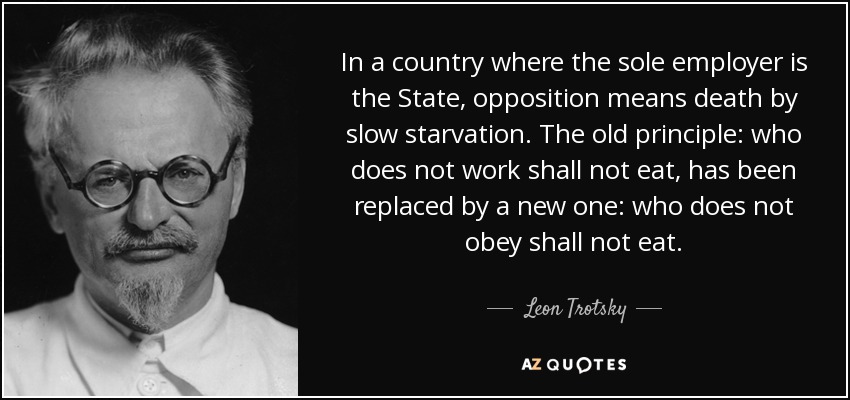
Of course there are differences in 2020 USA from 1966 China. The charismatic Mao called the signals for the purge of dissenters in China, while the woke leadership is more diffuse and hidden. Clearly the media are broadcasting the “Resistance” playbook, but the directors and financiers are in the shadows. The slow-moving coup is reaching a crescendo, but the citizenry still have a choice to be heard.
While the drastic educational reform measures have given peasants opportunities to attain basic education in rural areas, as well as agricultural production and political gains, it naturally came with lasting negative impacts that promoted many post-modernist’s critiques. In the beginning of the Cultural Revolution, values like collaboration, diligence, modesty, and respect for elders and teachers were discarded as a result of the purge of the old Chinese cultures and traditions. Many have failed to retain the virtues during the revolution. Second, due to political struggle and line drawn between working classes and intellectuals, as well as political and violent nature of the social revolution, substantial innocent teachers and professionals were subjected to personal attacks and humiliation, some even executed. Third, specific strategies of the reformed curriculum and examination system proved to be misguided and wasted the schooling of many young people. The disconnection between academic achievement and students’ future career, the emphasis on political correctness over academic achievement, and the neglecting of theory learning and over-emphasis on hands-on experiences were all examples of poor decisions. Fourth, the Cultural Revolution both liberated students and dominated them. It liberated students and people because it opened their eyes to the inequality existing in education and society; However, it imposed political control and dominated them because it did not allow real democratic, independent and critical thinking ability.[12] As Freire (1970) put it, “If teachers help students from oppressed communities to read the word but do not also teach them to read the world, students might become literate in a technical sense but will remain passive objects of history rather than active subjects.”
via Science Matters
July 17, 2020 at 10:27AM
16 July 2020 – As the storm passed through Argentina and Chile, heavy snowfalls left international crossings closed, with walls on both sides of the route of up to 5 meters (16 1/2 ft) of snow (national 242); extreme temperatures with thermometers that have marked 23 negative degrees.
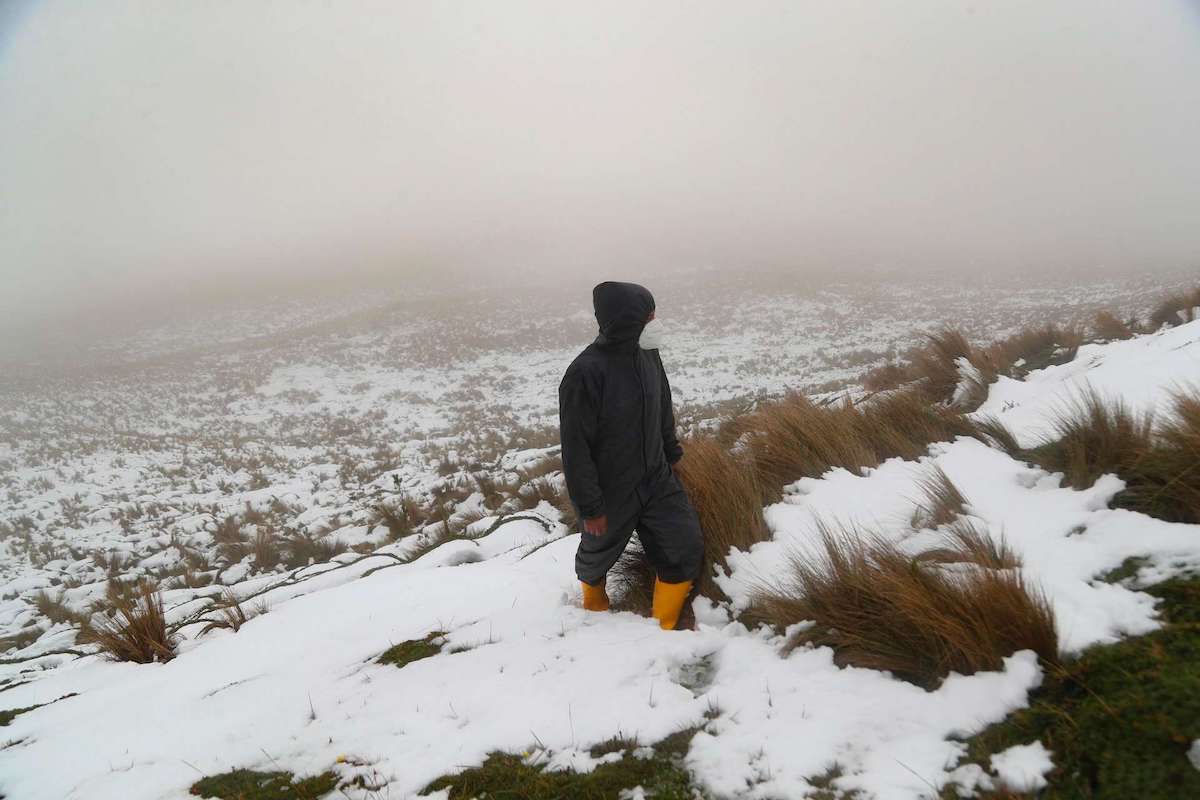
The storm in Ecuador in the Andean area of Píllaro, in the center of the country and entrance to the Llanganates National Park, left a snowy surprise of up to 30 cm (12 inches).
Since the end of June, Patagonia has been punished with heavy snowfalls and severe low temperatures which make it difficult or impossible to travel between towns and cities. Asphalt or gravel roads are the basis of these accumulations of ice and snow, which in many cases are very dangerous to travel. For example, National Route 40 at night, in some sections, is closed. Route 237 that goes to Neuquén also presents a similar panorama.
One of those places is the La Hoya Ski Center, which shows a significant amount of snow on its slopes but unfortunately cannot be opened due to the pandemic.
The same at Cerro Catedral Alta Patagonia, Cerro Chapelco, Corralco or Nevados de Chillán, to give just a few examples of winter centers overflowing with snow -in some cases it reaches 7 meters- but empty, and awaiting permission from the authorities to start the 2020 ski season.
The first two ski centers with limited opening dates are Cerro Catedral Alta Patagonia (on July 21) and Chapelco on August 1.
Meanwhile, images such as the struggle of some peons in Chubut to prevent their cows and sheep from starving to death amidst the white blanket, images of rivers, lakes and streams transformed into huge mirrors of ice, or images of a man digging a tunnel under the snow to leave his home in Caviahue are difficult to remember in recent winters.
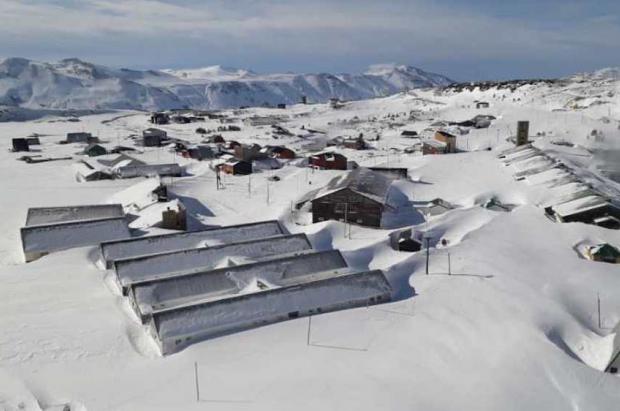
Copahue and the surrounding town are covered by snow, which reaches seven meters in this Neuquén paradise.
https://www.lugaresdenieve.com/sites/default/files/styles/imagenes_ancho_total/public/copahue.jpg?itok=dWc5cF97
blob:
https://www.facebook.com/8032ad3c-e400-45a0-8fdb-9a5df202bde9
Surprise snowfall in Pillaró, in the Poaló area, in Ecuador.
https://www.lugaresdenieve.com/sites/default/files/pillaro-ecuador.jpg
The Pichi Leufu River of Río Negro, Argentina
https://www.lugaresdenieve.com/sites/default/files/rio-negro.jpg
Buried to the knees try to reach to feed the animals
https://www.lugaresdenieve.com/sites/default/files/ADN_SUR.jpg
Thanks to Argiris Diamantis for these links
The post Twenty-three feet of snow in the Andes but ski areas closed due to Covid-19 appeared first on Ice Age Now.
via Ice Age Now
July 17, 2020 at 09:49AM
 Iowa Climate Science Education