
A new balloon experiment (inadvertently) demonstrates just how weak and inconsequential CO2’s warming effect is.
Levendis et al. (2020) tried using an experiment with air-filled (99% nitrogen and oxygen) versus CO2-filled (100% CO2) balloons to demonstrate a consequential warming effect for CO2. But their study may have demonstrated the opposite.
In the experiment a heat source was applied and then removed (shut off) to 3 different-sized balloons with 100% (1,000,000 ppm) CO2 in them. They compared the rate of cooling for these CO2-filled balloons to the cooling rate for a balloon filled with regular room air that has ~790,000 ppm nitrogen (N2), ~210,000 ppm oxygen (O2), ~9,000 ppm Argon (Ar), and ~500 ppm CO2.
The results revealed the temperature inside the 1,000,000 ppm CO2 balloons cooled just ~1.3°C (0.5 to 2.0°C) more slowly after 6½ minutes than the balloon with ambient air with ~500 ppm CO2. Put another way, raising CO2 concentrations from 500 ppm to 1,000,000 ppm only leads to a warming (reduced cooling) effect of 1.3°C.
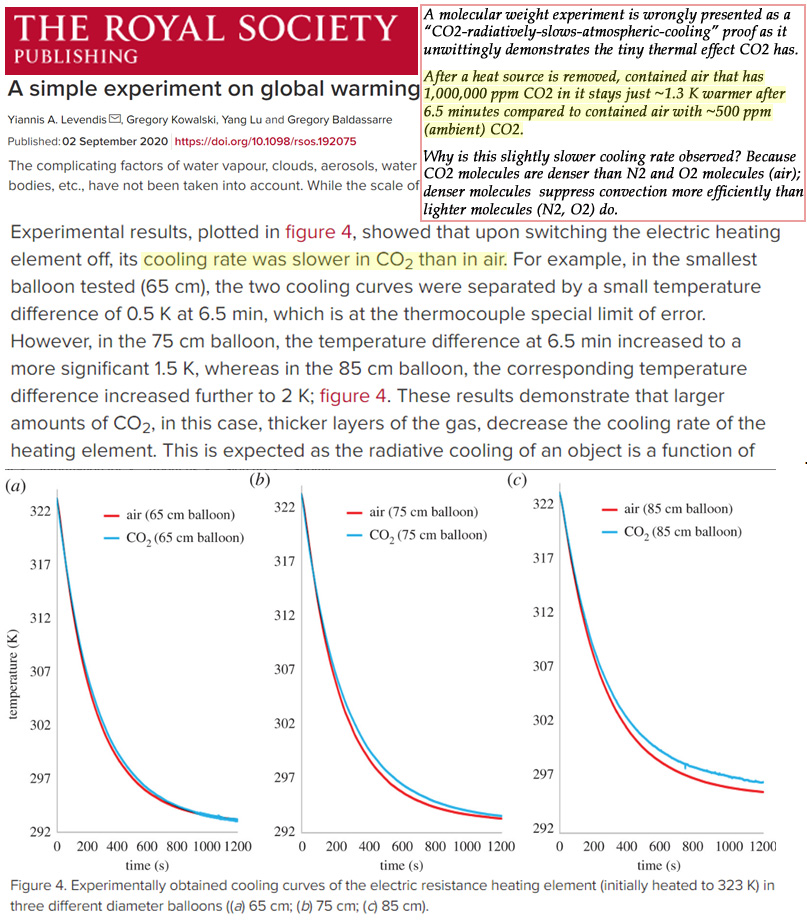
Image Source: Levendis et al. (2020)
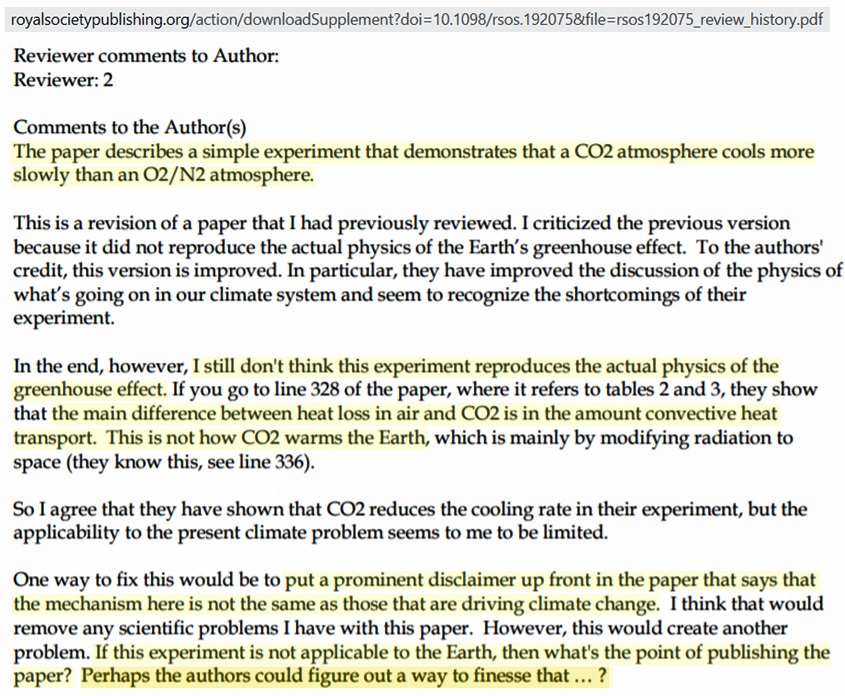
Image Source: Review history for Levendis et al., 2020
Reviewer #2 is correct. These lab experiments claiming to show CO2’s special role in the greenhouse effect only demonstrate denser molecules like CO2 (44 u) slow heat loss better than (29 u) lighter (N2 and O2, air) molecules, just as a heavier coat slows cooling better than a lighter coat.
In fact, Argon (Ar) has a much larger representation in the atmosphere (~9,000 ppm, or 0.9%) than CO2 does, but it is not considered a greenhouse gas that plays a role in the greenhouse effect. But as Wagoner and colleagues (2010) point out, Ar can be shown to reduce cooling (i.e., “cause” warming) with “identical” rates and magnitudes as CO2 molecules do in experiments like these because both Ar and CO2 have similar molecular densities (40 vs. 44 u) whereas N2 and O2 (29 u) do not.

Image Source: Wagoner et al., 2010
Wagoner and colleagues clearly affirm their support for the anthropogenic global warming (AGW) cause in their paper, but they seem to lamentably admit that a demonstration of CO2’s special and significant greenhouse effect role it “is difficult to demonstrate convincingly.” This is because the magnitude of the CO2’s radiative effect is already “more than an order of magnitude smaller” than observed in experiments like these that merely affirm the larger convective cooling reduction for denser vs. lighter molecules.
A real-world demonstration of CO2’s “specialness” as a greenhouse gas has yet to be observed.
via NoTricksZone
December 3, 2020 at 09:47AM
 Iowa Climate Science Education