
Guest “Now that’s funny right there!” by David Middleton
NOVEMBER 23, 2020
New York generated the fourth most electricity from renewable sources of any state in 2019In 2019, more electricity was generated from renewable sources in New York than in all but three states, according to the U.S. Energy Information Administration’s (EIA) Electric Power Monthly. New York’s 39.4 million megawatthours (MWh) of renewable electricity generation was more than any other state east of the Mississippi River and accounted for 30% of the state’s total electricity generation in 2019.
Hydroelectricity is the primary source of renewable generation in New York. Nearly 31 million MWh of hydroelectric power was generated in New York in 2019, which accounted for 78% of the state’s renewable electricity generation and 23% of the state’s total electricity generation. The Robert Moses Niagara hydroelectricity plant, located downstream from Niagara Falls, has a capacity of 2.4 gigawatts and is the second-largest conventional hydroelectric power plant in the country in terms of electric generating capacity, behind only Washington’s Grand Coulee dam.
Wind has been the second-largest source of renewable electricity in New York, with 4.5 million MWh generated in 2019. Wind generation in New York during 2019 accounted for 11% of the state’s renewable generation and 3% of the state’s total electricity generation. At the end of 2019, New York had 1,132 wind turbines at 27 power plants, according to EIA’s Annual Electric Generator Inventory.
Solar energy generated nearly 2.4 million MWh of electricity in New York during 2019. Small-scale solar installations, such as those found on residential and commercial rooftops, accounted for nearly 80% of the state’s solar electricity generation. Biomass, at 1.9 million MWh, accounted for the remainder of New York’s renewable electricity generation in 2019.
[…]
The Top Ten
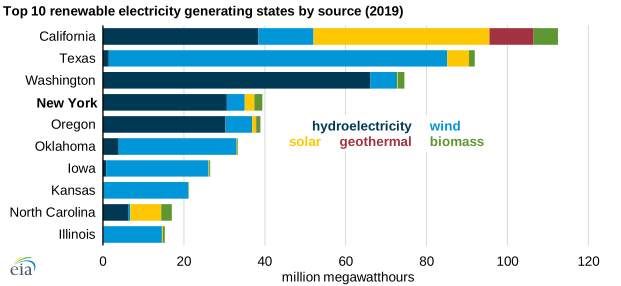
In 2019, New York generated 29% of its electricity from “renewable” sources, the vast majority coming from hydroelectric…
| Source | Million MWh | |
| Hydroelectric | 30.6 | 78% |
| Wind | 4.5 | 11% |
| Solar | 2.4 | 6% |
| Biomass | 1.9 | 5% |
| Renewables | 39.4 | 100% |
The article goes on to note the following:
[…]
In the United States, the sources of electricity generation have been shifting from coal to natural gas and renewables since the mid-2000s. Changes in New York’s electricity generating mix have contributed to this trend. Coal’s share of New York’s electricity generation fell from 14% in 2005 to less than 1% in 2019, and natural gas-fired electricity grew from 22% to 36%.
Electricity generation from renewable energy technologies collectively grew from 19% to 29% in the same period. New York adopted a renewable portfolio standard in 2004 and the Clean Energy Standard (CES) in 2015. The CES currently requires New York to generate 100% carbon-free electricity by 2040 and attain economy-wide net-zero carbon emissions by 2050.
[…]
The increase in so-called “renewables” generation is really funny. Biomass and hydroelectric barely changed; while wind and solar grew from nonexistent to trivial.
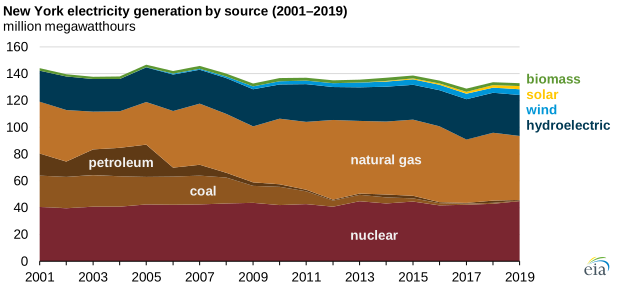
It appears that about half of the growth in so-called “renewables” from 19% to 29% was due to New Yorkers using less electricity, with a precipitous decline since 2015. I guess people are turning out the lights when they leave.
New York’s population continues to decline
By Jeff Platsky / Gannett New York
Posted Apr 29, 2020More than one-third of New York’s 62 counties failed to record a population increase in any year in the past decade — 25 reported nine years of successive decreases, all upstate, census data showed.
Included in the population decline are all but two counties stretching along New York’s Southern Tier, where the the combined loss was nearly 32,000 people.
[…]
After showing consistent, if relatively small gains from 2010 through 2015, the state’s population posted successive losses from 2016 through 2019, according to Census estimates.
That means it has fallen further behind the three states with the largest population, California, Texas and Florida.
Florida passed New York in population in 2014, and out of the 1.4 million residents who left for other states between 2011 and 2018, 21% of them went to the Sunshine State, census data earlier this year showed.
New York has lost more people than any other state in the nation for two years in a row.
[…]

Related
via Watts Up With That?
December 3, 2020 at 04:15AM
 Iowa Climate Science Education