
In summary, along with Canada, Alaska and Sweden, also Finland, France and Ireland have been showing no March warming.
via Watts Up With That?
April 30, 2021 at 08:56PM
In summary, along with Canada, Alaska and Sweden, also Finland, France and Ireland have been showing no March warming.
via Watts Up With That?
April 30, 2021 at 08:56PM
Coldest in 99 years, but MET Office tries to divert your attention by talking about ‘frostiest’ instead of ‘coldest.’
“April 2021 has provisionally been the frostiest in at least 60 years for the UK, topping the previous frostiest April in 1970, with records going back to 1960.”
“This is how the MET Office downplays the coldest April in England in 99 years (records about the CET Central England Temperature going back many hundreds of years),” says Argiris Diamantis in the Netherlands.
“They don’t talk about the coldest April in England, but about the frostiest April in the UK, records going back to 1960. This way they don’t have to go back further, because records of the FROSTIEST April in the UK do not go back further.”
“Many farmers and fruit growers suffered enormous losses.”
https://blog.metoffice.gov.uk/2021/04/27/frostiest-april-for-at-least-60-years-in-uk/
In fact, it has been cold across Europe.
Cold April across Europe.
Temperature anomaly up to April 30, in relation to the climate norm 1981-2010

https://dobrapogoda24.pl/uploads/assets/8907/full_Zimny_kwiecie%C5%84_2021.jpg
Coldest April in Germany in 40 years
According to the Polish website Dobra Pogoda 24, this April was the coldest in Germany for more than the last FORTY years (not 30). And for England the coldest April in almost 100 years.
April 30, 2021:
“Outrageously cold April in Europe
In Poland, the lowest temperature in 24 years, in Germany for over 40.
April 2021 is coming to an end and we want to forget about it quickly.
Scandalous low temperatures with frosts and snowfall affected not only Poland, but many other European countries.
Coldest April in Poland in 24 years
Preliminary summaries say about the coldest April in England since 1922, in Germany since 1980, and in Poland this year’s April is the coldest in 24 years, i.e. since 1997.
According to the data of the British Met Office, in the UK, an average of 13 days with frost (data until April 27)! The new record broke the previous one from 1972 by at least 2 days. Many farmers and fruit growers suffered enormous losses.
There were also significant losses in grapevine cultivation in France. The famous French wine may be less on the tables.
Germany is very disappointed in April, because the exceptionally warm end of March and the beginning of April filled us with optimism for the warm remaining days. But the descending jet stream far south quickly dropped the “chill bomb” with a prolonged advection of cold air flowing in from the north, including the Arctic.
April 2021 in Germany the coldest since 1980
2nd coldest in entire measurement history
The end of April 2021 brought 13 days of frost in Germany. In this respect, it was the 2nd coldest in the entire measurement history. More days with frost were recorded in Germany only in 1929. The average temperature this year in April was 6.1 degrees Celsius. It was -1.3 degrees lower than the average for the base period 1961-1990.
Across Europe, persistently low temperatures significantly delayed plant vegetation
April 2021 in Europe was a cold month from the British Isles, through France, the Benelux countries, Germany, Poland, parts of Norway to western Ukraine and the Balkans. Persistently low temperatures, including frosts, significantly delayed plant vegetation.
This year’s cold April delayed the arrival of the phenological spring. The pictures compare the vicinity of Barlinek from April 28. On the left from 2020, on the right from 2021.
https://dobrapogoda24.pl/uploads/assets/8908/full_Gdzie_wiosna_kwiecie%C5%84_2021.jpg
https://dobrapogoda24.pl/artykul/pogoda-zimny-kwiecien-2021-w-polsce-i-europie
Thanks to Argiris Diamantis for these links
The post MET Office downplaying April cold appeared first on Ice Age Now.
via Ice Age Now
April 30, 2021 at 07:37PM

EIA explains the news today New York’s Indian Point nuclear power plant closes after 59 years of operation. Excerpts in italics with my bolds.
The Indian Point Energy Center (Indian Point) permanently stopped generating electricity on April 30, 2021, when it retired its last operating nuclear reactor, Unit 3, earlier than originally planned. The Indian Point nuclear power plant began operations in 1962 and produced over 565 terawatthours (TWh) of electricity in the 59 years it was open. The Unit 3 retirement removes almost 1,040 megawatts (MW) of nuclear generating capacity from New York State, leaving about 3,200 MW of remaining nuclear capacity at three plants in upstate New York.
“New York Nukes Itself” refers not to the disastrous decisions in managing WuHanFlu, but about New York’s insane decision to close nuclear power plants in favor of wind farms. Robert Bryce writes at Forbes New York Has 1,300 Reasons Not To Close Indian Point. Excerpts in italics with my bolds.
At the end of this month, the Unit 2 reactor at the Indian Point Energy Center in Buchanan, New York will be permanently shut down. Next April, the final reactor at the site, Unit 3, will also be shuttered.
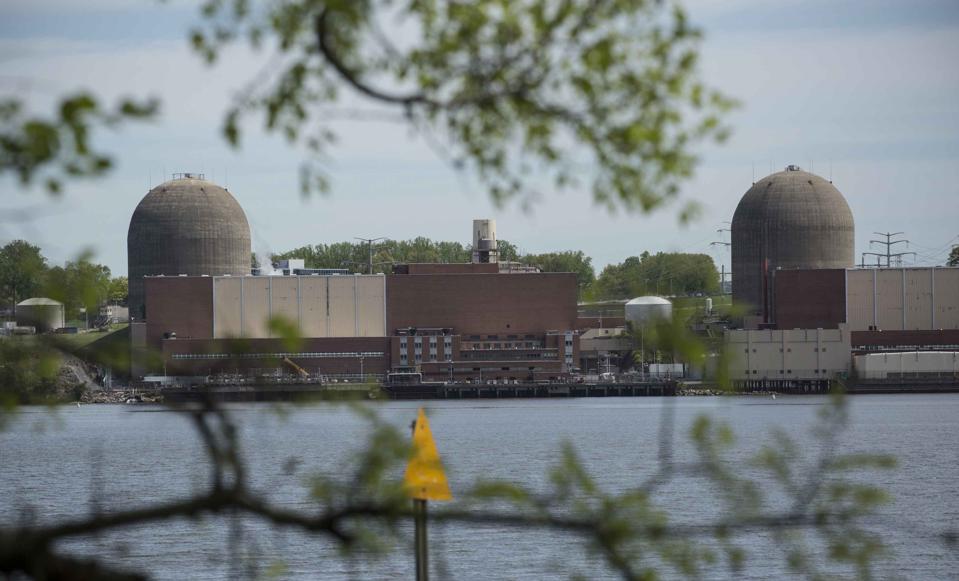
TOMKINS COVE , NY – MAY 11: The Indian Point nuclear power plant is seen from Tomkins Cove, New York … [+] CORBIS VIA GETTY IMAGES
But the premature closure of the 2,069-megawatt nuclear plant is even worse land-use policy. Here’s why: replacing the 16 terawatt-hours of carbon-free electricity that is now being produced by the twin-reactor plant with wind turbines will require 1,300 times as much territory as what is now covered by Indian Point.

Here are the facts: Indian Point covers 239 acres, or about 1 square kilometer. To put Indian Point’s footprint into context, think of it this way: you could fit three Indian Points inside Central Park in Manhattan.
Based on projected output from offshore wind projects (which have higher capacity factors than onshore wind projects), producing that same amount of electricity as is now generated by Indian Point – about 16 terawatt-hours per year – would require installing about 4,000 megawatts of wind turbines. That estimate is based on the proposed South Fork offshore wind project, a 90-megawatt facility that is expected to produce 370 gigawatt-hours per year. (Note that these output figures are substantially higher than what can be expected from onshore wind capacity.) Using the numbers from South Fork, a bit of simple division shows that each megawatt of wind capacity will produce about 4.1 gigawatt-hours per year. Thus, matching the energy output of Indian Point will require about 4,000 megawatts of wind capacity.
That’s a lot of wind turbines. According to the American Wind Energy Association, existing wind-energy capacity in New York state now totals about 1,987 megawatts. That capacity will require enormous amounts of land. Numerous studies, including ones by the Department of Energy have found that the footprint, or capacity density, of wind energy projects is about 3 watts per square meter. Thus, 4,000 megawatts (four billion watts) divided by 3 watts per square meter = 1.33 billion square meters or 1,333 square kilometers. (Or roughly 515 square miles.)
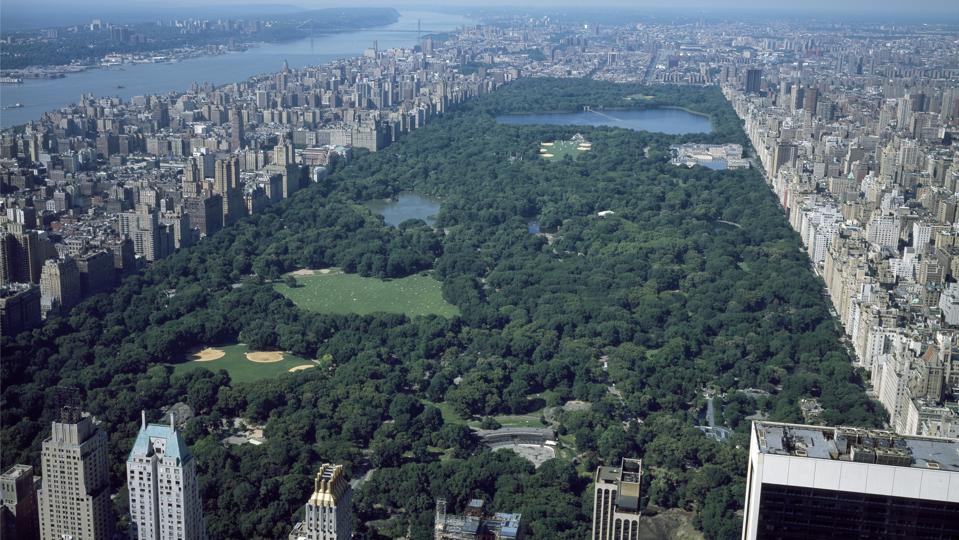
UNITED STATES – AUGUST 20: Aerial view of New York City’s Central Park (Photo by Carol M. … [+] GETTY IMAGES
Those numbers are almost too big to imagine. Therefore, let’s look again at Central Park. Recall that three Indian Points could fit inside the confines of the famed park. Thus, replacing the energy production from Indian Point would require paving a land area equal to 400 Central Parks with forests of wind turbines.
Put another way, the 1,300 square kilometers of wind turbines needed to replace the electricity output of Indian Point is nearly equal to the size of Albany County. Would New York legislators who convene in the capitol in Albany consent to having the entire county covered in wind turbines? I can’t be sure, but I am guessing that they might oppose such plan. (See yellow area in Google Earth image at top).
These basic calculations prove some undeniable facts. Among them: Indian Point represents the apogee of densification. The massive amount of energy being produced by the two reactors on such a small footprint provides a perfect illustration of what may be nuclear energy’s single greatest virtue: its unsurpassed power density. (Power density is a measure of energy flow from a given area, volume, or mass.) High power density sources, like nuclear, allow us to spare land for nature. Density is green.
Alas, the environmental groups that are influencing policymakers in New York and in other states are strident in their belief that nuclear energy is bad and that renewables are good. But that theology ignores the greenness of density and the essential role that nuclear energy must play if we are to have any hope of making significant reductions in carbon-dioxide emissions.
In short, the premature closure of Indian Point – and the raging land-use battles over renewable energy siting in New York – should lead environmental groups to rethink their definition of what qualifies as “green.” Just because wind and solar are renewable doesn’t mean they are green. In fact, the land-use problems with renewables show the exact opposite.

via Science Matters
April 30, 2021 at 05:09PM
“Right now, we’re in the phase of an 18.6-year lunar cycle that lessens the moon’s influence on the oceans. The result can make it seem like the coastal flooding risk has leveled off, and that can make sea level rise less obvious.”
via Watts Up With That?
April 30, 2021 at 05:01PM
 Iowa Climate Science Education

