Just another cheap, safe and long-used-drug for our Health Ministers to ignore
A new study looked at 944,000 US Veterans who had a Covid test sometime. Of those, 2,200 were alcoholics who were also prescribed disulphram. We might expect alcoholics to crash and burn against Covid, but amongst them, strangely, infections were lower than in the non-alcoholics — 34% lower. And there were no deaths from Covid in the 188 either. Sadly the death rate in infected vets who caught Covid, but weren’t using disulphram, was 3%.
It’s only a very odd observational study, not a randomized one. The mechanism isn’t known for sure, but there are suggestions the drug interferes with an enzyme the virus needs and may reduce hyperinflammation. Haven’t we heard that before?
Ivermectin appears to be better, but for people without access to it, at least there is the option to become an alcoholic. Thinking about the corruption at the FDA or the TGA will help. And if you are already an alcoholic, best get treatment now before they ban it.
It obviously needs a proper study. Bear in mind there were only 188 alcoholic veterans who caught Covid. But still, none of them died, and we’d expect 5 or 6 deaths in a group of 188 non-alcoholic vets.
Wonder what the drug might achieve in a non-alcoholic test group?
The message here is that we are living in a sea of antivirals, but our funding system, the bureaucracy, and our deep medical swamp are getting in the way.
By HealthDay News
The investigators found that people taking disulfiram, known as Antabuse, for alcoholism had a lower risk of infection with COVID-19 and were less likely to die from the coronavirus…
Listen to the sweet naivete of a Professor:
“This is a great candidate for a repurposed drug. It could easily be made available worldwide if we can prove it has a positive effect on patients with COVID-19,” said Chris Sander, a professor of cell biology at Harvard Medical School.
They noted that disulfiram has been prescribed for more than 60 years as a treatment for alcoholism, and that it’s safe, inexpensive, familiar to physicians, and widely used in many countries.
And he thinks those are good selling points. If only this drug were $3,000 a dose, barely useful and fully patented.
REFERENCE
Fillmore N, Bell S, Shen C, Nguyen V, La J, Dubreuil M, et al. (2021) Disulfiram use is associated with lower risk of COVID-19: A retrospective cohort study. PLoS ONE 16(10): e0259061. https://ift.tt/3190TQD
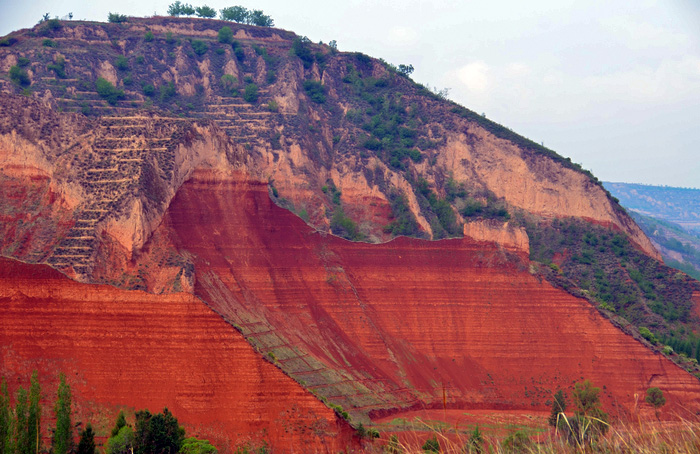
IMAGE: FIELD PHOTOGRAPH OF THE SHILOU RED-CLAY SEQUENCE FROM THE EASTERN CHINESE LOESS PLATEAUview more CREDIT: AO HONG
A recent study by an international research group led by Prof. AO Hong from the Institute of Earth Environment of the Chinese Academy of Sciences has revealed Asian climate variability and dynamics across the early-to-middle Pliocene Warm Period, thus providing clues for future climate change.
The joint research team comprised scientists from China, Australia, Germany, France, Netherlands, and the USA. The group’s findings were published in Nature Communicationson Nov. 26.
The early-to-middle Pliocene Warm Period between ~5 and 3 million years ago (Ma) that preceded Northern Hemisphere glaciation was the most recent period of persistently warmer-than-present conditions. During this warm interval, Earth’s mean annual surface air temperatures were ~2–4° C higher than today, the Northern Hemisphere was largely ice-free, global sea level was ~20–25 m higher than today, and atmospheric CO2 concentrations were comparable to present-day levels.
The Intergovernmental Panel on Climate Change (IPCC) Sixth Assessment Report projects that present-day high-CO2, warm conditions will continue for a long time and likely intensify, which may shift Earth’s future climate to a warm state similar to the early-to-middle Pliocene Warm Period.
“Understanding climate variability and dynamics during the early-to-middle Pliocene Warm Period is significant to better projecting future climate responses to sustained global warming,” said Prof. AO, the principal investigator of the study.
The aeolian loess/red-clay sequences on the Chinese Loess Plateau (CLP) provide a unique high-resolution archive of terrestrial climate variations continuously spanning the last 25 million years (Myr). The researchers established ~4.7-Myr-long summer monsoon records (Al/Na, Rb/Sr, and lightness) continuously spanning the period from ~8.1 to ~3.4 Ma at ~1–2-thousand-year (kyr) resolution from the Shilou aeolian red-clay succession on the eastern CLP. These records reveal the details and forcing mechanisms of Asian climate variability at an orbital timescale as well as longer trends from the late Miocene to the mid-Pliocene.
The high-resolution Al/Na, Rb/Sr, and lightness records show that the Asian summer monsoon had prominent 405-kyr and ~100-kyr periodicities between 8.1 and 3.4 Ma, consistent with a dynamic response to eccentricity modulation of solar insolation, a low-latitude forcing.
Surprisingly, obliquity cyclicity is only weakly expressed in those monsoon records, although it dominated the Antarctic glacial cycles throughout the late Miocene–Pliocene. Thus, it appears that orbital-scale Asian summer monsoon variability responded more dynamically to insolation forcing than to ice-sheet forcing during the warmer-than-present late Miocene to the mid-Pliocene when the Northern Hemisphere was largely ice free and continental-scale ice sheets only developed in Antarctica.
By integrating their new CLP red-clay, summer monsoon records with existing terrestrial records, land-sea correlations, and climate-model simulations, the research group found that CO2-induced global warming across the Miocene–Pliocene boundary (MPB) at ~5.3 Ma both increased summer monsoon moisture transport over East Asia, and enhanced aridification over large parts of Central Asia by increasing evaporation.
This finding offers palaeoclimate-based support for “wet-gets-wetter and dry-gets-drier” projections of future regional hydroclimate responses to sustained anthropogenic forcing.
The observation of continental-scale hydrological gradient intensification over Asia linking to global warming across the MPB has significant implications for future Asian climate responses to sustained high anthropogenic emissions.
“It implies that along with long-term sustained global warming, most East Asian monsoon regions may become even wetter than they are currently, with increasing flooding risks, while Central Asia may become even drier, with more persistent droughts and desertification in future,” said Prof. JIN Zhangdong, a coauthor of the study and director of State Key Laboratory of Loess and Quaternary Geology.
This study was supported by the Chinese Academy of Sciences, the Ministry of Science and Technology of China, and the National Natural Science Foundation of China.

 Iowa Climate Science Education