
In 1947, coal miners were on strike and this caused major hurricanes in both the Atlantic and Pacific. 18 Sep 1947 – 125 M.P.H. BLOW HITS FLORIDA – Trove 18 Sep 1947 – TYPHOON HITS TOKYO – Trove
via Real Climate Science
November 30, 2021 at 06:04AM
In 1947, coal miners were on strike and this caused major hurricanes in both the Atlantic and Pacific. 18 Sep 1947 – 125 M.P.H. BLOW HITS FLORIDA – Trove 18 Sep 1947 – TYPHOON HITS TOKYO – Trove
via Real Climate Science
November 30, 2021 at 06:04AM
By Paul Homewood

AMHERST, Mass. — A civil and environmental engineering researcher at the University of Massachusetts Amherst has, for the first time, assimilated satellite information into on-site river measurements and hydrologic models to calculate the past 35 years of river discharge in the entire pan-Arctic region. The research reveals, with unprecedented accuracy, that the acceleration of water pouring into the Arctic Ocean could be three times higher than previously thought.
The publicly available study, published recently in Nature Communications, is the result of three years of intensive work by research assistant professor Dongmei Feng, the first and corresponding author on the paper. The unprecedented research assimilates 9.18 million river discharge estimates made from 155,710 orbital satellite images into hydrologic model simulations of 486,493 Arctic river reaches from 1984-2018. The project and the paper are called RADR (Remotely-sensed Arctic Discharge Reanalysis) and was funded by NASA and National Science Foundation programs for early career researchers.
https://www.eurekalert.org/multimedia/809497
The key thing about this study is not that river flows are greater than previously estimated, but that they have increased over the period of the study, 1984-2018:

https://www.nature.com/articles/s41467-021-27228-1
This is significant because it means the Arctic Ocean is gradually becoming fresher. Exactly the same phenomenon occurred during what was called The Great Salinity Anomaly, GSA, which began in the 1960s. As Dickson & Osterhus described in their study, One Hundred Years in the Norwegian Sea in 2007:
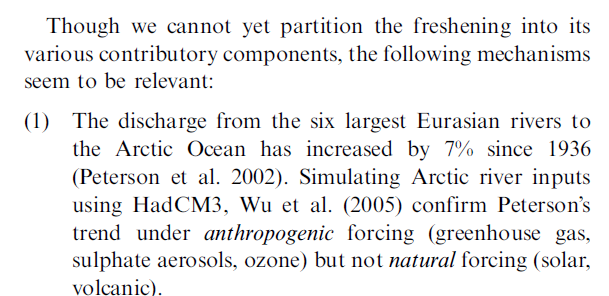
Though other factors were involved in the freshening of the Arctic Ocean, such as the NAO, the GSA marked a dramatic shift in the Arctic climate, putting an end to what is known as the Warming of the North between 1920 and 1960 and bringing a much colder era.
Part of the reason for this is the fact that freshwater freezes at higher temperatures than salty water, leading to an increase in sea ice. The GSA is also known to have slowed down the Atlantic meridional overturning circulation (AMOC).
HH Lamb also wrote about it, particularly how the GSA was triggered by greater run off from rivers in Canada flowing into the Arctic:

HH Lamb: Climate, History & The Modern World
And a Russian study by Viktor Kuzin shows that 11% of the world’s river water flows into the Arctic, a considerable amount.


A milder Arctic tends to be a wetter one, but a wetter climate leads to freshening of the ocean and a return to colder conditions. In other words, it is cyclical.
All of this reinforces the likelihood that the Arctic will become much colder, with sea ice expanding again in the not too distant future.
via NOT A LOT OF PEOPLE KNOW THAT
November 30, 2021 at 06:00AM
By Paul Homewood

http://rammb-data.cira.colostate.edu/tc_realtime/season.asp?storm_season=2021
The Atlantic Hurricane season has now officially ended, with a count of seven hurricanes, spot on the 30-year average.
Of these four were major, slightly above the average of three.
Long term comparisons of Atlantic hurricanes are essentially meaningless, because many hurricanes were simply never spotted or measured prior to the satellite era.
For example, if we compared this year’s tracking chart of hurricanes/tropical storms with 1932, when there were a similar number of hurricanes, we can readily see how many more mid ocean hurricanes are now being observed:
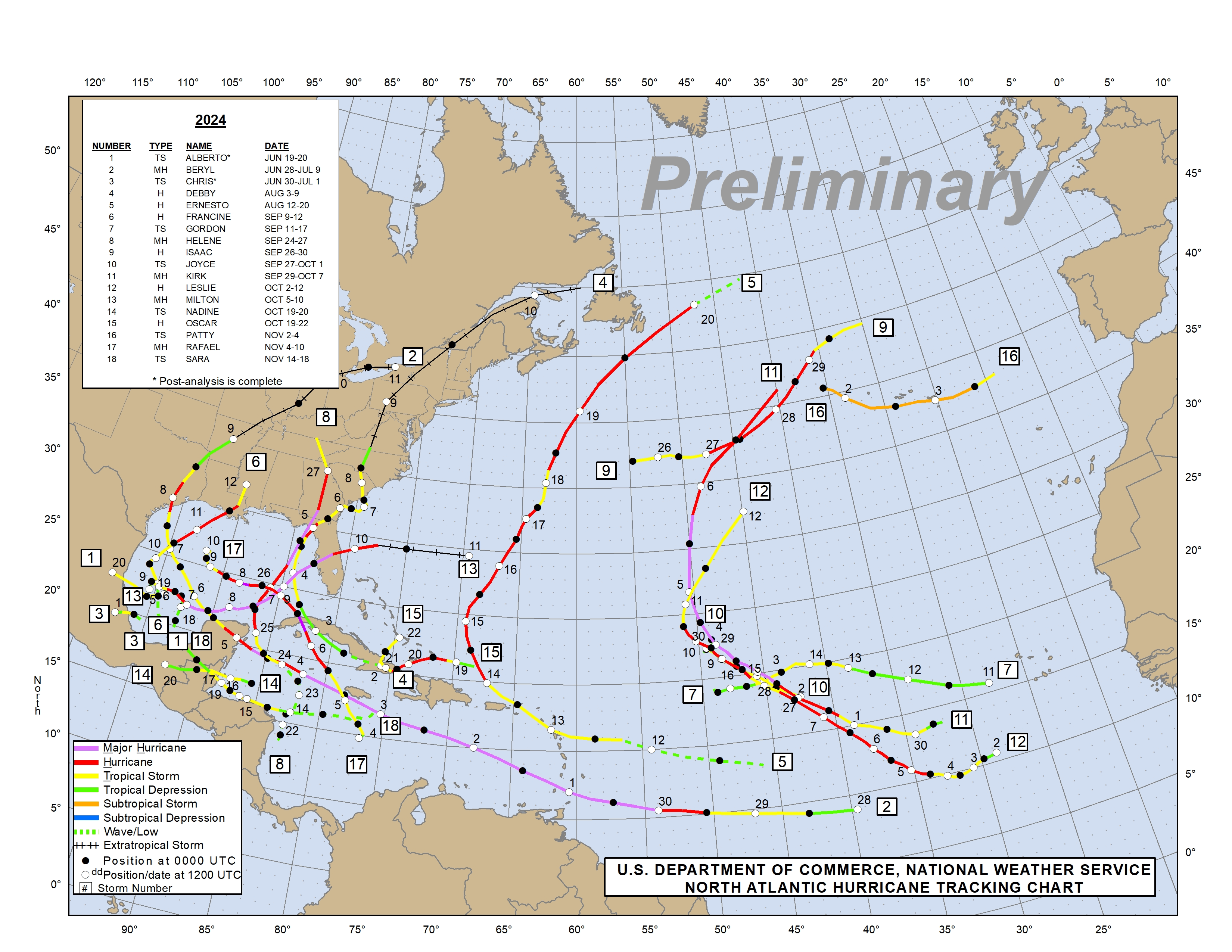
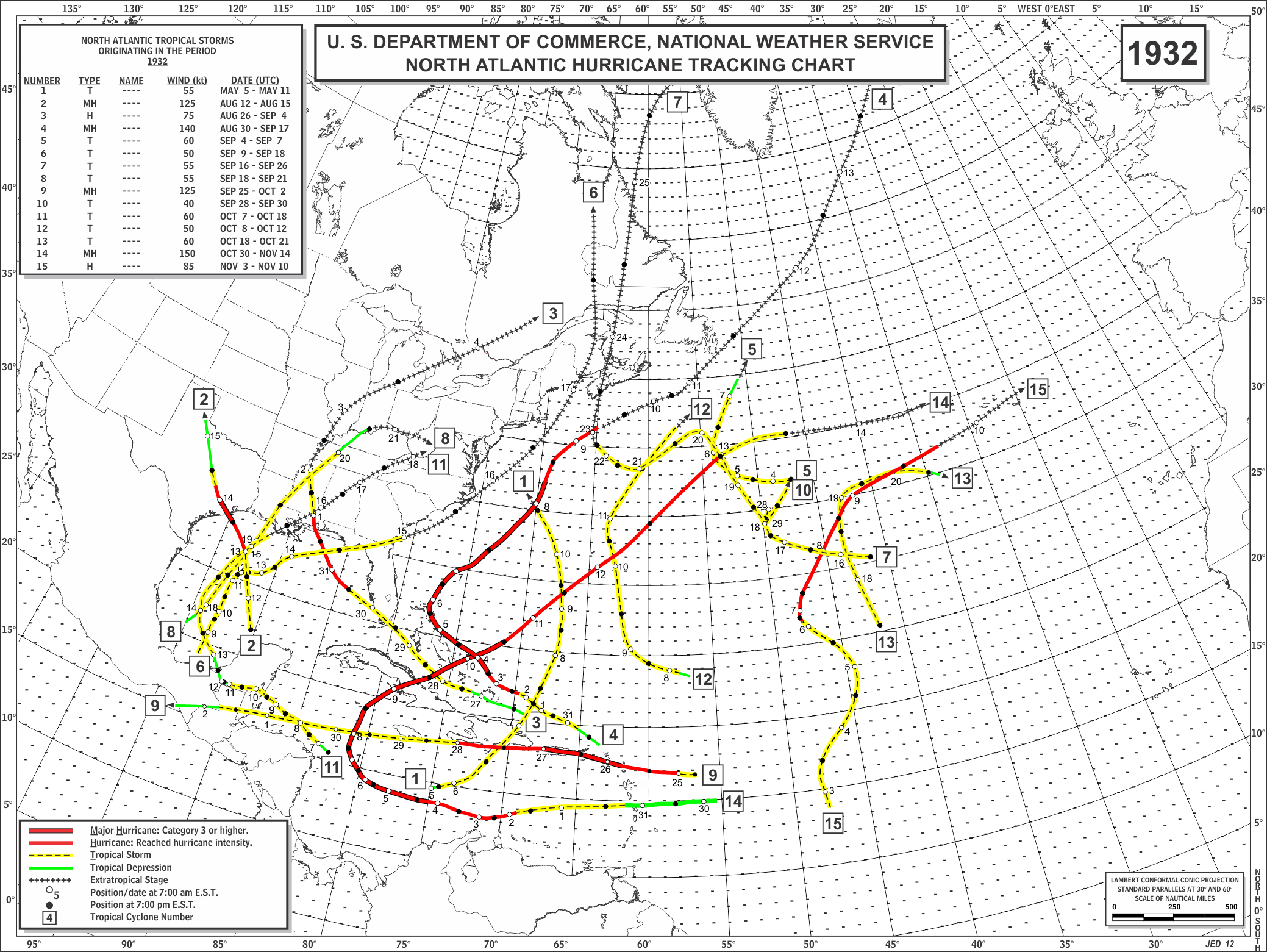
https://www.aoml.noaa.gov/hrd/hurdat/1932.html
It is also important to recognise the effect of the Atlantic Multidecadal Oscillation, or AMO. When this is in warm phase, as it has been since the mid 1990s, hurricane seasons tend to be more active, as NOAA explain:

https://www.noaa.gov/media-release/record-breaking-atlantic-hurricane-season-draws-to-end
This effect is obvious on the above graph, with the 1930s to 60s (Warm AMO) recording many more hurricanes than the 1960s to 90s (Cold AMO).
Because of the lack of historical data, the best measure we have is for US landfalling hurricanes, for which there is good data as far back as 1851.
Again, the AMO cycles are clearcut, but there is no evidence that hurricanes are either becoming more frequent or severe in the long term.


https://www.aoml.noaa.gov/hrd/hurdat/All_U.S._Hurricanes.html
Finally, globally hurricane activity has been well below average this year, thanks to a quiet typhoon season in the Pacific.
Meanwhile, overall hurricane numbers show no long term trends at all.


https://climatlas.com/tropical/
via NOT A LOT OF PEOPLE KNOW THAT
November 30, 2021 at 05:54AM
At a little after midnight, I got an email. Some time ago I dutifully signed a petition for a referendum on Net Zero, with absolutely no hope that one would ever materialise. The mail was our government’s response. They said no. The quotes below are from the BEIS message. My responses are in-line.
National referendums are a mechanism to endorse major constitutional change; debates about national policy are best determined through Parliamentary democracy and the holding of elections.
Jit responds: all parties had substantially the same position on this subject, so don’t give me that.
The government made a key manifesto commitment to reach “Net Zero by 2050 with investment in clean energy solutions and green infrastructure to reduce carbon emissions and pollution”. It was one of the top six pledges in the government’s manifesto, alongside policy commitments to help achieve the target. The net zero target was passed into law by Parliament with strong cross-Party support.
Yes, you had cross-party support. It was hardly debated. Few of our MPs were or even are fully aware of the consequences of that decision, beyond its obvious benefits for signalling how virtuous they were. Do not come here and pretend that carbon dioxide = pollution. There are lots of kinds of pollution that people who oppose net zero would endorse strong controls on. This has nothing to do with a molecule upon which all life on Earth depends, one which is NOT A POLLUTANT.
It is clear that public concern about climate change is high, having doubled since 2016, with 80% of people in the UK either concerned or very concerned (BEIS Public Attitudes Tracker Wave 37, 2021). We also know that people and businesses recognise that change must happen – 80% of respondents in a recent survey believe the way we live our lives will need to change to address climate change (BEIS, Climate change and net zero: public awareness and perceptions, 2021). In the same survey, after being provided with information on net zero, 78% of all participants said they strongly or somewhat supported the net zero target.
That the public is concerned about climate change is not remarkable considering the entirely one-sided nature of coverage of climate change by government and media. The chance to move towards a more even-handed coverage is one reason why a referendum is essential. We cannot make rational decisions if valid criticisms are suppressed, as they are now. [Are you sure that the “information on net zero” that you provided was squeaky clean?]
Moving away from fossil fuels and towards net zero gives us the unprecedented opportunity to:
– Create and secure thousands of well-paid, quality jobs across the UK, helping to level up the country. Tackling net zero will create thousands long-term jobs in our reindustrialised heartlands.
This is your fantasy. It is not reality. The jobs, if they exist, will go to countries where labour and energy costs are lower.
– Build a more secure, home-grown energy sector based on nuclear, wind, hydrogen and solar that is not reliant on imported fossil fuels, providing consumers with affordable, reliable energy for warmer homes and workplaces.
I’m glad to see that finally nuclear is first in this list. The other three items are next to useless for a variety of reasons of which you should be aware if you are doing your jobs.
– Reduce harmful pollution which contaminates our air and our natural environment to improve our health and wellbeing, as well as that of future generations.
Again we conflate pollution with carbon dioxide emissions.
– Attract investment into UK businesses and industry, revitalising our industrial heartlands while driving down the costs of key technologies – from electric vehicles to heat pumps – to reduce bills and give the UK a competitive edge. Since the launch of the Prime Minister’s Ten Point Plan we have secured £5.8bn in green foreign investment.
This is your fantasy again. There is no way that heat pumps are better than gas central heating. Nor is there the slightest scope for reducing bills by a margin wide enough to make investment in heat pumps viable for the average British family. The green foreign investment is predicated on government subsidies, not on a genuine appraisal of a policy neutral business opportunity.
Recent volatile international gas prices have demonstrated that we need to reduce our reliance on fossil fuels. We need to protect consumers and businesses from global gas prices by increasing our domestic energy security through clean power that is generated in the UK for the people of the UK.
The volatile gas prices demonstrate that we need to reduce our reliance on IMPORTS OF fossil fuels. I think you are beginning to troll me now: you can’t really believe what you just wrote, surely?
Taking action on climate is also crucial to strengthening the UK’s place in the global economy as we Build Back Better from the pandemic. The whole world is trying to capitalise on the benefits of going greener, investing in innovative new technology, building new industries, and creating quality jobs in sustainable sectors.
This soundbite scarcely warrants a reply. If the new technology is so great, it will displace the existing technology WITHOUT ANY GOVERNMENT POLICY ON NET ZERO. If it is worse, you will have to ram it down our necks, as you are doing now.
Our transition to net zero we will be tech-led using the best of British technology and innovation – just as we did in the last industrial revolution – to help make homes and buildings warmer, the air cleaner and our journeys greener, all while creating thousands of jobs in new future-proof industries.
The industrial revolution came from bureaucratic mandates? You’re joking, right? Do not try to draw parallels between the industrial revolution and this green madness, especially not with such appalling English. If you can’t fit everything into one sentence, just start a new one. You’ll need another noun.
Transitioning to net zero is not about telling people what to do or stopping people doing things; it’s about giving them the support they need to do the same things they do now but in a more sustainable way.
YOU ARE YANKING MY CHAIN. What is the banning of ICE cars if not telling people what to do? What is banning gas boilers? Your plan will reduce our freedom. For you to try to reframe this as supporting us to do the same things as now but more sustainably is laughable.
We must seize the moment to get a head start on this worldwide green industrial revolution and ensure UK industries, workers and the wider public benefit. Taking action now will put us at the forefront of large, expanding global markets and allow us to capitalise on export opportunities in low carbon technologies and services.
Taking action now will make us less competitive. Worse, it won’t have any effect on global temperatures. If you believe otherwise, please tell us. My estimate is that if the UK disappeared today, the net effect on global temperatures would be that the increase by 2100 would be reduced by 0.01 K. What is your estimate?
Department for Business, Energy and Industrial Strategy
Don’t you mean Department for Bankruptcies, Power Cuts and Industrial Destruction?
via Climate Scepticism
November 30, 2021 at 04:57AM
 Iowa Climate Science Education