
Guest essay by Eric Worrall
The diverse predictions produced by 20 major research centres represent “strength in numbers”, according to UCL Professor of Earth System Science Mark Maslin.
The diverse predictions produced by 20 major research centres represent “strength in numbers”, according to UCL Professor of Earth System Science Mark Maslin.
Mark Maslin
Professor of Earth System Science, UCLIt’s a common argument among climate deniers: scientific models cannot predict the future, so why should we trust them to tell us how the climate will change?
…
Deniers often confuse the climate with weather when arguing that models are inherently inaccurate. Weather refers to the short-term conditions in the atmosphere at any given time. The climate, meanwhile, is the weather of a region averaged over several decades.
Weather predictions have got much more accurate over the last 40 years, but the chaotic nature of weather means they become unreliable beyond a week or so. Modelling climate change is much easier however, as you are dealing with long-term averages. For example, we know the weather will be warmer in summer and colder in winter.
…
Here’s a helpful comparison. It is impossible to predict at what age any particular person will die, but we can say with a high degree of confidence what the average life expectancy of a person will be in a particular country. And we can say with 100% confidence that they will die. Just as we can say with absolute certainty that putting greenhouses gases in the atmosphere warms the planet.
…
Strength in numbers
There are a huge range of climate models, from those attempting to understand specific mechanisms such as the behaviour of clouds, to general circulation models (GCM) that are used to predict the future climate of our planet.
There are over 20 major international research centres where teams of some of the smartest people in the world have built and run these GCMs which contain millions of lines of code representing the very latest understanding of the climate system. These models are continually tested against historic and palaeoclimate data (this refers to climate data from well before direct measurements, like the last ice age), as well as individual climate events such as large volcanic eruptions to make sure they reconstruct the climate, which they do extremely well.
No single model should ever be considered complete as they represent a very complex global climate system. But having so many different models constructed and calibrated independently means that scientists can be confident when the models agree.
…
Errors about error
Given the climate is such a complicated system, you might reasonably ask how scientists address potential sources of error, especially when modelling the climate over hundreds of years.
…
We scientists are very aware that models are simplifications of a complex world. But by having so many different models, built by different groups of experts, we can be more certain of the results they produce. All the models show the same thing: put greenhouses gases into the atmosphere and the world warms up. We represent the potential errors by showing the range of warming produced by all the models for each scenario.
…
I have few problems with these arguments:
- Comparing climate models to life expectancy models in my opinion is a false comparison.
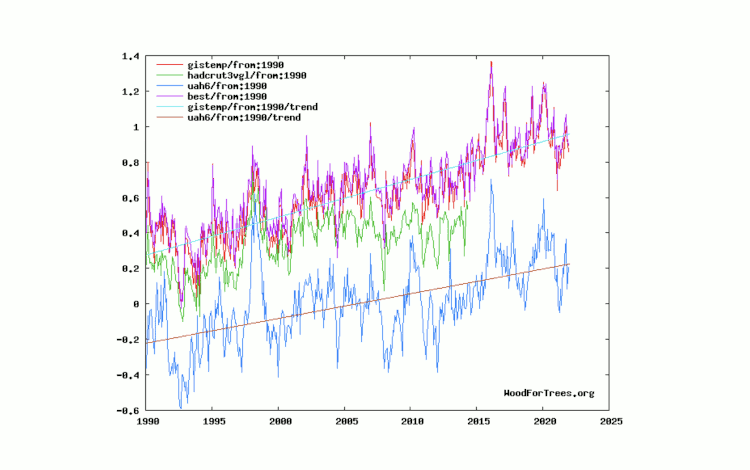
Life expectancy models are constructed from millions of independent observations, medical records vs time of death. By contrast, climate scientists struggle to reconstruct what happened yesterday. There is a significant divergence between temperature reconstructions of the last 30 years, let alone climate projections.
(source Wood for Trees)
- “Millions of lines of code” are not a source of confidence. Millions of lines of code are millions of opportunities to stuff up. As a software developer I’ve worked with physicists and mathematicians. They all think they know how to code, but with very few exceptions they wrote dreadful code.
The problem I saw over and over was that mathematics and physics training creates an irresistible inner compulsion to reduce everything to the simplest possible expression, even when such reduction means ditching software best practices designed to minimise the risk of serious errors. I knew what to expect well before I read Climategate’s “Harry Read Me“.
- If the climate models were fit for purpose, scientists would only need one unified model. The fact there are many diverse models is itself evidence climate scientists are struggling to get it right. Compare this plethora of climate models to say models used to predict the motion of satellites. If satellite orbital predictions were as uncertain as climate projections, it would not be possible to create a global position system which can tell you where you are on the Earth’s surface to within a few feet.
- Climate models may contain major physics errors. Lord Monckton, Willie Soon, David Legates and William Briggs created a peer reviewed “irreducibly simple climate model“, which appears to demonstrate that most mainstream climate scientists use a grossly defective climate feedback model.
… In official climatology, feedback not only accounts for up to 90% of total warming but also for up to 90% of the uncertainty in how much warming there will be. How settled is “settled science”, when after 40 years and trillions spent, the modelers still cannot constrain that vast interval? IPCC’s lower bound is 1.5 K Charney sensitivity; the CMIP5 models’ upper bound is 4.7 K. The usual suspects have no idea how much warming there is going to be.
My co-authors and I beg to differ. Feedback is not the big enchilada. Official climatology has – as far as we can discover – entirely neglected a central truth. That truth is that whatever feedback processes are present in the climate at any given moment must necessarily respond not merely to changes in the pre-existing temperature: they must respond to the entire reference temperature obtaining at that moment, specifically including the emission temperature that would be present even in the absence of any non-condensing greenhouse gases or of any feedbacks. …
Read more: https://wattsupwiththat.com/2019/06/08/feedback-is-not-the-big-enchilada/
Lord Monckton’s point is, since feedback is a function of temperature, feedback processes can’t tell the difference between greenhouse warming and the initial starting temperature, all they see is the total temperature. You have to include the initial starting temperature alongside any greenhouse warming when calculating total feedback, you can’t just use the the change in temperature caused by adding CO2 to the atmosphere. Making this correction dramatically reduces estimated climate sensitivity, slashes future projections of global warming, and removes the need to panic about anthropogenic CO2.
- Cloud error. As Dr. Roy Spencer explains in a 2007 paper which supports Richard Lindzen’s Iris Hypothesis, clouds are potentially a very significant player in future climate change. Yet as scientists sometimes admit, climate models do a terrible job of explaining cloud behaviour. If climate models can’t explain major processes which contribute to global surface temperature, they are not ready to be used as a serious guide to future surface temperature.
Why are climate scientists so keen to have models accepted, why do they seem so ready to gloss over the shortcomings? The following quote from a Climategate email provides an important hint as to what might have gone wrong;
… K Hutter added that politicians accused scientists of a high signal to noise ratio; scientists must make sure that they come up with stronger signals. The time-frame for science and politics is very different; politicians need instant information, but scientific results take a long time …
Source: Climategate Email 0700.txt
In my opinion, political paymasters demanded certainty, so certainty is what they got.
Science needs people like Mark Maslin, who are confident and willing to defend their positions and models.
I’m not suggesting Mark Maslin is in any way following the money or acting in a way which is contrary to his conscience. If there is one thing which comes through very clearly in the Climategate emails, that is that the climate scientists who wrote them are utterly sincere.
What in my opinion broke climate science is the other side of this equation was all but eliminated. What I am suggesting is climate scientists who were not confident in their models and their projections mostly got defunded, via a politically driven brutal Darwinian selection process which weeded out almost everyone who wasn’t “certain”.
We can still see this happening today. Climate scientists who support politically approved narratives receive lavish funding, while those like Peter Ridd who question official narratives, not so much.
I’m not against climate models as such, I believe there is a chance, though not a certainty, that eventually we shall have a comprehensive model of climate change which can produce worthwhile projections of future climate. What I dispute is that most current climate models which tend to run way too hot are fit for purpose. In my opinion, climate models should be regarded as a work in progress, not an instrument which is useful for advising government policy.
via Watts Up With That?
January 29, 2022 at 08:48PM
 Iowa Climate Science Education