
By Paul Homewood

It is abundantly clear that all our major parties are now opposed to further development of North Sea oil and gas reserves.
Ed Miliband, for instance, had this to say about the proposed Cambo field last month:
“It makes no environmental sense and now Shell are accepting it doesn’t make economic sense,” he said.
“Ploughing on with business as usual on fossil fuels will kill off our chances of keeping 1.5 degrees alive and carries huge risks for investors as it is simply an unsustainable choice.
“Shell have woken up to the fact that Cambo is the wrong choice. It’s long past time for the Government to do so.”
Lib Dim leader, Ed Davey went one step further last year, effectively declaring war on Big Oil:
Under the plan outlined to the Guardian by the Lib Dem leader, Ed Davey, another immediate policy would be to stop new bonds being issued in London to finance oil, coal or gas exploration.
Fossil fuel firms already listed in the UK would then have two years to produce a coherent plan about how they would reach net zero emissions by 2045, or risk being struck off the LSE.
In the longer term, pension funds would have to disinvest from fossil fuels by 2035, with all companies with fossil fuel assets removed from the exchange by 2045.
Both parties have of course called for a windfall tax on North Sea oil, which would effectively kill the entire sector stone dead anyway.
Meanwhile regulators have killed off the massive new Jackdaw gas field on spurious environmental grounds, and new North Sea projects will only be approved if ministers judge them to be compatible with the drive to net zero.
Yet none of these politicians seem to appreciate that the UK will carry on needing gas and oil, and lots of it too, for decades to come.
Take natural gas, for example:

https://www.gov.uk/government/statistics/digest-of-uk-energy-statistics-dukes-2020
Total gas consumption, net of energy industry use, was 810 TWh in 2019, more than double total electricity generation.
Gas used in the power sector was 297 TWh, which in turn generated 132 TWh of electricity.
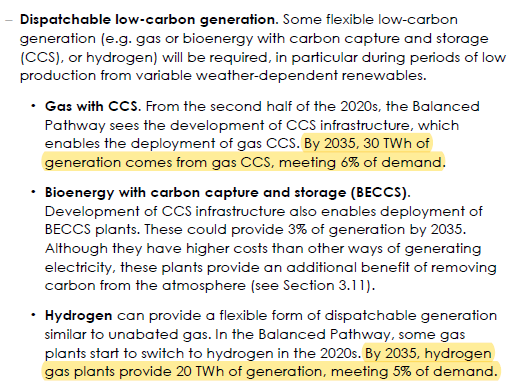
According to the Committee on Climate Change’s Sixth Carbon Budget, we will still need 50 TWh of dispatchable generation by 2035, rising to 60 TWh in 2040:
https://www.theccc.org.uk/publication/sixth-carbon-budget/
This will either have to come from gas with carbon storage, or hydrogen made from gas. (The CCC acknowledge that electrolysis will remain a tiny source of hydrogen for many years to come).
So we will therefore still need a lot of gas for power generation, one way or another. And because both CCS and hydrogen production are energy inefficient, even more gas.
A rough calculation would suggest we would require 180 TWh of gas to produce 60 TWh of electricity, via CCS or hydrogen. That is 60% of current consumption.
It is hard to see much of a decline in gas consumption in the other sectors. Even if new gas boilers are banned in 2035, as mooted, it is unlikely many householders will have already converted to heat pumps beforehand.
Equally industrial users of gas will be loathe to spend billions switching to electricity, and a hydrogen network simply won’t exist in any scale by then.
My guess is that natural gas consumption will still be around 700 TWh by 2035, only 14% lower than currently.
At the moment, we produce about half the gas we use, and import the rest.
North Sea Oil
Now let’s move on to oil.

https://www.gov.uk/government/statistics/digest-of-uk-energy-statistics-dukes-2020
Surface transport accounts for most of the UK’s oil consumption, 37 TWh or 57%.
According to the CCC, the ban on new petrol/diesel cars from 2030 will reduce numbers of these on the road from the current 34 million to around 14 million in 2035. This is on the extremely optimistic assumption that there will already be 12 million EVs on the road in 2030, up from the current hundred thousand or so.
But taking the CCC’s projections at face value, we could estimate that oil consumption will decline from 37 million tonnes to approximately 17 TWh. This assumes that HGVs will still largely be dependent on diesel.
Oil used for aviation fuels may decline slightly, as biofuels start to play a bigger part, but given this is essentially an international issue, it would be risky to assume any significant drop in demand for oil.
As for the other sectors, it is difficult to see any substantial cuts in oil consumption.
If we add this lot up, oil consumption in 2035 will still probably be around two thirds of today’s.
Worse still, it is not only the UK, where oil and gas exploration is being actively discouraged. We see the same thing happening in the USA and across Europe. And all in the wishful thinking that we will be able to run our economies largely on renewable energy in a few years time.
Instead we will end up facing acute shortages of oil and gas, which will make the current energy crisis seem like a picnic in the park.
That would trigger another Great Depression.
via NOT A LOT OF PEOPLE KNOW THAT
January 30, 2022 at 07:45AM
 Iowa Climate Science Education