Month: January 2022

Climate Clown Show

via Real Climate Science

https://ift.tt/3GrScA1

January 13, 2022 at 06:10PM

All Roads Lead to Wuhan

Matt Ridley connects the dots in his Spiked article Why did scientists suppress the lab-leak theory? Excerpts in italics with my bolds and added images.

In private, they said it was plausible. In public, they called it a conspiracy theory.

In December 2019 there was an outbreak in China of a novel bat-borne SARS-like coronavirus a few miles from the world’s leading laboratory for collecting, studying and manipulating novel bat-borne SARS-like coronaviruses. We were assured by leading scientists in China, the US and the UK that this really was a coincidence, even when the nine closest relatives of the new virus turned up in the freezer of the laboratory in question, at the Wuhan Institute of Virology.

Now we know what those leading scientists really thought.

Emails exchanged between them after a conference call on 1 February 2020, and only now forced into the public domain by Republicans in the US Congress, show that they not only thought the virus might have leaked from a lab, but they also went much further in private. They thought the genome sequence of the new virus showed a strong likelihood of having been deliberately manipulated or accidentally mutated in the lab. Yet later they drafted an article for a scientific journal arguing that the suggestion not just of a manipulated virus, but even of an accidental spill, could be confidently dismissed and was a crackpot conspiracy theory.

Jeremy Farrar – who organised the call on 1 February with Patrick Vallance, Francis Collins, Anthony Fauci and a Who’s Who of virology – had already spilled a few of the beans in his book, Spike, published last year. He wrote that at the start of February 2020 he thought there was a 50 per cent chance the virus was engineered, while Kristian Andersen of the Scripps Research Institute was at 60-70 per cent and Eddie Holmes of Sydney University put it at 80 per cent. But some time after the call they all changed their mind. Why? They have never troubled us with an answer.

Even after the call, their concern centred on a feature of the SARS-CoV-2 genome that had never been seen in any other SARS-like coronavirus before: the insertion (compared with the closest related virus in bats) of a 12-letter genetic sequence that creates a thing called a furin cleavage site, which makes the virus much more infectious.

These are the very suspicions raised in April 2020 in a careful essay by Russian-Canadian biotech entrepreneur Yuri Deigin, which was dismissed at the time by Garry and the others as nonsense.

Two years later, no such natural furin-cleavage-site insertion has yet turned up in the many wild SARS-like viruses found since then. But what has turned up is a grant proposal put to the US’s Defense Advanced Research Projects Agency (DARPA) in 2018 to fund experiments that would deliberately insert novel furin cleavage sites into novel SARS-like coronaviruses to help them grow in the lab. And who was party to that proposal? Why, the Wuhan Institute of Virology.

It’s an open secret in science that you sometimes put things into grant proposals that you have already started doing, and the Chinese Academy of Sciences was funding most of the work in the Wuhan Institute of Virology anyway.

The emails unveiled this week reveal no good scientific reason at all for why these leading virologists changed their minds and became deniers rather than believers in even the remote possibility of a lab leak, all in just a few days in February 2020. No new data, no new arguments. But they do very clearly reveal a blatant political reason for the volte-face. Speculating about a lab leak, said Ron Fouchier, a Dutch researcher, might ‘do unnecessary harm to science in general and science in China in particular’. Francis Collins was pithier, worrying about ‘doing great potential harm to science and international harmony’.

Contradicting Donald Trump, protecting science’s reputation at all costs and keeping in with those who dole out large grants are pretty strong incentives to change one’s mind.

In August 2020 Kristian Andersen and Robert Garry were among the lead investigators to receive $8.9million to study emerging infectious diseases, in a grant from Anthony Fauci’s National Institute of Allergy and Infectious Diseases, part of Francis Collins’s National Institutes of Health.


via Science Matters

https://ift.tt/3fov35O

January 13, 2022 at 06:04PM

“Hansen vs. The World” (Richard Kerr on uncertain climate science in 1989)

From MasterResource

By Robert Bradley Jr. — January 13, 2022

A historical oddity is how the U.S. government and Exxon “knew” about the ‘greenhouse signal’ and perilous anthropogenic climate change when climate scientists did not. But such is the state of the debate where PR and lawsuits overwhelm a rational view of knowledge. (below)

“In my expert opinion, in the period shortly after President Carter took office in 1977,” state James Gustave Speth, “there was a growing sense of concern and indeed urgency within the federal government that fossil fuel burning was heating the planet and causing the climate to change in many ways that could be catastrophic….” [1]

“Exxon was aware of climate change, as early as 1977, 11 years before it became a public issue,” stated an article in Scientific American. “This knowledge did not prevent the company … from spending decades refusing to publicly acknowledge climate change and even promoting climate misinformation.”

But the Science . . .

How did the U.S. government and Exxon know about the “greenhouse signal” and perilous anthropogenic climate change when climate science did not? But such is the state of the debate where PR and lawsuits overwhelm a rational view of knowledge.

In the real world, global cooling was the fear. “Certainly the threat of another ice age was the topic of much scientific and popular discussion in the 1970s, stated Harold Bernard, Jr., in The Greenhouse Effect.

Books and articles entitled ‘The Cooling,’ ‘Blizzard,’ ‘Ice,’ and ‘A Mini Ice Age Could Begin in a Decade,’ abounded. The ‘snow blitz’ theory was popularized on the public television presentation of ‘The Weather Machine’ in 1975. And certainly the winters of the late 1970s were enough to send shivers through our imaginations. [2]

And in the late 1980s and early 1990s (and even today), evidence about the positive and negative effects of carbon dioxide on global climate was (is) controversial. [3]

Enter Richard Kerr, longtime global-warming writer at Science, the flagship publication of the American Association for the Advancement of Science. He chronicled how the mainstream of climate science disputed James Hansen’s assertions of the arrival of global warming and the enhanced greenhouse effect as opinion rather than science.

Kerr wrote in mid-1989:

If many of Hansen’s colleagues find his first point about the warming trend regrettable, they view his second–that the warming could, with “high confidence,” be linked to the greenhouse effect–as unforgivable. None of the select greenhouse researchers at the meeting could agree with him. ‘Taken together, his statements have given people the feeling the greenhouse effect has been detected with certitude,” says Michael Schlesinger, himself a modeler at Oregon State University. “Our current understanding does not support that. Confidence in detection is now down near zero.”

Continuing Uncertainty

There was no settled science about a climate crisis well after James Hansen lit the fires in 1988. In 1998, William K. Stevens, global warming scribe at the New York Times, quoted “a leading expert on the issue of detecting the greenhouse signal, climatologist Thomas Wigley of the National Center for Atmospheric Research in Boulder:

”They’re making progress, and there is a lot of hard work involved, and I hold them in the highest regard,” Dr. Tom Wigley … said of Dr. Mann and his colleagues. ”But I think there’s a limit to how far you can ever go.” As for using proxy data to detect a man-made greenhouse effect, he said, ”I don’t think we’re ever going to get to the point where we’re going to be totally convincing.”

So again, what did Exxon or the U.S. government (or anyone else) know about the strength of the enhanced greenhouse effect, much as a doom-and-gloom answer to increasing concentrations of CO2 and other man-made greenhouse gases in the atmosphere?

—————————

[1] Speth, They Knew: The US Federal Government’s Fifty-Year Role in Causing the Climate Crisis (MIT Press: 2021), p. 11.

[2] Harold Bernard, Jr., The Greenhouse Effect (Cambridge, MA: Ballinger Publishing, 1980), p. 20.

[3] Given anthropogenic global warming, the qualitative begs the quantitative question of good, benign, and benign. Lower-range warming is generally thought by climate economists as net beneficial, while higher warming scenarios are neutral-to-negative. (Climate models can be calibrated to tell you just about anything).

via Watts Up With That?

https://ift.tt/33kPcqR

January 13, 2022 at 04:42PM

Repeat boosters may reduce the immune response

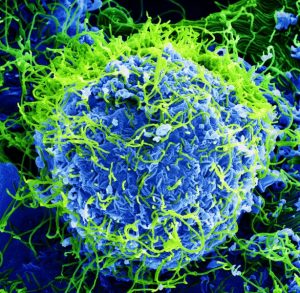
Ebola Virus, electron micrograph

Author BernbaumJG

Our immune systems are a fully functioning type of AI, or rather BI — biological intelligence. After millions of years of evolution, the system is tuned for efficiency with feedback loops “up the kazoo”. We’re provoking a complicated system we don’t understand.

It’s quite possible, if we keep provoking it with something “non threatening”, rather than getting more excited, the immune system may get bored. It could also get tired, desensitized, or exhausted.

Robert Malone warned months ago that we need to test each round of vaccines and we can’t assume our bodies will respond the same way.

Whatever it is, the European Medicines Agency wants to put the brakes on the booster program:

By: Bloomberg |

Repeat booster doses every four months could eventually weaken the immune response and tire out people, according to the European Medicines Agency.

European Union regulators warned that frequent Covid-19 booster shots could adversely affect the immune response and may not be feasible.

Repeat booster doses every four months could eventually weaken the immune response and tire out people, according to the European Medicines Agency. Instead, countries should leave more time between booster programs and tie them to the onset of the cold season in each hemisphere, following the blueprint set out by influenza vaccination strategies, the agency said.

The head of vaccine strategy at the EMA said that we can’t repeat boosters constantly:

“We should be careful in not overloading the immune system with repeated immunizations” — Marco Cavaleri, the EMA head of biological health threats and vaccines strategy

He also said effectively that we don’t even know exactly how many antibodies  people need to get protection. We can’t define the threshhold of protection. Some people with quite high levels of neutralizing antibody still got infected while people with low levels of neutralizing antibody that did not get sick in the trials.

This is a bit of a major problem I would think. Isn’t the usual test to see if someone has “protection” just a blood test looking for antibodies? If that doesn’t work, something is very wrong with the mental model we have for how vaccines operate? Is it some other antibodies that really offer protection, ones they are not testing for?


0 out of 10 based on 0 rating

via JoNova

https://ift.tt/3Fp6bWc

January 13, 2022 at 02:37PM