Month: January 2022

The World Has Been Getting Much Colder For The Last Six Years

By Paul Homewood


 image

The past seven years have been the hottest on record, according to new data from the EU’s satellite system.

The Copernicus Climate Change Service said 2021 was the fifth-warmest year, with record-breaking heat in some regions.

And the amount of warming gases in our atmosphere continued to increase.

Governments are committed to limiting global temperature rise to 1.5C to curb climate change. But scientists warn that time is fast running out.

The environmental, human and economic costs of hotter temperatures are already being seen globally.

Europe lived through its warmest summer, and temperature records in western US and Canada were broken by several degrees. Extreme wildfires in July and August burnt almost entire towns to the ground and killed hundreds.

"These events are a stark reminder of the need to change our ways, take decisive and effective steps toward a sustainable society and work towards reducing net carbon emissions," Carlo Buontempo, director of the Copernicus Climate Change Service, explains.

The Copernicus data comes from a constellation of Sentinel satellites that monitor the Earth from orbit, as well as measurements taken at ground level.

Fifth-warmest year

Copernicus data showed that 2021 was the fifth-hottest on record, marginally warmer than 2015 and 2018. Taken together, the past seven years were the hottest seven years on record by a clear margin, the agency explained.

The 2021 average temperature was 1.1-1.2C above the pre-industrial level around 150 years ago.

line

Analysis box by Justin Rowlatt, climate editor

It would be easy to dismiss the latest global temperature figure as a non-event. Who celebrates fifth place in anything?

If we were in a film, these annual temperature updates would be the ominous drum beat signalling the plot is darkening.

They measure out the pace of change in our world. The increments may be tiny – a fraction of a degree – but the direction of travel is inescapable.

And make no mistake, the rhythm they mark out increasingly sets the pace for all our lives. Think of the fires and floods that affected so many people in 2021.

And now look again at what the data is telling us: the seven hottest years ever recorded have been the last seven years.

We can’t say we weren’t warned.

line

https://www.bbc.co.uk/news/science-environment-59915690


Quite what a picture of a girl cooling herself down has to do with anything beats me. Evidently we did not have hot weather in the past!


Despite the visions of apocalypse, Justin Rowlatt misses the crucial issue. Global warming is taking place far more slowly than the models predicted:

image

RSS Satellite Global Temperature anomalies v Climate Models

https://www.remss.com/research/climate/#:~:text=The%20RSS%20merged%20lower%20stratospheric%20temperature%20data%20product,in%20well-mixed%20greenhouse%20gases%20causes%20by%20human%20activity.


It is those computer models that dictated UN climate policies, based on ludicrous projections of rapid warming. In reality, the amount of warming since 1979 has been tiny.

Indeed, when you factor in margins of error, there has been no statistically significant warming since 1998.

You might also note that the satellite data begins in 1979, which just so happens to be the coldest period of the 20thC. At the time it was acknowledged that global temperatures had decline by 0.5C since 1940, which offsets most of the increase since 1979.

This decline in temperatures coincides with the cold phase of the Atlantic Multidecadal Oscillation, which has been in warm phase since the 1990s and is soon due to revert to cold.


https://psl.noaa.gov/cgi-bin/gcos_wgsp/tsanalysis.pl?tstype1=91&tstype2=0&year1=&year2=&itypea=0&axistype=0&anom=0&plotstyle=0&climo1=&climo2=&y1=&y2=&y21=&y22=&length=&lag=&iall=0&iseas=0&mon1=0&mon2=11&Submit=Calculate+Results


Everything therefore points to a standstill in global warming for coming decades, and quite probably a period of cooling.

None of this justifies the hysteria promulgated by the BBC, or the Net Zero policies being enforced across the western world.

Final comment.

The BBC makes a big issue about the supposed “warmest summer in Europe”. Let us suppose we had a thermostat to take the world’s climate back to those halcyon days of the 18thC.

I wonder what Justin Rowlatt would have made of headlines that read:

“Europe has just had its coldest year on record”

via NOT A LOT OF PEOPLE KNOW THAT

https://ift.tt/3GnbKFL

January 11, 2022 at 04:45PM

Climate Industrial Complex Left Clueless As Fossil Fuels Proliferate

By Vijay Jayaraj

This commentary was first published January 11, 2022 at Real Clear Energy

It has been a little more than a month since the United Nations climate meeting at Glasgow, yet global use of fossil fuels has increased rapidly.

For instance, U.S. President Joe Biden cancelled domestic oil projects and vowed to stop funding for international fossil fuel projects. But as fuel prices rose, Biden responded to his self-induced energy insecurity by releasing 50 million barrels of oil reserves and even called for an increase in domestic oil production.

Within a span of a few months, the U.S. president went from being a climate savior to climate villain. Though many may classify his actions as temporary solutions (to a non-existent problem), the rest of the world sees through the veneer of climate politics and the hypocrisy within.

There is nothing that the climate industrial complex can do about the situation in the U.S. or other parts of the world. In fact, in Asia, production of fossil fuels is proliferating.

India and China Goes Full Throttle on Coal

As climate doomsayers met in November in Glasgow for the annual U.N. meeting, Asian political leaders promoted policies that sought to increase fossil fuel production — largely because of lessons learned from acute coal shortages in India and China earlier in the year.

The Indian government has opened more coal mines and has allocated new mines to private players through auctions. India’s coal minister has asked the government’s coal production arm, Coal India Limited, to meet an annual target of 1 billion tonnes by 2024.

Meanwhile, China is taking similar measures to ensure its coal supply. Coal production for November hit record highs as Beijing scrambled to ensure enough of the fuel to meet winter needs. October 2021 witnessed the highest monthly production since March 2015. Overall, the first 11 months of this year accounted for 3.67 billion tonnes of coal, which is 4.2% higher than 2020.

Though India and China have managed to overcome the recent shortage in coal reserves, domestic production must be complemented by imports. Hence, the price of coal from Australia and Indonesia remains high. With the Omicron variant expected to have only a minimal impact on the economy, we can expect sustained demand for coal through 2022.

Oil Futures on a high and India cashes in on imports

India is also keen on securing its oil sources as OPEC has forecasted a high global demand in 2022. Oil from Saudi Arabia, Kuwait, and Iraq were bought in large quantities by Asian countries.

India’s Minister of Petroleum and Natural Gas reported that the country would acquire “massive additional areas for oil exploration and production” by 2025. “As far as the government of India is concerned, we are going to step on the accelerator in terms of exploration and production in a very big way,” said the minister in November.

An UAE firm owned by India’s richest man is all set to import crude oil, petroleum, and petrochemical products in December. The country’s major state-owned oil firms and refineries have already secured supply for the first half of 2022.

Gas prices at fuel stations remained high in India throughout the year. However, the federal government intervened by releasing millions of barrels of oil from strategic reserves, prices have come down drastically. Meanwhile, the country’s aviation minister has made an open call to states to reduce jet fuel prices in order to “increase air-traffic.”

So, if anyone is thinking that fossil fuels are dead, they should think again. The 2.6 billion people in India and China will continue to use fossil fuels as their primary energy source until 2070.  Even the most advanced European and Scandinavian countries are witnessing a revival of the fossil fuel sector.

It is as if the anti-fossil climate conference never happened this year. As if promises to end fossil fuels are nothing but vapors from the incense offered at the altar of climate drama — only to be consumed by an inescapable energy reality.

Vijay Jayaraj is a Research Associate at the CO2 Coalition, Arlington, Va., and holds a Master’s degree in environmental sciences from the University of East Anglia, England. He resides in Bengaluru, India.

via Watts Up With That?

https://ift.tt/33tolc5

January 11, 2022 at 04:44PM

Glow-Worm Waning

Global warming is apparently leading to glow-worm waning in the UK. Today the Guardian has an articlei on its website under the title “How the speed of climate change is unbalancing the insect world”. This deals with a lot of issues, and inevitably it’s always bad news. Good insects are going to struggle with climate change, while nasty ones are going to thrive. It’s always the way, isn’t it? However, one section, which particularly interests me, concentrates on glow-worms in the UK. And this is what it solemnly tells us:

Further south, in the UK, glowworm numbers have collapsed by three-quarters since 2001, research has found, with the climate crisis considered the primary culprit. The larvae of the insects feed on snails that thrive in damp conditions, but a string of hot and dry summers has left the glowworms critically short of prey.

No link is offered up to support the claim that climate change is the primary culprit for the decline in UK glow-worm numbers, though a team of researchers from Sweden and Spain are mentioned (though not, curiously, researchers from the UK).

But here’s the thing. On 22nd February 2020, the Guardian ran a story under the headline “Why the lights are going out for fireflies”ii. And it told a rather different story. It started by discussing declining firefly populations in the US, then went on to say that the best data is from the UK, where citizen scientists have tracked the UK’s only firefly, the common glow-worm, Lampyris noctiluca, since the 1970s.

Then it linked to a reportiii entitled “A Global Perspective on Firefly Extinction Threats” which, as even the Guardian had to acknowledge, makes it abundantly clear that climate change is far from being the main threat to glow-worms. Indeed, as the report’s abstract states:

We conducted a survey of experts from diverse geographic regions to identify the most prominent perceived threats to firefly population and species persistence. Habitat loss, light pollution, and pesticide use were regarded as the most serious threats…

And the body of the report goes further:

More than half of the 49 respondents assigned the highest possible threat score (5) to habitat loss, whereas nearly one-third did so for light pollution, and one-fifth did so for pesticide use. However, their threat scores differed considerably across geographic regions… with additional threats such as water pollution and tourism ranked as important concerns in some regions.

Rather than quote extensively from the report, I simply note that habitat loss was noted as occurring for a variety of reasons, though other than two brief references to drought, the reasons are all man-made, but nothing to do with climate change. In Europe, reference is made to urbanization, industrialization, and agricultural intensification, plus increased use of pesticides, herbicides, and fertilizer. In England specifically, mention is made of road construction, ditch filling, timber stockpiling (and drought; I’m nothing if not fair). Italy sees blame put on agricultural intensification, while in Spain it’s down to the abandonment of small orchards and irrigated agricultural plots in which Nyctophila reichii, Lampyris iberica, and Lamprohiza paulinoi often occur. Once abandoned, these cultivated areas become more xeric and less suitable for snails, which constitute the main prey for certain fireflies, apparently. In Malaysia it’s conversion of riverbank mangroves to agriculture, aquaculture, and urbanization. Throughout south east Asia, large areas of riverbank mangroves have been cleared for oil palm plantations, shrimp farms, or flood mitigation, making these sections unsuitable for the growth and development of Pteroptyx firefly larvae and their snail prey

On and on it goes. Globally, increasing human populations along coastlines have caused extensive habitat loss and fragmentation, threatening both mangrove fireflies and other species inhabiting coastal marshes. In the western United States and Texas, several fireflies are restricted to habitats adjoining permanent water sources, including rivers, streams, lakes, ponds, springs, and irrigated fields. Groundwater pumping to meet urban and agricultural water demands has substantially reduced surface water flow and lowered groundwater tables, and this might be exacerbated by climate-change induced drought (though that’s far from being the primary issue).

Apart from habitat loss, light pollution, and pesticides, other threats were mentioned – water pollution, tourism, overharvesting, invasive species, and finally climate change. And what do the authors have to say about climate change?

…the effect of anthropogenic climate disruption on firefly populations remains unknown, the restricted ranges and specialized habitat requirements of certain fireflies suggest that they are likely to be threatened by drought and sea level rise.

In other words, it’s a potential threat, and an additional problem, but it’s well down the list, and certainly isn’t, as today’s Guardian article tells us, “the primary culprit”.

And yet, despite all that, less than two weeks after the Guardian article summarising the report that said climate change was almost immaterial, on 5th March 2020 a new articleiv appeared at the Guardian under the heading “Glowing, glowing, gone: plunge in glow-worm numbers revealed – Exclusive: study shows a 75% fall in 18 years in England, with climate a clear factor”. The story this time was broadly the same as the story today:

Glow-worm numbers have plunged by three-quarters since 2001, research in England has revealed, with the climate crisis a clear factor.

The larvae feed on damp-loving snails, and increasingly hot and dry summers mean fewer prey and a greater risk of glow-worms becoming desiccated.

So, which is it? Climate change or not climate change? Well, there’s a problem with blaming hot, dry summers, at least so far as the data provided by the Met Office makes clear. They supply a UK summer rain chartv among other things, and I can’t see the decline in summer rainfall postulated by the Guardian. In fact, since the collapse in numbers is specifically said to have occurred sine 2001, on the contrary summer rainfall trends seem to have increased since them. The same is broadly true for the England-only data.

I knew very little about glow-worms before the Guardian’s article today piqued my interest. I am now slightly better informed, though still with a lot to learn. I note that others who know more than me, don’t blame climate change for the glow-worm decline. For instance, the Woodland Trustvi says this:

Whilst glow-worms remain fairly common, there is some concern about possible declines, and they have vanished from some sites. Possible threats include changes in land-use and habitat, use of pesticides, light pollution, and possibly parasites.

There are usually two sides (at least) to every story. Climate change may be playing a part in the decline of glow-worm numbers in the UK and firefly numbers globally. However, that part seems to be a lot less than the Guardian would have us believe.

Endnotes

i https://www.theguardian.com/news/2022/jan/11/climate-change-insect-world-global-heating-species

ii https://www.theguardian.com/environment/2020/feb/22/why-lights-going-out-fireflies-conservation-pollution

iii https://academic.oup.com/bioscience/article/70/2/157/5715071#192204015

iv https://www.theguardian.com/environment/2020/mar/05/glowing-glowing-gone-plunge-in-glow-worm-numbers-revealed

v https://www.metoffice.gov.uk/research/climate/maps-and-data/uk-temperature-rainfall-and-sunshine-time-series

vi https://www.woodlandtrust.org.uk/trees-woods-and-wildlife/animals/beetles/glow-worm/

via Climate Scepticism

https://ift.tt/3zLlF5C

January 11, 2022 at 02:48PM

Coal power to hit all time high in 2022 says IEA weeping

h.t Andy May

So much for the End of Coal

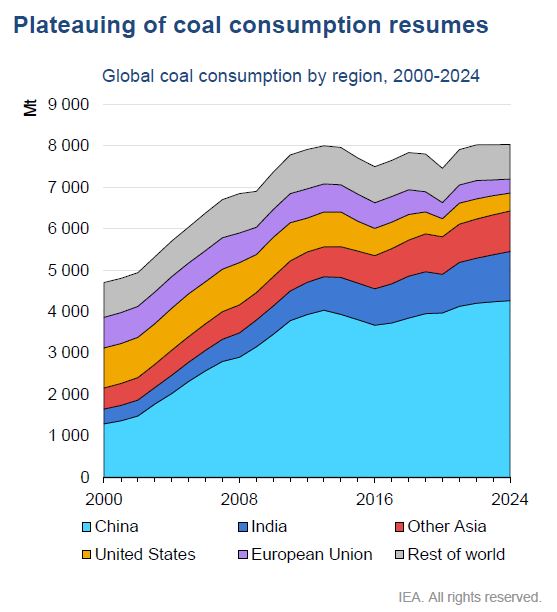
It’s a bumper year in 2021, a bigger year in 2022, and possibly more glorious records for coal in 2023 and 2024. Humans burnt more coal this year than at any other time in history.

Coal-fired power generation is set to reach an all-time high in 2021

The declines in global coal-fired power generation in 2019 and 2020 led to expectations that it might have peaked in 2018. But 2021 dashed those hopes. With electricity demand outpacing low-carbon supply, and with steeply rising natural gas prices, global coal power generation is on course to increase by 9% in 2021 to 10 350 terawatt-hours (TWh) – a new all-time high.

As the IEA concludes through gritted teeth: Global coal consumption is not on the Net Zero trajectory and is unlikely to be before 2024. Perhaps someone should tell all the Glasgow Minions?

Other editors might have labelled this, “Coal Still Vital” or “Coals Day is Here”! Instead the IEA saw a sedate plateauing that kept plateuing in the headlines:

IEA, Global Coal Use, 2021. Graph.

Fully two-thirds of global coal is used by just two countries. The other 193 nations split the last third. Many of these other nations are the same ones fighting  hard to make tiny reductions in their coal use in the quest for fashionable weather-purity.

Indeed, one third of all the coal on Earth is used to make electricity in China

Power generation in China alone is responsible for almost one-third
of global coal consumption. No other sector in any other country –
or any other fuel – has a comparable influence on global trends.

Communist planning still doesn’t work

In the third quarter of 2021, an imbalance between coal supply and demand became apparent when coal producers were unable to keep up with surging demand (see also the Supply chapter). The shortage’s effects were exacerbated by China’s rigid electricity tariff system. Because Chinese electricity prices are regulated, they do not follow coal prices. Therefore, as coal prices rose and electricity prices remained rigid (they could oscillate only 10% from the benchmark price, although this was reformed in October to allow a higher range), coal-fired power producers had no incentive to secure sufficient coal.

And then there was pain in China. Imagine power cuts and production losses of 70 – 80%? And these were not pandemic losses, just bad planning:

In mid-2021, China began to curtail industrial activity in some
provinces as coal supplies and imports were unable to keep up with
demand. In September, power rationing for industrial consumers
occurred in 20 provinces. In Guangdong province, for example,
manufacturers of ceramic products experienced power cuts of up to
70%, and Yunnan province ordered cement producers to cut
production by 80%. Similar measures – and even complete power cuts – affected aluminium, steel and other energy-intensive industries all over China. In Heilongjiang, Jilin and Liaoning, even residential consumers were affected as power supplies fell short of demand by as much as 20% at times.

“coal’s share of the global power mix in 2021 is expected to be 36%”

REFERENCE

Coal 2021, IEA, https://ift.tt/3ngP96l, the press release.

10 out of 10 based on 3 ratings

via JoNova

https://ift.tt/337F9FD

January 11, 2022 at 02:00PM