Month: January 2022

University of Houston: More Renewable Energy to Prevent Another Texas Ice Storm Outage

Guest essay by Eric Worrall

According to the University of Houston and Houston Advanced Research Centre, more investment in renewable energy will prevent a repeat of the deadly power outages during last year’s ice storm.

Energy experts say renewable energy will be key in making Texas’ electricity more reliable in 2022

To learn more about what’s expected in 2022 for clean energy, Houston Public Media spoke with Gavin Dillingham, Vice President of Research for energy with the Houston Advanced Research Center. 

KYRA BUCKLEY | POSTED ON JANUARY 7, 2022, 1:20 PM

Experts watching Houston’s energy industry say the pandemic has accelerated the transition away from fossil fuels and towards renewable energy — and demand is growing worldwide for clean, affordable energy. 

It comes as leaders in Texas are working to increase reliability of the electric grid after last February’s deadly winter storm caused widespread outages across the state. 

Growth in renewable energy will be key making the grid better able to handle sharp increases in energy demand, like what happened during Winter Storm Uri.

To learn more about what’s expected in 2022 for clean energy, Houston Public Media spoke with Gavin Dillingham, Vice President of Research for energy with the Houston Advanced Research Center (HARC).

Read more: https://www.houstonpublicmedia.org/articles/news/in-depth/2022/01/07/416801/in-2022-expect-renewable-energy-to-be-key-in-discussion-around-how-to-make-texas-electricity-more-reliable/

My first reaction was to wonder what they are putting into the drinking water in the University of Houston. Anyone can tell just be looking at the output graph (above) that renewables performed dismally during the ice storm. Solar energy dropped away to almost nothing, and wind turbines froze solid.

I’m not denying winterising wind turbines might have saved a few from freezing, but there are other problems.

New York Times wrote a frantic defence of wind last February, which hilariously claimed that “… Blades of some Texas wind turbines did freeze in place, but wind power is estimated to make up only 7 percent or so of the state’s total capacity this time of year in part because utilities lower their expectations for wind generation in the winter in general. …“.

If utilities do “lower their expectations” for wind power generation in winter, there seems no point chasing more wind.

Solar is also a poor performer because in winter the days are shorter and the angle of the sun is lower, even without the added bonus of winter storm clouds darkening the sky or ice and snow covering the solar panels.

So the question is, how could more investment in renewables possibly improve the situation? No amount of investment can capture renewable energy which does not exist, in a winter environment which appears to be consistently hostile to the harvesting of any form of renewable energy.

via Watts Up With That?

https://ift.tt/31H2pcK

January 10, 2022 at 12:26PM

Study Shows COVID Vaccines Make Things Worse

“another independent analysis that is difficult to refute: we have been misled by the CDC, FDA, and NIH.” New big data study of 145 countries show COVID vaccines makes things worse (cases and deaths) France: +28% Vaccine Causal Impact on … Continue reading

via Real Climate Science

https://ift.tt/3HQbpvM

January 10, 2022 at 12:21PM

Coastal Land Area Is Expanding So Fast That ‘Catastrophic’ Sea Level Rise Cannot Keep Up

Contrary to what would be expected with alarmingly high sea level rise rates, shorelines across the world are expanding rather than retreating into the sea.

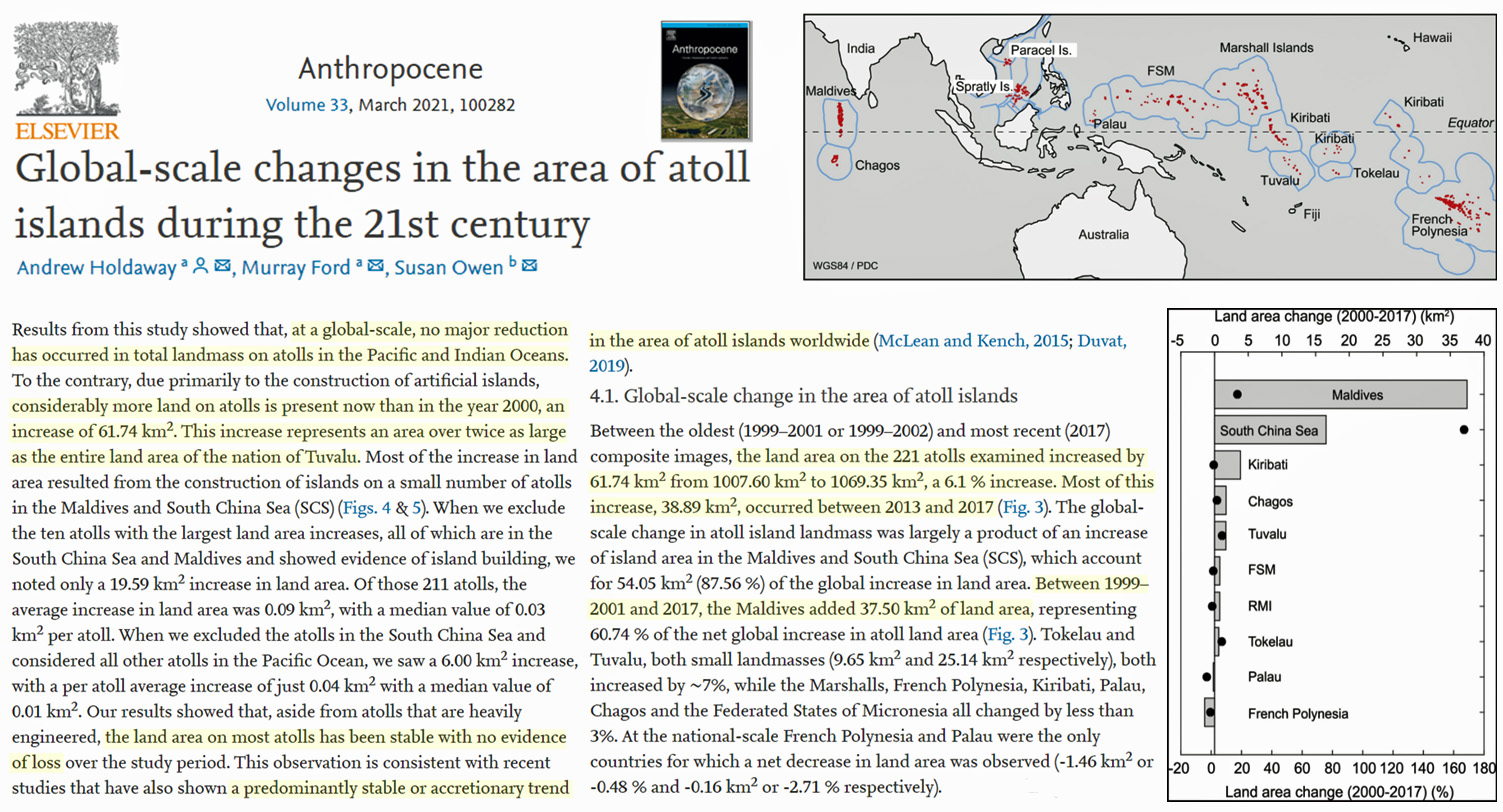
A few months ago we highlighted an analysis of the post-2000 net expansion (from 1007.60 km² to 1069.35 km², or +6.1%) in coastal land area for 221 Pacific and Indian Ocean islands (Holdaway et al., 2021).

Over half of the net 21st century growth (39 km² of 62 km²) for these islands occurred in a span of just four years: 2013 to 2017.

Image Source: Holdaway et al., 2021

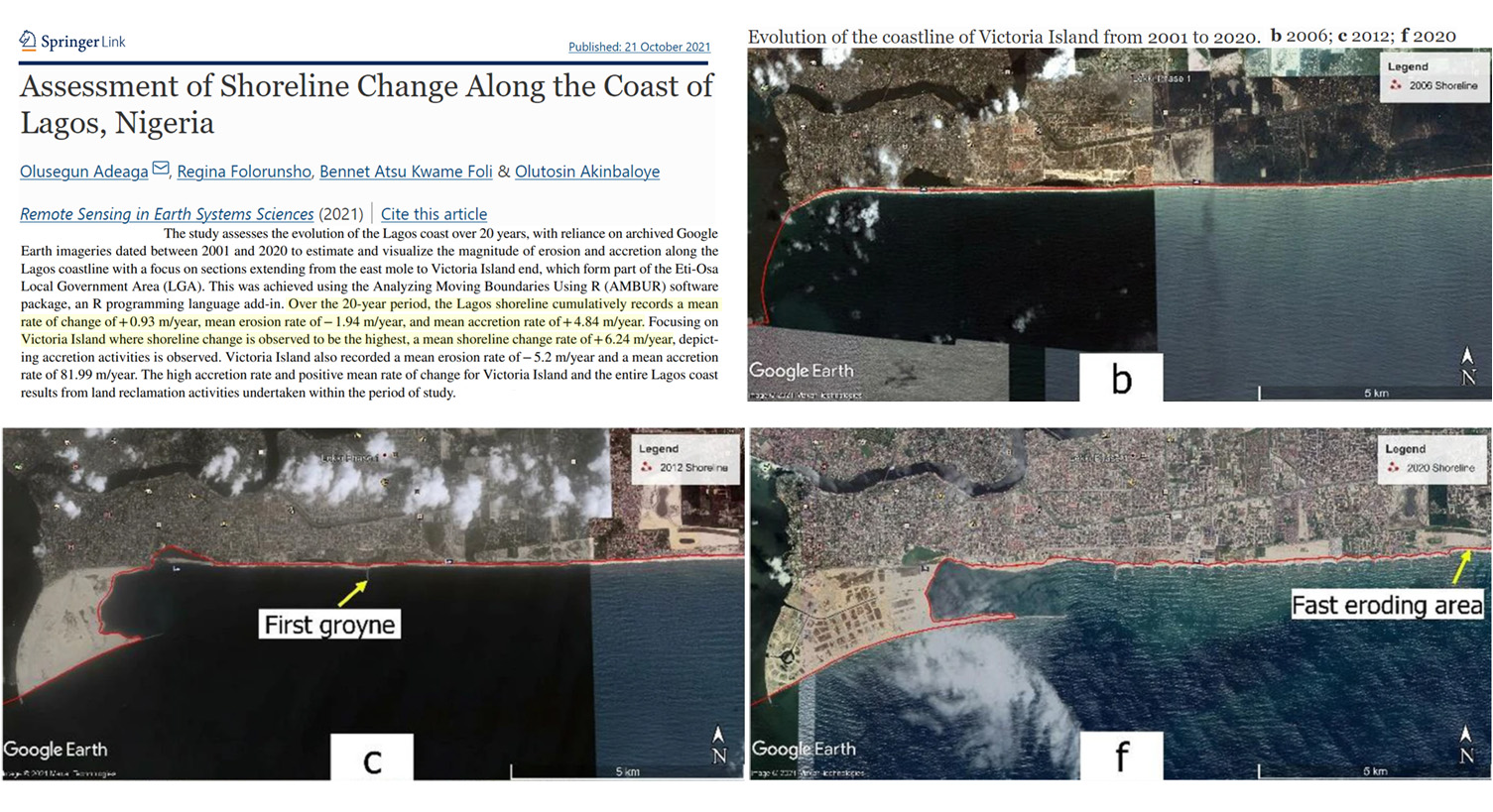
Notice the rapid shoreline changes in these satellite images of the coast of Lagos, Nigeria (Adeaga et al., 2021). The first (b) is from 2006. The second (c) is 2012. The last image (f) is 2020.

Between 2001 and 2020 the average regional net shoreline growth rate was +0.93 m/year. One area – Victorian Island – has had a mean shoreline change rate of +6.24 m/year.

Image Source: Adeaga et al., 2021

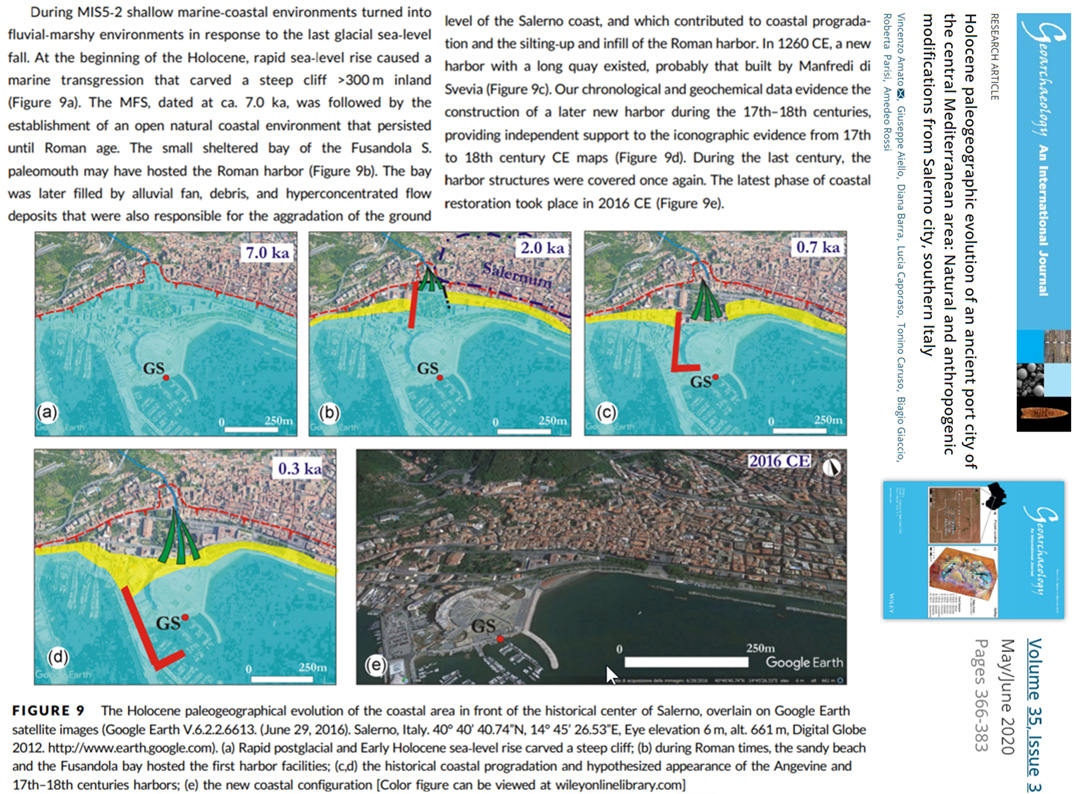
The current shoreline for Salerno City, southern Italy, has expanded seawards rather rapidly in recent centuries (Amato et al., 2020). If we track the relative location of the red “GS” dot from the below images we see that the 17th to 18th centuries (0.3 ka) had a shoreline >250 m further landward than 2016.

Image Source: Amato et al., 2020

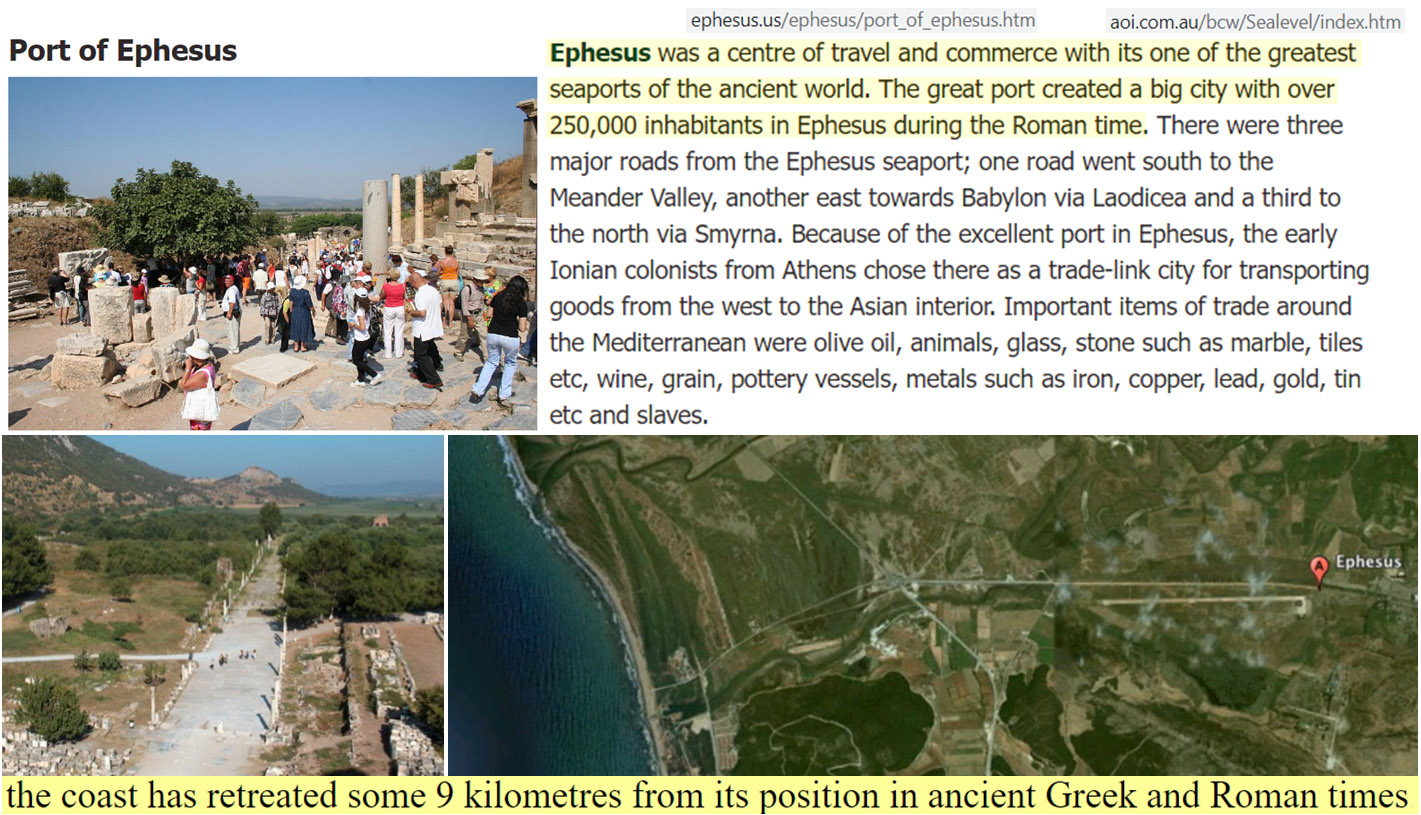
During Roman times (~2200-1600 years ago), CO2 levels were about 265 ppm. Ephesus was then a thriving seaport city situated on the Aegean Sea.

Sea levels have fallen ~2-3 m in recent millennia, as more water is trapped on land as ice today.

The Ephesus harbor remains are now 9 km from the coast.

Image Source: ephesus.us and David Noel, Australia

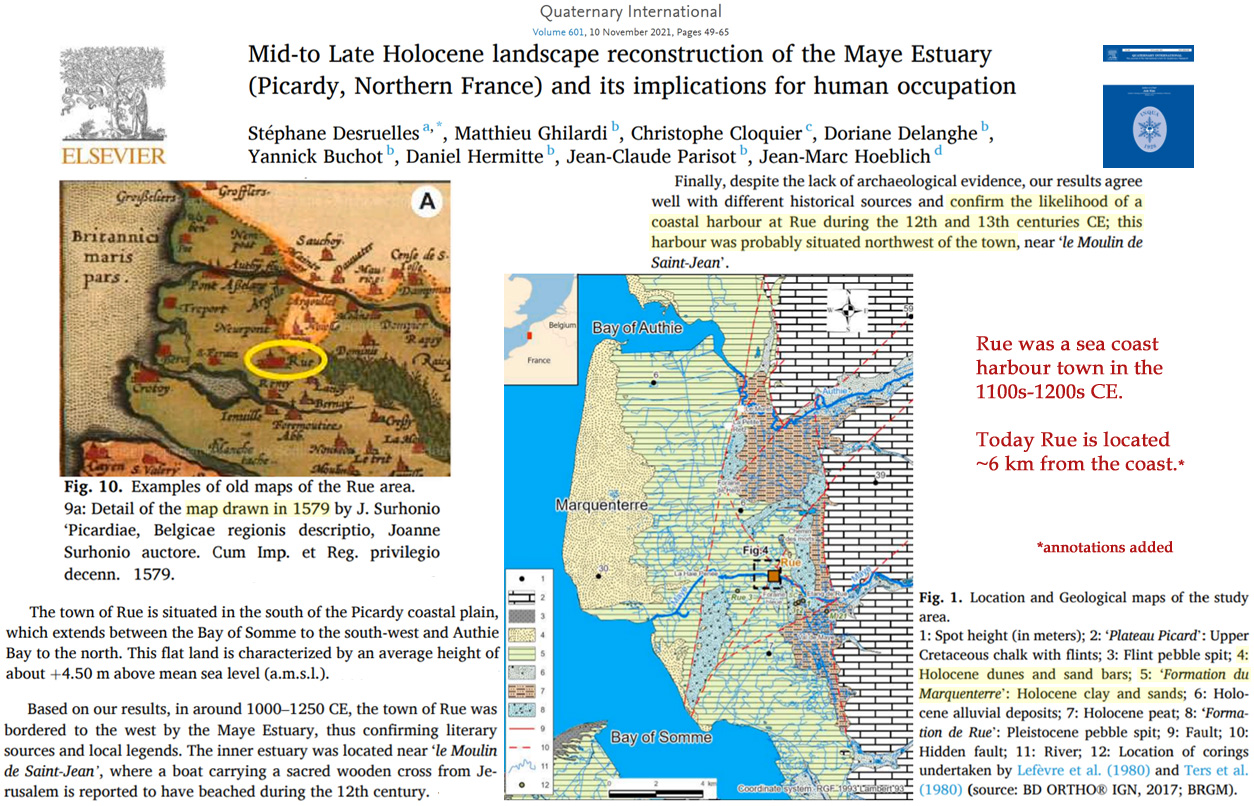
A new study (Desruelles et al., 2021) details the history of Rue, a sea harbor town in the 12th and 13th centuries.

Today Rue sits ~6 km from the sea coast.

Evidence for the presence of Late Holocene dunes and sand can be found spanning from the Rue site to the current coastline. A 1579 map still had Rue nearly bordering the sea, suggesting that the retreat of the sea waters has been relatively recent.

Image Source: Desruelles et al., 2021

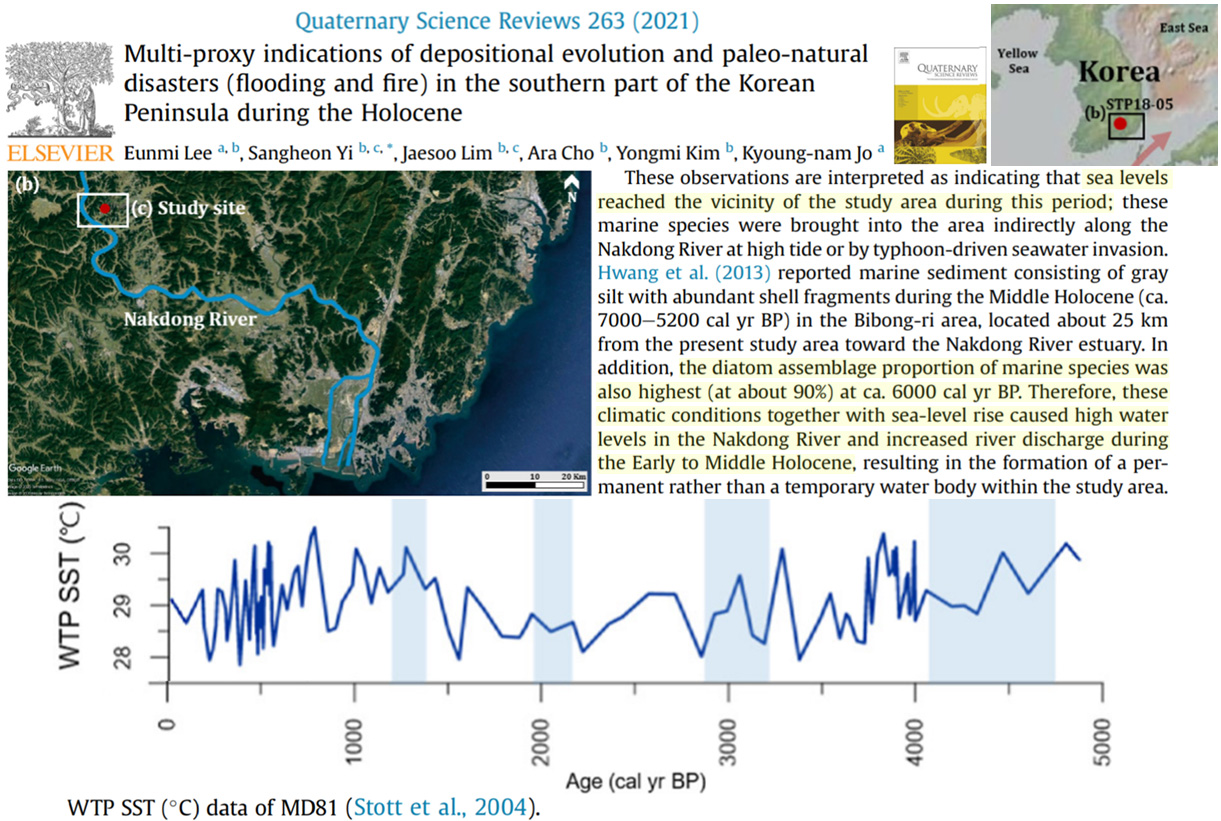
Scientists (Lee et al., 2021) have studied the history of Holocene coastal flooding along the southern part of the Korean Peninsula. Judging from the distance (km) metric in the legend, the study site (red circle) is located at least 50 km inland from today’s coast.

The authors determined sea levels during the Early to Middle Holocene (peaking ~6,000 years ago) were high enough that marine species and “abundant shell fragments” can be found at the study site, which means “sea levels reached the vicinity of the study area during this period.”

Image Source: Lee et al., 2021

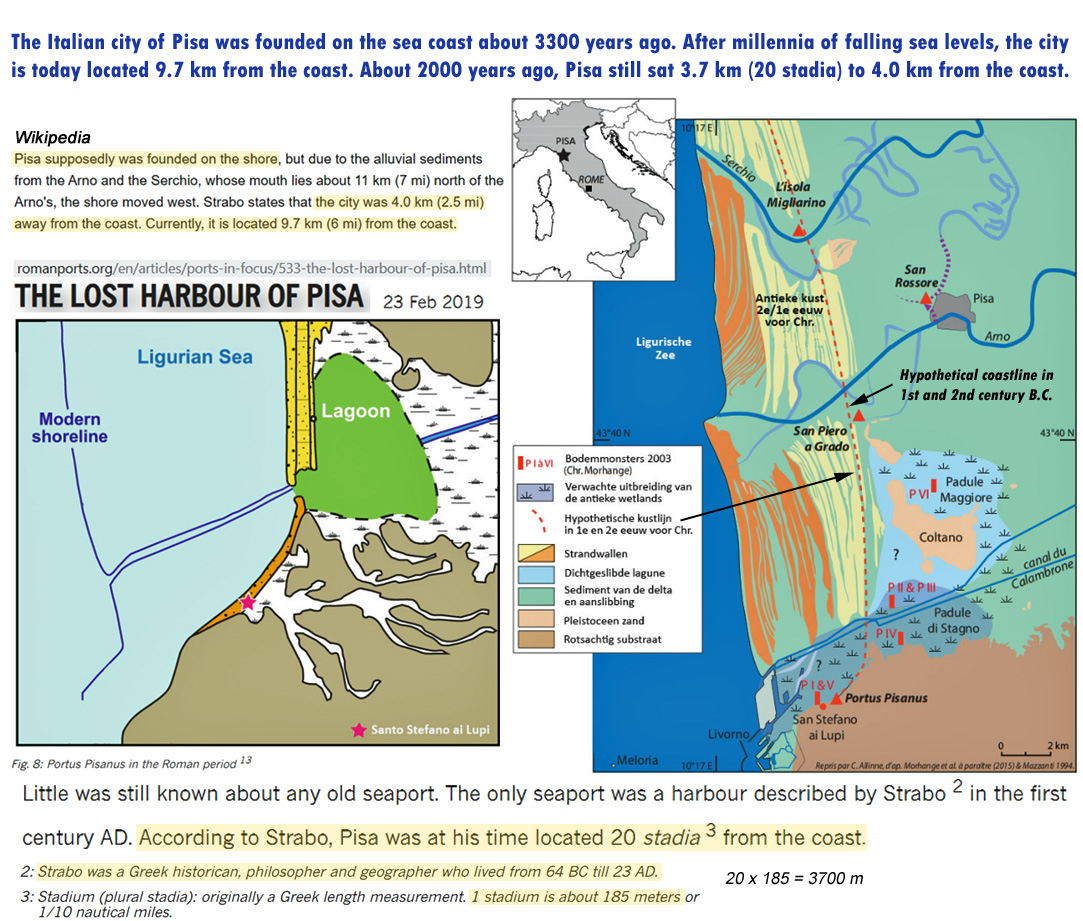
Italy’s famous leaning-tower city, Pisa, used to be a bustling sea port just ~3,300 years ago. That was when sea levels were much higher than they are today.

As the seas retreated over the next millennia, Pisa was left sitting almost 4 km from the sea coast during the Roman Warm Period.

Today Pisa is located 9.7 km from the coast.

Image Source: romanports.org

via NoTricksZone

https://ift.tt/3Ghg6hy

January 10, 2022 at 11:13AM

New York Times – 900,000 Children Hospitalized

Supreme Court Justice Sotomayor claimed that 100,000 children are hospitalized with COVID-19. “We have hospitals that are almost at full capacity with people severely ill on ventilators. We have over 100,000 children, which we’ve never had before, in serious condition, … Continue reading

via Real Climate Science

https://ift.tt/33dpcNP

January 10, 2022 at 09:10AM