Month: January 2022

Vaccinated Germans Eight Times More Likely To Get Infected

Vaccinated Germans are eight times as likely to get infected as unvaccinated. The German government responds by shutting down dissent and free speech. Official German Government data suggests the Fully Vaccinated will develop Acquired Immunodeficiency Syndrome by the end of … Continue reading

via Real Climate Science

https://ift.tt/3sUS7RC

January 4, 2022 at 05:16PM

How Pressure Systems Control Climate Part 2: ITCZ, Rainforests And Deserts

.

Jim Steele

.

This is part 2 in my educational series on Climate Science

Here you’ll see how the ITCZ  determines the location of rainforests and deserts

In contrast to media narratives that global warming causes higher temperatures and drought, you will see, conclusively, why droughts and dryness cause higher temperatures and how reduced transport of moisture from the oceans to the land causes drought.

You will see that during the coldest periods of the last 10,000 years, societies experienced the worst droughts,

And contrary to media narratives, the science shows warmer temperatures will bring more rain.

A transcript of this video is available at

https://perhapsallnatural.blogspot.com/2022/01/how-pressure-systems-control-climate.html

Jim Steele is Director emeritus of San Francisco State University’s Sierra Nevada Field Campus, authored Landscapes and Cycles: An Environmentalist’s Journey to Climate Skepticism, and proud member of the CO2 Coalition.

via Watts Up With That?

https://ift.tt/3JJDkPs

January 4, 2022 at 04:29PM

Existential risks

by Judith Curry

Some reflections on the movie Don’t Look Up.

If you haven’t seen the movie, it is worth watching (available on Netflix).

The movie is a satirical black comedy, with a large number of A-list actors. It’s about scientists giving 6 months warning of a comet striking Earth and mass extinction.  The story is about how politicians, the media, scientists, the public and space entrepreneurs react to this.  The Director, screen writers and lead actor (Leonardo DiCaprio) all say that it is a satirical film about climate change.

If you ignore for the moment that this movie is supposed to be about climate change, you can enjoy it for what it is.  The style is reminiscent of Dr Strangelove (but not nearly as good).  The A-list actors give entertaining performances, but I wouldn’t expect any of them to be nominated for awards (the most likely award will be for the theme song, sung by Ariana Grande).  The movie is fast paced, plays into amusing stereotypes, and is good fun.

However, if you are looking for some grand allegory for climate change, its communication, our failure to act, and a subsequent existential crisis, you will be sorely disappointed and may not even think that the film is funny.  The movie is about an existential risk on a time-scale of a few months, that you can actually see happening.  In spite of the rhetoric and declarations that every severe weather is caused by climate change, at the end of the day very few lives are being lost by extreme weather (let alone by manmade climate change).

There has been substantial discussion on twitter of the movie, with climate scientists saying that finally they feel heard, and feel vindicated by this attention that is provided to their plight of effectively trying to communicate the risk of climate change and effect their desired policies to prevent climate change. They seem to think that the moral of the movie is Believe Experts.

There is no scientific debate over whether the comet will actually strike Earth, when it will strike, or the catastrophic consequences. However, throughout the movie, every scientific institution ends up lying about the risk – the head of NASA, big tech CEO, government officials, and eventually the protagonist professor (Leonardo DiCaprio).  The only scientist who maintains their integrity is the female graduate student (Jennifer Lawrence), who ends up bagging groceries.  Trusting the experts doesn’t end up being such a good idea, when the end result is extinction.

The issue is what should be done about the comet strike. Here is where we find some meaningful analogies with climate change.  The more pragmatic choice is to use rockets to deflect the path of the comet away from collision with the earth; there is some confidence this can work based on experience with asteroids.  By analogy, the pragmatic climate change solution is to adapt, hang on to your nuclear power and develop better technologies.   The competing solution for the comet gets wrapped in the economic opportunity associated with rare metals in the comet, job creation and presidential politics.  The analogous climate solution wraps in all sorts of additional objectives such as environmental justice, job creation, anti-nuclear sentiments, anti-capitalist governance, punishing fossil fuel companies.  The problem is that the complexity of the competing solutions fails to address the original problem and causes new (and even worse) problems.

The movie isn’t about a simple battle between those who want to take action to address the problem and those who don’t. There’s a genuine lack of consensus scientists, government, etc.  as to what should actually be done about the problem. This is invariably the case when the the problem is multifaceted and the solutions are technically challenging.

The fundamental policy challenge of climate change is that it involves making changes now for the sake of preventing harms that occur largely in the future to people living in other countries. This challenge can be addressed by producing technological breakthroughs that make these tradeoffs less painful and progress easier.

It’s far more interesting to interpret this movie as part of the cinema of existential risk, rather than climate change.  Comets are a great topic for this, especially since they are much more difficult to deflect than asteroids.  Deflecting comets would be a great endeavor for the billionaire space cowboys (Bezos, Musk, Branson) to take on. 

And what about supervolcanoes? Does anyone have a plan for this?  These genuine existential risks fall outside of ordinary political conflicts.  Instead, we focus on the faux existential risk of climate change, with solutions that focus on first-world perceptions of environmental justice and punishing fossil fuel companies.

via Climate Etc.

https://ift.tt/3eSENoI

January 4, 2022 at 04:29PM

Insurance chief talks about “unheard” of rise in deaths in working adults

Something is going very wrong. Insurers are paying out on more long and short disability claims, which we might expect in a pandemic, but in the 18 – 64 age group in Indiana deaths are up by wildly exotic sigma deviations above the norm.

Margaret Menge

(The Center Square) – The head of Indianapolis-based insurance company OneAmerica said the death rate is up a stunning 40% from pre-pandemic levels among working-age people.

“We are seeing, right now, the highest death rates we have seen in the history of this business – not just at OneAmerica,” the company’s CEO Scott Davison said during an online news conference this week. “The data is consistent across every player in that business.”

Davison said the increase in deaths represents “huge, huge numbers,” and that’s it’s not elderly people who are dying, but “primarily working-age people 18 to 64” who are the employees of companies that have group life insurance plans through OneAmerica.

“And what we saw just in third quarter, we’re seeing it continue into fourth quarter, is that death rates are up 40% over what they were pre-pandemic,” he said.

“Just to give you an idea of how bad that is, a three-sigma or a one-in-200-year catastrophe would be 10% increase over pre-pandemic,” he said. “So 40% is just unheard of.”

The President of the Indiana Hospital Association confirmed that hospitals across the state were full of patients with “many different conditions” and that what Davison was reporting fitted with what he was seeing too. About 37% of the ICU beds were filled with Covid patients, but 54% were other conditions.

Evidence suggests it’s not untested Covid deaths

There will always be some who die of Covid who didn’t get tested. And in 2020 there were rises in unexplained deaths in different regions of the US at different times. But those peaks in unexplained deaths were always were during the same weeks as the peaks of the known Covid deaths or very close to them. That’s not what is happening here.

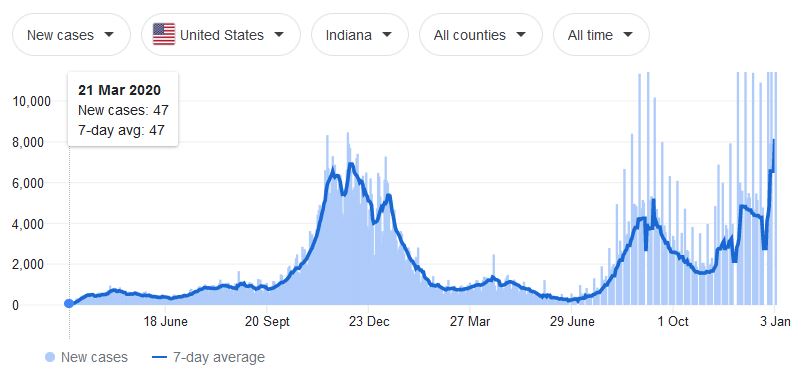
Davison is talking about deaths in the third and fourth quarter of 2021. He compares the current wave to the peak in winter the year before. But official cases of Covid in Indiana were slightly higher in 2020 than most of 2021.

Indiana Covid Cases

….

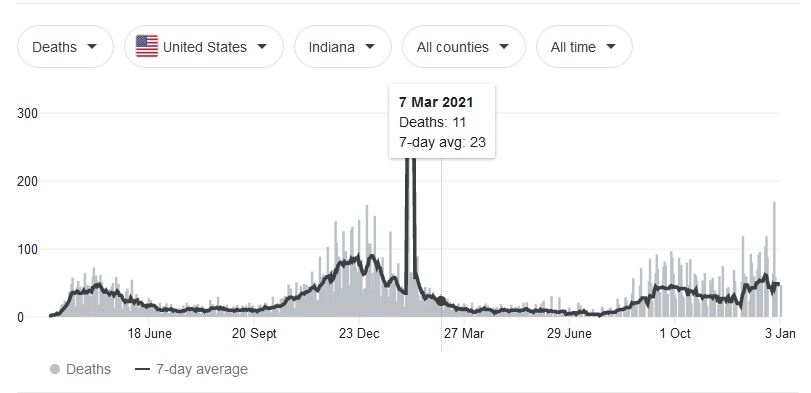
Official deaths were also lower in 2021, so unexplained deaths due to Covid should also be lower now than the year before, not higher.

Indiana Deaths Covid

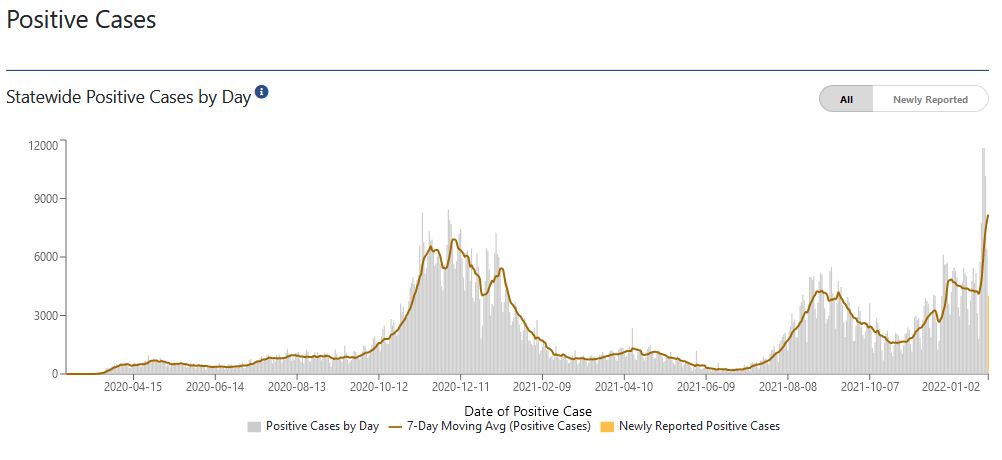
So imagine for some mysterious reason, that Indiana hospitals got very slack, and were testing less in 2021. If that were the case, and they were missing Covid infections we’d expect test positivity would be higher — but it wasn’t (at least until until Omicron blew it away in the last week).

Indiana Test Positivity

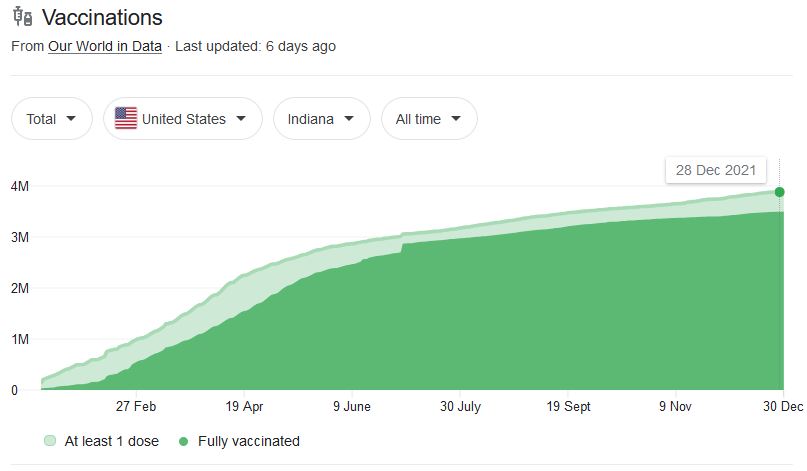
Which leaves one new medical intervention that peaked in 2021.

Indiana Vaccinations

Vaccinations in Indiana were mostly rolled out from Feb to December.

It would be interesting to know which weeks Covid vaccines were rolled out for particular age groups and if the extra deaths in each age group were linked, like they so obviously were in the UK as shown by Neil and Fenton: Many deaths in vaccinated people were recorded as “unvaccinated” in the UK.

If the Indiana Health Department was really interested in the health of people in Indiana it would already have done that study.

There is going to be hell to pay when people find out.

h/t Analitik, William Astley, Don B, Clarence.t, OldOzzie, ColA, TedM.

Commenter Analitik estimates it’s a Sigma 12 type event.

REFERENCE

Test positivity, Covid, in Indiana: https://ift.tt/3dZ3aR9

Neil, and Fenton et al (2021) Latest statistics on England mortality data suggest systematic mis-categorisation of vaccine status and uncertain effectiveness of Covid-19 vaccination


0 out of 10 based on 0 rating

via JoNova

https://ift.tt/3JKiIGT

January 4, 2022 at 12:59PM