Month: January 2022

Plastics are not forever: Bugs already evolved 30,000 new plastic eating enzymes

Plastics are a free dinner for life on Earth so it was just a matter of time before microbes evolved to eat it.

A PET bottle normally takes 16 – 48 years to break down, but if it were lunch for microflora it would take weeks instead. Hydrocarbons are ultimately just different forms of C-H-O waiting to be liberated as carbon dioxide and water. The only question was “how long” it would take bacteria and fungi to break those unusual bonds.

Sooner or later all plastic will be biodegradable.
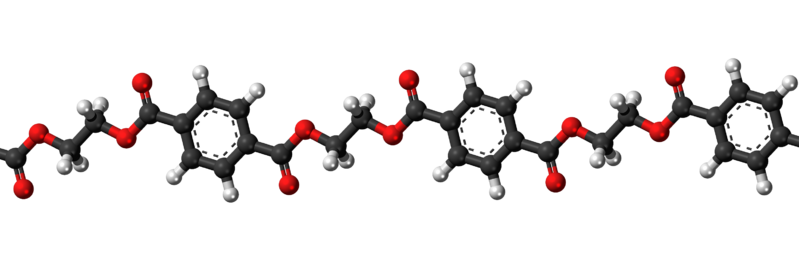
PET Plastic, Polyethylene-terephthalate

Polyethylene-terephthalate (PET)

The first bacteria known to chew through PET bottles was discovered at a Japanese rubbish dump in 2016. But we had no idea then just how advanced the microbial world of plastic processing was.

A new study shows. Instead of hunting for single bacteria Zrimec et al mined through collected metagenomes of soil and ocean and found not just 5 or 10 new enzymes but 30,000. It appears that they could metabolize at least ten different types of plastic.

And in places where there was more plastic pollution, there were more enzymes. All over the world a whole new ecosystem is rising out of the puddles and bubbles and grains of sand.

Enzymes that degrade plastics are found all over the world
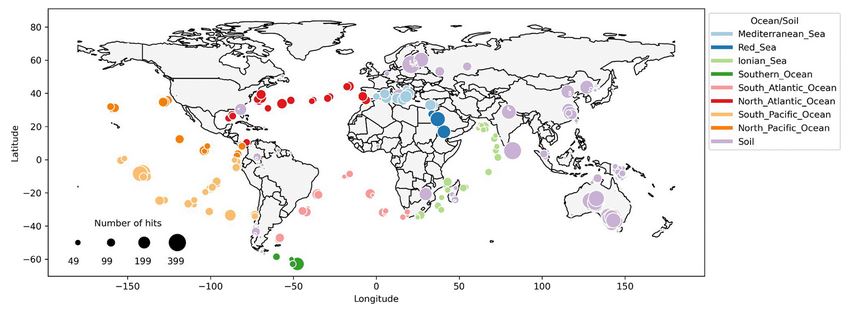
Map od plastic degrading microbes

FIG 2 Plastic-degrading enzymes across the global microbiome. Depicted are 11,906 enzyme hits in the ocean and 18,119 in the soil data sets, obtained by constructing HMMs of known plastic-degrading enzymes and querying them across metagenomic sequencing data sets. The potential to degrade up to 10 and 9 different plastic types was observed in the respective ocean and soil fractions (Fig. S3A).

Mother Nature has a big toolshed of genes to play with:

With a library like this, is it any wonder life on Earth could find and amplify the right tools to process plastics?

For example, global ocean sampling revealed over 40 million mostly novel nonredundant genes from 35,000 species (35), whereas over 99% of the ∼160 million genes identified in global topsoil cannot be found in any previous microbial gene catalogue (34)

So there are 200 million genes to work with.

Bugs across globe are evolving to eat plastic, study finds

Damian Carrington, The Guardian, 15 Dec 2021

The explosion of plastic production in the past 70 years, from 2m tonnes to 380m tonnes a year, had given microbes time to evolve to deal with plastic, the researchers said. The study, published in the journal Microbial Ecology, started by compiling a dataset of 95 microbial enzymes already known to degrade plastic, often found in bacteria in rubbish dumps and similar places rife with plastic.

About 12,000 of the new enzymes were found in ocean samples, taken at 67 locations and at three different depths. The results showed consistently higher levels of degrading enzymes at deeper levels, matching the higher levels of plastic pollution known to exist at lower depths.

The soil samples were taken from 169 locations in 38 countries and 11 different habitats and contained 18,000 plastic-degrading enzymes. Soils are known to contain more plastics with phthalate additives than the oceans and the researchers found more enzymes that attack these chemicals in the land samples.

Nearly 60% of the new enzymes did not fit into any known enzyme classes, the scientists said, suggesting these molecules degrade plastics in ways that were previously unknown.

The not so apocalyptic plastic crisis

The new 250 page “Consensus” Study (their words) by the National Academies of Science, Engineering and Medicine, is as out of date and useless as it sounds. While it is scoring headlines, scaring us about accumulating plastics, it largely writes off the idea that microbes will evolve to degrade plastic, saying “measurable biodegradation (complete carbon utilization by microbes) in the environment has not been observed.” Which is one of those true but useless statements.

Some 40 year old theory says it won’t happen:

Plastics with hydrolysable chemical backbones (e.g., PET and polyurethanes) may be more susceptible to enzymatic degradation and eventual biodegradation than those with carbon-carbon backbones (Amaral- Zettler, Zettler, and Mincer 2020), as illustrated by the discovery of PET-degrading bacteria isolated from a bottle recycling plant (Yoshida et al. 2016). However, Oberbeckmann and Labrenz (2020) argue, based upon Alexander’s (1975) paradigm on microbial metabolism of a substrate, that the very low bioavailability and relatively low concentration of plastics in the ocean together with their chemical stability render these molecules very unlikely candidates for biodegradation by marine microbes, despite their potential as an energy and carbon source.

But if plastics are so tiny and low in concentration, it’s a big “so what” — they are unlikely to be a problem. If they were concentrated in one place or collected in an organism, they would be bad, but then, of course, they also become fodder for microbes.

The bottom line: We don’t want to drown dolphins and trap turtles, but we shouldn’t demonize plastics either. Don’t throw rubbish in the ocean or toss hype in national news. It’s all litter.


Hat tip to Kip Hansen at Watts Up.

REFERENCES

Zrimec et al (2021) Plastic-Degrading Potential across the Global Microbiome Correlates with Recent Pollution Trends, ASM Journals mBio Vol. 12, No. 5 DOI: https://doi.org/10.1128/mBio.02155-21 

Reckoning with the U.S. Role in Global Ocean Plastic Waste, (2021) ISBN 978-0-309-45885-6 | DOI 10.17226/26132  https://ift.tt/3JDrDtW

Image: PET Plastic Jynto

0 out of 10 based on 0 rating

via JoNova

https://ift.tt/3JzJu4O

January 3, 2022 at 12:55PM

Viral, A Review

By Andy May

Alina Chan is a molecular biologist specializing in gene therapy and cell engineering at the Broad Institute of MIT and Harvard. She partnered with the famous science writer, Matt Ridley, to write Viral, the Search for the Origin of COVID-19. The book was published November 16, 2021, and the combination of Dr. Chan’s expertise and Dr. Ridley’s impeccable writing skills make the book read like an Agatha Christie whodunnit. It is fascinating, educational, and an entertaining read. Well worth your time. This review is based on the Kindle version.

The book is about the search for the origins of the coronavirus—SARS-CoV-2—that causes COVID-19 by a small group of amateur and professional investigators that call themselves “Drastic.” The name means “Decentralized Radical Autonomous Search Team Investigating COVID-19.” This organization traces its beginnings to Twitter, and it gained substantial credibility when Facebook labeled its posts as “false information.” Nearly all the findings of Drastic have subsequently been found to be true. There is no definitive proof that COVID-19 was genetically altered in the Wuhan Institute of Virology (WIV), but the book does an excellent job of laying out the evidence.

In early January of 2020, as the seriousness of COVID-19 was becoming apparent, Dr. Shi of the WIV, found that the SARS-CoV-2 gene sequence was a near perfect match (96.2%) to one of her Institute’s bat viruses, named 4991, aka RaTG13. Yet when she published this discovery February 3, she neglected to cite her own 2016 paper describing the origin of the virus. The sample was collected in 2012 in a Mojiang County, Yunnan Province copper mine 1,800 km from Wuhan, where three people from the mine died of an unknown respiratory illness. A 2013 thesis concluded that the miners died of a SARS-like coronavirus from bats in the mine. The virus, at that time, could not spread from human to human, only from bats to humans. This was the beginning of a Chinese-led coverup of the data required to establish the origins of SARS-CoV-2. The coverup was aided by an American, Dr. Peter Daszak of the Eco-Health Alliance, who obtained U.S. National Institutes of Health (NIH) funding for the WIV.  

In November of 2020, Nature published an addendum acknowledging the existence of the 2013 thesis and the story of the 2012 Mojiang copper mine deaths and virus sample. Drastic had uncovered all these important facts and the Nature addendum confirmed the results of their investigation, which had been ridiculed as a “conspiracy theory” by the mainstream media, Daszak, and other prominent virologists. It seems the only serious investigative journalism being done on the origins of SARS-CoV-2 was by bloggers.

There are two crucial facts that play an important role in this mystery. When a virus jumps from an animal to humans (called a zoonotic event) it must adapt to its human host through a quick series of mutations. First it needs adapt to the human cells it will invade and finally it must change so that it can transmit from human to human. These steps have not been found for SARS-CoV-2, it appeared in 2019 fully formed and already adapted to humans. Normally the zoonotic source for a new virus is found very quickly, as it was for 2003 SARS, since these necessary mutations can be seen in samples from the animal source and in the first human-to-human victims, but no zoonotic source has been found for SARS-CoV-2. The question is why?

Dr. George Gao, the director of the Chinese Center for Disease Control and Prevention in Beijing originally thought the novel SARS-CoV-2 virus came from the Wuhan seafood market, but later found that the seafood market was a victim, the virus existed and was being passed from human to human long before it was observed in people or animals in the market. It was people who brought the virus to the market, not the other way around.

There is no definitive way to tell a genetically engineered virus from a natural mutation. As Chan and Ridley write: “Today’s technology allows the seamless construction of entire virus genomes.” However, strange and unnatural gene sequences can give investigators clues. It is interesting that Dr. Kristian Anderson emailed Dr. Fauci on January 31, 2020, saying that “some of the features (potentially) look engineered.” Many other prominent virologists thought the same. Yet, in public they said the opposite. Seven days later, Dr. Daszac wrote: “We stand together to strongly condemn conspiracy theories suggesting that 2019-nCoV does not have a natural origin.”

Engineering animal viruses to spread through the air from human to human had been done before. In May 2012, Dr. Yoshiro Kawaoka’s research group at the University of Wisconsin and the University of Tokyo published a paper on how they engineered a version of the highly deadly H5N1 poultry virus to spread through the air from mammal to mammal. Kawaoka’s results were duplicated by Dr. Fouchier at Erasmus University in Rotterdam.

These two papers caused an uproar in the medical community, why were researchers manufacturing deadly airborne diseases? When H5N1 does infect humans, it is 60% deadly. It is only caught directly from birds during their slaughter, it has not mutated (naturally) to spread from human to human. These were not rogue researchers working in secret military labs, but eminent researchers in major universities that were funded by the NIH. The researcher’s motive was to see if it could be done, NIH funded them for that purpose, interesting, but is it worth the risk?

There is a long list of labs that accidentally released deadly viruses and bacteria that later killed people, is this a reasonable and safe expenditure of NIH funds? Smallpox and foot-and-mouth escaped from laboratories in the U.K., Marburg escaped from labs in Russia and Germany, among others. U.S. laboratories notified federal authorities of 1,500 accidental releases of pathogens between 2006 and 2013. Escapes are not rare occurrences. The H1N1 epidemic almost certainly originated from an accidental laboratory release in China during a vaccine trial, as Chan and Ridley explain in their book on page 150.

How likely is it that SARS-CoV-2 was engineered in a laboratory? It has never been found in an animal that has not had close contact with humans infected with COVID-19 and the closest animal virus is the aforementioned RaTG13. RaTG13 is only a 96% match to SARS-CoV-2, not close enough to be the direct source. This is suspicious, but not definitive. There is no evidence that Chinese researchers adapted RatG13 to humans through human cell cultures or humanized animal tissues, and lacking that, we don’t know if SARS-CoV-2 was engineered. It is possible for a virus to magically appear, fully adapted to humans, with no intermediate versions present in any animal, but very unlikely. That is the point of the book, draw your own conclusions.

It is also important to consider that no evidence of a natural origin for SARS-CoV-2 has surfaced. This is extraordinary when we consider how quickly the natural origin of the 2003 SARS epidemic was found in Guangdong. Locating the original 2003 SARS infected animals took several months, but antibodies were found in the Guangdong animal traders very quickly and nothing like that has been found in the animal markets in Wuhan. Eighty thousand animal samples, from dozens of species, and hundreds of animal carcasses from the seafood markets have all tested negative for the virus.

Chan and Ridley remind us that while WIV has published scores of papers on the various viruses that it has manipulated and tested, not one of the papers mentions a virus like SARS-CoV-2. If we conclude that SARS-CoV-2 was engineered there, we must believe that it was done during the brief window between the genetic engineering procedure and the first paper on the new virus.

Since Viral was published, Taiwan News has reported that Taiwan’s Central Epidemic Command Center (CECC) head Chen Shih-chung has confirmed that the Delta variant of the virus infected a researcher in a Biosafety Level 3 laboratory. The genetic sequence of the Delta variant the researcher was infected with matches the samples she had been working on and does not match the local Taiwan Delta strain. Laboratory accidents do happen.

Chan and Ridley do not accuse China or WIV of deliberately releasing the virus, in their opinion the release, if it happened, was accidental, just as it was in the Level-3 lab in Taiwan. However, the absurd secrecy imposed by the Chinese government is odd, if they have nothing to hide. The location of the cave where RaTG13 came from is well known but remains strictly off limits to journalists, scientists, and people who try and approach the mine. Invariably people who try to approach the mine are followed and detained by police. Requests by WHO and the CDC to participate and help in the Chinese investigations into the origins of SARS-CoV-2 have been denied. Likewise requests for critical data are denied.

No matter that there is no conclusive evidence for the lab-leak theory or the natural theory, there is no excuse to withhold evidence and data on the origin of SARS-CoV-2. The virus caused death, suffering, and loss worldwide. China has an ethical obligation to share whatever it can to help find the cause. Withholding data and access to the likely origin point only makes them look guilty and helps no one.

The book is well organized, illuminating, and well written, as we would expect from Matt Ridley. The book is authoritative due to the eminent credentials of Dr. Alina Chan. I highly recommend the book to anyone interested in the source of COVID-19, which is probably everyone.

Chan and Ridley testified on the origins of COVID-19 before the U.K. Parliament and the video is here. Their testimony begins about 18 minutes in.

via Watts Up With That?

https://ift.tt/3zoAquJ

January 3, 2022 at 12:34PM

Every Generation Imagines

“Every generation imagines itself to be more intelligent than the one that went before it, and wiser than the one that comes after it.” ― George Orwell The 1825 Miramichi fire burned more than two million acres in nine hours. … Continue reading

via Real Climate Science

https://ift.tt/3ESt581

January 3, 2022 at 12:30PM

YouTube Deletes Dr. Fauci For “Medical Misinformation”

via Real Climate Science

https://ift.tt/3eJItZI

January 3, 2022 at 12:30PM