Month: January 2022

Dr. Judith Curry’s Year in Review

From Climate Etc.

by Judith Curry

A year ago, who would have thought that 2021 would be crazier than 2020?

A quick post to end out the year with some random reflections

Covid

The new normal (for me, anyways) is to stay home, not travel. Greater ventilation, use of HEPA air cleaners (also a big help when the air quality in the U.S. west was horrible from the wildfires), outdoor social events, masking. I’m triple vaxxed (Moderna), haven’t even gotten a cold in the past two years, also taking a cocktail of supplements. My entire company is now working from home – surprisingly, younger employees don’t like this so much, but people with kids/dogs definitely like it. I’m fine with my new normal, although I realize this isn’t feasible or desirable for most. God bless the internet. Personal precautionary principle in action, with a clear and immediate target – I really don’t want to get sick from a communicable disease.

Missed opportunities in 2021 to deal with Covid: scarcity of Covid tests in the U.S., failure to systematically investigate the re-purposing of existing drugs for Covid treatment protocols, and the failure to rapidly approve and manufacture new drugs for treatment. Failure to emphasize the need for better ventilation in buildings. Mask fatigue by insisting that masks be worn outside (schools, etc).

Death of Expertise

“Follow the science” almost seems like a joke at this point. Attempts to create and enforce various covid ‘consensus’ statements on everything from its origins, masks, transmission mode, treatments etc. have mostly backfired. The WHO and the CDC (U.S.) have much egg on their faces.

The various Covid consensus fiascoes have had an adverse impact on the trust of experts and expertise in a variety of domains.

‘Fact checks’ in the media have been shown to be (mostly) partisan/political enforcement of dogma.

Scientists playing politics and politicians misusing science for political ends has become endemic.

Cancel culture

Further wounds to expertise are coming from within universities and the enforcement of dogma in many disciplines. Many academics have left academia, some involuntarily over such issues. The whiny woke-babies and the insane focus on victimhood, intersectionality, gender and diversity at the expense of traditional academic values has made many universities pretty dysfunctional and even scary places.

Within politics and popular culture, cancel culture has also run amok. The heroine in all this has to be J.K. Rowling in her defense of sanity related to gender and sex.

Recently there has been increasing blowback against such nonsense, which is particularly bad in the U.S. (doesn’t seem to be so bad elsewhere?)

Innovation

On the good news front, the urgent rush to develop Covid vaccines produced not only some innovative research but demonstrated how quickly research to applications to deployment can proceed. This seems to have spurred a spirit of innovation, looking to science and engineering to provide better solutions to our current problems. There is much venture capital and money from billionaires floating around towards these purposes (for a variety of applications including climate change), which seems to have been invigorated by the Covid vaccines.

Covid has also spurred the development of new (and cheaper!) online workflow, meeting and conference platforms that facilitate working and meeting remotely and also conference. The IPCC AR6 managed to complete its work without hordes of scientists traveling all over the world; the colossal loss of productivity from extensive travelling is, well, colossal.

Substack

The last few years have seen a massive decline in audience for the mainstream media, for good reasons. In the U.S., there is no longer any pretense of objectivity or real investigation by the mainstream media. A plethora of partisan news outlets has emerged, and investigation occurs randomly and is published on blogs or whatever.

About a year ago a new framework for publishing was launched, called Substack. Substack wooed some serious journalists to the platform and tons of others from many different fields have joined. One key to its success is that Substack has figured out how its journalists can actually make a decent living

I follow a bunch of writers on Substack, and have paid subscriptions to about a half dozen. The posts are mostly long form (there are also podcasts), and the people that I follow are writing some fascinating essays, many on topics that aren’t trendy or overhashed.

Let me know who your favorite writers are.

The rise of anarchy and federalism

Apart from anarchy and redefinition of what is mainstream media, we are also seeing broader hints of anarchy in the U.S. In the U.S. anyways, we have seen a resurgence of federalism in terms of power of individual states. Previously I was mostly aware of different levels of prosperity and different weather among the different states. Covid, and Trumps insistence that the individual states manage their own crises, revealed different modes and styles of governance, different levels of freedom, different priorities on law and order, different energy and environmental policies, differences in rights to abortion, different tax structures and different cultures. Governors are getting more media attention than Biden. There has been massive migration out of California, Illinois and New York, and particularly into Texas and Florida.

The U.S. federal government has recently seemed impotent to do much of anything. In the Trump administration this seems to have been a feature not a bug; in the Biden administration, this is definitely a bug. The devolution of power from the federal government to the states has been characterized as anarchy; to my mind, there are elements of this that are very positive.

Climate

A few weeks ago I spotted this quote:

” “Climate change” is just a mental tattoo — a phrase we invoke with an air of scientific sophistication to give some sense of knowledgeability about the unknowable.”

That statement pretty much sums up the whole thing. Climate ‘science’ has become boring, mostly dotting i’s and crossing t’s (or worse yet, crossing i’s and dotting t’s). Even if we assume the science is ‘settled’, the policy discussion is even more boring – infeasible solutions that even if successfully implemented would very possibly leave us worse off than doing nothing (such has having inadequate electricity and fuel for heating during the winter).

My book

How we can break out of this rut is the topic of a book that I am working on. I’m about 70% finished, hope to submit it to my publisher before June. This is being published by an academic press, so the book needs to be scholarly. The challenge is to write it in a way that passes scholarly muster while at the same time being readable/interesting to a broader audience.

Stay tuned.

Weather and climate biz

My company, Climate Forecast Applications Network, continues to take up most of my time, while providing an endless source of interesting ideas and applications.

On the weather side of the business, growing vulnerability to extreme weather events is spawning new insurance vehicles and Insurance Linked Securities funds. The insurance sector is a rapidly growing part of my company’s business.

Traditionally, energy companies have been the biggest consumers for private sector weather forecasts, for natural gas trading and load management for electric utilities. The renewable energy boom (particularly wind, to a lesser extent solar) is increasing the demand for wind and solar energy forecasts.

The whole private sector weather enterprise is becoming more competitive as there is more and more information freely available online and from apps that generates revenue from advertising or from inexpensive subscriptions. My company focuses on major businesses that desire customized forecast products, innovative forecast products, and analyses in forecast reports.

A growing part of our business is in the climate sector. Until a few years ago, the requests I received were related to interpreting climate model outputs and advising lawyers regarding litigation. After one project of bias correcting and downscaling climate model simulations, which I felt was a fairly worthless exercise, I no longer accept such projects. For a few years there was a burst of litigation cases that I was consulting for, but most of these have been mired for years in procedural and jurisdictional issues.

Over the past few years I’ve been getting some more interesting projects related to renewable energy, potential insurance losses, scenario projections to 2050, and development of worst case scenarios for specific locales. I’ve also been asked to provide reality checks on climate impact assessments provided by other groups. I suspect that this will become a growing part of the business.

Books

Far and away the best book I’ve read this year (or in recent memory) was The Dawn of Everything – A New History of Humanity. From the blurb:

A dramatically new understanding of human history, challenging our most fundamental assumptions about social evolution—from the development of agriculture and cities to the origins of the state, democracy, and inequality—and revealing new possibilities for human emancipation.

This book was an instant NYTimes Bestseller, there are tons of reviews out there. Overall, a fascinating and exhilarating read that changed the way I think about the past, present and future.

I can only aspire to accomplish something like this with my own book that is in progress.

On the lighter side, my favorite reads this year were the Hawthorne and Horowitz mysteries, by Anthony Horowitz. This interview with the author gives you a flavor.

Climate Etc.

Thanks to all who have participated at Climate Etc. over the past year, especially the guest bloggers. Between my book and running the company, blogging takes a back seat. Both in principle should provide fodder for blog posts, but it takes time.

The blog has been sluggish, I think it is too big. I will be culling some of the old inconsequential posts to lighten the load a bit. Also, the moderation queue has been out of control. I think I have fixed one of the problems, we’ll see.

My very best wishes to each of you for a happy, interesting and healthy New Year.

via Watts Up With That?

https://ift.tt/3HvK8OK

January 1, 2022 at 04:40PM
Arctic Ice New Year 2022

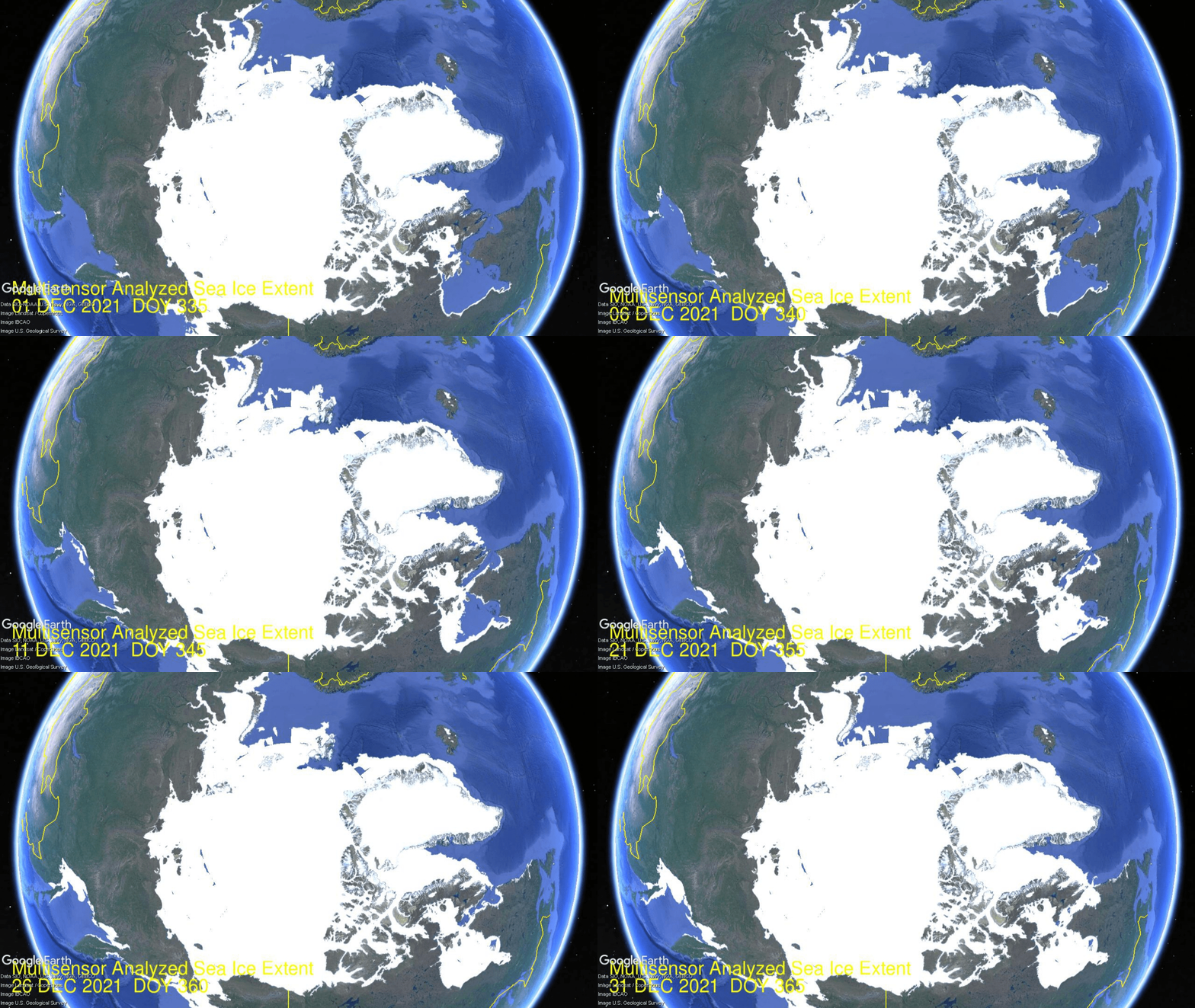
Remarkable Arctic ice recovery continued in December as seen in the animation below:

The month of December 2021 shows Hudson Bay (lower right) starting with only some shore ice and ending virtually ice covered, adding in that basin 925K km2, nearly a full Wadham. Just above Hudson, you can see the Gulf of St. Lawrence icing over, and Baffin Bay adding ice as well, adding 257k km2 to the total.

At the extreme left Okhotsk Sea also starts with shore ice and grows 435k km2, reaching down to Japan.  At the top Kara freezes over and Barents and Greenland Seas add ice to their margins. The graph below shows the December ice recovery

Note the average year adds 2M km2 and 2021 exceeded that by ~200k km2, maintaining its surplus position.  Other years starting far behind drew closer to average by the end.  SII has not yet reported its estimate of day 365.

The table below shows year-end ice extents in the various Arctic basins compared to the 14-year averages and some recent years.

Region 2021365 Day 365 Average 2021-Ave. 2020365 2021-2020
 (0) Northern_Hemisphere 13340119 13052148  287971  12765491 574628 
 (1) Beaufort_Sea 1070776 1070324  452  1070689 87 
 (2) Chukchi_Sea 966006 964420  1586  966006
 (3) East_Siberian_Sea 1087137 1087132  1087120 17 
 (4) Laptev_Sea 897827 897841  -14  897827
 (5) Kara_Sea 932872 883615  49256  879232 53640 
 (6) Barents_Sea 653611 423352  230260  371122 282489 
 (7) Greenland_Sea 620509 579341  41168  592839 27671 
 (8) Baffin_Bay_Gulf_of_St._Lawrence 873269 1003682  -130413  867509 5760 
 (9) Canadian_Archipelago 854685 853276  1409  854597 88 
 (10) Hudson_Bay 1245910 1236600  9311  1257919 -12009 
 (11) Central_Arctic 3221247 3203619  17628  3159881 61366 
 (12) Bering_Sea 358002 408726  -50724  249522 108481 
 (13) Baltic_Sea 61428 30674 30755  7986 53443 
 (14) Sea_of_Okhotsk 478257 382234  96023  479972 -1715 

This year’s ice extent is almost 300k km2 or 2% above average.  Only Baffin Bay and Bering Sea are in deficit to average, more than offset by surpluses elsewhere, especially in Kara, Barents and Okhotsk seas.

Comparing Arctic Ice at End of Years

At  the bottom is a discussion of statistics on year-end Arctic Sea Ice extents.  The values are averages of the last five days of each year.  End of December is a neutral point in the melting-freezing cycle, midway between September minimum and March maximum extents.

Background from Previous Post Updated to Year-End 2021

Some years ago reading a thread on global warming at WUWT, I was struck by one person’s comment: “I’m an actuary with limited knowledge of climate metrics, but it seems to me if you want to understand temperature changes, you should analyze the changes, not the temperatures.” That rang bells for me, and I applied that insight in a series of Temperature Trend Analysis studies of surface station temperature records. Those posts are available under this heading. Climate Compilation Part I Temperatures

This post seeks to understand Arctic Sea Ice fluctuations using a similar approach: Focusing on the rates of extent changes rather than the usual study of the ice extents themselves. Fortunately, Sea Ice Index (SII) from NOAA provides a suitable dataset for this project. As many know, SII relies on satellite passive microwave sensors to produce charts of Arctic Ice extents going back to 1979.  The current Version 3 has become more closely aligned with MASIE, the modern form of Naval ice charting in support of Arctic navigation. The SII User Guide is here.

There are statistical analyses available, and the one of interest (table below) is called Sea Ice Index Rates of Change (here). As indicated by the title, this spreadsheet consists not of monthly extents, but changes of extents from the previous month. Specifically, a monthly value is calculated by subtracting the average of the last five days of the previous month from this month’s average of final five days. So the value presents the amount of ice gained or lost during the present month.

These monthly rates of change have been compiled into a baseline for the period 1980 to 2010, which shows the fluctuations of Arctic ice extents over the course of a calendar year. Below is a graph of those averages of monthly changes during the baseline period. Those familiar with Arctic Ice studies will not be surprised at the sine wave form. December end is a relatively neutral point in the cycle, midway between the September Minimum and March Maximum.

The graph makes evident the six spring/summer months of melting and the six autumn/winter months of freezing.  Note that June-August produce the bulk of losses, while October-December show the bulk of gains. Also the peak and valley months of March and September show very little change in extent from beginning to end.

The table of monthly data reveals the variability of ice extents over the last 4 decades.

The values in January show changes from the end of the previous December, and by summing twelve consecutive months we can calculate an annual rate of change for the years 1979 to 2021.


As many know, there has been a decline of Arctic ice extent over these 40 years, averaging 70k km2 per year. But year over year, the changes shift constantly between gains and losses.

Moreover, it seems random as to which months are determinative for a given year. For example, much ado was been printed about June and July 2021 melting faster than expected to refreeze with higher losses of ice extents. But then the final 3 months of 2021 more than made up for those summer losses

As it happens in this dataset, October has the highest rate of adding ice. The table below shows the variety of monthly rates in the record as anomalies from the 1980-2010 baseline. In this exhibit a red cell is a negative anomaly (less than baseline for that month) and blue is positive (higher than baseline).


Note that the  +/ –  rate anomalies are distributed all across the grid, sequences of different months in different years, with gains and losses offsetting one another.  Yes, June 2021 lost more ice than the baseline, but about the same as 2016, and not as much as 2012. The gains in Oct.-Dec. 2021 were ~1M km2 above baseline, but were exceeded by the same months in 2019 and 2020.  The bottom line presents the average anomalies for each month over the period 1979-2020.  Note the rates of gains and losses mostly offset, and the average of all months in the bottom right cell is virtually zero.

A final observation: The graph below shows the Yearend Arctic Ice Extents for the last 32 years.


Year-end Arctic ice extents (last 5 days of December) show three distinct regimes: 1988-1998, 1998-2010, 2010-2021. The average year-end extent 1989-2010 is 13.4M km2. In the last decade, 2011 was 13.0M km2, and six years later, 2017 was 12.3M km2. 2021 rose back to 13.06  So for all the the fluctuations, the net is zero, or a gain from 2010. Talk of an Arctic ice death spiral is fanciful.

These data show a noisy, highly variable natural phenomenon. Clearly, unpredictable factors are in play, principally water structure and circulation, atmospheric circulation regimes, and also incursions and storms. And in the longer view, today’s extents are not unusual.


Illustration by Eleanor Lutz shows Earth’s seasonal climate changes. If played in full screen, the four corners present views from top, bottom and sides. It is a visual representation of scientific datasets measuring Arctic ice extents.


via Science Matters

https://ift.tt/31f5Eb8

January 1, 2022 at 02:07PM

2022: The Year of Inflation

The most dangerous Big-Government Qango of all may well be the Central Banks (not the NIH). Money drives all the incentives across national economies, but one small unelected group decides the price of money, and all corruption flows downstream from there. Ponder how they set the temperature that drives the global currents of goods, resources and opportunity. They feed Big Government, Big Pharma and Big Tech.

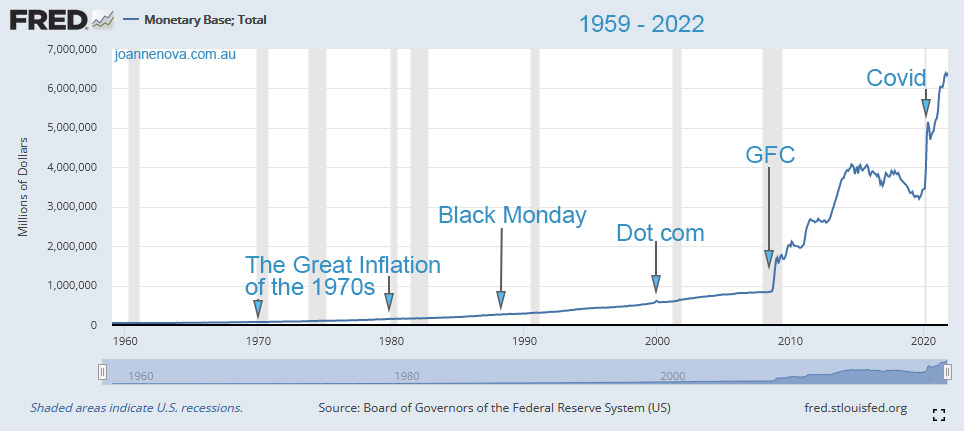
Saddle Up: There is no hiding inflation. Despite the global economy grinding to a halt in a pandemic, house prices set surging records and paradoxically the Dow hit all times highs.

It is just supply and demand. As more dollars are printed, a bigger supply of money competes for the same number of goods. And boy, have they been printing money.

It’s a temporary spike they say:

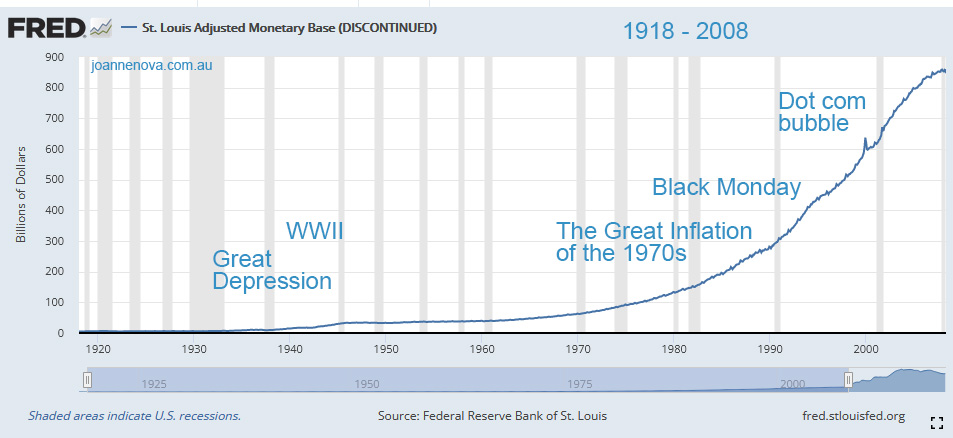
US St Louis Federal Reserve, Money Base graph 1918-2008

US St Louis Federal Reserve, Money Base graph 1918-2008 | Source

For perspective this is the history of the growth in US Dollars since 1918. The US left the Gold Standard in stages between 1913 and 1971, and the growth in money supply since then is obvious. But as fast as this appeared to grow in ninety years, it was nothing compared to what would come in the 14 years since.

US St Louis Federal Reserve, Money Base graph 1918-2008

US St Louis Federal Reserve, Money Base graph 1918-2008. Source

All the market-rattling crashes of history shrank when compared to the GFC and the Pandemic, which change the whole scale of the graph. The Occupy Crowd, and the Tea Party both recognized something was very wrong with the bail-out of 2009. But the Occupy Crowd have no understanding of what drives the inequality they hate and oppose.

The corruption of the dollar feeds all the other corruption

The people that benefit are the ones that borrow the money and spend it first. The people who lose are those holding their money in cash. Did your wage grow sixfold from 2008 to 2021?

Printing money-for-nothing is always the politically easy way to win votes. Voters like to vote themselves the treasury, so what Treasurer wants to promise austerity?

But inflation eats away at the strength of the economy. The incentives during inflation favor high risk speculation and punish the hourly wage earner and the savers. Inflation makes possible and rewards the mergers and hostile takeovers, thus conglomerating power and reducing competition. It feeds the predators like Amazon, Facebook and Google. Like acid, it destroys the benefits of competition as the big fish swallow up the little fish. It feeds inequality, and of course, it feeds Big-Government.

Worse than World War II

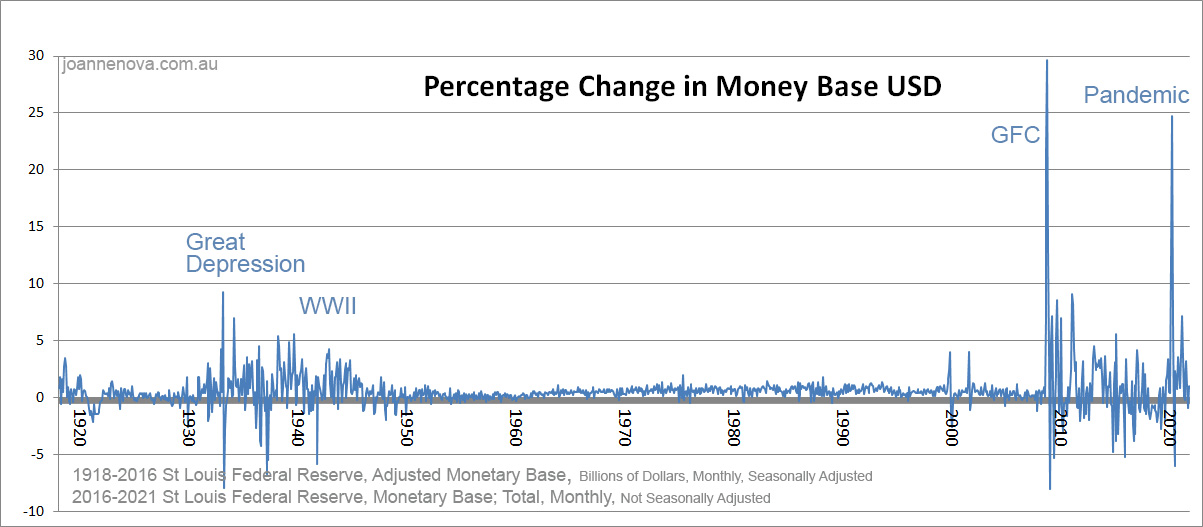
The graphs above are not log graphs, so they don’t show the proportionate shift. But the percentage change in money base shows the “seismic” surges in money supply. The GFC and the Pandemic have clearly shaken the value of the American Dollar more than The Great Depression and World War II.

Percentage Monthly Money base change, USD, St Louis Federal Reserve.

Percentage Monthly Money base change, USD, St Louis Federal Reserve.*

Is it the end of an empire? We hope not. But We The People need to plan accordingly.  The Chinese Communist Party is.  China is buying gold.

The Treasury officials are doing their best to hide inflation. Just as with climate change, the bureaucrats keep adjusting their inflation indicators so they can keep getting away with the game of silent theft. Big Government lives off silent inflation. Gold or any other real and timeless asset is an anti-cheating device.  If currencies were pegged to something real, it’s much harder for governments to grow.

REFERENCE and DATA

St Louis Federal Reserve:  AMBSL and  BOGMBASE

*To show both the Great Depression and recent era, the last graph crudely, brutally, connects the Adjusted Money base (seasonally adjusted) to 2016 to a different series (not seasonally adjusted) in the last 5 years. But the bodgey nature of this meld still captures the overall effect of the percentage changes quite accurately. Both the graph edits with “percent change” show that. If the Fed Reserve didn’t “discontinue” data series just when things get interesting, this sort of dodgy splicing wouldn’t be needed.

0 out of 10 based on 0 rating

via JoNova

https://ift.tt/3eIzmIQ

January 1, 2022 at 01:48PM

Manifesto For 2022

By Paul Homewood


Any suggestions welcome, but I suggest we circulate this to our local MPs and Conservative candidates:


MANIFESTO FOR 2022

Preamble

It is gradually dawning on the public just how ruinously expensive and suicidal the Net Zero project is going to be.

Sadly though Net Zero is embedded across all the main political parties, throughout the establishment and the media. There is therefore no realistic chance that it will be abandoned anytime soon.

However there are a number of things which could and should be done, that would effectively put the brakes on Net Zero and help to reduce some of the costs already being incurred by the public because of climate policy.

Fundamental Principles

All government actions regarding Net Zero should be consistent with two fundamental principles:


1) Policy should be affordable, both for the public and government finances.

2) Decarbonisation in future should not be at a faster rate than the rest of the world.

Policy Actions

The following actions are therefore proposed:


1) All Carbon Budget targets should be suspended.

2) The proposed ban on gas boilers should be postponed until alternatives are cost competitive

3) The proposed ban on petrol/diesel cars should also be postponed, until:

a) Alternatives are cost competitive

b) Solutions are found for the millions of drivers without off-street parking

c) A nationwide charging network is established, with sufficient capacity and at no cost to the public purse

d) The electricity grid and distribution network has been upgraded

4) Immediately abolish carbon pricing and the UK Emissions Trading System, which is already driving up power prices.

5) Implement an Intermittency Tax for wind and solar generators, so that they bear the cost of standby and grid balancing, instead of electricity consumers.

6) Implement a Windfall Tax on all recipients of Renewable Obligation Certificates, who currently benefit from high wholesale power prices in addition to ROCs, which currently cost consumers £6bn a year. The revenue to be used to offset ROC costs currently added to electricity bills.

7) End all constraint payments to wind farms

8) Put a stop to all new subsidies for renewable energy

9) Fully commit to a long tern future for North Sea oil and gas, necessary to encourage development. This must include a recognition of the need for substantial amounts of natural gas in the medium term.

10) End the ban on fracking, and lift all unnecessary restrictions which were previously in place.

11) Extend the life of existing coal power plants.

12) Fast track mini nuclear development.

13) Immediately approve the Cumbria coal mine

14) Guarantee that no new taxes will be raised, designed to “encourage” consumers away from high carbon consumption. In particular, no new tax on meat or gas.

15) Put an immediate stop on plans to force landlords to meet higher energy efficiency and low-carbon standards

16) Put an end to plans to ban mortgages for homes which don’t meet energy efficiency and low-carbon standards.

Financial Impact


Many of the above actions could be speedily introduced and would have an immediate impact on energy bills.

For instance:

  • Carbon pricing – £1.4bn
  • Intermittency tax – £2.0bn
  • Windfall Tax – £6.4bn
  • Constraint payments – £0.1bn

A total saving of £9.9 billion would reduce average household energy bills by £366 a year.

via NOT A LOT OF PEOPLE KNOW THAT

https://ift.tt/3G1x5oh

January 1, 2022 at 01:09PM