Month: January 2022

Channeling Dan and Jane to confront Biden policies

What could be better than SNL for examining Biden Administration energy policies?

Paul Driessen

As Covid lockdowns eased this past year, people all over the world went back to work and play. But while oil, natural gas, coal and electricity demand predictably shot up, President Biden canceled and hyper-regulated pipelines, leases and drilling permits. European leaders took similarly shortsighted actions. Inadequate global supplies chased rising global demand, and prices predictably skyrocketed.

Regular gasoline that averaged $2.17 per gallon in 2020 hit $3.49 in November 2021, costing American motorists $17 more to fill their tanks.

Biden Energy Secretary Jennifer Granholm laughed it off, saying, “If you drove an electric car, this wouldn’t be affecting you.” Transportation Secretary Pete Buttigieg echoed her flippant comment; so did White House Press Secretary Jen Psaki.

President Biden begged Russia and OPEC to produce more oil, siphoned oil from the Strategic Petroleum Reserve, and told the Federal Trade Commission to investigate price gouging by American oil companies. Meanwhile, his administration and their environmentalist allies continue pressuring banks and financial institutions to deny loans to oil and gas companies and refuse to invest in them.

Less charitable folks among us might wonder if the Marx Brothers or Bevis and Buttheadgeek are now setting energy policy. Others might channel Dan Aykroyd and Jane Curtin, and their raucous Saturday Night Live skits. A current events version might go something like this.

Den Astroyd: Hello, I’m Den Astroyd, host of Weekend Update. Despite recent setbacks, President Biden remains committed to “Building Back Better” and “transforming” America away from oil, gas and coal. During tonight’s Point-Counterpoint, Jan Granski will take the pro-transformation viewpoint, and I’ll take the anti-transformation counterpoint.

Jan Granski: Den, only a complete climate crisis denier and fossilized idiot like you could possibly oppose replacing dirty fossil fuels with clean renewable energy. If we don’t, Earth will fry, icecaps will melt, coastal cities will be inundated by rising seas and destroyed by hurricanes, and precious wildlife will be driven to extinction. But when haven’t you ignored reality? You’re a capitalist pig who lives to line the pockets of Big Oil. You think every American should have a big house and fly or drive wherever and whenever they want. You don’t give a damn about preserving a livable climate and planet, you jerk.

Den Astroyd: Jan, you ignorant slut. Your climate crisis exists only in worthless compute models and your fevered imagination. Your pals’ real objective is amassing more power, while they make commoners freeze jobless and hungry in the dark. Saving the planet? What a joke. Under your asinine policies, China will eat our kungpao lunch, while it spews out more greenhouse gases every year and turns our planet into a massive open pit mine and toxic waste dump – to extract raw materials needed to blanket our country with bird-killing wind turbines and habitat smothering solar panels. And you’ll just keep hopping into bed with any Climate Industrialist who’ll pay you twenty bucks to shill for their greenbacks energy scams.

I miss SNL’s old spunk and mojo. But you only have to look at the actual evidence to realize Michael-Mann-made climate cataclysms exist only in junk-science computer models that rely on the bogus assertion that plant-fertilizing carbon dioxide has replaced the complex, powerful, natural forces that have always governed Earth’s climate and weather.

The slight rise in actually measured average planetary temperatures is less than half of what climate models predicted (chart on page 5), and the discrepancy gets worse every year. Moreover, increasing CO2 is greening our planet, helping forests, grasslands and crops grow faster, better and with less water. Indeed, the worst possible outcome is a colder climate with less atmospheric CO2. That would shrink arable land, shorten growing seasons, reduce plant growth, and starve humans and animals.

As horrific as recent (and all) tornadoes are, 40% fewer strong to violent tornadoes (F3-F5) hammered the United States the past 35 years than the three decades before that (1954-1986). And the history of hurricanes making US landfall since 1850 shows no consistency, pattern or upward trend. In fact, the only reason climate alarmists can claim an increase in Category 3-5 hurricanes in recent years is that Harvey, Irma and a few others came after a record-setting 12-year absence of powerful hurricanes hitting the USA (October 2005 to August 2017).

As to buying an electric vehicle to avoid more pain at the pump, that’s a lot easier for jet-setting, limo-riding elites than it is for Average Joe families. The sticker shock of $50,000-100,000 EVs is just the beginning. If you want a fast charge when you get home, you’ll have to upgrade your neighborhood and home electrical systems to 220 volts – and hope AOC’s utopian wind and solar power cooperates.

Europe’s wind turbines performed at barely 14% of their “rated” or “nameplate” capacity during the fourth quarter of 2021. That’s barely one day per week; four days a month. It means you’ll also need expensive PowerWalls, to ensure backup electricity during extended blackouts when the wind doesn’t blow and the sun doesn’t shine.

Pray, too, that you don’t get stuck in a blizzard. Even if you turn off your heater, the cold will quickly kill your EV’s battery. Don’t get caught in a traffic jam trying to escape the next fiery conflagration roaring through a mismanaged California forest, either. And be careful where you park your EV, as those half-ton battery modules have a nasty habit of bursting into flames that cannot be extinguished easily.

If you still insist on buying an EV, please think about the poor kids and parents slaving away for a couple dollars a day in cobalt and lithium mines. Pay Fair Trade prices, so that they can get living wages.

Any Net Zero economy means a lot of turbines, panels and batteries – and a lot of mines, processing plants and factories to extract the raw materials and manufacture the non-renewable equipment.

Dr. Roger Pielke, Jr. calculates that replacing all US fossil fuel use (today’s electricity generation, home heating and cooking, factory power, and vehicle fuel) with “green” electricity would require over five million 2.5-megawatt, 650-foot-tall wind turbines, sprawling across two-thirds of the continental USA – or solar panels blanketing 40% of that land mass – plus thousands of miles of new transmission lines.

Give some thought too to what we’re going to do with all those turbine blades, solar panels, battery modules and other “renewable” energy equipment when they’ve reached the end of their productive lives – often in just 10 or 20 years. We’re going to need some massive landfills. Perhaps the Grand Canyon?

“Clean, renewable, sustainable” energy, my eye.

Keep one other thing in mind. Democrats, environmentalists, bureaucrats and judges despise mining, processing and most manufacturing. Very little will happen in the United States – and it can’t be done without fossil fuels. It will happen overseas, under minimal environmental and safety safeguards.

That means China, India and other countries will continue burning fossil fuels for all these operations, and to lift more people out of abject poverty. That means it’s pointless for the USA, Britain, Canada, Australia and Europe to “decarbonize” their economies – and send their economies down the toilet – while all these other countries keep growing, mining, manufacturing and emitting greenhouse gases.

A final reality: Africans, Asians and Latin Americans will no longer tolerate living in huts and slurping gruel – under the eco-imperialist, carbon-colonialist, energy-Apartheid rules that rich-country environmentalists have been imposing on them.

In fact, Americans and Europeans aren’t going to tolerate Net Zero decarbonization much longer, either. Especially to “save our planet” from a nonexistent manmade climate crisis.

Paul Driessen is senior policy analyst for the Committee For A Constructive Tomorrow (www.CFACT.org) and author of books and articles on energy, environment, climate and human rights issues.

via Watts Up With That?

https://ift.tt/3JxZHrf

January 1, 2022 at 08:31AM

Wind Power Drops By A Third In Q3

By Paul Homewood

h/t Joe Public

The latest energy trends data have been published by BEIS:


 image


It is quite shocking to see that wind generation has fallen by 38% for onshore and 24% for offshore year on year. This is despite new capacity being added.

We are familiar with short term drops in output, maybe for a few days or even weeks. But to lose effectively a third of generation for a whole quarter shows just how dangerous over reliance on wind power is.

The difference was made up largely from imports, which doubled:

image

How long we can count on that is anybody’s guess.

via NOT A LOT OF PEOPLE KNOW THAT

https://ift.tt/3FQo1Cn

January 1, 2022 at 06:27AM

Yet Another Man-made Crisis

Opinion by Kip Hansen – January 1st 2022

Just in time to ring in the New Year – a New Crisis!

CRISIS / ˈkraɪ sɪs /  : 

”a situation that has reached a critical phase”

 or, alternately,”specific, unexpected, and non-routine events or series of events that [create] high levels of uncertainty and threat or perceived threat to [a society’s] high priority goals.”

And, of course, this crisis is man-made.  Man-made in two senses: 

1) Caused by something that mankind is doing

and

2) is a situation that ordinarily would be considered an interesting problem that has been declared a CRISIS! by a couple of dozen well-positioned single-issue advocates. 

These crisis-creating advocates are endowed with societal clout by the fact that they are Scientists.   Not only scientists but scientists who have been (self-) appointed to an important committee of an important scientific organization.   Which of the all-so-important scientific bodies?  The august, venerated, always absolutely correct and perfectly reliable U.S. National Academies of Sciences, Engineering, and Medicine, more regularly referred to simply as The National Academies

They, not the National Academies itself, but the members of the “Committee on the United States Contributions to Global Ocean Plastic Waste”, have stated plainly and upfront:

“In the United States, ocean plastic waste has become a top public concern, but the developing plastic waste crisis has been building for decades.”

And of what is this crisis of ocean plastic waste made up of? 

“Sampling on the ocean’s surface has allowed scientists to assess the large-scale accumulation of floating debris across ocean basins, which occurs in ocean gyres in both the northern and southern hemispheres. These accumulation zones, commonly referred to as “garbage patches,” are mainly composed of microplastics that have broken apart from larger items, although large floating debris (especially derelict fishing gear, including nets, floats, and buoys) is also found.” [ source ]

You may be confused by the language used, even if you are a native English speaker.  The “large scale accumulation” is not “of floating debris across ocean basins” at all, though the report expressly makes that claim, while simultaneously clarifying that the non-existent (but ever so popular in advocacy propaganda) garbage patches “are mainly composed of microplastics that have broken apart from larger items”.

Just what are these dangerous microplastics?  They are bits of plastic that are 4 to 120 micrometers in size.How big is that in inches (it is, after all, the U.S. National Academies)

From one and a half ten-thousandths of an inch all the way up to five one -thousandths of an inch.

To see microplastics, you generally need a microscope. Your eye can discern a grain of fine sand, if you place it on a sheet of paper with a contrasting color and you would be able to see a bit of microplastic at 120um if similarly displayed (well, you younger people could, I could not).  But even the young cannot see something only 4um in diameter without the aid of a microscope. 

Almost all of the created-crisis-creating plastic pollution in the oceans is so small that you cannot see it.  This admission aligns well with my personal experience.  Like Nils-Axel Mörner, I am a dedicated fan of the “Oh yeah? Let me see for myself”-school of evidence.  Until I retired five years ago, I had spent one half of my adult life living on the sea on boats and ships, both as a professional mariner and as Captain of my own vessels.  I have a lot of sea miles under my belt.  To actually see something floating on the surface of the sea is so very rare that it invariably calls for closer inspection at least by binoculars or at other times by a brief divergence from one’s intended course to “go have a look”.  Failing to investigate an object large enough to be seen at any distance was considered negligent by the Captains I have served under and I have followed suit when I was the Captain.  The “garbage patch” is a fraudulent invention – a fantasy.

Here is a view of the worst area of the pacific Garbage Patch:

You can read the entire 211-page National Academies’ report “Reckoning with the U.S. Role in Global Ocean Plastic Waste (2021)in .pdf format by downloading it here.

The truest thing in the report is represented in this image (originally from Law  2017):

It at least shows that oceanic plastic, where found, fragments into smaller and smaller pieces and then undergoes (albeit with a “?”) biodegradation.  Bio-what? Plastic are not forever as they wish you to believe, but are broken down into smaller and smaller pieces and then into simpler and simpler chemical compounds, they are literally eaten by microbes and itty-bitty living things in the sea. 

The image below explains the repeated findings of trolling sieve nets through the sea to search for pelagic (ocean going) plastic – under a certain size, the number of plastic bits, which should be increasing exponentially as larger bits break into many smaller bits, sharply drops to zero as size decreases.  Like ice chips in a glass of water, as size decreases, the ratio between surface area and volume increases.  The biota eating the plastic bit from the outside in eventually end up consuming the entire little bit. 

In every ocean basin, as particle size decreases through natural fragmentation, especially when the size drops below 0.5 mm, the number of findable plastic particles rapidly approaches zero.  Plastic Waste Crisis advocates simply don’t mention this glaring scientific fact – it doesn’t contribute to their agenda.

The trumpeted crisis of Microplastics! involves bits of plastic that are 4 to 120 micrometers in size – 4um is 0.004 mm and 120um is 0.12mm – both below the vanishing point on the graph above. 

If you read the Academies report, you will discover that the whole crisis is based on the new and developing ability to detect such small bits of plastic – the amount of plastic entering the oceans used in the report are, even by the most lenient scientific standards, mere wild-ass guesses.   These SWAGs are then used in over-confident computer models to create further alarming estimates of total number of microplastic bits and potential harms, despite very few documented cases of any real harm at all (Creatures can become entangled floating masses of discarded fishing nets and the like, but not with microplastics).  As with other invented crises, the presence of a thing alone is defined as harm. 

Bottom Lines:

1.  There is no crisis of any kind whatever involving plastics.  Any claims to the contrary are fantasies.

2.  Plastics are just another type of hydrocarbon compound, many created and used because of their ability to survive intact under many conditions and survive for long periods of time.  Both are features not bugs.

3.  It is not true that “Plastics are Forever”.  Plastics degrade, breakdown, and are literally consumed by Earth’s lifeforms, which are all carbon based.

4.  Plastics are made from petroleum and its byproducts.  The petroleum converted to plastics instead of being burnt for energy sequesters that carbon for long periods of time just like trees ….and eventually is broken down by Nature into other chemical compounds, such as methane.

5.  However, Kindergarten Rules apply at all stages and areas of life:  Pick up after yourself — clean up your own messes.  Thus, we need to do all we can to keep every sort of trash, including plastics, contained and disposed of in a responsible manner – this keeps it out of the oceans and the rest of the natural environment. 

6. Plastics are valuable and should be recycled whenever possible into useful and valuable commodities, such as replacements for lumber in decking, shipping pallets, etc.  Plastics that cannot be recycled are valuable sources of energy when burnt in properly designed clean Waste-to-energy plants.

# # # # #

Author’s Comment:

I have written a lot about plastics over the last decade.  You can find many of these essays using this link

None of our society’s waste belongs in the ocean – or on the roadside or in the woods.  But creating a crisis from almost nothing is not helpful. 

Lady Bird Johnson taught my generation to “put your trash in the trash bin” and I have had a life-long habit of placing candy wrappers and other bits of trash in my back pockets – often to the annoyance of my wife. 

The oceanic plastic waste hobby-horse is an outgrowth of all the other anti-petroleum madness.

By the way, while floating masses of discarded fishing nets and plastic ropes are a hazard to maritime shipping because they can become entangled in ship’s propellers – which I know from sad personal experience – they are also floating reefs and make wonderful habitat for innumerable sea creatures on the high seas. 

Hoping you all have a prosperous, productive and healthy New Year.

Thanks for reading.

# # # # #

via Watts Up With That?

https://ift.tt/3qHJwPh

January 1, 2022 at 04:51AM

Climate lockdown: Paper published in prestigious journal laments ‘democracy’ & calls for ‘authoritarian environmentalism’ modeled after COVID lockdowns to fight climate ’emergency’

From Climate Depot

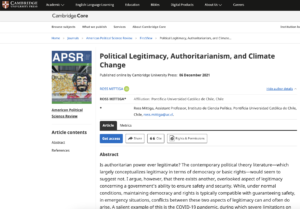
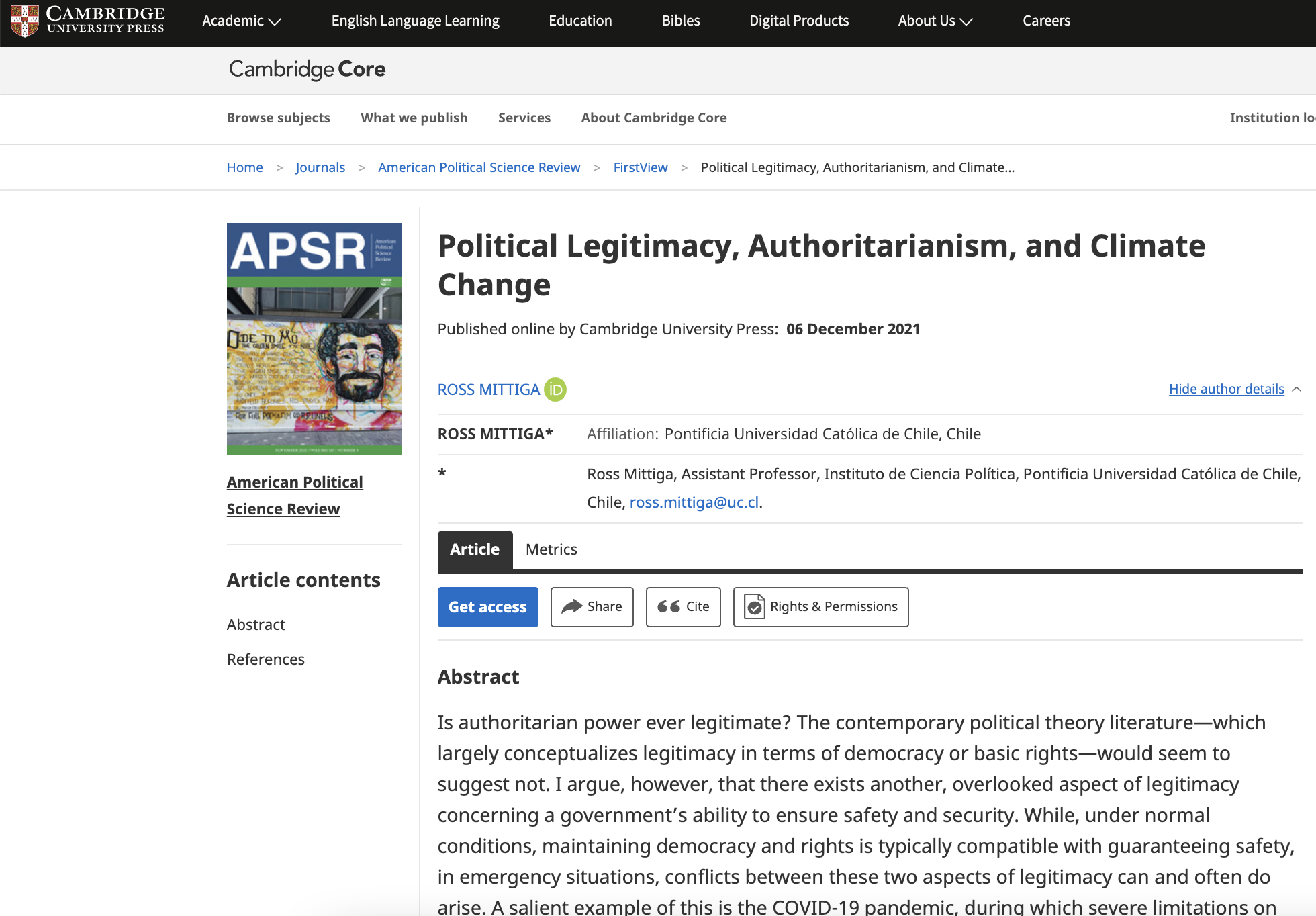
Political Legitimacy, Authoritarianism, and Climate Change – Published online by Cambridge University Press – American Political Science Review – December 6, 2021

ROSS MITTIGA – Assistant Professor, Instituto de Ciencia Política, Pontificia Universidad Católica de Chile, Chile, ross.mittiga@uc.cl 

Abstract Excerpt: Is authoritarian power ever legitimate? … While, under normal conditions, maintaining democracy and rights is typically compatible with guaranteeing safety, in emergency situations, conflicts between these two aspects of legitimacy can and often do arise. A salient example of this is the COVID-19 pandemic, during which severe limitations on free movement and association have become legitimate techniques of government. Climate change poses an even graver threat to public safety. Consequently, I argue, legitimacy may require a similarly authoritarian approach.” 

.   . 

The paper’s author Ross Mittaga, calls for “authoritarian environmentalism” to address the alleged climate “emergency.” : “It is ultimately an empirical question whether authoritarian governance is better able to realize desired environmental outcomes and, if so why and to what extent? Yet, it is undeniable that nearly all wealthy democratic states have failed to respond adequately to the climate crisis. By contrast, various less affluent authoritarian regimes have been successful in implementing stringent climate policies…”  

#

Climate Depot Note: Here is a full report on the growing movement to push climate lockdowns:Reality Check: ‘Climate lockdowns’ touted by Gates & Soros funded professors, Govts, media, & academia

Watch: Morano’s full 25 min speech on Climate Lockdowns at Heartland Skeptic Conference in Las Vegas

By: Marc Morano – Climate Depot

December 31, 2021

AbstractIs authoritarian power ever legitimate? The contemporary political theory literature—which largely conceptualizes legitimacy in terms of democracy or basic rights—would seem to suggest not. I argue, however, that there exists another, overlooked aspect of legitimacy concerning a government’s ability to ensure safety and security. While, under normal conditions, maintaining democracy and rights is typically compatible with guaranteeing safety, in emergency situations, conflicts between these two aspects of legitimacy can and often do arise. A salient example of this is the COVID-19 pandemic, during which severe limitations on free movement and association have become legitimate techniques of government. Climate change poses an even graver threat to public safety. Consequently, I argue, legitimacy may require a similarly authoritarian approach. While unsettling, this suggests the political importance of climate action. For if we wish to avoid legitimating authoritarian power, we must act to prevent crises from arising that can only be resolved by such means.

#

Below is an analysis of the new study by Professor Alexander Wutke, Political Psychology at U Mannheim who does not support the paper’s ideas.

https://threadreaderapp.com/thread/1476850341564063756.html

Other academics have critiqued the paper.

Professor Alexander Wutke, Political Psychology at U Mannheim: “A prestigious journal in political science, @apsrjournal, has published a disturbing piece of l political theory. In my reading, it explicitly argues that we must put climate action over democracy and adopt authoritarian governance if democracies fail to act on climate change. The study’s main question, as I see it, is whether we should abandon democracy to save the climate. It argues why it could be justified to dismantle democracy in order to ensure climate policies through authoritarian governance. To make the point of abandoning democratic governance the study builds on an unholy alliance of democracy-skeptic references from Hobbes to Schmitt to Extinction rebellion. … If most citizens disagree with you about the optimal trade-off between climate change mitigations and other goals, where do you take the right from to put your preferences over the expressed will of most other citizens? … Overall, I find the article troubling for the context in which it is published. We are going through a 3rd wave of autocratization as @AnnaLuehrmann / @StaffanILindber put it. Pressure on democracy is mounting from multiple sides. … In this climate, we need elites who stand up for the principle of self-governing free and equal people… I think my reading reflects the core argument of the article: a hierarchy of desired goals with climate politics first and democracy second. The article argues that crises not only can legitimize but may require authoritarian governance.” 

A prestigious journal in political science, @apsrjournal, has published a disturbing piece of l political theory. In my reading, it explicitly argues that we must put climate action over democracy and adopt authoritarian governance if democracies fail to act on climate change.

A longer thread to explain why I disagree with the study’s conclusion and arguments.

The author of the study is @RossMittiga.
I’ve been in touch with Ross before publishing this thread but let’s focus on the study itself.

Political Legitimacy, Authoritarianism, and Climate Change | American Political Science Review | Cambridge Core Political Legitimacy, Authoritarianism, and Climate Changehttps://doi.org/10.1017/S0003055421001301

I preface that I am no expert in political philosophy. I do not know the disciplinary standards or expectations. Please tell me where I get things wrong. Also, there is much to like about this article. It is well written and accessible for empirical scholars like myself. It does not shy away from controversial conclusions.

It is clearly written, even when calling for the dismantling of democracy. The study’s main question, as I see it, is whether we should abandon democracy to save the climate. It argues why it could be justified to dismantle democracy in order to ensure climate policies through authoritarian governance. The study preemptively states that the relative efficacy of democracies vs authoritarian is an empirical question but still expresses sympathies with climate policies of authoritarian governments.

I take from a recent @vdeminstitute symposium that democracies are more likely to provide environmental goods for their citizens – but results seem less clear for global commons including climate politics

But if it was an open question whether democracies do or do not better at climate change mitigation, where does the impetus come from to question democracy? Why not authoritarian governance and see their regime type as an obstacle to climate change mitigation? It would make equal sense to think about justifications to eradicate authoritarian governments that do not pursue sufficient climate policies.

Yet, the starting point here is to see democracy as the problem.
(This mirrors sentiments often heard from climate activists.) (Also, if it’s an open question whether regime types determine climate policies, why agonize over trade-offs between regime vs climate? If we do not know whether the two are related, why not spend the energy in areas where potential effects are promising and not open questions?) I am genuinely puzzled about the origins of this anti-democratic intuition that seems to give rise to the entire endeavor of exploring whether we should sacrifice democracy for the sake of a higher good. Still, while I cannot grasp the motivation for this question, let us take the study’s answer seriously. 

To make the point of abandoning democratic governance the study builds on an unholy alliance of democracy-skeptic references from Hobbes to Schmitt to Extinction rebellion.

The core argument is a distinction between foundational (FL) and contingent legitimacy (CL).In a Hobbesian tradition, any government’s most fundamental goal is to protect the safety of its citizens which provides foundational legitimacy.

Not mitigating climate change threatens safety and thus undermines foundational legitimacy. Democracy, on the other hand, is nice to have but the principle of self-governance of free and equal people only provides contingent legitimacy.

That’s unfortunate for democracy as it now is only of secondary importance. Democracy does not fulfill primary needs. Its value is contingent and more like a fashion. In our times, people value it, but in earlier centuries people did not. So its value is not foundational but contingent on the people’s current desires.Distinguishing fundamental legitimacy (safety, climate politics) vs contingent legitimacy (democracy) is the core of the argument.

And it leads the author to anti-democratic conclusions. I find all of this troubling and not convincing.1st, what is the epistemic value of people’s opinions a few decades ago for normative judgments today?
2nd, why would climate change mitigation so clearly count as a primary goal?
3rd, why are the values we want to realize with democracy -equality and freedom- not primary goals? We could have long discussions about each of these questions. But isn’t the point of democracy to establish procedures exactly to pacify and regulate conflict over these and similar questions? Democracy is based on the principle of epistemic humility. The existence of intellectual fashions reminds us not to be too certain with our beliefs. We need democracy to decide on what the primary goods are and what is most important. If most citizens disagree with you about the optimal trade-off between climate change mitigations and other goals, where do you take the right from to put your preferences over the expressed will of most other citizens? I see the point that climate change makes our lives less safe and secure but many threats do.

Are all these (anticipated) threats reason to give up on democracy and who decides on which threats count? What I consider most valuable about this article is that it takes the problem of democratic trade-offs seriously. This is an underappreciated issue. We regularly have to balance democracy against other goals such as minority protection, rule of law of multilateralism. We too rarely discuss that, indeed, it is a (perhaps desirable) limitation of popular self-governance when courts overrule referenda or unelected international organizations put limits on parliamentary sovereignty. However, the article does not do much to help resolve these tensions. The article mainly treats these trade-offs as an either-or-question. In the rank order of legitimacy, only one goal can get first place. And this is safety (climate) and not democracy. But, in fact, institutional design is complex and often a question of degree and combination. We engage these trade-offs by, eg, tilting some rules towards rule of law and others towards pure democracy. I think the real and difficult question is not to decide whether democracy or protecting the climate is more important and then choose one over the other but how to balance multiple desirable goals at once. This is also why the article’s reference to the COVID-19 crisis is misguided. Yes, many countries changed legal rules, formal or informal institutions for decision-making to cope with the pandemic. But the point is that we never gave up on democracy.

Neither in principle nor in practice. Yes, we changed rules but not with the intention of dismantling democracy but with the goal to uphold the democratic principle in difficult circumstances. The article argues that crises not only can legitimize but may require authoritarian governance. This is not true. Democracies have fought the pandemic without giving up being democratic. (And yes, do not get me started on how democracies could have done a better job at it) (Note that the article does discuss specific authoritarian policies such as banning politicians from running for office after failing a climate litmus test, moving away from the either-or-approach that characterizes the main argument which pits democratic vs authoritarian gov) Overall, I find the article troubling for the context in which it is published.

We are going through a 3rd wave of autocratization as @AnnaLuehrmann / @StaffanILindber put it. Pressure on democracy is mounting from multiple sides. In this climate, we need elites who stand up for the principle of self-governing free and equal people.

This does not imply denying trade-offs or existing problems. To the contrary.
Being a committed democrat means acknowledging democracy’s imperfections and working on them Live in a democracy it is easy to become complacent and take freedom for granted. And it is easy to become frustrated for all the things that do not go your way. Stripping other people who disagree with you of their right to participate seems like a quick way to achieve what you think is best for society. But once we open pandora’s box we must be prepared that it will turn against ourselves some time. This article spends three sentences on the value of democracy and multiple pages on its drawbacks and flaws. It does not try to improve democracy or to make democracy compatible with the climate crisis. As a discipline, we should publish and discuss these positions and then reject them. 

You made it to the end of this thread. Congratulations!

Now let me add that @RossMittiga objects that I mischaracterize his article and that he would not advocate for an either/or dichotomy or for dismantling democracy. I see the point but I think my reading reflects the core argument of the article: a hierarchy of desired goals with climate politics first and democracy second. The article argues that crises not only can legitimize but may require authoritarian governance. This is not true. Democracies have fought the pandemic without giving up being democratic. (And yes, do not get me started on how democracies could have done a better job at it) (Note that the article does discuss specific authoritarian policies such as banning politicians from running for office after failing a climate litmus test, moving away from the either-or-approach that characterizes the main argument which pits democratic vs authoritarian gov) 

#

via Watts Up With That?

https://ift.tt/3FKNSvD

January 1, 2022 at 12:22AM