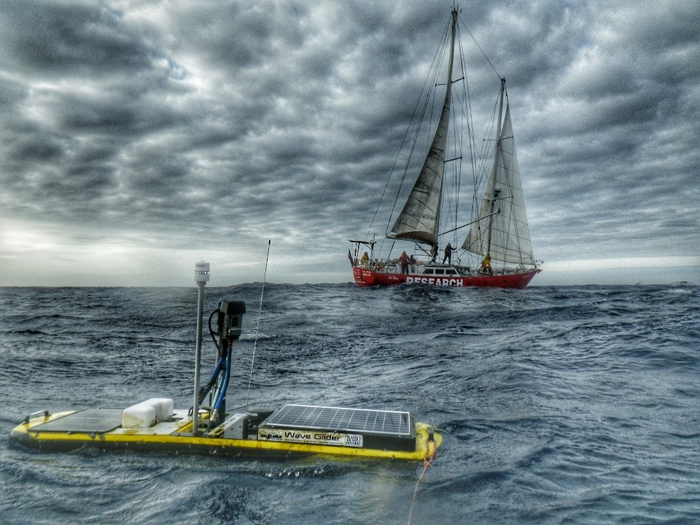
IMAGE: A WAVE GLIDER WAS ONE OF THE OCEAN ROBOTS IN THE PROJECT, COLLECTING DATA FROM THE SURFACEview more CREDIT: FRED FOURIE
Storms over the waters around Antarctica drive an outgassing of carbon dioxide into the atmosphere, according to a new international study with researchers from the University of Gothenburg. The research group used advanced ocean robots for the study, which provides a better understanding of climate change and can lead to better global climate models.
The world’s southernmost ocean, the Southern Ocean that surrounds Antarctica, plays an important role in the global climate because its waters contain large amounts of carbon dioxide. A new international study, in which researchers from the University of Gothenburg participated, has examined the complex processes driving air-sea fluxes of gasses, such as carbon dioxide.
Storms bring carbon dioxide-rich waters to the surface The research group is now delivering new findings that shed light on the area’s important role in climate change.
“We show how the intense storms that often occur in the region increase ocean mixing and bring carbon dioxide-rich waters from the deep to the surface. This drives an outgassing of carbon dioxide from the ocean to the atmosphere. There has been a lack of knowledge about these complex processes, so the study is an important key to understanding the Southern Ocean’s significance for the climate and the global carbon budget”, says Sebastiaan Swart, professor of oceanography at the University of Gothenburg and co-author of the study.
Facilitates better climate models Half of all carbon dioxide bound in the world’s oceans is found in the Southern Ocean. At the same time, climate change is expected to result in more intense storms in the future. Therefore, it is vital to understand the storms’ impact on the outgassing of carbon dioxide into the atmosphere, the researchers point out.
“This knowledge is necessary to be able to make more accurate predictions about future climate change. Currently, these environmental processes are not captured by global climate models”, says Marcel du Plessis at the University of Gothenburg, who also participated in the study.
Pioneering ocean robotics Measuring the inaccessible and stormy waters around Antarctica for a long period of time is a real challenge, which the researchers tackled with the help of unique robot technology. For several months, autonomous ocean robots; drones and ocean gliders, collected data from the surface and through to depths of one kilometer.
“This pioneering technology gave us the opportunity to collect data with long endurance, which would not have been possible via a research vessel. Thanks to these ocean robots we can now fill important knowledge gaps and gain a better understanding of the importance of the ocean for the climate, says Sebastiaan Swart.
Contact: Sebastiaan Swart, Professor of Oceanography at the University of Gothenburg, Department of Marine Sciences. Phone: 0046 723 667672, Email: sebastiaan.swart@marine.gu.se
About the research The article “Storms drive outgassing of CO2 in the subpolar Southern Ocean” has been published in Nature Communications. The international study was carried out in a collaboration between Sebastiaan Swart and Marcel du Plessis at the Department of Marine Sciences at the University of Gothenburg and, among others, CSIR (Council for Scientific and Industrial Research) in South Africa. The first author is Sarah Nicholson at CSIR.
The contributions to the study from University of Gothenburg have been supported by the Knut and Alice Wallenberg Foundation through the Wallenberg Academy Fellows Program and the Swedish Research Council.
JOURNAL
Nature Communications
METHOD OF RESEARCH
Survey
SUBJECT OF RESEARCH
Not applicable
ARTICLE TITLE
Storms drive outgassing of CO2 in the subpolar Southern Ocean
Canadian Truckers for Freedom growing fast — 11 convoys, $5m, one convoy said to be 150km long
11 convoys are converging across Canada. One convoy was claimed to be over 150 kilometers long last night and growing. US truckers are joining in, and they can’t come over the border they are going to block it.
This is not a union organized thing. It’s grassroots and it’s come out of nowhere. People are coming out and standing in minus 20 degree weather just to cheer the trucks on. The fundraising started last Friday and has reached $5m. It has grown so fast that GoFundMe is holding funds til the organisers present a clear plan. Truckdrivers are even coming from Alaska.
Think about this. From a standing start, this ‘army’ was mobilized, organized, financed, and shipped out in 3 days. In another 2 days it’s covered over 1,500 miles heading East, and additional columns have headed West, not sure how far they’ve traveled at this point.
It’d take the Cdn. Forces weeks to accomplish the same thing, with the same size force.
I’m not knocking the Cdn Forces; I’m just pointing out how incredible this enterprise is. The organizers are a folklore in the making.
This is going down in History no matter how it turns out.
Tireroaster below shows lots of small gatherings waiting in the middle of nowhere to see one small part of the convoy. At 7:45 he joins one of the big convoys in Mousejaw. So many cars lined up beside the roads, Canadian flag waving and finally overpasses loaded with trucks.
Last three minutes here is a compilation that includes a song that must have been made for this event.

 Iowa Climate Science Education