Month: January 2022

The Tongan Island that Didn’t Slip Below the Waves

We have been warned repeatedly that rising sea levels will wipe small Pacific Island nations from the map of the world thanks to climate change; that they are particularly vulnerable to human-caused emission of carbon dioxide. Not so the island with the crazy-sounding name Hunga Tonga – Hunga Ha’apai. It wasn’t overtaken by rising sea levels. Rather it blasted itself into the sky! Obliterated in an instant. The massive volcanic eruption caused sonic booms, tsunami waves, spectacular lightning bolts, and a giant umbrella cloud that rose to a height of 30 kilometres and reached 500 kilometres in diameter in less than 2 hours.

I was reminded of that exhaustingly long novel ‘Hawaii’ by James Michener – it begins with comment about the relentless surge of the universe, the violence of birth, the cold tearing away of death; and yet how promising was the interplay of forces as an island struggled to be born, vanishing in agony.

This fiction gets closer to the truth than many of the leaders of Pacific Island Nations that lament carbon dioxide emissions from human-sources while apparently blind to the reality that they are standing atop extinct volcanoes that once belched carbon dioxide.  And never mind that a recent University of Auckland study found the purportedly ‘at risk’ Marshall Island, Kiribati, as well as the Maldives archipelago in the Indian Ocean, have grown in land area by up to 8 percent over the last six decades, despite rising sea levels – because of the accumulation of coral sediment.

To be clear, most volcanic islands that have persisted, eventually by their very nature gradually sink again because they are effectively floating on top of hot ductile rocks that slowly give way.  Observed subsidence of many hundreds of metres in the case of flat-topped wave-eroded seamounts cannot be explained by sea level rise alone.  The islands that continue to exist in tropical waters still have corals growing on top of their subsiding summits, with some of the dead coral accumulating as sediment, thrown, or blown above sea level during storms and cyclones. Kiribati, Tuvalu and Marshall Islands in the Pacific, and the Maldives and Seychelles in the Indian Ocean, are all atolls built up from dead corals that grow on-top of long extinct subsiding volcanoes.

The spectacular emergence of Hunga Tonga – Hunga Ha’apai as a small island just a few years ago is evidence that the long-drawn-out geological processes that can create new Pacific islands continue to the present day. The island’s even more spectacular obliteration through an explosion on 15 January, may not be its end. It has erupted on a similar scale at least twice before in the last few thousand years, and this latest eruption is perhaps just a short setback in a million-year long story.

We marvel when a volcano explodes, and mostly ignore them the rest of the time.

Hawaii’s Mauna Loa is the world’s largest active volcano, but it does not erupt explosively.

It emerged above sea level about 400,000 years ago and has been steadily dribbling out low- viscosity basaltic lava, along with lots of steam and some carbon dioxide, for at least 700,000 years. Mauna Loa is the quintessential shield volcano with broad, rounded slopes – growing slowly, and for so long. It is now one of the largest single mountain masses in the world, rising more than 4 kilometres above sea level with a total height of more than 9 kilometres from base to summit. It is an example of ‘hot spot’ ocean island volcanism, characterised by the formation of individual sea mounts. A lot of the world’s coral reefs are hosted by these volcanoes – many of them now extinct and slowly sinking under their own weight into the sea floor.

Most volcanism commences underwater. Much more extensive than ‘hot spots’, the Earth’s mid-ocean ridges are a continuous network of volcanically active undersea ridgelines crisscrossing Earth’s seafloor like stitching on a baseball – the Earth being the baseball. Mid- ocean ridge volcanism is relatively slow and steady, and almost entirely non-explosive. The material that erupts through fissures at what are called ‘spreading centres’ along the ridge lines is primarily basalt, the most common volcanic rock on Earth.  This is where the thin and young oceanic crust of the Earth is being created, at what are called constructive divergent plate boundaries.

Volcanologist Arthur Day explained to me that Hunga Tonga – Hunga Ha’apai is not part of the mid-ocean ridge network, nor a ‘hot spot’ volcano like Mauna Loa. The tectonic setting, magma composition, and eruptive style of this volcano is completely different. Hunga Tonga – Hunga Ha’apai sits on the shallow Tonga-Kermadec Ridge and is a volcanic arc volcano. Volcanic arcs occur at convergent zones where the Earth’s crust is being destroyed.

Hunga Tonga – Hunga Ha’apai first appeared above sea level in 2015 as a large crater volcano with a cauldron-like pit in an area of subsidence. Its magma has more silica, making it more viscous and therefore more explosive. In addition, the explosion of Hunga Tonga – Hunga Ha’apai was made all-the-more violent due to two more effects: the sudden depressurisation of dissolved gasses as the magma escaped from its submarine magma chamber, plus the vaporisation of vast amounts of seawater as the then-unsupported chamber collapsed inward. This submarine collapse may have displaced enough seawater to also trigger the associated tsunami.

Those concerned about human-caused climate change have been quick to explain that the amount of carbon dioxide expelled from the depth of the Earth by this Tongan volcano on January 15, was insignificant relative to the relentless activities of humankind.  I agree.  But the blast did penetrate the stratosphere and could cause global cooling.  The eruption of Mount Pinatubo in the Philippines in 1991 caused a drop in global temperatures of 0.6 degrees Celsius for the next 15 months that is visible as a blip in the monthly global satellite temperature record.   If Hunga Tonga – Hunga Ha’apai were to trigger catastrophic global cooling, would the rest of the world be entitled to sue the people of Tonga?

****

The schematic representation of the birth of a volcanic island is from Shutterstock.com

via Jennifer Marohasy

https://ift.tt/3GY3blh

January 24, 2022 at 02:15PM

New England Will Freeze If Sleepy Joe Gets His Green New Deal

By Paul Homewood


 Boston temperature

Joe Biden promised to “achieve net zero carbon emissions in the power sector by 2035.”

I’m sure the inhabitants of New England will be over the moon. It’s been a pretty average week temperature wise there and electricity demand is around normal, peaking below the summer air conditioning highs:

Daily peak-hour electricity load in New England

Yet even then wind and solar are only managing to supply 3% of generation. Most of that is solar power at midday.


chart 


New England already relies on imports for a third of its power, mainly from across the border in Canada:

chart-1

Canada exports about 50 TWh a year to the US, about a tenth of output, of which hydro and nuclear make up 75% (BP Energy Review). New England takes mainly surplus hydro power from Quebec and New Brunswick, but transmission capacity limits the scope for New England to take much more than the 2 GW it does now.

In any event. were Canada to step up exports to the US, it could only do this by increasing fossil fuel generation, as the other sources are fixed.

Which all begs the question – where will New England get all the power it needs when fossil fuels, which currently supply 65%, are excluded from the mix. Nuclear, we are led to believe, has no future in Biden’s green utopia. Instead his main hope is solar power, which has supplied just half a percent this week so far.

But it gets worse!


Although natural gas provides nearly half of New England’s electricity, about three quarters of gas consumption goes elsewhere, mainly for residential heating:

Daily natural gas consumption by sector in New England 


Just as in the UK, the use of gas for heating will have to be drastically reduced very quickly, if decarbonisation targets are to be met.

Gas usage in New England is running at around 3 bcf/day at this time of year, excluding power generation. This is equivalent in energy terms to 879 GWh/day, or 36 GW.

In other words, if this heating is switched from gas to electricity, New England’s power demand would rise from about 17 GW to 53 GW. That’s triple current demand, and more than double the summertime peak.

Most of the US will be in a similar position in winter, so they cannot all rely on piping solar power in from Nevada.

There is no easy way to say this. People will die, and lots of them, if Joe Biden’s crazy green agenda is implemented.

via NOT A LOT OF PEOPLE KNOW THAT

https://ift.tt/3tVLwqH

January 24, 2022 at 01:15PM

Alex Epstein: “It’s time for Larry Fink to come clean about fossil fuels”

Guest “Will the real Larry Fink please stand up?” by David Middleton

Remember the old game show, To Tell the Truth?

To Tell the Truth
September 8, 1969 – September, 1978
Produced for daily syndication
The Show:
A team of three challengers comes onstage and each challenger introduces him/herself with the same name. One challenger really is the person s/he claims to be, while the other two are imposters. The host reads an affidavit, written in the first person, explaining why the central character is significant, after which the challengers take their seats at podiums labeled with the numbers 1, 2, & 3.

Each of the four panelists, in turn, has about a minute to cross-examine the challengers by asking them questions about their field of expertise, what they did, etc. After all four panelists have had a turn, they cast their votes as to who they think the “real person” is.

After all four panelists have had a turn, they cast their votes as to who they think the “real person” is. After the votes had been cast, it was customary for the host to ask, “Will the real (name) please stand up?” The real challenger stands up, and the vote scores are tallied. On this particular version, the contestants split $50 for each wrong vote cast or $500 if all four panelists were wrong.

[…]

BillCullen.net

Alex Epstein’s latest Substack article basically asks…

Will the real Larry Fink please stand up?

It’s time for Larry Fink to come clean about fossil fuels
A previously-unreleased pro-oil/gas letter sent by BlackRock to Texas lawmakers and oil/gas executives reveals a major contradiction

Alex Epstein
Jan 18

Breaking: A previously-unreleased pro-oil/gas letter sent by BlackRock to Texas lawmakers and oil/gas executives reveals that the company is simultaneously 1) trying to gain status by supporting anti-oil/gas net zero goals, and 2) trying not to lose any pro-oil/gas investors.

[…]

Energy Talking Points by Alex Epstein

I highly recommend reading Mr. Epstein’s full Substack article.

Dan Patrick vs. Larry Fink

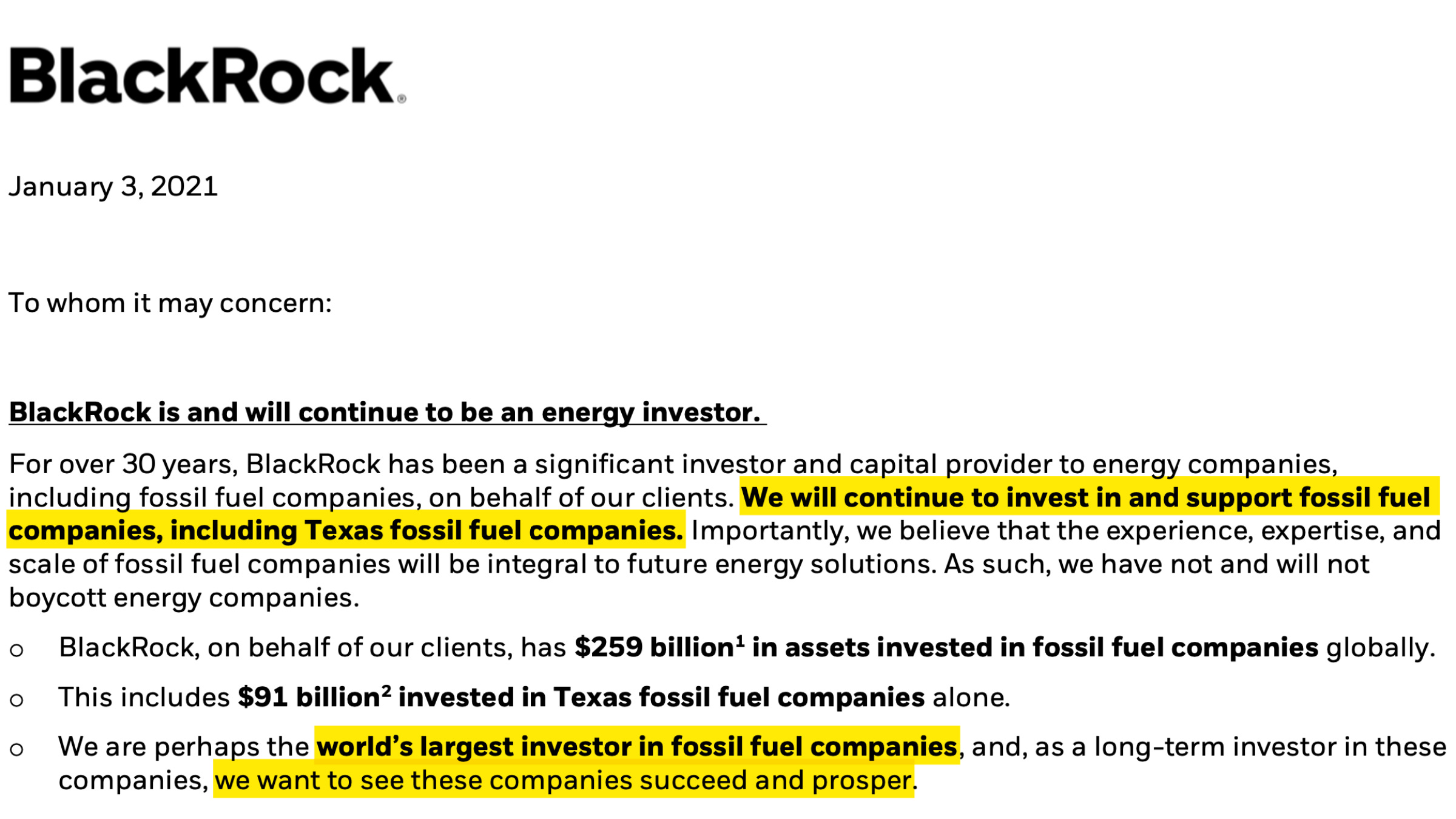
Mr. Fink’s January 3, 2022 letter stated, “We will continue to invest in and support fossil fuel companies, including Texas fossil fuel companies.” This letter was specifically to Texas lawmakers and oil & gas executives, probably in an effort to avert this:

January 19, 2022

HOUSTON – Lt. Gov. Dan Patrick sent the following letter to Comptroller Glenn Hegar today asking him to place BlackRock at the top of the list of financial companies that boycott the Texas oil & gas industry under Senate Bill 13, the Oil & Gas Investment Protection Act. Upon sending the letter, Lt. Gov. Patrick issued the following statement:

“When the Senate passed Senate Bill 13, we made it clear that Texans will not tolerate Wall Street turning its back on our flourishing oil and gas industry and the millions of Texans who rely upon it. As long as I am Lt. Governor, I will never back down from defending our oil and gas industry and I remain committed to ensuring Texas is the top state for oil and gas in America.”

Dear Comptroller Hegar,

Thank you for your ongoing efforts to implement Senate Bill (SB) 13 (87th Regular Session), the Oil & Gas Investment Protection Act, by Sen. Brian Birdwell, R-Granbury. As you know, this law says Texas should not contract with or invest in companies that boycott energy companies. Because I strongly believe we need to prioritize and protect our state’s and nation’s energy independence, I made the passage of SB 13 a high priority.

As you prepare the official list of companies that boycott energy companies, I ask that you include BlackRock, and any company like them, that choose to hurt Texas oil and gas energy companies by boycotting them in violation of Senate Bill 13. As I have stated before, if Wall Street turns their back on Texas and our thriving oil and gas industry, then Texas will not do business with Wall Street.

Please know, BlackRock only recently met with my office after you sent BlackRock and others a letter threatening to take action against entities that boycott energy companies. At the meeting with my staff, Blackrock said it was committed to Texas and Texas’s vast energy footprint, but I have grave concerns that BlackRock’s public statements and actions do not reflect its sentiments presented to my office.

Just yesterday, BlackRock Chairman and CEO, Larry Fink, issued his annual 2022 letter to CEOs indicating that BlackRock’s goal is to transition to a “net zero” world, including decarbonizing the energy sector. Needless to say, it is highly inconsistent to claim support for Texas’ oil and gas energy industry while leading a “net zero” policy effort that will destroy the oil and gas industry and destabilize the economy worldwide.

This is nothing new for Mr. Fink. In his 2020 letter to CEOs, he stated that Blackrock would be “exiting investments that present a high sustainability-related risk.” He expanded on this initiative further in his letter to BlackRock’s clients:

“Where we do not see progress in [transitioning to “net zero”], and in particular where we see a lack of alignment combined with a lack of engagement, we will not only use our vote against management for our index portfolio-held shares, we will also flag these holdings for potential exit in our discretionary active portfolios[.]”

According to Bloomberg on January 12, 2022, when addressing their new Climate Action Multi-Asset Fund and Climate Action Equity Fund, BlackRock said that it intends to incorporate a year-on-year decarbonization rate and identify companies that appear to be “long-term, disruptive structural winners” in driving down greenhouse gas emissions.

These statements indicate that BlackRock is capriciously discriminating against the oil and gas industry by exiting investments solely because companies do not subscribe to a “net zero” policy beyond what is required by law.

According to SB 13, a company is considered to be boycotting an energy company if it limits relations with an entity involved in the fossil fuel-based energy sector if the entity “does not commit or pledge to meet environmental standards beyond applicable federal and state law[.]” Committing to a “net zero” carbon strategy is beyond applicable environmental standards in federal and state law. Therefore, BlackRock is boycotting energy companies by basing investment decisions on whether a company pledges to meet BlackRock’s “net zero” goals.

Furthermore, BlackRock’s discrimination goes well beyond just its investment decisions. In a recent Wall Street Journal article, it was noted that “BlackRock made waves last spring when it voted to replace three Exxon Mobil Corp. directors over the oil giant’s reluctance to quickly transition to cleaner energy sources.” It is not appropriate for Mr. Fink and BlackRock, or any other company, to arbitrarily strong-arm the energy sector to commit to exceed federal and state environmental laws.

As you prepare the list of those that boycott Texas energy companies, I ask that BlackRock be at the top of the list, and any company like them that discriminates against Texas energy. I am committed to keeping Texas the number one oil and gas state in the country. Texas will not do business with those that boycott fossil fuels.

Thank you for all you do for Texas.

Sincerely,

Dan Patrick
Lieutenant Governor

LIEUTENANT GOVERNOR OF TEXAS DAN PATRICK

Lt. Gov. Patrick was responding to Larry Fink’s January 18, 2022 public letter to CEOs:

Every company and every industry will be transformed by the transition to a net zero world. The question is, will you lead, or will you be led?

In a few short years, we have all watched innovators reimagine the auto industry. And today, every car manufacturer is racing toward an electric future. The auto industry, however, is merely on the leading edge – every sector will be transformed by new, sustainable technology.

Engineers and scientists are working around the clock on how to decarbonize cement, steel, and plastics; shipping, trucking, and aviation; agriculture, energy, and construction. I believe the decarbonizing of the global economy is going to create the greatest investment opportunity of our lifetime. It will also leave behind the companies that don’t adapt, regardless of what industry they are in. And just as some companies risk being left behind, so do cities and countries that don’t plan for the future. They risk losing jobs, even as other places gain them. The decarbonization of the economy will be accompanied by enormous job creation for those that engage in the necessary long-term planning.

[…]

LARRY FINK’S 2022 LETTER TO CEOS

This was the only mention of “fossil fuels” in the public letter to CEOs:

The transition to net zero is already uneven with different parts of the global economy moving at different speeds. It will not happen overnight. We need to pass through shades of brown to shades of green. For example, to ensure continuity of affordable energy supplies during the transition, traditional fossil fuels like natural gas will play an important role both for power generation and heating in certain regions, as well as for the production of hydrogen.

LARRY FINK’S 2022 LETTER TO CEOS

Mr. Fink’s grasp of reality is fleeting, at best. The US Energy Information Administration’s 2021 International Energy Outlook paints a somewhat more realistic path forward…

How could someone with so much influence be so out of touch with reality?

When my partners and I founded BlackRock as a startup 34 years ago, I had no experience running a company. Over the past three decades, I’ve had the opportunity to talk with countless CEOs and to learn what distinguishes truly great companies. Time and again, what they all share is that they have a clear sense of purpose; consistent values; and, crucially, they recognize the importance of engaging with and delivering for their key stakeholders. This is the foundation of stakeholder capitalism.

LARRY FINK’S 2022 LETTER TO CEOS

Who would have ever guessed that Mr. Fink had no experience running a company before trying to tell everyone else in the world how to run their companies?

Despite the overall hostility toward fossil fuels in Mr. Fink’s public letter to CEO’s, this paragraph drew harsh criticism from the lamestream media and ignorant activists:

Divesting from entire sectors – or simply passing carbon-intensive assets from public markets to private markets – will not get the world to net zero. And BlackRock does not pursue divestment from oil and gas companies as a policy. We do have some clients who choose to divest their assets while other clients reject that approach. Foresighted companies across a wide range of carbon intensive sectors are transforming their businesses, and their actions are a critical part of decarbonization. We believe the companies leading the transition present a vital investment opportunity for our clients and driving capital towards these phoenixes will be essential to achieving a net zero world.

LARRY FINK’S 2022 LETTER TO CEOS

Ignorant activists responded with babble like this:

“His opportunistic argument for supporting fossil gas as part of the green transition is flatly contradicted by climate science,” added Lara Cuvelier, a campaigner at Reclaim Finance, a nonprofit organization that argues the world’s largest financial institutions should move away from fossil fuels.

“Fink is thus providing cover for the building of dozens of new gas plants, which would lock us into fossil fuels for years to come. Moreover, his simplistic attack on divestment obscures a vital lesson: to succeed, engagement must be paired with a clear demand to stop fossil fuel expansion,” Cuvelier said in a written statement.

“Given BlackRock’s enormous fossil fuel interests, perhaps this truth is just too inconvenient to stomach,” she added.

CNBC

There’s only one answer for someone who thinks that reality is “flatly contradicted by climate science,” and it’s reality that must change…

Larry Fink doesn’t support “divestment from oil and gas companies;” yet he seems to think that only natural gas is needed and that it will just play a limited, regional role in the transition to a “net zero world.” No wonder, Lt. Gov. Patrick asked the state Comptroller to list BlackRock as “Public Enemy #1.”

While the fossil fuel industries will continue to decrease the carbon intensity of production, transportation and consumption, currently through replacing coal-fired electricity generation with natural gas and will soon accelerate this process with carbon capture utilization and storage (CCUS) over the next few decades, “net zero” is just a slogan.

On January 3, 2020, in a private letter, Mr. Fink assured Texas lawmakers and oil & gas executives that BlackRock expected to be “long term investors” in the fossil fuel industries “because these companies play crucial roles in the economy.” Two weeks later, in a public letter to CEOs, the future for fossil fuels was limited to natural gas in a limited role “in certain regions.” Which is it?

Will the real Larry Fink please stand up?

  1. “Every company and every industry will be transformed by the transition to a net zero world.”
  2. “We will continue to invest in and support fossil fuel companies, including Texas fossil fuel companies.”
  3. “When my partners and I founded BlackRock as a startup 34 years ago, I had no experience running a company.”

I’m going with contestant #3.

Although I do have to give Mr. Fink kudos for p!$$ing off both sides…

via Watts Up With That?

https://ift.tt/3GZdSny

January 24, 2022 at 12:10PM

The Forever Health “Emergency”

Ryan McMaken writes at Mises Institute Why They Want to Keep the “Health Emergency” Going Forever. Excerpts in italics with my bolds and added images.

Last month, Colorado governor Jared Polis ended statewide mask mandates and social-distancing provisions, stating that “the emergency is over.“ This, of course, does not mean Colorado is now laissez-faire in terms of covid. Public higher education institutions—thanks to Polis’ tacit approval—still have free rein in terms of imposing vaccine and mask mandates, and in forcing classes to “go online” whenever the college bureaucrats grow sufficiently alarmed about covid. Moreover, local officials were quick to react to the governor’s nonemergency by imposing a variety of mandates of their own.

More than 80 percent of the state’s population still lives in counties with mask mandates.

For even this extremely mild and timid move in the direction of personal freedom, Polis was raked over the coals by the state’s left-of-center activists. Within days, The Sentinel, a newspaper out of Aurora, Colorado, issued an unsigned editorial declaring “No, Gov. Polis, the pandemic emergency is not over.” The column excoriated the governor for daring to end mask mandates and for categorically refusing the idea of future lockdowns.

Polis was also forced to walk back comments he made about how it’s not the job of health officials to “tell people what to wear“ in an apparent reference to mask mandates. Polis rather unconvincingly “clarified” that what he really meant was this was not the proper role of state health officials; it’s fine for local officials to tell people what to wear.

The fact that Polis himself had earlier claimed this was, in fact, the role of health officials is now beside the point. Incoherence and inconsistency from politicians is a given. The point now is that when a governor—even a Democratic one—tries to slightly scale back covid mandates, he or she is likely to meet furious opposition from the Left.

The lesson here is that no matter what the policy is, there will be no shortage of covid-obsessed college professors, politicians, and activists who will vehemently demand that more draconian policies be imposed immediately and everywhere.

No moderation of any kind is to be tolerated.

Indeed, so many bureaucrats, politicians, and technocrats have doubled down on covid mandate maximalism, it’s difficult to see them ever letting go. We should expect them to search out new ways to extend current “health emergencies“ indefinitely into the future by forever moving the goal posts and finding new diseases that justify continued mask mandates and social distancing rules.

Moving the Goal Posts

Back in January of 2021, Karol Markowicz at the New York Post warned that there are many out there who want the covid emergency state “to go on forever.“ Nearly a year after the initial covid panic, when it was clear covid was not a civilization-ending disease and hardly “the plague of the century,“ these technocrats were pushing for more masks and more isolation for children.

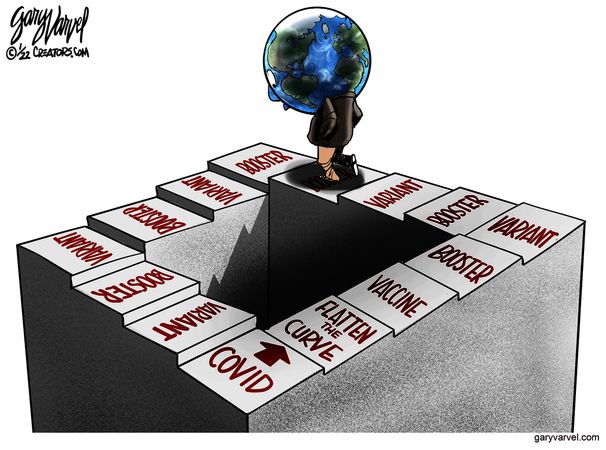
Much of this strategy has long been pushed through constant movement of the goal posts. While vaccines were initially being sold to the public as a cure-all that would allow everything to go back to “normal“ this soon evolved into a series of explanations as to why vaccines actually changed nothing. Rather, vaccines might do some good, but the public should nonetheless be prepared to wear masks forever. Then they decided their “uniquely effective” vaccines were so effective that it was necessary to “protect the vaccinated from the unvaccinated.” Even lockdowns were still on the table into late 2021. The story was then changed to a narrative in which so long as every single child is not vaccinated, schools must remain closed, and everyone must remain masked.

These mandates might also come in handy whenever some new bird flu or swine flu crops up. Yes, earlier flu-based “emergencies” had failed to command widespread hysteria as with the swine flu scares of 1976 and 2009. But now the health bureaucrats finally had seized the authority they always wanted: keep emergency “pandemic powers” in place forever so that if the CDC or the World Health Organization identifies a new “threat,” lockdowns, mask mandates, and vaccine passports can be forced upon the population until the “danger” is past.

Institute a Warning System

Another key challenge will be to keep the public always on the edge of alarm. On this, the mandate enthusiasts could take a page from the War on Terror propaganda employed in the wake of 9/11. In March 2002, the Bush administration instituted a color-coded terrorism threat advisory scale designed to indicate the terrorism “threat level.” This presumably allowed the public to gauge just how much they should be living in fear of terrorism at any given time. As propaganda it was helpful as a means of constantly reminding the public that the government keeps them safe, and that an all-powerful national security state is a necessity.

A similar scheme could easily be used to address health “threats.” Naturally, the scale would never be moved to “low” because if some actual epidemic did break out, that would make the “experts” look like they were asleep at the switch. So, naturally, the scale would always be at “guarded”—perhaps in the summertime—but would reliably be raised to “elevated” in the wintertime as hospital beds filled up with flu and pneumonia sufferers. Then, if any muttering of some new bird flu out of Asia hit the headlines, the technocrats could raise the threat level to “high.” This could then be used to justify the imposition of new mask mandates, vaccine requirements, or even lockdowns.

Then when summer weather returned and the hospital beds emptied, the experts would insist they had prevented disaster by imposing new mandates.

The only way these health experts will stop with their perpetual emergency is if they’re forced to. Health bureaucrats must be stripped of their far-too-expansive “emergency powers” and their agencies reined in. Their “scientific” opinions should be treated as the thinly veiled political statements they so frequently are. As I wrote in 2020, the pandemic only ends when the public decides it is over.

Some politicians have figured out that it’s dangerous to keep pushing the same old covid mandates into election season this fall. This is surely why Polis now appears uninterested in haranguing the public about covid on a daily basis as he was doing back in 2020.

But the academics and technocrats who can afford to live in their echo chamber—thanks to taxpayer money—are unlikely to relent. They’ll be singing the same tune twenty years from now and calling for new mandates—for the disease du jour—every year. Let’s just hope that the world will have finally stopped listening.


via Science Matters

https://ift.tt/3IAIfAS

January 24, 2022 at 11:11AM