Month: January 2022

Removing green levies from energy bills welcomed

London, 22 January — Net Zero Watch has welcomed the government’s apparent decision to removing green levies from energy bills, providing direct relief to hard-hit households and also to industrial and commercial consumers.

According to a report in the Times, “ministers have been considering scrapping green levies from energy bills. However officials have concluded that because the government is contractually obliged to pay them they would simply be moved from energy bills to general taxation.”

Direct subsidies for renewable energy investors – via the Renewables Obligation, the Feed-in Tariff and the Contracts for Difference systems – run to £10 billion a year, but there is a further £2 billion from the high system costs renewables bring to the grid.

Net Zero Watch has repeatedly called on ministers to remove these renewable energy subsidies from energy bills to help reduce mounting pressure on the general cost of living.

Cutting green levies from energy bills will also allow the Treasury, in the medium-term, to buy back these subsidy entitlements at a discount, and eventually cease to provide green energy subsidies in any form.

Steve Baker MP said,

Thank goodness we now seem to be making progress towards better energy policy. Setting out to make the public poorer and colder never seemed likely to survive contact with electors. We can only hope ministers now accelerate down the path to policy with is socially, economically and politically viable.”

Dr Benny Peiser, Net Zero Watch director said:

It would appear that Rishi Sunak and his advisers in the Treasury are realising that billions in subsidies for renewable energy is no longer compatible in its present form, threatening the welfare of millions of households and undermining economic and political stability. Sooner or later, the Government will have to consider terminating all energy subsidies that are increasing costs and pain to consumers and businesses.”

Note for bloggers and journalists

Net Zero Watch has published a simple guide on a number of additional options available to the government to effectively solve the energy bills crisis in the short and medium term.

With mounting concern about the true cost of the Government’s Net Zero project the Global Warming Policy Forum (GWPF) has publishing a realistic alternative that reduces CO2 emissions without inflicting astronomical costs on consumers.

John Constable & Capell Aris: A workable alternative to Net Zero. A plan for cleaner, reliable and affordable energy (pdf)

via Net Zero Watch

https://ift.tt/3KxUoIG

January 22, 2022 at 05:31AM

Global agency sows fear with misinformation

By Paul Homewood


From CO2 Coalition:


 image

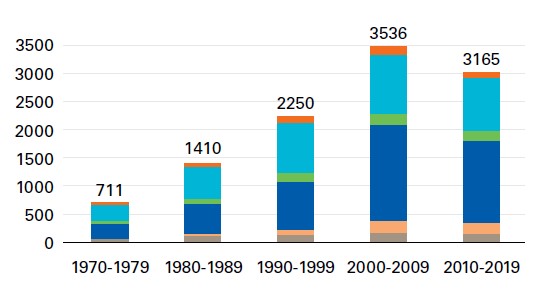
A recent report by the World Meteorological Organization claims that there has been a dramatic increase in the number of natural disasters over the last 50 years. According to the WMO Atlas of Mortality and Economic Losses from Weather, Climate and Water Extremes (1970 – 2019), there were more than 11,000 reported disasters attributed to these hazards globally, with just over 2 million deaths and U.S. $ 3.64 trillion in losses.

The report claims that the number of disasters “has increased by a factor of five” since 1970 and that human additions of carbon dioxide are to blame. Referring to this data, WMO Secretary-General Petteri Taalas stated:

“The number of weather, climate and water extremes are increasing and will become more frequent and severe in many parts of the world as a result of climate change. That means more heatwaves, drought and forest fires such as those we have observed recently in Europe and North America.” He further warned: “The warming of the oceans has affected the frequency and area of existence of the most intense tropical storms.”

The chart used to support their alarming claims of a five-fold increase of disasters is shown below, and taken at face value appears alarming.

Figure 1 – Number of reported disasters

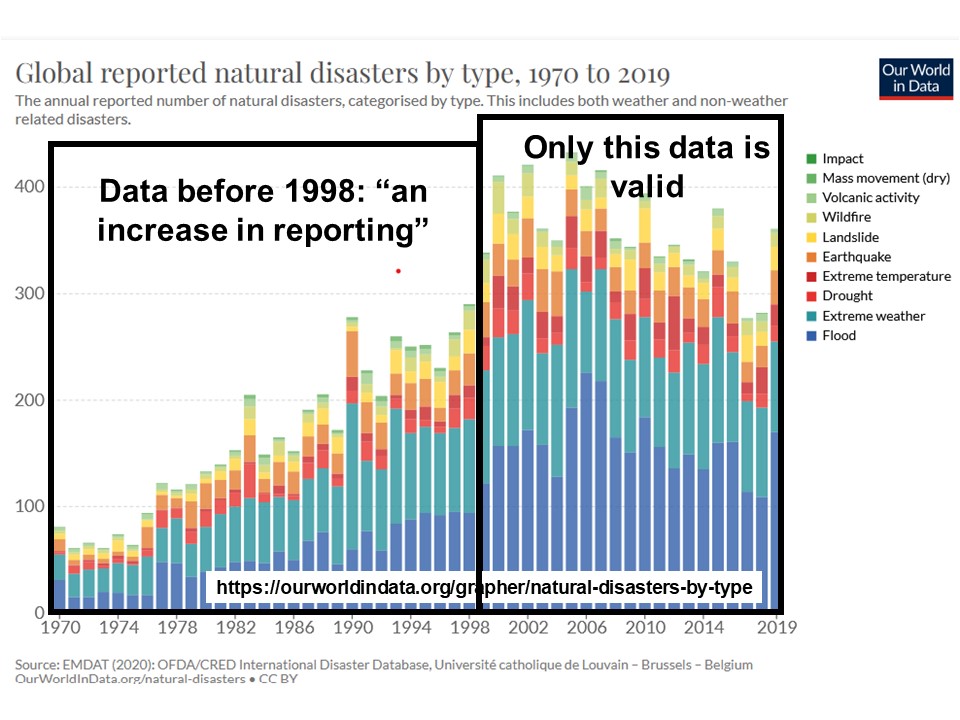
The claims of increasing numbers of these severe weather events should generate alarm if they were correct. Fortunately for the peoples of the world, the facts fly in the face of the reporting. The WMO and its authors chose to misrepresent disaster data as gathered by one of the most reputable agencies in the world, the Centre for Research on the Epidemiology of Disasters (CRED) in their EM-DAT database. The WMO based its reporting on the CRED data as shown below and displayed by Our World In Data.

Figure 2 – Global reported disasters by type

The claims of a five-fold increase in the numbers of disasters appears to be supported by a significant increase in calamities from 1970 until 2000 and a decline over the last twenty or so years. Why the change from increasing disasters over the first 30 years of data and a decline thereafter?

It turns out that the period from 1970 to about 2000 are the years in which CRED was building a data collection system that depends heavily on external reporting. Please note that the title of the WMO chart is “Number of reported disasters,” not “number of disasters.”

That the chart was driven by reporting rather than numbers was confirmed by CO2 Coalition Science Research Journalist Kip Hansen when he first questioned the validity of the data after its publication in 2019. At the time, he emailed Regina Below, CRED database manager and documentalist, asking her to confirm that the increase in the early period represented an increase in reporting, rather than an increase in actual natural disasters. Her response via email?

“Thank for your e-mail. You are right, it is an increase in reporting.”

In other words, the CRED system’s counts rose as it received reports from more and more sources over the years. Comparing totals from the 1970s with 21st century data is not only inappropriate, but also a blatant misuse of statistics to bolster a pre-ordained conclusion of increasing destruction.

To restate: The WMO released a “study” claiming climate disasters were increasing based on numbers that the authors knew were misleading at best. The actual numbers of disasters since proper reporting has been in place show a decline in disasters over the last twenty years, exactly opposite the hyperbolic claims of the WMO.

The World Meteorological Organization should immediately retract this flawed study and issue a formal statement publicly correcting the record.

https://co2coalition.org/2022/01/17/global-agency-sows-fear-with-misinformation/

via NOT A LOT OF PEOPLE KNOW THAT

https://ift.tt/353d7LY

January 22, 2022 at 04:45AM

Eugene, Oregon: “We need some climate change”

Guest essay by Eric Worrall

Seems like winter has been a little cold in Oregon this year.

Opinion: We need some climate change

Beatrice Byrd
11 hrs ago

It’s been cold. I mean freezing. I mean perpetual chills running down the vertebrae of my spine and cloudy vision due to the ferocity of my teeth chattering. Not even two layers of sweaters can preclude the arctic airs that kickstart the process of my hypothermia.

We keep hearing the words “climate change” come up in the news. All I’m saying is, what could be so bad about that? I know that I, for one, need some more warmth, seeing as I almost freeze to death doing simple tasks outdoors.

NASA said, “global temperatures will continue to rise for decades,” but why is everyone freaking out? I know I don’t want to have to wear a big, honking coat every winter.

Read more: https://www.dailyemerald.com/opinion/opinion-we-need-some-climate-change/article_f5d9fa48-7a2a-11ec-b0dc-0f48b23165b2.html

Oregon is on my bucket list of places I would love to see. But I think I’ll wait until Summer to visit.

via Watts Up With That?

https://ift.tt/3tNOU6N

January 22, 2022 at 04:27AM

Russia moves into the Arctic as the U.S. withdraws

The Biden Administration is proving to be the willing lackey of Russian President Vladimir Putin.

The post Russia moves into the Arctic as the U.S. withdraws appeared first on CFACT.

via CFACT

https://ift.tt/32n1mzb

January 22, 2022 at 04:22AM