On this date sixty-five years ago, deadly tornadoes struck Oklahoma and Louisiana. 22 Jan 1957, Page 1 – The Greenwood Commonwealth at Newspapers.com 22 Jan 1957, 1 – The York Dispatch at Newspapers.com Twenty six states were over 60F, twelve … Continue reading →
By refusing to back reliable coal-fired power plants, global elites have condemned the world’s poorest to a life of abject and eternal poverty.
The prospect of making $trillions trading in carbon dioxide gas credits – presumably backed by an invisible commodity that will never be delivered – has international bankers salivating. To get there, the money men have engineered so-called net-zero carbon oxide gas emissions targets, and plenty of Western governments have bought in.
The pinstriped beneficiaries thereof, however, couldn’t care less about the billion or so of the planet’s occupants who struggle every day to obtain the merest skerrick of energy for cooking or warmth. And then, often in the form of scavenged twigs and dung.
The ‘Kill the Poor’ attitude was on full display during the Glasgow climate gabfest, as Donn Dears details below.
Banks Agree: No more Coal-fired Power Plants
Power for USA
Donn Dears
14 December 2021
COP26 has reached an agreement that will condemn millions of people in poor, developing countries to live in poverty and die an early death.
These are mostly non-white people, and since race seems to be of primary importance to elite Europeans and Americans, that fact shouldn’t go unmentioned.
Quoting an article from the Wall Street Journal:
“Most of the world’s big banks, its major investors and insurers and its financial regulators have for the first time signed up to a coordinated pledge that will incorporate carbon emissions into their most fundamental decisions.”
And:
“Financial regulators, including the U.S. Federal Reserve, the Bank of England, plus the global-accounting-standards organization, have agreed to add their own oversight to the system through reviews and disclosure standards.”
A new international body is being established to enforce the making of the right decarbonization investments.
Some of these institutions have already said they won’t invest in coal-fired power plants or coal mining.
From a report by Morgan Stanley:
“Around 220 institutional investors representing some $57 trillion in assets have already committed to align their portfolios with net-zero. In addition, 88 banks, representing a third of global banking assets, have promised to decarbonize their lending and investment portfolios, in line with the net zero ambition.”
This means millions will continue to live without electricity and to having to use wood and dung for cooking. Dung, just to be clear, is the waste products, i.e., manure, from animals.
Supposedly, developed countries will provide billions for investing in wind and solar farms in developing countries.
Will these banks also invest in hydrogen production in countries that already don’t have enough electricity to supply even minimum amounts of electricity to their citizens?
And how will developing countries get along with battery-powered vehicles when they don’t have enough electricity to light their homes for just a few hours every day?
Has anyone been to Samarang, Indonesia, or cities in India and Africa to see how people move around and how goods are transported?
Battery-powered motor bikes and three-wheeled jitneys don’t work very well without electricity.
The media will declare COP 26 a success, but will the three or four billion poor people of color living in developing nations agree? Power for USA
The work of citizen scientist, Dr. Lindsay Moore, has failed to confirm an important IPCC prediction about what will happen to the spread between maximum and minimum temperatures due to the Enhanced Greenhouse Effect. The IPCC’s position is that this spread will narrow as a result of global warming.
Moore’s work focuses on the remote weather station at Giles in Western Australia and run by Australia’s peak weather monitoring body, the Bureau of Meteorology (BoM).
Why Giles?
Giles is the most remote weather station in mainland Australia and its isolation in a desert makes it an ideal place to study the issue of temperature spread. It is virtually in the middle of the Continent.It is far from influencing factors such as Urban Heat Island effect, land use changes, encroachment by shading vegetation, shading by buildings and so on, that can potentially corrupt the data. Humidity is usually low and stable and it is far from the sea. In addition, as a sign of its importance in the BoM network, Giles is permanently staffed.
As stated, the IPCC hypothesis is that the ‘gap’ will become steadily smaller as the Enhanced Greenhouse Effect takes hold. As temperature rises the gap will narrow and this will result in an increase in average temperature, so says the IPCC.
Moore’s research indicates that this is just not happening at this showcase BoM site. It may be happening elsewhere, and this needs to be tested in each case against the range of all data-corrupting effects, but it is not happening at Giles.
Notes about the graphs.
The top plot line shows the average Tmax for each year – that is, the average maximum daytime temperature.
The middle plot shows the average Tmin for each year – that is, the average minimum night time temperature.
The lower plot shows the result of the calculation Tmax-Tmin. In laypersons’ terms it is the result you get when you subtract the average yearly minimum temperature from the average yearly maximum temperature.
.
If the IPCC hypothesis is valid, then the lower plot line should be rising steadily through the years because, according to the IPCC, more carbon dioxide in the atmosphere should make nights warmer. But the plot line does not show this.
******
The IPCC’s reasoning for its narrowing prediction is that global warming will be driven more by a general rise in minimum temps that it will be by a general rise in maximums. This is not my assertion, nor is it Dr. Moore’s, it is the assertion of the IPCC and can be found in the IPCC’s AR4 Report.
Dr. Moore states, “In the AR4 report the IPCC claims that elevated CO2 levels trap heat, specifically the long wave radiation escaping to space.
“As a result of this the IPCC states at page 750 that, ‘almost everywhere night time temperatures increase more than day time temperatures, that decrease in number of frost days are projected over time, and that temperatures over land will be approximately twice average Global temp rise,” he says citing page 749 of the AR4 report.
So where can we go to find evidence that the IPCC assertion of a narrowing spread of Tmax-Tmin is either happening or not happening? Giles is a great start point. Can we use the BoM’s own publicly available data to either confirm, or disprove, the narrowing prediction? The short answer is – Yes we can.
But, before we all get too excited about the result Dr. Moore has found, we need to recognise the limitation that this is just one site and, to the cautious scientific mind, may still be subject to some bizarre influence that somehow skews the result away from the IPCC prediction. If anyone can suggest what viable contenders for ‘bizarre influences’ might be at Giles we would welcome them in the comments section of this post.
The caution validly exercised by the rigorous scientific mind can be validly balanced by the fact that Giles is a premier, permanently staffed and credible site. The station was also set up with great care, and for very specific scientific purposes, in the days of the Cold War as part of the British nuclear test program in Australia in the 1950’s. It was also important in supplying timely and accurate meteorological data for rocket launches from the Woomera Rocket Range in South Australia in the development of the Bluestreak Rocket as part of the British/Australian space program. This range extended almost all the way across Australia from the launching site at Woomera to the arid North West of Western Australia.
In the early years there were several other weather monitoring stations along the track of the range. Such has been the care and precision of the operation of the station that Giles has the characteristics of a controlled experiment.
Dr. Moore states, “Giles is arguably the best site in the World because of its position and the accuracy and reliability of its records which is a constant recognised problem in many sites. Data is freely available on the BoM website for this site.”
With regard to the site validity having the nature of a controlled experiment, something about the method of analysis is also notable. The novel adoption of deriving the spread Tmax-Tmin by doing it on a daily basis neatly avoids meta data issues that have plagued the reliability of data from other stations and sometimes skewed results from other supposedly reliable observation sites.
“I would argue that the only change in environmental conditions over the life of this station is the increase in CO2 from 280 to 410 ppm,” he says.
“In effect this is, I suggest, a controlled experiment with the only identifiable variable input being CO2 concentration,” he says.
The conclusion reached by Dr. Moore is that an examination of the historical records for this site by accessing the same data through the BoM website unequivocally shows NO significant reduction in Tmax-Tmin. It also shows no rise in Tmin. Anyone can research this data on the Bureau of Meteorology website as it is not paywalled. It is truly sound data from a government authority for the unrestricted attention of citizens and other researchers.
Dr. Moore concludes, “The logical interpretation of this observation is that, notwithstanding any other unidentified temperature influencing factor, the Enhanced Greenhouse Effect due to elevated CO2 had no discernible effect on temperatures at this site. And, by inference, any other site.”
He further states, “On the basis of the observations I have made, there can be no climate emergency due to rising CO2 levels, whatever the cause of the rise. To claim so is just scaremongering.
“Any serious climate scientist must surely be aware of such basic facts yet, despite following the science for many years, I have never seen any discussion on this specific approach,” he says.
Finally, Dr. Moore poses a few questions and makes some pertinent points:
He asks, “Can anyone explain, given the current state of the science why there is no rise in minimum temperatures (raw) or, more importantly, no reduction in Tmax-Tmin spread, over the last 65 years of records despite a significant rise in CO2 levels at Giles (280-410ppm) as projected by the IPCC in their AR4 report?” He notes that other published research indicates similar temperature profiles in the whole of the central Australian region as well as similarly qualified North American and World sites.
Seeking further input, he asks, “Can anyone provide specific data that demonstrates that elevated CO2 levels actually do increase Tmin as predicted by the IPCC?” And further, “Has there been a reduction in frost days in pristine sites as predicted by the IPCC?”
On a search for more information, he queries, “Can anyone explain why the CSIRO ‘State of the Climate’ statement (2020) says that Australian average temperatures have risen by more than 1 deg C since 1950 when, clearly, there has been no such rise at this pristine site?” With regard to this question, he notes that Giles should surely be the ‘go to’ reference site in the Australian Continent.
Again he tries to untangle the web of conflicting assertions by reputedly credible scientific organisations. He notes that, according to the IPCC rising average temperatures are attributable to rise in minimum temperatures. For the CSIRO State of the Climate statement to be consistent with this, it would necessitate a rise of around 2 deg C in Tmin. But, at Giles, there was zero rise. He also notes that, according to the IPCC, temperature rises over land should be double World average temperature rises. But he can see no data to support this.
Dr. Moore’s final conclusion: “Through examination of over 65 years of data at Giles it can be demonstrated that, in the absence of any other identifiable temperature forcing, the influence of the Enhanced Greenhouse Effect at this site appears to be zero,” he says. “Not even a little bit!”
<text ends>
David Mason-Jones is a freelance journalist of many years’ experience. He publishes the website www.bomwatch.com.au
Dr. Lindsay Moore, BVSC. For approaching 50 years Lindsay Moore has operated a successful veterinary business in a rural setting in the Australian State of Victoria. His veterinary expertise is in the field of large animals and he is involved with sophisticated techniques such as embryo transfer. Over the years he has seen several major instances in veterinary science where something that was once accepted on apparently reasonable grounds, and adopted in the industry, has later been proven to be incorrect. He is aware that this phenomenon is not only confined to the field of Veterinary Science but is happens in other scientific fields as well. The lesson he has taken from this is that science needs to advance with caution and that knee-jerk assumptions about ‘the science is settled’ can lead to significant mistakes. Having become aware of this problem in science he has become concerned about how science is conducted and how it is used. He has been interested in the global warming issue for around 20 years.
General link to Bureau of Meteorology website is www.bom.gov.au
This is the transcript of a talk I gave to the ASME (The American Society of Mechanical Engineers) South Texas Section January 20, 2022
Federal money allows unelected bureaucrats to control scientific research. They dictate the projects, and often the outcomes. They use selective leaks to the press to embarrass anyone who tries to interfere with their control. They trade in fear and relish it. Anyone who disagrees with them is suppressing “science.”
They also use an ignorant and compliant news media, to demonize privately funded scientific research as “corrupted” by “evil” corporations. Government research is “science” and privately funded research is corrupt. Using this narrative, they become the “truth,” and no contrary views are allowed.
President Eisenhower said, quote:
“The prospect of domination of the nation’s scholars by Federal employment, project allocation, and the power of money is ever present and is gravely to be regarded.”
President Eisenhower’s farewell speech, 1961
H. L. Mencken wrote, quote:
“The whole aim of practical politics is to keep the populace alarmed (and hence clamorous to be led to safety) by menacing it with an endless series of hobgoblins, all of them imaginary.”
H. L. Mencken, 1918, In Defense of Women
What better way to frighten the public than with a scientist’s prediction?
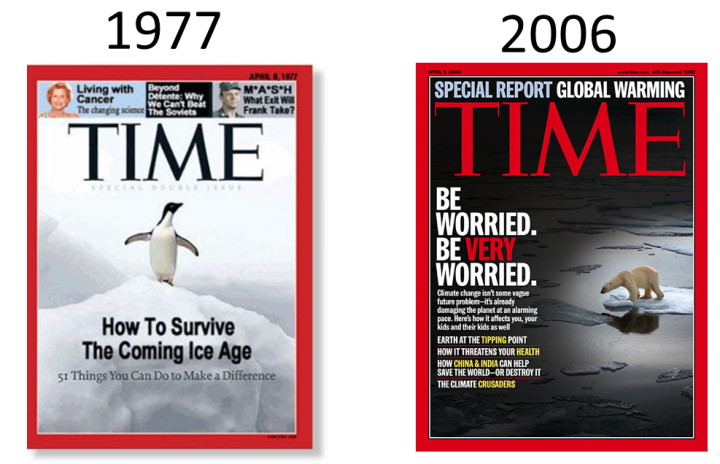
Figure 1. Time covers, 1977 and 2006.
In Figure 1 we see a Time cover from April 8, 1977, that announces an article on how to survive a coming Ice Age. Contrast this with the April 3, 2006, cover that advises us to be very worried about a hypothesized global warming tipping point.
Government funded research told us we were all going to freeze in a new ice age in 1977, then the world stopped cooling and began to warm and by 2006 the editors of Time decided we are all going to cook due to global warming if we don’t destroy the fossil fuel industry.
I don’t know how much government money was spent to predict a new Ice Age in 1977, but a 2018 Government Accountability Office report claims the U.S. spent over $154 billion on climate change related activities since 1993.
Figure 2. Y2K Warnings
Figure 2 shows two Y2K warnings from 1999. We were all going to die because computers couldn’t tell the difference between 1900 and 2000. This bug would undoubtably (speaking sarcastically) cause computer failures resulting in accidental nuclear bomb detonations, dangerous prisoner releases, and terrorist attacks. But nothing happened. As Ross Perot remarked, he has yet to be hit by a car he saw coming three blocks away. Hospitals were supposedly in danger of overflowing if we didn’t shut the country down due to Covid-19, in the meantime Sweden did nothing and was fine. The list goes on and on.
What has private research done for us? Examples include semiconductors, personal computers, cameras, telephones, automobiles, airplanes, scotch tape, television and movies, Teflon, Velcro, aspirin, and more. Governments, not as many inventions, but examples include atomic bombs, ballistic missiles, AK-47s, and probably COVID-19 and the COVID-19 vaccines! Private inventions tend to improve our lives, government inventions tend to destroy lives.
But, then the advocates of government-controlled science ask, “What about basic research? What about research that companies will not fund?” This is nonsense, science and technology will advance regardless of government intervention, governments aren’t that important. Witness that both Newton and Leibniz invented Calculus at about the same time and Elisha Gray and Alexander Graham Bell filed for telephone patents on the very same day.
Much government research money is spent on useless or dangerous research. The COVID SARs virus was probably developed partly with U.S. government research dollars. Specific U.S. NIH research grants have gone to the Wuhan Institute of Virology. Research dollars have recently funded efforts to addict zebrafish to nicotine, four million dollars was spent to study the connection between drinking alcohol and winding up in the ER. Who would think there was a connection?
It is a myth that science and technology can be conjured up by spending money. It is also a myth that scientific research drives the development of new technology, it is the other way around, scientific breakthroughs are normally the result of technological change. Not the reverse. Thermodynamics was developed because of the steam engine, not the other way around. Einstein’s theory of relativity may not have been developed without the Michelson interferometer and other spectacular inventions in the 19th century. As everyone here should appreciate, the engineering is done first, then science figures out how it happened.
Politicians and bureaucrats control scientific research and research outcomes by selectively funding projects that look for potential disasters, ideally global disasters. Many people love disaster stories, journalists love disaster stories, scientists love to be quoted in newspapers and on television. It’s win-win for everyone but the general public. Princeton physics Professor William Happer once wrote, quote:
“[As] Director of Energy Research of the Department of Energy in the early 1990s I was amazed that the great bulk of federal funds for environmental studies from the DOE, NASA, EPA, and other federal agencies flowed into research programs that reinforced a message of imminent doom: humanity and planet earth devastated by global warming, pestilence, famine, and flood.”
Prof. William Happer, 2003
So, it is not surprising that as government has taken over funding scientific research, scientists have migrated from research that helps people, to researching possible catastrophes, no matter how remote the possibility. Science has devolved from improving human lives to developing plots for disaster movies. And, if humans can be blamed for the catastrophe, it is even better, then the politicians can mandate people change their lives “for the greater good.” The politician’s power then increases because exercising power increases it and people will give up their freedoms in exchange for security, whether the danger is real or not.
When a politician uses the phrase “for the greater good” hide your children and hold onto your wallet, he’s after something and up to no good.
When Al Gore was running for Vice President in 1992, he wrote a book Earth in the Balance in which he said on page 5, quote:
“Professor Revelle explained that higher levels of CO2 would create what he called the greenhouse effect, which would cause the earth to grow warmer. The implications of his words were startling; we were looking at only eight years of information, but if this trend continued, human civilization would be forcing a profound and disruptive change in the entire global climate.”
Al Gore, Earth in the Balance
Revelle was a famous scientist who had taught a class that Gore attended at Harvard. He wrote the following in 1991, a year before Gore’s book came out. It is from a Cosmos paper entitled: “What to do about Greenhouse Warming: Look before you Leap,” written in collaboration with Fred Singer and Chauncey Starr, two other famous scientists.
Quoting the paper:
“We can sum up our conclusions in a simple message: The scientific [basis] for a greenhouse warming is too uncertain to justify drastic action at this [time]. There is little risk in delaying policy responses to this century old problem since there is every expectation that scientific understanding will be substantially improved within the next decade.”
(Singer, Revelle, & Starr, 1991)
Revelle had studied the growth of carbon dioxide in the atmosphere for decades and concluded that it might cause some warming, but he was unsure if it would be a problem. His mention of “within the next decade,” was eerily correct, as the famous pause in warming started in the year 2000, just nine years later. It lasted at least until 2014.
Al Gore, who had little training in science, suffered no such doubts. He was sure that burning fossil fuels was causing carbon dioxide to rise to “dangerous” levels in the atmosphere and was convinced this was a problem for civilization through rising sea levels and extreme weather. He was sure we needed to mitigate CO2for the greater good. There was no evidence to support these assumptions, but Al Gore didn’t need evidence, he could always rely on climate models, and he did. Revelle had a deep distrust of climate models.
The incompatibility between Revelle’s true views and the way they were presented in Gore’s book was noticed by Gregg Easterbrook, a Newsweek editor, who wrote about it in the July 6, 1992 issue of TheNew Republic.
Al Gore was humiliated by Easterbrook’s article and follow up articles by George Will and others. Justin Lancaster was Revelle’s graduate student and teaching assistant at the Scripps Institution of Oceanography from 1981 until Revelle’s sudden death in July 1991. He was also an Al Gore supporter. Lancaster claimed that Revelle was “hoodwinked” by Singer into adding his name to the Cosmos “Look before you Leap” article. He also claimed that Revelle was “intensely embarrassed that his name was associated” with it. Lancaster further claimed that Singer’s actions were “unethical” and specifically designed to undercut Senator Al Gore’s global warming policy position. Lancaster harassed Singer in 1992, accusing him of putting Revelle’s name on the article over his objections and demanding that Singer have it removed. He even demanded that the publisher of a volume that was to include the article remove it.
Professor Singer, the Cosmos publisher, and the publisher of the book, objected to these demands and charges. Then Singer sued Lancaster for libel with the help of the Center for Individual Rights in Washington, D.C. Professor Singer and the Center won the lawsuit and forced Lancaster to issue an apology.
The discovery process during the lawsuit revealed that Lancaster was working closely with Al Gore and his staff. In fact, Al Gore personally called Lancaster after the Easterbrook article appeared and asked him about Revelle’s mental capacity in the months before his death in July of 1991. Friends and family of Revelle recall that he was sharp and active right up to the moment when he passed away from a sudden heart attack. But this did not stop Al Gore and Lancaster from claiming Revelle was suffering from senility or dementia and that was why the account in Gore’s book was so different from what Revelle wrote elsewhere, including in the Cosmos article. Lancaster himself had written in a draft letter to Al Gore stating that Revelle was “mentally sharp to the end” and was “not casual about his integrity.”
During the discovery process, Singer and his lawyers found that Lancaster knew everything in the Cosmos article was true and that Revelle agreed with everything in it. The article even included a lot of material that Revelle had previously presented to a 1990 American Academy for the Advancement of Science meeting.
When Revelle argued against “drastic” action, he meant measures that would cost trillions of dollars and cripple the fossil fuel industry and developing countries. Up until his death, he thought extreme measures were premature. He clearly believed that we should look before we leap.
Al Gore tried to get Ted Koppel to trash Singer on his weekly TV show, Nightline, and it failed spectacularly. He wanted Koppel to investigate the “antienvironmental movement” and in particular “expose the fact” that Singer and other skeptical scientists were receiving financial support from the coal industry and the wacky Lyndon LaRouche organization. Rather than do Al Gore’s bidding Ted Koppel said the following on television on February 24, 1994.
“There is some irony in the fact that Vice President Gore, one of the most scientifically literate men to sit in the White House in this century, [is] resorting to political means to achieve what should ultimately be resolved on a purely scientific basis. The measure of good science is neither the politics of the scientist nor the people with whom the scientist associates. It is the immersion of hypotheses into the acid of truth. That’s the hard way to do it, but it’s the only way that works.”
Ted Koppel, Nightline, February 24, 1994
Calling Al Gore “scientifically literate” is debatable, but Koppel has the rest of it right. He has integrity that is lacking in journalism today, further he understands the scientific process. The attempt to use Koppel to tar Singer, brought a huge amount of well-deserved criticism down on Gore.
Given this, it is not surprising that Lancaster agreed to issue an apology only two months later, on April 29, 1994. Lancaster’s retraction was specific:
“I retract as being unwarranted any and all statements, oral or written, I have made which state or imply that Professor Revelle was not a true and voluntary coauthor of the Cosmos article, or which in any other way impugn or malign the conduct or motives of Professor Singer with regard to the Cosmos article (including but not limited to its drafting, editing, publication, republication, and circulation). I agree not to make any such statements in future. … I apologize to Professor Singer”
Justin Lancaster, court ordered apology, April 29, 1994
So, in his court affidavit Lancaster admitted he lied about Fred Singer. Then afterward, Lancaster withdrew his court-ordered retraction and reiterated the same charges. He admits he lied under oath in a courtroom and in writing, then tells us he didn’t lie. He admits that Professor Revelle was a true coauthor of the paper, then he states “Revelle did not write it” and “Revelle cannot be an author.” What some people are willing do to their reputations, in the name of an imaginary climate change catastrophe is hard to believe. He retracted his retraction despite documentary evidence in Revelle’s own handwriting, and numerous testimonials from others that Revelle did contribute to the article. A Climate Change catastrophe? Let’s look further.
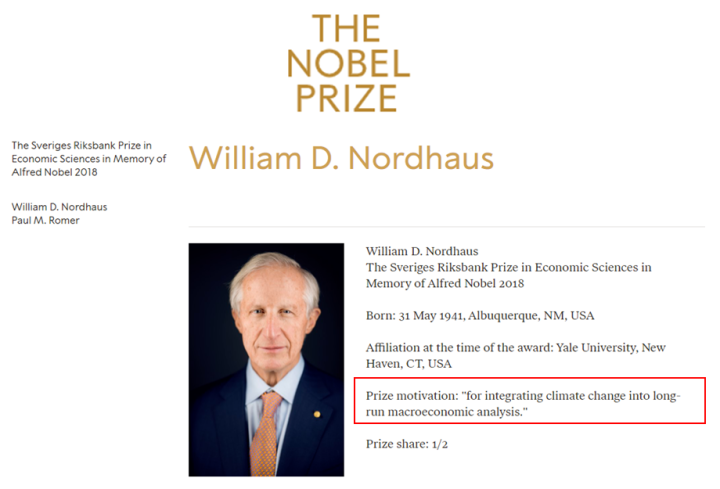
Figure 3 contains the Nobel Prize committee’s announcement of Yale Professor William Nordhaus’s prize, received in 2018. He was given the prize for his decades of research on climate change economics and for developing the DICE economic model of potential climate change economic damages.
Figure 3. The Nobel Prize Committee’s announcement of Prof. William Nordhaus’s Nobel Prize for economics.
In 1990 Nordhaus wrote, Quote:
“…those who argue for strong measures to slow greenhouse warming have reached their conclusion without any discernible analysis of the cost and benefits…”
(Nordhaus, 1990)
Nordhaus won the Nobel Prize 28 years after writing this. Nordhaus also called Al Gore’s 1997 Kyoto Protocol a:
“… conceptual disaster; it has no coherence politically or economically or environmentally.”
Yale conference minutes
Kyoto had little to do with climate change, it was mainly an enormous transfer of money from wealthy countries to poor countries.
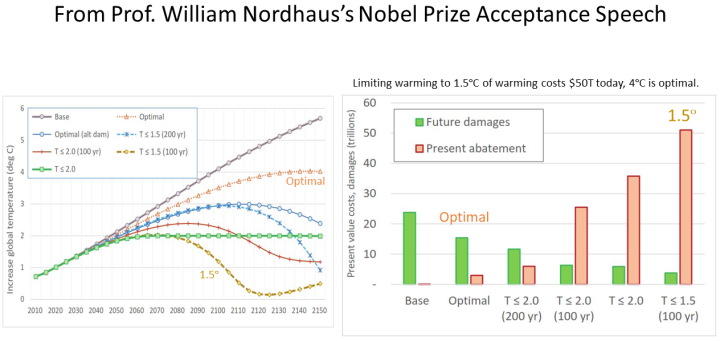
Figure 4. Two graphs summarizing Nordhaus’s analysis of the future damages avoided in green and the present-day costs of CO2 mitigation in red. The left graph plots the IPCC expected temperatures for each scenario and the right graph plots the costs and benefits of the scenarios.
Figure 4 summarizes the result of Nordhaus’s analysis, using graphs from his 2018 Nobel Prize lecture. The slide highlights two economic scenarios, the first is the IPCC recommended path to an average 21st century warming of 1.5 degrees Celsius, which reaches two degrees of warming from 2060 to 2080, but then falls. This hypothetical warming scenario is shown in dirty yellow in the left graph. The Nordhaus DICE economic model results of this scenario are shown on the right side of the right graph. The red bar shows the present cost of abatement, or the cost of reducing greenhouse emissions enough to limit the warming to 1.5 degrees. As you can see, we pay over 50 trillion dollars today, to achieve a potential savings of less than five trillion dollars in the future. If everything works out the way the IPCC says it will, it is not a very good deal.
The second highlighted scenario is the economically “optimal” DICE model. On the left graph, it is the labeled orange line dotted with triangles. It reaches four degrees of warming before leveling out. It is the scenario with the lowest cost to society. The increase in temperature is higher than the IPCC recommends we plan for, and considerably higher than observations suggest we will reach. Four degrees of warming is certainly not physically dangerous to humans, animals, or plants. Temperatures are warming more in the high latitudes, at night, and in the winter. The changes during the daytime, in the tropics, and in the summer are quite small. Life thrives in areas with very high temperatures, so our economy is the main concern, and Nordhaus is saying four degrees of warming is optimal from an economic perspective. As we can see in the right graph, the projected benefits of this optimal scenario (in green) are much higher than the costs (shown in red).
The right graph plots the analysis of all the scenarios plotted in the left graph, except for the “optimal (alt dam)” scenario with uses a different future damage scenario. The “base” scenario is the IPCC RCP8.5 emissions scenario with essentially no attempt at mitigation.
Nordhaus arrives at his conclusions by analyzing the “social cost of carbon” dioxide emissions. If a carbon tax is applied to fossil fuels, then the cost of the fuels goes up causing damage to the economy. Fossil fuels are used to make or distribute nearly everything we use in our daily lives; thus, as a result, implementing the tax increases causes the cost of everything to go up, which reduces consumption and lowers our standard of living. But, if the IPCC’s worst-case scenario is true, and their analysis of the cost of warming is accurate, there will be benefits to raising the cost of fossil fuels because we will use less of them, emit less CO2, and avoid costs due to global warming. The right-hand plot compares the IPCC calculated damages to climate change costs for various CO2 mitigation taxes designed to limit warming for various scenarios.
The IPCC would like us to limit warming to 1.5°C over the pre-industrial era, roughly pre-1900, or the end of the Little Ice Age, when CO2 was about 280 to 290 ppm. But as Nordhaus’s analysis shows this would be an economic disaster and cost over $50 trillion out of an $88T world economy. It would likely impoverish nearly everyone. Even limiting us to less than two degrees of warming in the next 100 years, would lead to an economic catastrophe. Compare this with the IPCC estimate of a trivial 0.2–2% reduction in world GDP in 60 years if we do nothing.
Nordhaus used the IPCC RCP 8.5 emissions scenario for his calculations, this scenario has been shown to be an improbable worst-case scenario and has been discredited by numerous researchers. The other more moderate IPCC scenarios look much better economically and from a supposedly dangerous climate perspective.
Bjørn Lomborg also looked at the potential costs of global warming versus the cost of radically reducing CO2 emissions in a 2020 paper in Technological Forecasting & Social Change. In a detailed analysis of economic projections by Nordhaus, the IPCC, and others, Lomborg also finds an imperceptible change in global GDP today due to climate change. He observes a slight change of -0.28% in GDP at 1.5°C of warming, and a 2.9% reduction in GDP in 2100 with 4°C of warming if we do nothing about climate change.
Lomborg points out that the IPCC projects an increase in human welfare of 450% between now and the end of the 21st century. Projected climate damages, if we do nothing, would reduce this gain in welfare to 434%. Thus, climate change is projected to reduce the gain in global wealth by 4% in 2100.
Lomborg goes on to point out that, while the cost of doing nothing is small, the costs of proposed climate policies are very large. The Paris agreement, if fully implemented, will cost over $800 billion per year in 2030 and will reduce emissions by just 1% of what is needed to limit the average global temperature rise to 1.5°C. Each dollar spent on Paris will result in only 11¢ of benefits. Again, not a very good deal.
The public and the news media, who should be asking probing questions, have become convinced that they cannot understand science. They have elevated science to a form of magic, only understood by witches and warlocks. They are reduced to asking scientists to spoon feed them meaningless sound bites. With a little work, most lay people can understand scientific papers and they should try. Relying on politicians, scientists, and the media to tell us what is happening is not acceptable. Scientists should also write more that can be understood by lay people, as John Tyndall, Svante Arrhenius, and many other early scientists did. Not little 600–800-word op-eds, but real scientific papers, just written for the common man. The news media are awful at writing about science because they often have no interest in what is true, they just want attention and startling predictions. Their goal is attention, not education. As a result, we must figure it out for ourselves. Toward that end remember these words from the great physicist Richard Feynman:
Quote:
“Science is the belief in the ignorance of experts.”
Prof. Richard Feynman
Science is a method of uncovering the truth. It is a methodology, honed over millennia, that can be used to destroy what the majority thinks is true, but isn’t. When a scientist stops challenging the consensus view, he is no longer a scientist.
Finally, we will end with one last story. Steven Koonin reports in his book Unsettled, that “Senator [Charles] Schumer (together with Senators Carper, Reed, Van Hollen, Whitehouse, Markey, Schatz, Smith, Blumenthal, Shaheen, Booker, Stabenow, Klobuchar, Hassan, Merkley, and Feinstein) introduced Senate bill S.729” , which says in part, quote:
“. . . to prohibit the use of funds to Federal agencies to establish a panel, task force, advisory committee, or other effort to challenge the scientific consensus on climate change…”
Senate Bill S.729
Yes, these Senators were trying to legislate against challenging an unproven scientific hypothesis, basically a scientific opinion, using government research money. It doesn’t get much worse than that. Science is debate, if all sides are not examined and argued, it isn’t science. Thankfully, their effort failed, the last thing we need is for scientific truth to be determined by the U.S. Senate!
“When you mix politics with science, all you get is politics.”
Anthony Sadar, Washington Times,
Politics is about forging a consensus opinion through persuasion and intimidation; science is about challenging that consensus. Debates are about education, let’s hear all sides.



 Iowa Climate Science Education