Month: January 2022

When Did They Know? Industrial Wind on the Health Firing Line

From MasterResource

By Robert Bradley Jr. — January 20, 2022

“It seems that, in common with the tobacco industry, the wind industry was well aware that its products were inimical to health. The introduction of larger turbines is also problematic because the larger the turbines, the more noise they produce.” (- Alun Evans, Centre for Public Health, The Queen’s University of Belfast, below)

Yesterday’s post presented a peer-reviewed article concluding that industrial wind turbines generate negative health effects for nearby residents: “Wind turbines and adverse health effects: Applying Bradford Hill’s criteria for causation (by Anne Dumbrille, Robert McMurtry, and Carmen Krogh).

That article inspired an editorial in the same journal by Alun Evans of the Centre for Public Health, The Queen’s University of Belfast, Institute of Clinical Science B, Belfast, United Kingdom.

————-

Evans’s editorial, ‘Big noises: Tobacco and Wind’ [Environmental Disease (2021) 6: pp. 109-10)], is reprinted below (footnotes omitted).

In the absence of a direct means of assessing causality by experiment, Dumbrille, McMurtry, and Krogh have resorted to the nine criteria devised by the English Statistician, Austin Bradford Hill, to assign causality. They have applied them to the putative adverse health effects associated with wind farm noise and have found all nine to be upheld.

Bradford Hill’s outstanding contribution to Public Health, with Richard Doll, was assembling a cohort of 40,000 British Doctors to study the epidemic of lung cancer that emerged in the first half of the 20th century. They showed extremely strong associations between the number of cigarettes smoked and the development of lung cancer and other diseases.

These associations were well known to the Tobacco Industry, which had suppressed the scientific evidence for years, but eventually, the companies were made to apologize to the public. For how long have the adverse health effects of wind turbine noise been known?

In 1967, a UNESCO publication discussed, “…the dangers of sounds we cannot hear,” defining Infrasound as <30 Hz. By 1973, the Russians had defined safe upper limits for Infrasound (<20 Hz) in various settings. In the 1980s, Kelley et al. investigated a single turbine in America where around 12% of families within 3 km were impacted by noise emissions.

The passage of the rotors past the turbine’s supports caused low-frequency pressure pulsations to be directed into the complainants’ dwellings. The situation was aggravated by a complex sound propagation process controlled by terrain and atmospheric focusing. The impulsiveness of the emitted low-frequency acoustic radiation was identified as a major problem. Various recommendations were made concerning noise reduction and as to how the Low-Frequency Noise should be measured.

In the UK in 1990, The Batho (Noise Review Working Party) Report devoted a single, important, page to Low-Frequency Noise, observing that it could have a serious effect on the lives of those affected by it: “The noise may be inaudible to the Environmental Health Officer (EHO) and its measurement often requires sophisticated monitoring techniques.” It was stated that the normal A-weighted scale was not appropriate for its measurement, and the problem was a real one, recommending in bold: “…that full support should be given to the current program of research.”

In the UK in 2001, a Report on Low-Frequency Noise by Stanger was prepared for the UK’s Department of Environment, Food and Rural Affairs. It drew on the Batho Report but went much further. Two years later, when the British Prime Minister launched his country’s “Our Energy Future,” largely based on wind energy, there was no mention whatsoever of Low-Frequency Noise.

What had happened? Although all potential sources of renewable energy were being considered in the early 1980s, by the mid-1990s, wind energy was deemed paramount by the UK’s Government. In 1996, the Department of Trade and Industry, whose remit was to create the optimal environment for business success, with no brief for environmental protection, established The Working Group (WG) on Noise from Wind Turbines.

The WG brief was to identify noise levels thought to offer a reasonable degree of protection, without unreasonably restricting development. Of its 14 members, six were directly, and two indirectly, connected with the wind industry, three were civil servants and three EHOs, with no medical or planning input whatsoever.

The impact of Low-Frequency Noise was discounted, so A-weighted noise measurements were recommended, and only turbines to a hub height of 32 m were considered. The WG’s chief concern was to promote wind energy, irrespective of its impacts on rural communities. This resulted in the highest night-time noise limits permitted anywhere. A proposed review 2 years after 1996 never took place.

In 2011, a letter written by the CEO of the Danish wind turbine manufacturer, Vestas, to the Danish Environment Minister, which was leaked and translated, asked why it was:

…that Vestas does not just make changes to the wind turbines so that they make less noise? The simple answer is that at the moment it is simply not possible to do so, and it requires time and resources because presently we are at the forefront of what is technically possible for our large wind turbines, and they are the most efficient of all.

It seems that, in common with the tobacco industry, the wind industry was well aware that its products were inimical to health. The introduction of larger turbines is also problematic because the larger the turbines, the more noise they produce.

Over half a century ago, Hill wrote that Public Health should be, “…ever striving for improved environmental quality with the accompanying reduction in disease morbidity and mortality.” We still have a long way to go to adequately protect people’s health from the impact of wind farm noise, as the authors’ findings have so amply demonstrated.

——————–

4.3
6
votes

Article Rating

via Watts Up With That?

https://ift.tt/3rCorX6

January 21, 2022 at 12:45PM

Analysis By German Prof: “Thousands Of Hidden Deaths Daily” …May Be Greatest Medical Debacle In Human History

Shocking mortality data from Germany, Austria, Israel, England: thousands of post-vaccine non-Covid deaths covered up – miscategorized as unvaccinated deaths…”extremely alarming situation”

“Thousands are dying of the vaccine daily without us even being aware of it.”

University of Regensberg Professor Christof Kuhbandner uncovered what he calls an extremely alarming situation, one where thousands and thousands of vaccine deaths are being hidden in the statistics.

England report sets off alarms

According to this Austrian report broadcast by servus.tv, Prof. Kuhbandner happened to come across a recent preprint study in the journal ResearchGate, where the authors examined the UK ONS vaccine mortality surveillance report.

Although at first glance the all-cause mortality appeared far lower in the vaccinated than the unvaccinated, on closer inspection they found fundamental inconsistencies and anomalies in the data and that there had been a “systemic miscategorization of deaths between the different categories of unvaccinated and vaccinated” among other factors.

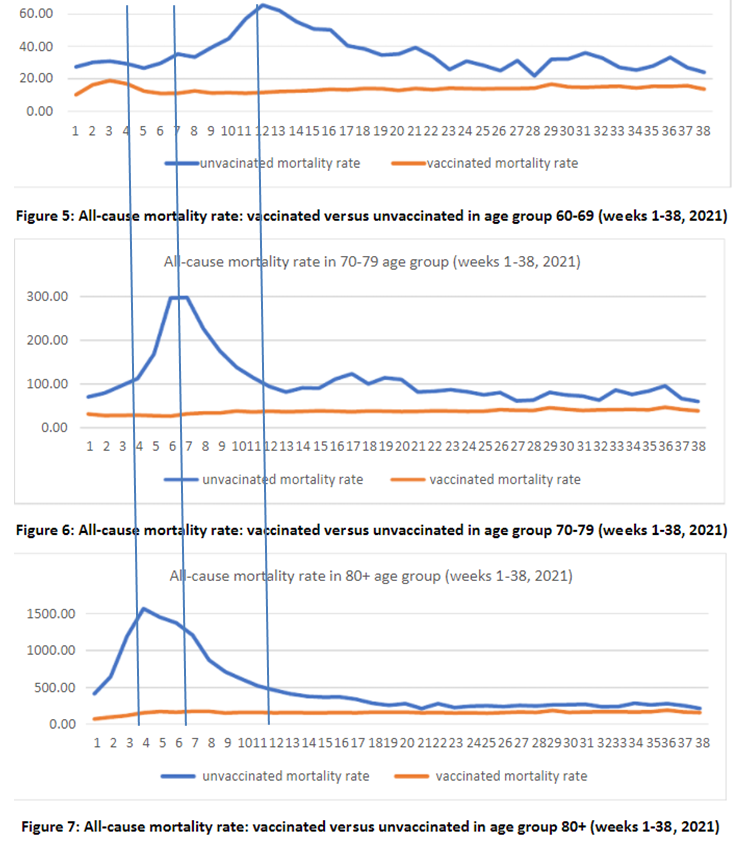
For the period of calendar week 1-38, 2021, Figures 8 and 9 show strong peaks in non-Covid mortality for the unvaccinated 60-69 and 70-79 age groups while the mortality among the vaccinated stayed steady.

Chart: ResearchGate

At first glance this would suggest that the vaccines were functioning well in England and Wales. But the ending is not a happy one.

Disturbing: The peaks did occur at the same time

Prof. Kuhbandner noted something very unusual was going on and examined the trend also for the 80+ age group as well. The following are the plots for all three age groups. The peaks and deaths were offset.

Chart: ResearchGate

Moreover, the paper’s authors also commented:

In previous years, each of the 60-69, 70-79 and 80+ groups have mortality peaks at the same time during the year (including 2020 when all suffered the April Covid peak at the same time). Yet in 2021 each age group has non-Covid mortality peaks for the unvaccinated, at a different time, namely the time that vaccination rollout programmes for those cohorts reach a peak.”

In other words, the vaccines were rolled out in stages, first administered to the most elderly (80+years old) and then to the next group (70-79) and then to the 60-69 group some weeks later. The death peaks then followed the vaccination stages.

So why would people NOT getting the vaccine be the ones dying in huge numbers, and not those getting the vaccine?

This is because in Europe the status of “vaccinated” first gets assigned 14 days after getting the final jab. Thus any deaths occurring before this, ends up being counted as an “unvaccinated death”! So if a patient who got a vaccine dies less than 14 days later, he/she gets counted as an unvaccinated death. This is how vaccine deaths are getting hidden. And there many thousands.

As Figures 5-7 above show, thousands of deaths occurred shortly after the vaccines had been administered, and many among them were likely linked to the vaccine itself. If this is the case globally, and not just in Britain, then the number of vaccine deaths may be profound. The nightmare appears to be true, Prof Kuhbandner shows.

Same pattern in Germany

Prof. Kuhbandner then examined the mortality data for Germany and found the very same pattern: large jumps in mortality immediately following the vaccine campaigns. These deaths appear to be directly the result of vaccinations. It’s just too coincidental to be dismissed.

Carnage equivalent to two commercial jets crashing every day

“When you express this in numbers, it translates to 700 more deaths a day on average,’ Kuhbandner tells servus.tv, looking just at the German numbers. “It would be like two commercial planes full of people crashing every day.”

Kuhbandner also found the same pattern of post-vaccination death in Israel.

The  U. of Regensburg professor contacted both the Robert Koch Institute and Paul Ehrlich institutes to present his findings, but so far they’ve ignored them. The RKI wrote they did not “have the capacity to evaluate suspicions from every individual.”

“Extremely alarming situation”

As it stands, no one knows when these extremely disturbing findings are going to be taken seriously by the responsible authorities. Until they do, however, many thousands more are going to die each and every day.

“If it turns out that there’s a causal effect with the vaccinations, then we are dealing with an extremely alarming situation,” says Kuhbandner. “Then we have a case here where thousands of people are dying of the vaccine daily without us even being aware of it,”

Donate – choose an amount

via NoTricksZone

https://ift.tt/3KAeYIo

January 21, 2022 at 11:33AM

“Conquer climate change and grow your business in 2022”

Intuit® Climate | Climate Action Marketplace

via Real Climate Science

https://ift.tt/3GSbsai

January 21, 2022 at 11:31AM

The Bureau of Meteorology finds Australia is still getting colder a century later

Surprisingly, the World War I era is still getting colder. Mornings that seemed nippy at the time are now susceptible to frosts.

Someone should warn the farmers — except they’re all dead.

Thanks to Chris Gillham for independently and laboriously going through the new unannounced changes in another cycle of BOM’s hidden revamp of Australia’s history. ACORN 2.2 is the latest version of the Australian Climate Observation Reference Network of “the best” 112 weather stations across Australia.

Graham Lloyd, The Australian

“The bureau has now remodelled the national temperature ­dataset three times in just nine years,” Dr [Jennifer] Marohasy said.

In the last five years the ACORN revisions by the BOM have discovered another quarter of a degree of warming that we didn’t know about from the last hundred years. It’s not clear why the BOM doesn’t want to tell the world how good they are at correcting thermometer records from 1913.  It seems like a remarkable skill.

The minima just keep getting cooler

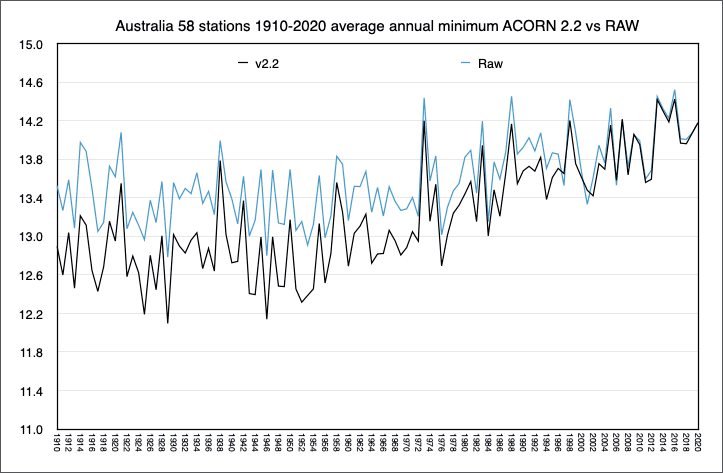
Chris Gillham plots the longest running stations from the ACORN 2.2 set against the old raw readings:

Chris Gillham, ACORN 2.2 versus Raw Temperatures

Who knew all those old thermometers were so wrong?


Independent analysis of the latest changes show they added 0.06C to maximum warming and 0.11C to minimum warming from 1910-19 to 2010-19.

A series of updates to the ACORN data have added 0.228C mean temperature warming if comparing 1910-19 with 2010-17 (2017 being the final year of ACORN 1)

Clearly, the cheapest way to stop global warming would be to sack everyone at the BOM.

The Bureau admitted to Lloyd that they changed 25 sites in the latest round, most of them because of statistical revelations:

The bureau said changes were made to 20 sites on the basis of statistical analysis. According to the bureau, statistical analysis is used to identify an abrupt warming or cooling at a particular site, relative to other sites in the region.

The BOM refuses to tell us exactly how they do this — admitting that they can’t train anyone outside their sacred guild. Which reminds us of the old axiom, “if it can’t be replicated, it isn’t science”.

Apparently the future of life on Earth depends on their data, but it would take too long to train someone outside BOM to check it. Sure.

Here’s the BOM justification:

“A significant change relative to other sites indicates a non-­climatic driver, which sometimes has an easily identifiable cause (e.g. a new building near a site) and sometimes does not (often these will relate to local vegetation or land surface changes)”, the bureau said. “In carrying out this statistical analysis, the bureau uses 10 years’ worth of data from multiple sites to quantify the size of the change. Adjustments are only applied where a significant change has been identified.

So instead of researching the site history, the BOM use statistical trickery analysis to figure out local site changes using some of the thermometers “within a thousand miles”. What they don’t do is full historical research and documentation of the sites first. (Like the ones here, here and here, thanks Bill Johnston). So it’s possible that if, say, 10 sites got similar changes at the same time (like changing to a new small screen) the other better sites in non-changing screens could be slowly “corrected” one by one by the junkier sites with the right statistical algorithm. Now, perhaps the BOM have ways to make sure that doesn’t happen — but they won’t tell us what they are, they don’t publish the detailed documentation of either the full site histories or the methods they use to correct them.

As Chris Gillham notes, the BOM say the new adjustments didn’t change the long term trend. But a lot of little changes in the same direction would. The new adjustments might have also made local hottest ever headlines much easier to get.

The mysterious process of homogenization

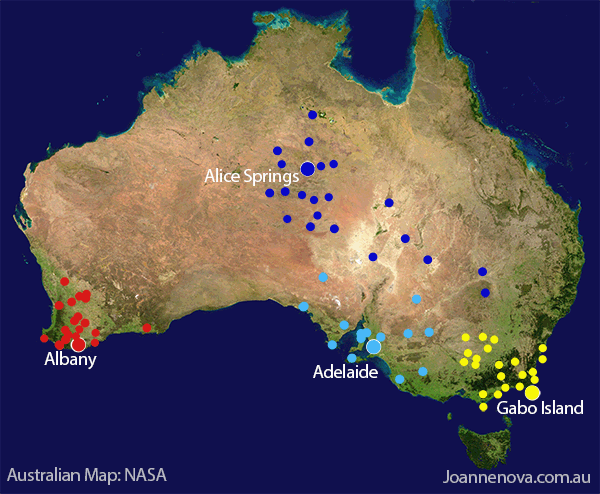
The Bureau “homogenizes” a site according to a mystical method that uses an inexplicable group of sites that are in the same region, or at least in Australia somewhere. For example, lighthouse readings off the Bass Strait have been corrected with help from Hay, 600 kilometers away, on the other side of the Great Dividing Range. Thermometers in Ballarat have corrected one at Bruny Island off the South coast of Tasmania.  The BOM has also corrected Alice Springs from Collarenabri nearly 1,600 kilometers away. (Thanks to Ken Stewart).

So “region” apparently means anywhere in the nearest 8 million square kilometers.

Australian BOM, Bureau of Meteorology, homogenisation of sites. Map.

All the sites marked in black, for example, have been used to homogenize Alice Springs

0 out of 10 based on 0 rating

via JoNova

https://ift.tt/3nMbLfd

January 21, 2022 at 11:06AM