Month: January 2022

Smug & Shameless: Exposing ‘Green’ Energy’s Dirty Slave Labour Secret

Unshackling the smug and self-righteous from the fixed and firm belief that their solar panels are saving the world, is no mean feat. The same characters also believe that the Teslas they occasionally drive to the local café and/or that they’ve strapped to their homes to capture a fraction of the six hours of solar power their panels generate are, likewise, doing nothing but unadulterated good.

Well, we here at STT, beg to differ.

Giant industrial wind turbines, solar panels and lithium batteries (whether shoved in overpriced golf carts or bolted to brick walls) are a veritable cocktail of toxic compounds made from so-called ‘rare earths’ and a range of more mundane chemicals, all requiring mountains of fossil fuel to produce.

After 10 to 15 years in service, solar panels end up crushed and buried in landfills, along with the great poisonous bulk they contain. Millions have already been crushed and dumped; leaching a heady brew of gallium arsenide, tellurium, silver, crystalline silicon, lead, cadmium and other heavy metals into the water table.

Then there’s the manner of production.

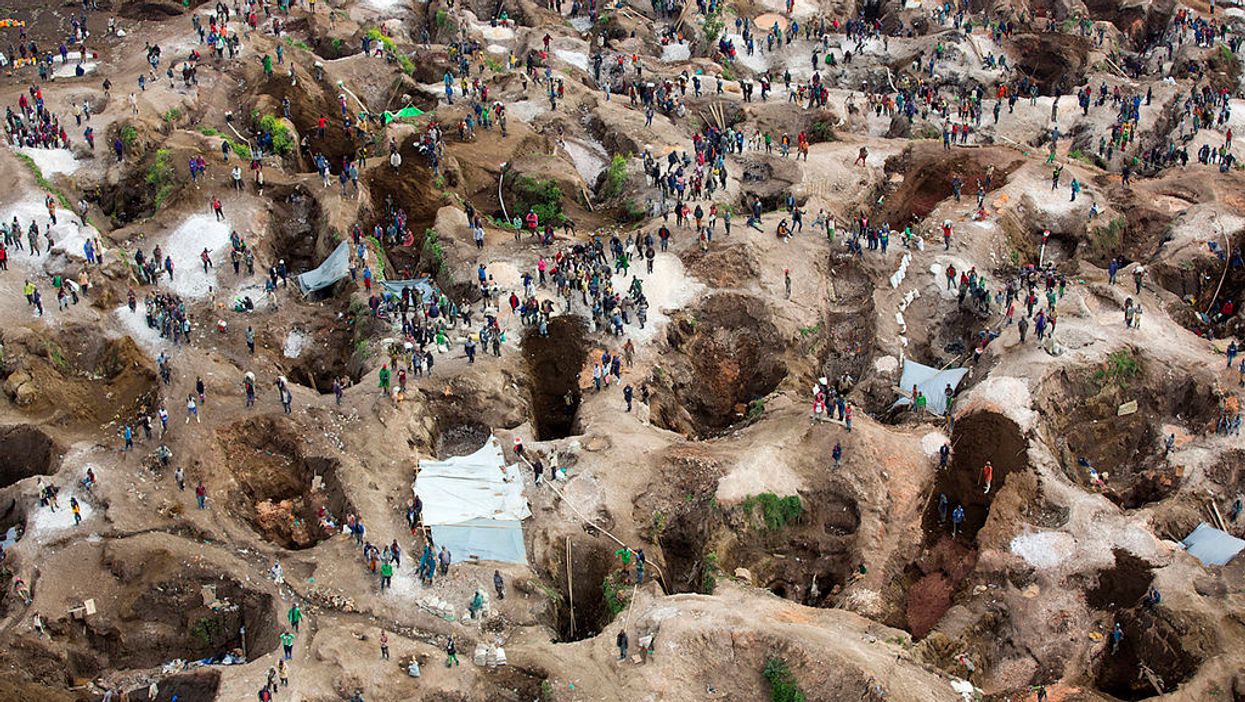
The rare earths used in wind turbines, solar panels and lithium batteries are mined by children as young as six, treated no better than slaves. The products of their punitive labours are then shipped to China where slaves are put to work to turn them into the products that give Westerners the ability to signal their purported virtue, far and wide.

When it comes to exposing faux ‘green’ hypocrisy, this article by Bizpac Review proves that sunlight truly is the best disinfectant.

How Many Slaves Does It Take To Build A Solar Panel?
Principia Scientific International
Bizpac Review
17 December 2021

Products that are fundamental to nearly all global “green pledges” — including electric vehicle batteries, solar panels, wind turbines and industrial-grade storage batteries — require minerals that are produced with significant human rights violations.

Overall, about 45% of the world’s solar panel polysilicon supply is produced in the Uyghur region of China, according to a Sheffield Hallam University Helena Kennedy Centre for International Justice report, which tied it to forced labor practices.

“In that region, every single company that’s involved in the production of polysilicon, or its inputs, was either engaged in forced labor or sourcing from a company that was engaged in forced labor,” Laura Murphy, a human rights and contemporary slavery expert, told the Daily Caller News Foundation in an interview. “So the significance of forced labor in the solar supply chain is enormous.”

In addition, more than 40,000 child workers, some as young as six-years-old, are estimated to work in Democratic Republic of the Congo mining cobalt, a key material for electric vehicle batteries, according to the most recent approximation made by Amnesty International.

Jewhar Ilham last saw her father seven years ago.

“I don’t even know if he’s alive,” said Ilham, a Chinese-born Uyghur Muslim. “My cousin, she was a nurse, she was sentenced to 10 years for having a photo and an article of my father in her cell phone.”

Ilham’s father, Uyghur scholar Ilham Tohti, is an accomplished academic, having taught economics at Minzu University of China in Beijing and received several international awards including five Nobel Peace Prize nominations. But Chinese authorities arrested Tohti, who researched human rights violations committed by the Chinese Communist Party-controlled government, in 2014 and later sentenced him to life imprisonment after finding him guilty of “separatism.”

“This is just one of the stories, it’s happening to hundreds of thousands of others,” Ilham told the Daily Caller News Foundation. “So many of my friends and acquaintances — their family members are locked up either in camps or prisons or factories and are forced to work even though they had perfect jobs before that they enjoyed doing.”

Following her father’s arrest, Ilham successfully fled to the U.S. where she has become an activist fighting Chinese repression. She is currently the forced labor project coordinator at the Worker Rights Consortium, a founding member of the Coalition to End Forced Labour in the Uyghur Region, a group of several organizations and labor unions fighting human rights violations of Uyghurs in the Xinjiang province of China.

More than a million ethnic minorities like Ilham’s father are believed to have been coerced into forced labor or interned in camps in Xinjiang, according to government and academic research. The Department of State reported that “entire communities” of Uyghurs have become ghost towns as a result of government repression in the region.

Uyghurs are often forced to work in large cotton factories which produce clothing sold by Adidas, Nike, H&M and others. But many others are placed in facilities that are central to the burgeoning global renewable energy industry.

‘Everything Else Is Secondary’
Led by the U.S. and European Union, governments worldwide have made ambitious pledges for a so-called green transition away from fossil fuel dependence and toward renewable energy production in an effort to stave off cataclysmic climate change. Fossil fuels, namely crude oil, natural gas and coal, continue to supply more than 80% of the world’s energy needs.

A green transition will require the development of advanced technologies which require certain minerals found in mines across the globe. These minerals, though, are largely sourced from regions with few labor and environmental protections such as China, the Democratic Republic of the Congo (DRC) and Russia.

Products that are fundamental to nearly all global “green pledges” — including electric vehicle batteries, solar panels, wind turbines and industrial-grade storage batteries — require these minerals.

In June, a White House report on supply chains labeled human rights violations as a “risk” for the renewable energy industry. But the Biden administration continues to forge ahead in its crusade against global warming, outlining goals of wind farms, solar fields, electric vehicle fleets and massive storage batteries powering the grid.

U.S. envoy for climate John Kerry sidestepped a question in November on labor abuses taking place in China and tied to green technology production, saying he’s the “climate guy” and had to stay in his lane.

A State Department spokesperson was quick to refer to Kerry’s 37-year record in office “standing up for human rights and defending democracy” when asked about his comments.

“As Secretary Kerry has said from the start, the United States and China have mutual interests in solving the climate crisis while there’s still time, even when we fundamentally disagree on other critical issues,” the spokesperson told the Daily Caller News Foundation in a statement.

However, millions of Chinese citizens, who are members of the Uyghur Muslim minority group, have been coerced by the Chinese government into forced labor throughout the nation’s Xinjiang province, according to a May report from Sheffield Hallam University’s Helena Kennedy Centre for International Justice in the U.K. Many of the Uyghurs victimized by such labor practices have been placed at factories producing polysilicon, an important material for solar panels.

“The mood seems to be that climate change is the existential crisis and everything else is secondary,” Dustin Mulvaney, a San José State University environmental studies professor who has studied the solar panel supply chain, told the DCNF in an interview. “And I’m not sure that that is the best approach to this.”

“Every time there’s a news story about this, it gets a little traction for a couple hours and then it literally disappears,” he continued. “It’s like there’s no engagement on this issue and that’s really frustrating because if there’s forced labor, someone’s got to do something about it.”

‘The Significance … Is Enormous’
China has established a major foothold in global polysilicon production, accounting for about 80% of the market, according to an S&P Global report published in 2020. Several of the world’s top polysilicon providers for solar panels have flocked to Xinjiang in particular for its cheap coal-fired energy.

Polysilicon is a material made using an energy-intensive, complex process. While much of the process would require a highly-trained and knowledgeable workforce, one part whereby polysilicon rods are smashed into chunks requires far less expertise.

“They’ve not really figured out a way to crush that polysilicon without contaminating it. So, it’s usually human labor that’s doing some of this hammering,” Mulvaney said. “It’s very repetitive labor. That implies that forced labor could be implicated there.”

Overall, about 45% of the world’s solar panel polysilicon supply is produced in the Uyghur region of China, according to a Sheffield Hallam University Helena Kennedy Centre for International Justice report. After a thorough review of public records, investor reports, press releases and corporate filings, the report determined that 11 companies engaged in forced labor transfers in China, four accepted such transfers at their facilities in Xinjiang and the supply chains of 90 companies around the world were affected.

Xinjiang has become a major player in global polysilicon production largely because of government subsidies that incentivize companies to move to the region, the report found. The extensive subsidies were designed with the purpose of facilitating “the implementation of the government’s expansive labour transfer strategy.”

“In that region, every single company that’s involved in the production of polysilicon, or its inputs, was either engaged in forced labor or sourcing from a company that was engaged in forced labor,” Laura Murphy, a human rights and contemporary slavery professor at Sheffield Hallam and one of the report’s authors, told the DCNF in an interview. “So the significance of forced labor in the solar supply chain is enormous.”

“It’s possible that any solar module that a person might buy or a government might buy would have Xinjiang-made polysilicon and thus, potentially forced labor-made polysilicon,” she added.

In the report, Murphy tied the world’s four largest solar module producers — LONGi Solar, Jinko Solar, JA Solar and Trina Solar — to forced labor practices in Xinjiang. Jinko Solar invested nearly $500 million in a Xinjiang industrial park that is home to its factory, but also a high-security prison and an internment camp which are both operated by the local government.

The three buildings appear to have been built between 2015-2017.

LONGi, the largest solar panel provider in the world, buys polysilicon from several companies that engaged in labor transfers in Xinjiang, according to the report. In 2020, the company exported solar panels which altogether have a whopping 24.5 gigawatts of capacity, a year-over-year increase of 224%, PV Magazine reported.

Labor transfer programs, often the center of forced labor reports like Murphy’s, are a method by which Chinese officials coerce minorities like Uyghurs into labor, high-level government documents obtained by the BBC in March showed. Authorities “mobilize collectively” and visit citizens’ homes armed with a variety of false promises to convince them to leave for a labor camp.

“The key issue is that there are these labor transfer schemes in the region,” said William Nee, the coordinator for research and advocacy at the Chinese Human Rights Defenders, a coalition of international rights groups. “The government wants to take people who they call surplus rural laborers, or surplus farmers, from the countryside and, in their view, provide them with jobs in industrial zones.”

“But in many cases, there could be coercion involved,” Nee continued.

‘There Is No Place For Forced Labor’
In the wake of reports establishing the profound connection between global solar panel supply and forced labor in China, the industry group Solar Energy Industries Association issued a forced labor prevention pledge that was signed by more than 300 firms. The Chinese companies that Murphy’s report highlighted, including LONGi and Jinko, were among the signatories.

“We hereby commit to helping ensure that the solar supply chain is free of forced labor and raising awareness within the industry on this important issue,” the pledge read.

LG Electronics, another signatory of the pledge and one of the largest solar panel providers in the U.S., is among the companies that hasn’t been tied to Xinjiang-made polysilicon.

“LG strongly believes there is no place for forced labor in any supply chain, including solar and renewable energy,” LG Electronics Senior Vice President John Taylor told the DCNF in a statement. “LG’s global supplier code of conduct strictly forbids forced labor and other violations of human rights, and LG will continue to work with our suppliers to assure that LG’s solar products are manufactured without the use of any forced labor.”

California-based SunPower has similarly been an outspoken proponent of ensuring supply chains are free of forced labor. The company said it doesn’t source products from regions where forced labor is rampant to its “knowledge” and its CEO Peter Faricy vowed to immediately terminate contracts with firms tied to such human rights abuses.

Others, however, have promised to move their business away from Xinjiang in light of recent reports, but haven’t been clear how they plan to follow through on such commitments, according to Murphy.

“They’re not being public about it,” Murphy told the DCNF. “So it’s harder for consumers and for companies downstream to know exactly where their goods are being made. Because now, suddenly, the announcements are starting to dry up, the shifting of the supply chain is being silenced. This is in part due to pressure from the Chinese government and from Chinese companies.”

But the broader issue facing researchers and companies who wish to eradicate forced labor from solar panel supply chains is the Chinese government’s suppression of information and lack of transparency. Mulvaney said the lack of public information makes the entire issue “very awkward” since it forces reliance on academic research based on anecdotes and indirect reports.

The 2020 annual report from the Congressional-Executive Commission on China similarly concluded that forced labor in China is “widespread and systematic” but that there are barriers for conducting independent analyses of the situation on the ground. In March, two Bloomberg reporters traveled to Xinjiang with the intent to gather information on the ground, but were quickly met with law enforcement who followed them, prevented interviews with locals and force-deleted photos from their phones.

Still, the Chinese government continues to deny that any forced labor practices are taking place within its borders, calling such allegations a lie invented by the West.

“The so-called ‘forced labor’ issue is a century-old lie invented by the US and other western institutions and personnel to restrict and suppress relevant Chinese enterprises and contain China’s development,” Liu Pengyu, a spokesperson for the Chinese Embassy in Washington, D.C., told the DCNF in a statement.

“We oppose any interference by external forces in Xinjiang affairs and the imposition of sanctions on relevant Chinese entities and individuals based on lies, false information,” Pengyu said.

‘Children Carrying Bags Of Rocks’
Labor abuses, meanwhile, have been documented in places around the world beyond China.

More than 40,000 child workers, some as young as six-years-old, are estimated to work in cobalt mines located in the southern region of the Democratic Republic of the Congo, according to the most recent approximation made by Amnesty International in 2016. Cobalt is a key mineral for electric vehicles and phone batteries.

Children interviewed by the human rights organization said they were forced to work 12-hour shifts and paid $1-2 per day. They were tasked with carrying heavy loads of mined minerals.

One child, a 14-year-old boy, said he worked 24 hours straight in the mine’s tunnels, according to the Amnesty International report.

“The glamorous shop displays and marketing of state of the art technologies are a stark contrast to the children carrying bags of rocks, and miners in narrow manmade tunnels risking permanent lung damage,” Mark Dummett, a business and human rights researcher at Amnesty International, said.

“Millions of people enjoy the benefits of new technologies but rarely ask how they are made,” he continued. “It is high time the big brands took some responsibility for the mining of the raw materials that make their lucrative products.”

The children were also subject to physical abuse, drug abuse, sexual exploitation and violence, the report said.

In response to the 2016 report, the U.S. government and electric vehicle companies have made an effort to shift from cobalt. Congress appropriated $2.5 million for a project to assist the DRC’s government on how to enforce human rights laws.

Still, reports of labor abuses in the DRC’s cobalt mining industry — which continues to produce more than 70% of global cobalt supply — haven’t stopped.

“The salary is very, very small. It gives me a headache … The mine makes so much and we make so little,” one worker told The Guardian in November.

“The relationship between us and the [mine] is like a slave and a master,” he added.

While cobalt-free batteries, which have been heralded by major electronics companies like Panasonic, a Tesla supplier, have been shown to lower a battery’s energy density, University of Texas materials scientist Arumugam Manthiram told Nature Magazine. Manthiram founded a startup which is attempting to create a cobalt-free battery that can be manufactured at scale.
Principia Scientific International
via STOP THESE THINGS

https://ift.tt/3H0RpXn

January 20, 2022 at 12:33AM

Time Magazine: We Only Have to TRIPLE the Global Renewable Energy Budget to Achieve Green Nirvana

Guest essay by Eric Worrall

According to Time the world currently spends 1% ($0.8 trillion / year) of global income on renewables. But for the “surprisingly low cost” of $2.4 Trillion / year, we could make all the green energy fantasies come true, though we might also have to become vegans and surrender our pension funds.

The Surprisingly Low Price Tag on Preventing Climate Disaster

BY YUVAL NOAH HARARI JANUARY 18, 2022 6:55 AM EST

Despair is as dangerous as denial. And it is equally false. Humanity has enormous resources under its command, and by applying them wisely, we can still prevent ecological cataclysm. But exactly how much would it cost to stop the apocalypse? If humankind wanted to prevent catastrophic climate change, how big a check would we have to write?

Naturally enough, no one knows for sure. My team and I have spent weeks poring over various reports and academic papers, living in a cloud of numbers. But while the models behind the numbers are dizzyingly complex, the bottom line should cheer us up. According to the International Energy Agency, achieving a net-zero carbon economy would require us to spend just 2% of annual global GDP over what we already do on our energy system. In a recent poll of climate economists conducted by Reuters, most agreed that getting to net zero would cost only 2% to 3% of annual global GDP. Other estimates put the cost of decarbonizing the economy a bit lower or a bit higher, but they are all in the low single digits of annual global GDP.

These numbers echo the assessment of the Intergovernmental Panel on Climate Change, which in its landmark 2018 report stated that in order to limit climate change to 1.5°C, annual investments in clean energy needed to increase to around 3% of global GDP. Since humankind already spends about 1% of annual global GDP on clean energy, we just need an extra 2% slice of the pie!

The above calculations focus on the cost of transforming the energy and transportation sectors, which are by far the most important. However, there are other sources of emissions as well, like land use, forestry and agriculture. You know, those infamous cow farts. The good news is that a lot of these emissions can be cut on the cheap through behavioral changes such as reducing meat and dairy consumption and relying more on a plant-based diet. It doesn’t cost anything to eat more veggies, and it can help you (and the rain forests) live longer.

In just the first nine months of 2020, governments around the world announced stimulus measures worth nearly 14% of global GDP to deal with the COVID-19 pandemic. If citizens press them hard enough, politicians can do the same to deal with the ecological crisis. So can investment banks and pension funds. Pension funds hold about $56 trillion USD. What’s the point of having a pension if you don’t have a future?

Read more: https://time.com/6132395/two-percent-climate-solution/

Yuval Noah Harari’s bio describes him as a historian, philosopher and author.

I love watching Dragon’s Den, a BBC TV series in which ordinary people with business ideas get to pitch to the “dragons”, very wealthy self made people who built up their own fortunes through investment and business creation.

One thing which is very clear is how quickly the dragons reject losers. They very rarely put money into micro businesses which are operating at a loss, because if the business can’t make money on a small scale, pumping more money in to scale the business up usually just increases the rate at which the idea loses money.

If renewable energy cannot become self sustaining with an injection of $0.8 trillion per year, an additional $1.6 trillion per year is not going to fix anything.

via Watts Up With That?

https://ift.tt/3GXkqmo

January 20, 2022 at 12:06AM

Old King Coal Not Going “Gentle Into That Good Night”

Guest “Rage, rage against the dying of the light” by David Middleton

Note: Except for Rudyard Kipling, I don’t like poetry, especially Dylan Thomas. It’s jut that I’ve just seen Rodney Dangerfield’s Back to School a few dozen times and his recital of Do not go gentle into that good night is fracking hilarious!

This is great news for those of us who think as highly of “climate campaigners” as we do poets:

China’s coal production hit record levels in 2021

In blow to climate campaigners, state encourages miners to ramp up output to avert winter gas crisis

Jillian Ambrose
Mon 17 Jan 2022

China’s coal production reached record levels last year as the state encouraged miners to ramp up their fossil fuel output to safeguard the country’s energy supplies through the winter gas crisis.

The world’s biggest coal producer and consumer mined 384.67m tonnes of the fossil fuel last month, easily topping its previous record of 370.84m tonnes set in November, after the government called for miners to work at maximum capacity to help fuel the country’s economic growth.

Official government figures show that China’s coal binge also spurred the country to record high coal output over the year as a whole. Chinese coal production climbed to an all-time high of 4.07bn tonnes, up 4.7% on the previous year, in a blow to climate campaigners months after the UN’s Cop26 climate talks in Glasgow.

[…]

The Grauniad

Peak Coal… Bwahaha!

The good news isn’t limited to Asia

As coal use surges, America finds it’s hard to unplug from carbon
BY ROBERT BRYCE, OPINION CONTRIBUTOR — 01/16/22 02:00 PM EST 2,069THE VIEWS EXPRESSED BY CONTRIBUTORS ARE THEIR OWN AND NOT THE VIEW OF THE HILL

So much for the myriad claims about going “beyond coal.” According to a new report from the Rhodium Group, U.S. coal consumption jumped by 17 percent last year compared to 2020 levels. That’s a huge increase, which Rhodium says was “largely driven by a run-up in natural gas prices.” Rather than burn gas, which averaged about $4.93 per million Btu last year — more than two times the price in 2020 — many electricity producers chose to burn coal instead.

The surge in domestic coal use is significant for two reasons. First, it proves again that coal remains an essential fuel for electricity producers both here in the U.S. and around the world. Second, it shows that the Biden administration’s pledge to decarbonize the electric grid by 2035 is little more than wishful thinking.

Hate coal if it makes you happy, but the reality is that power producers have relied on it ever since Thomas Edison used it to fuel the world’s first central power plant in Lower Manhattan in 1882. Indeed, the jump in domestic consumption is part of a surge in global demand for coal, which still accounts for about 36 percent of global electricity generation.

[…]

While Asian countries account for the biggest share of global coal use — China alone uses more than half the world’s coal — the Iron Law of Electricity also applies to Europe and Japan. During the third quarter of 2021, coal’s share of Germany’s electricity mix increased by 5.5 percent over the same period in 2020. That increase was due, in part, to lower production from the country’s wind-energy sector. France, which usually gets about 70 percent of its electricity from nuclear plants, is also considering burning more coal to replace some of the juice that it was getting from several reactors that have been shut down for repairs. Meanwhile, Japan is planning to build some 21 coal-fired power plants with a total capacity of more than 12,000 megawatts over the next decade or so.

[…]

In short, it’s easy for politicians and climate activists to vilify hydrocarbons, hype renewables, and talk about quitting coal. But as the Rhodium Group’s report makes clear, economics matter. The U.S. and other countries aren’t going to suddenly quit using coal (or natural gas) to produce electricity because doing so would be too expensive.

I’ll end by making the same point I have been making for more than a decade: If policymakers are serious about decarbonizing the electric grid, they need to get serious about nuclear energy. And they need to do so now.

Robert Bryce is the host of the “Power Hungry Podcast,” co-producer of the documentary, “Juice: How Electricity Explains the World,” and the author of six books, including most recently, “A Question of Power: Electricity and the Wealth of Nations.” Follow him on Twitter @pwrhungry.

The Hill

From the Rhodium Group report:

Coal’s comeback

The electric power sector, which accounts for 28% of net US emissions, saw the second largest increase in GHG emissions from 2020 levels. In 2021, emissions increased 6% (95 million metric tons CO2e) above 2020 levels (Figure 2). Despite the bounce back from 2020, emissions remained 4% lower than 2019 levels.

With only modest growth in overall electric power demand in 2021 (up 3% from 2020), the more robust growth in power sector GHG emissions was due to a sharp rise in coal generation, jumping 17% in 2021. This marks the first annual increase in coal generation since 2014, according to the US Energy Information Administration (Figure 4).

Coal’s rebound was driven largely by a run-up in natural gas prices, with Henry Hub spot prices averaging $4.93 per million Btu in 2021, or more than double their 2020 rate. Prices rose as oil and gas producers ramped down new production in 2021 in response to the COVID oil price collapse and ensuing slow growth in demand. High natural gas prices made gas-fired generation less economical in 2021, leading to a 3% decline in gas generation in 2021, dropping gas’s share of overall generation back down to 37% (Figure 5). Renewables continued their growth in 2021, with generation rising 4% (about half the rate of renewables growth in 2020), reaching 20% of US electricity generation for the first time.

Preliminary US Greenhouse Gas Emissions Estimates for 2021

Figures 4 & 5 from the Rhodium Group report:

The EIA actually described the above as “New renewable power plants are reducing U.S. electricity generation from natural gas“…

A quick dive into the STEO Data Browser demonstrates that, to the extent unreliable power sources are replacing anything, they are replacing reliable coal-fired power plants. The drop in natural gas-fired electricity generation in 2021 was due to high gas prices and increased utilization of existing coal-fired power plants.

According to the EIA’s 2021 International Energy Outlook almost all of the growth in electricity generation over the next 30 years will come from unreliable energy sources. However, Non-OECD nations will add as much reliable generation as OECD nations will take offline. The EIA projects that the world will generate just as much electricity from coal in 2050 as it did in 2010.

Old King Coal is not going “gentle Into that good night”… Right Rodney?

Also… If I offended any poets with this post…

via Watts Up With That?

https://ift.tt/3GL8c0l

January 19, 2022 at 08:33PM

Jordan Peterson Fed Up with DIE Ideology

Jordan Peterson writes at National Post Why I am no longer a tenured professor at the University of Toronto.  Excerpts in italics with my bolds and added images.

The appalling ideology of diversity, inclusion and equity is demolishing education and business

I recently resigned from my position as full tenured professor at the University of Toronto. I am now professor emeritus, and before I turned sixty. Emeritus is generally a designation reserved for superannuated faculty, albeit those who had served their term with some distinction. I had envisioned teaching and researching at the U of T, full time, until they had to haul my skeleton out of my office. I loved my job. And my students, undergraduates and graduates alike, were positively predisposed toward me. But that career path was not meant to be. There were many reasons, including the fact that I can now teach many more people and with less interference online. But here’s a few more:

First, my qualified and supremely trained heterosexual white male graduate students (and I’ve had many others, by the way) face a negligible chance of being offered university research positions, despite stellar scientific dossiers. This is partly because of Diversity, Inclusivity and Equity mandates (my preferred acronym: DIE). These have been imposed universally in academia, despite the fact that university hiring committees had already done everything reasonable for all the years of my career, and then some, to ensure that no qualified “minority” candidates were ever overlooked. My students are also partly unacceptable precisely because they are my students. I am academic persona non grata, because of my unacceptable philosophical positions. And this isn’t just some inconvenience. These facts rendered my job morally untenable. How can I accept prospective researchers and train them in good conscience knowing their employment prospects to be minimal?

Second reason: This is one of many issues of appalling ideology currently demolishing the universities and, downstream, the general culture. Not least because there simply is not enough qualified BIPOC people in the pipeline to meet diversity targets quickly enough (BIPOC: black, indigenous and people of colour, for those of you not in the knowing woke). This has been common knowledge among any remotely truthful academic who has served on a hiring committee for the last three decades. This means we’re out to produce a generation of researchers utterly unqualified for the job. And we’ve seen what that means already in the horrible grievance studies “disciplines.” That, combined with the death of objective testing, has compromised the universities so badly that it can hardly be overstated. And what happens in the universities eventually colours everything. As we have discovered.

All my craven colleagues must craft DIE statements to obtain a research grant. They all lie (excepting the minority of true believers) and they teach their students to do the same. And they do it constantly, with various rationalizations and justifications, further corrupting what is already a stunningly corrupt enterprise. Some of my colleagues even allow themselves to undergo so-called anti-bias training, conducted by supremely unqualified Human Resources personnel, lecturing inanely and blithely and in an accusatory manner about theoretically all-pervasive racist/sexist/heterosexist attitudes. Such training is now often a precondition to occupy a faculty position on a hiring committee.

Need I point out that implicit attitudes cannot — by the definitions generated by those who have made them a central point of our culture — be transformed by short-term explicit training? Assuming that those biases exist in the manner claimed, and that is a very weak claim, and I’m speaking scientifically here. The Implicit Association test — the much-vaunted IAT, which purports to objectively diagnose implicit bias (that’s automatic racism and the like) is by no means powerful enough — valid and reliable enough — to do what it purports to do. Two of the original designers of that test, Anthony Greenwald and Brian Nosek, have said as much, publicly. The third, Professor Mahzarin Banaji of Harvard, remains recalcitrant. Much of this can be attributed to her overtly leftist political agenda, as well as to her embeddedness within a sub-discipline of psychology, social psychology, so corrupt that it denied the existence of left-wing authoritarianism for six decades after World War II. The same social psychologists, broadly speaking, also casually regard conservatism (in the guise of “system justification”) as a form of psychopathology.

Banaji’s continued countenancing of the misuse of her research instrument, combined with the status of her position at Harvard, is a prime reason we still suffer under the DIE yoke, with its baleful effect on what was once the closest we had ever come to truly meritorious selection. A close friend and one of the few colleagues that remain friendly to me (and someone clearly liberal left, by the way) told me flat out that the new crop of his university’s psychology graduate students, selected without the objective Graduate Record Examination (GRE), cannot handle the first-year statistics class. The result: bubbling innuendo that the content is racist.

By the way: everything in the social sciences (and medicine, for that matter) stands or falls with honest and competent statistics.

Furthermore, the accrediting boards for graduate clinical psychology training programs in Canada are now planning to refuse to accredit university clinical programs unless they have a “social justice” orientation. That, combined with some recent legislative changes in Canada, claiming to outlaw so-called “conversion therapy” (but really making it exceedingly risky for clinicians to do anything ever but agree always and about everything with their clients) have likely doomed the practice of clinical psychology, which always depended entirely on trust and privacy. Similar moves are afoot in other professional disciplines, such as medicine and law. And if you don’t think that psychologists, lawyers and other professionals are anything but terrified of their now woke governing professional colleges, much to everyone’s extreme detriment, you simply don’t understand how far this has all gone.

Just exactly what am I supposed to do when I meet a graduate student or young professor, hired on DIE grounds? Manifest instant skepticism regarding their professional ability? What a slap in the face to a truly meritorious young outsider. And perhaps that’s the point. The DIE ideology is not friend to peace and tolerance. It is absolutely and completely the enemy of competence and justice.

And for those of you who think that I am overstating the case, or that this is something limited in some trivial sense to the universities, consider some other examples: This report from Hollywood, cliched hotbed of “liberal” sentiment, for example, indicates just how far this has gone. In 2020, the Academy of Motion Picture Arts and Sciences (the Oscar people) embarked on a five-year plan (does that ring any historical bells?) “to diversify our organization and expand our definition of the best,” They did so in an attempt which included developing “new representation and inclusion standards for Oscars,” to, hypothetically, “better reflect the diversity of the movie-going audience.” What fruit has this initiative, offspring of the DIE ideology, borne? According to a recent article, penned by Peter Kiefer and Peter Savodnik, but posted on former NY Times’ journalist Bari Weiss’s Common Sense website (and Weiss left the Times, because of the intrusion of radical left ideology into that newspaper, just as Tara Henley did recently, vis a vis the CBC): “We spoke to more than 25 writers, directors, and producers — all of whom identify as liberal, and all of whom described a pervasive fear of running afoul of the new dogma. … How to survive the revolution? By becoming its most ardent supporter. … Suddenly, every conversation with every agent or head of content started with: Is anyone BIPOC attached to this?”

And this is everywhere — and if you don’t see it, your head is either in the sand or shoved somewhere far more unmentionable. CBS, for example, has literally mandated that every writers’ room be at least 40 per cent BIPOC in 2021 (50 per cent in 2022).

We are now at the point where race, ethnicity, “gender,” or sexual preference is first, accepted as the fundamental characteristic defining each person (just as the radical leftists were hoping) and second, is now treated as the most important qualification for study, research and employment.

Need I point out that this is insane ? Even the benighted New York Times has its doubts. A headline from August 11, 2021: Are Workplace Diversity Programs Doing More Harm than Good? In a word, yes. How can accusing your employees of racism etc. sufficient to require re-training (particularly in relationship to those who are working in good faith to overcome whatever bias they might still, in these modern, liberal times, manifest) be anything other than insulting, annoying, invasive, high-handed, moralizing, inappropriate, ill-considered, counterproductive, and otherwise unjustifiable?

And if you think DIE is bad, wait until you get a load of Environmental, Social and Governance (ESG) scores . Purporting to assess corporate moral responsibility, these scores, which can dramatically affect an enterprise’s financial viability, are nothing less than the equivalent of China’s damnable social credit system, applied to the entrepreneurial and financial world. CEOs: what in the world is wrong with you? Can’t you see that the ideologues who push such appalling nonsense are driven by an agenda that is not only absolutely antithetical to your free-market enterprise, as such, but precisely targeted at the freedoms that made your success possible? Can’t you see that by going along, sheep-like (just as the professors are doing; just as the artists and writers are doing) that you are generating a veritable fifth column within your businesses? Are you really so blind, cowed and cowardly? With all your so-called privilege?

And it’s not just the universities. And the professional colleges. And Hollywood. And the corporate world. Diversity, Inclusivity and Equity — that radical leftist Trinity — is destroying us. Wondering about the divisiveness that is currently besetting us? Look no farther than DIE. Wondering — more specifically — about the attractiveness of Trump? Look no farther than DIE. When does the left go too far? When they worship at the altar of DIE, and insist that the rest of us, who mostly want to be left alone, do so as well. Enough already. Enough. Enough.

Finally, do you know that Vladimir Putin himself is capitalizing on this woke madness? Anna Mahjar-Barducci at MEMRI.org covered his recent speech. I quote from the article’s translation:

“The advocates of so-called ‘social progress’ believe they are introducing humanity to some kind of a new and better consciousness. Godspeed, hoist the flags, as we say, go right ahead. The only thing that I want to say now is that their prescriptions are not new at all. It may come as a surprise to some people, but Russia has been there already. After the 1917 revolution, the Bolsheviks, relying on the dogmas of Marx and Engels, also said that they would change existing ways and customs, and not just political and economic ones, but the very notion of human morality and the foundations of a healthy society. The destruction of age-old values, religion, and relations between people, up to and including the total rejection of family (we had that, too), encouragement to inform on loved ones — all this was proclaimed progress and, by the way, was widely supported around the world back then and was quite fashionable, same as today. By the way, the Bolsheviks were absolutely intolerant of opinions other than theirs.

“This, I believe, should call to mind some of what we are witnessing now. Looking at what is happening in a number of Western countries, we are amazed to see the domestic practices — which we, fortunately, have left, I hope — in the distant past. The fight for equality and against discrimination has turned into aggressive dogmatism bordering on absurdity, when the works of the great authors of the past — such as Shakespeare — are no longer taught at schools or universities, because their ideas are believed to be backward. The classics are declared backward and ignorant of the importance of gender or race. In Hollywood, memos are distributed about proper storytelling and how many characters of what color or gender should be in a movie. This is even worse than the agitprop department of the Central Committee of the Communist Party of the Soviet Union.”

This, from the head of the former totalitarian enterprise, against whom we fought a five decades’ long Cold War, risking the entire planet (in a very real manner). This, from the head of a country riven in a literally genocidal manner by ideas that Putin himself attributes to the progressives in the West, to the generally accepting audience of his once-burned (once (!)) twice-shy listeners.

And all of you going along with the DIE activists, whatever your reasons: this is on you. Professors. Cowering cravenly in pretence and silence. Teaching your students to dissimulate and lie. To get along. As the walls crumble. For shame. CEOs: signalling a virtue you don’t possess and shouldn’t want to please a minority who literally live their lives by displeasure. You’re evil capitalists, after all, and should be proud of it. At the moment, I can’t tell if you’re more reprehensibly timid even than the professors. Why the hell don’t you banish the human resource DIE upstarts back to the more-appropriately-named Personnel departments, stop them from interfering with the psyches of you and your employees, and be done with it? Musicians, artists, writers: stop bending your sacred and meritorious art to the demands of the propagandists before you fatally betray the spirit of your own intuition. Stop censoring your thought. Stop saying you will hire for your orchestral and theatrical productions for any reason other than talent and excellence. That’s all you have. That’s all any of us have.

He who sows the wind will reap the whirlwind. And the wind is rising.

via Science Matters

https://ift.tt/3KtAxdS

January 19, 2022 at 07:39PM