Month: January 2022

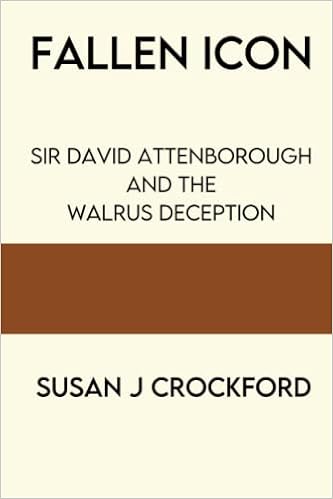
Fallen Icon

By Paul Homewood


 https://www.amazon.co.uk/dp/0991796691

In 2019 Netflix in conjunction with WWF broadcast Frozen Worlds, an episode in the Our Planet series and narrated by David Attenborough. The scenes it showed shocked and horrified viewers around the world.

After a brief introduction about the recent loss of Arctic summer sea ice and the ‘inevitable’ devastation this will cause for Arctic animals, it shifts to a series of amazing shots of tens of thousands of walrus, crowded cheek-by-jowl on a beach in Siberia.

The camera pans out to a rocky cliff, which several walrus are attempting to climb. Then suddenly, one after another, the walrus are shown falling off the cliff to their deaths on the rocky shore below.The scenes are shown in slow motion and repeated in order to maximise the shock effect.

As the scenes unfold, Attenborough coolly informs viewers that the walrus would not normally be there, but out on the sea ice instead. But because of man-made global warming, the poor walrus have been forced onto land in crowded conditions, where they will inevitably suffer and die.

But was it all as simple as Attenborough portrayed?

A number of suspicions were immediately evident. Far from these beach haulouts being unusual, walrus in fact regularly use these beaches every year, in order to rest and feed while waiting for the sea ice to move south in autumn.

Walrus also invariably crowd together in these situations, both for warmth and protection from polar bears. Indeed, far from walrus being threatened by climate change, their populations have been growing in recent years, explaining why so many were hauled out that day.

And what made those walrus try to climb the cliff?

Dr Susan Crockford is a professional zoologist, who has specialised in Arctic mammals for many years, particularly polar bears and walrus. She immediately smelled a rat.

Her newly released book, Fallen Icon, tells the story of how she uncovered exactly what went on that day on the Siberian beach. Her detective work reveals how it was polar bears stalking them that forced the walrus up that cliff; how this is a common hunting tactic and how the bears then fed off the carcasses down below.

She uncovers evidence that WWF already knew about this hunting tactic at that particular location, and that was precisely why this beach was chosen for the film.

She goes on to describe how retreating sea ice actually increases the food supply for walrus and how their populations are both healthy and increasing.

And how Attenborough used this horrifying imagery to jump-start a three year campaign against human-caused global warming that included ten documentaries laden with groundless climate emergency messaging, much of it aimed at the wealthiest and most powerful people in the world. Attenborough’s relentless climate activism included a utopian vision of global changes for society eerily similar to the one proposed by the World Economic Forum.

It is hard to disagree with Crockford’s conclusions:

The public’s trust in science and medicine now appears to be at an all-time low. People who had been blind to the abuse of science rampant in the climate change narrative have had their eyes opened by the pandemic response. These things cannot be unseen.
In a worrying trend, traditional scientists struggle to be heard or have their concerns and criticisms published, both for climate change and Covid-19 related issues. Research that features testable hypotheses and reproducible studies seem to be rare birds while predictive modelling projects gobble up grant funds as well as the media attention.
Is science as we used to know it already dead? If so, how much of a role has Attenborough played in this progression? Over the last three years, he has used weaponized science presented to a trusting public in a most egregious manner.
My ultimate goal in writing this book is not to denigrate Sir David but to correct the misinformation he has deliberately or unwittingly promoted in his documentaries and public statements.
I am a traditional scientist standing up for science as it is meant to be – without activism and without politicization – because its loss to society will be incalculable.
Over the years but especially since 2018, Attenborough has shown that he lets others do his serious thinking for him and has often placed his trust where it was ill-advised, as he has done with the WWF. By that I mean he has relied on others to present information to him in an easily digestible manner rather than delving into the literature himself.
And having spent a lifetime taking this easy way out, when he decided he wanted his legacy to be something more substantial than ‘a good storyteller’, he seemed to take on the role of spokesman for others with ideological political agendas.
It appears to me that when he agreed to present the gruesome falling walrus film footage in Our Planet as evidence of climate change, Attenborough compromised his principles to achieve a specific end result. Such noble cause corruption is common in the conservation world but it was new for Attenborough.
I am convinced that what Attenborough has done with the falling walrus episode will be remembered long after he’s dead but not for the reasons he intended. It will go down as another ‘own goal’ for the climate change movement and judged as the moment Attenborough fell from grace as a trusted British icon.

Susan Crockford’s book is now available on Amazon here:

https://www.amazon.co.uk/dp/0991796691

via NOT A LOT OF PEOPLE KNOW THAT

https://ift.tt/3tH7pde

January 19, 2022 at 05:39AM

NASA’s Curiosity Rover Measures Intriguing Carbon Signature on Mars

From NASA

After analyzing powdered rock samples collected from the surface of Mars by NASA’s Curiosity rover, scientists today announced that several of the samples are rich in a type of carbon that on Earth is associated with biological processes.

While the finding is intriguing, it doesn’t necessarily point to ancient life on Mars, as scientists have not yet found conclusive supporting evidence of ancient or current biology there, such as sedimentary rock formations produced by ancient bacteria, or a diversity of complex organic molecules formed by life.

“We’re finding things on Mars that are tantalizingly interesting, but we would really need more evidence to say we’ve identified life,” said Paul Mahaffy, who served as the principal investigator of the Sample Analysis at Mars (SAM) chemistry lab aboard Curiosity until retiring from NASA’s Goddard Space Flight Center in Greenbelt, Maryland, in December 2021. “So we’re looking at what else could have caused the carbon signature we’re seeing, if not life.”

This image shows the Highfield drill hole made by NASA’s Curiosity rover as it was collecting a sample on Vera Rubin Ridge in Gale crater on Mars. Drill powder from this hole was enriched in carbon 12. The image was taken by the Mars Hand Lens Imager on the 2,247th Martian day, or sol, of the mission.Credits: NASA/Caltech-JPL/MSSS.

In a report of their findings to be published in the Proceedings of the National Academy of Sciences journal on January 18, Curiosity scientists offer several explanations for the unusual carbon signals they detected. Their hypotheses are drawn partly from carbon signatures on Earth, but scientists warn the two planets are so different they can’t make definitive conclusions based on Earth examples.

“The hardest thing is letting go of Earth and letting go of that bias that we have and really trying to get into the fundamentals of the chemistry, physics and environmental processes on Mars,” said Goddard astrobiologist Jennifer L. Eigenbrode, who participated in the carbon study. Previously, Eigenbrode led an international team of Curiosity scientists in the detection of myriad organic molecules — ones that contain carbon — on the Martian surface.

“We need to open our minds and think outside the box,” Eigenbrode said, “and that’s what this paper does.”

The biological explanation Curiosity scientists present in their paper is inspired by Earth life. It involves ancient bacteria in the surface that would have produced a unique carbon signature as they released methane into the atmosphere where ultraviolet light would have converted that gas into larger, more complex molecules. These new molecules would have rained down to the surface and now could be preserved with their distinct carbon signature in Martian rocks.

Two other hypotheses offer nonbiological explanations. One suggests the carbon signature could have resulted from the interaction of ultraviolet light with carbon dioxide gas in the Martian atmosphere, producing new carbon-containing molecules that would have settled to the surface. And the other speculates that the carbon could have been left behind from a rare event hundreds of millions of years ago when the solar system passed through a giant molecular cloud rich in the type of carbon detected.

“All three explanations fit the data,” said Christopher House, a Curiosity scientist based at Penn State who led the carbon study. “We simply need more data to rule them in or out.”

Learn More:

With Mars Methane Mystery Unsolved, Curiosity Serves Scientists a New One: Oxygen

First You See It, Then You Don’t: Scientists Closer to Explaining Mars Methane Mystery

NASA’s Curiosity Rover Finds Clues to Chilly Ancient Mars Buried in Rocks

To analyze carbon in the Martian surface, House’s team used the Tunable Laser Spectrometer (TLS) instrument inside the SAM lab. SAM heated 24 samples from geologically diverse locations in the planet’s Gale crater to about 1,500 degrees Fahrenheit, or 850 degrees Celsius, to release the gases inside. Then the TLS measured the isotopes from some of the reduced carbon that was set free in the heating process. Isotopes are atoms of an element with different masses due to their distinct number of neutrons, and they are instrumental in understanding the chemical and biological evolution of planets.

Carbon is particularly important since this element is found in all life on Earth; it flows continuously through the air, water, and ground in a cycle that’s well understood thanks to isotope measurements.

For instance, living creatures on Earth use the smaller, lighter carbon 12 atom to metabolize food or for photosynthesis versus the heavier carbon 13 atom. Thus, significantly more carbon 12 than carbon 13 in ancient rocks, along with other evidence, suggests to scientists they’re looking at signatures of life-related chemistry. Looking at the ratio of these two carbon isotopes helps Earth scientists tell what type of life they’re looking at and the environment it lived in.

On Mars, Curiosity researchers found that nearly half of their samples had surprisingly large amounts of carbon 12 compared to what scientists have measured in the Martian atmosphere and meteorites. These samples came from five distinct locations in Gale crater, the researchers report, which may be related in that all the locations have well-preserved, ancient surfaces.

“On Earth, processes that would produce the carbon signal we’re detecting on Mars are biological,” House said. “We have to understand whether the same explanation works for Mars, or if there are other explanations, because Mars is very different.”

Mars is unique because it may have started off with a different mix of carbon isotopes than Earth 4.5 billion years ago. Mars is smaller, cooler, has weaker gravity, and different gases in its atmosphere. Additionally, the carbon on Mars could be cycling without any life involved.

“There’s a huge chunk of the carbon cycle on Earth that involves life, and because of life, there is a chunk of the carbon cycle on Earth we can’t understand, because everywhere we look there is life,” said Andrew Steele, a Curiosity scientist based at the Carnegie Institution for Science in Washington, D.C.

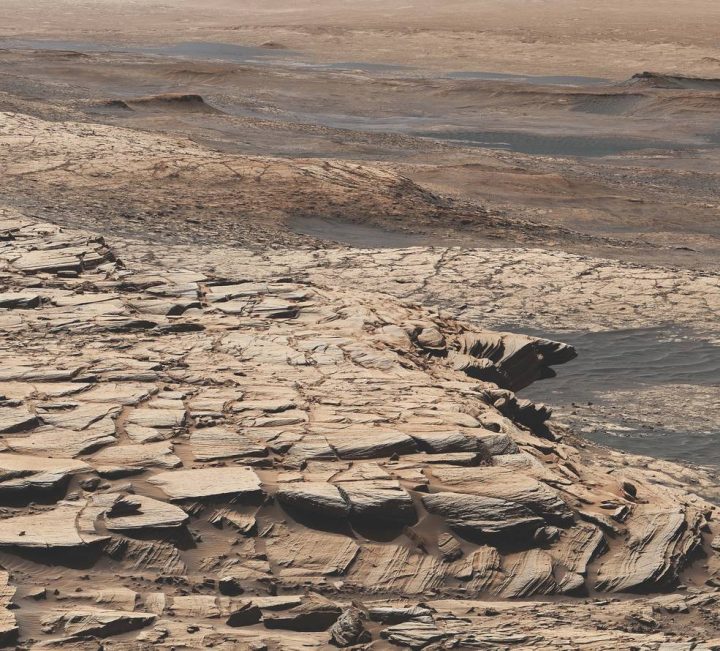
This mosaic was made from images taken by the Mast Camera aboard NASA’s Curiosity rover on the 2,729th Martian day, or sol, of the mission. It shows the landscape of the Stimson sandstone formation in Gale crater. In this general location, Curiosity drilled the Edinburgh drill hole, a sample from which was enriched in carbon 12.Credits: NASA/Caltech-JPL/MSSS

Steele noted that scientists are in the early stages of understanding how carbon cycles on Mars and, thus, how to interpret isotopic ratios and the nonbiological activities that could lead to those ratios. Curiosity, which arrived on the Red Planet in 2012, is the first rover with tools to study carbon isotopes in the surface. Other missions have collected information about isotopic signatures in the atmosphere, and scientists have measured ratios of Martian meteorites that have been collected on Earth.

“Defining the carbon cycle on Mars is absolutely key to trying to understand how life could fit into that cycle,” Steele said. “We have done that really successfully on Earth, but we are just beginning to define that cycle for Mars.”  

Curiosity scientists will continue to measure carbon isotopes to see if they get a similar signature when the rover visits other sites suspected to have well-preserved ancient surfaces. To further test the biological hypothesis involving methane-producing microorganisms, the Curiosity team would like to analyze the carbon content of a methane plume released from the surface. The rover unexpectedly encountered such a plume in 2019 but there’s no way to predict whether that will happen again. Otherwise, researchers point out that this study provides guidance to the team behind NASA’s Perseverance rover on the best types of samples to collect to confirm the carbon signature and determine definitively whether it’s coming from life or not. Perseverance is collecting samples from the Martian surface for possible future return to Earth.

Curiosity’s mission is led by NASA’s Jet Propulsion Laboratory in Southern California; JPL is managed by Caltech.Banner image: NASA’s Curiosity rover captured these clouds just after sunset on March 19, 2021, the 3,063rd Martian day, or sol, of the rover’s mission. The image is made up of 21 individual images stitched together and color-corrected so that the scene appears as it would to the human eye. Credits: NASA/JPL-Caltech/MSSS

By Lonnie Shekhtman
NASA’s Goddard Space Flight Center, Greenbelt, Md.Last Updated: Jan 18, 2022Editor: Svetlana Shekhtman

via Watts Up With That?

https://ift.tt/3fzRs06

January 19, 2022 at 04:47AM

Dreaming of a new conservatory? Climate change building rules could shatter that middle-class aspiration

By Paul Homewood

h/t Philip Bratby


When will this interference in what should be individual choice end?


 image

As a middle-class staple coveted even by members of the Royal family, the conservatory has been an object of aspiration for the British homeowner for decades.

But now its days could be numbered under new rules designed to limit windows to keep homes cool as the climate warms.

From June, new properties will face strict limits on window sizing or have to pass complex modelling tests to show that they do not become too hot in the summer.

The long-awaited regulations respond to concerns that Britain’s housing stock is at risk of becoming "uninhabitable" if 40C summers become commonplace.

It follows calls by environmental groups, including official government advisers the Climate Change Committee, to build houses in a way that makes sure people do not overheat in the summer.

The new rules limit window size to a specific percentage relating to the floor area of a room and house, depending on the direction they face and how at risk the home is from overheating.

For homes that do not meet the rules, bespoke analysis must be carried out, modelling the home’s design including shades and ventilation and the likely weather conditions to ensure internal temperatures will not get too hot.

Conservatories can be exempted from the rules if they are unheated and separated from the house with exterior doors and walls – but must be accounted for if they have heating and run on from another room in the house.

Building groups said developers could be put off installing conservatories, especially smaller companies concerned about the added cost of the modelling, which could run to thousands of pounds.

Experts said the rules would also hit trendy floor-to-ceiling windows, particularly in flats where ventilation is more difficult, as well as sliding patio doors.

Rico Wojtulewicz, head of housing and planning policy at the National Federation of Builders, said: "We can build heavily glazed buildings but smaller companies who do a number of different housing types on one development may avoid it, due to the potential cost of the dynamic thermal modelling on each home."

He said conservatories could become a more "premium product" as high-end builders continue to put them in while more lower-priced and mid-market companies ditch them from developments.

Andrew Mitchell, director of energy services at construction consultancy Stroma, said: "Conservatories are a loophole in the regulations as long as you keep the divide. You can keep the conservatory if you have that divide from the home. If you’re going to heat it you’ve run straight into trouble."

He added home designs would become more standardised as builders tried to avoid having to do too much modelling of different layouts.

"We are going to get boring homes across the country because the regulations have got so hard," he said.

The regulations, published last month as part of a wider overhaul of building standards, are set to come into force in June. They affect new-build homes but not extensions.

It came as the Government said that overheating in homes was a "priority risk" as Britain’s summers become hotter due to climate change, especially if people continue to work from home after the pandemic.

"As well as risk to life, high temperatures will lead to productivity losses for UK workers," the Government’s official Climate Change Risk Assessment warned on Monday.

Last year’s guidance from the Climate Change Committee warned: "More than 300,000 homes are due to be built each year across the UK and there is a major risk of lock-in if they are not planned and built to address overheating alongside energy efficiency and low-carbon heating.

"Inaction now will create unnecessary retrofit costs later and could even leave many existing and new homes uninhabitable as temperatures rise."

https://www.telegraph.co.uk/environment/2022/01/18/heat-conservatories-climate-change-building-rules-put-threat/


It seems that the main objection to conservatories comes from the energy efficiency side, rather than keeping homes cool in summer. Hence the exemption if they are not heated and separate from the main house.

But this would rather negate the main advantages of a conservatory, including the expansion of living space which they bring in a house. Many people use them all year round, as it expands their lounge area, and allows views out onto the garden.

And, of course, there are many times during the year when it is mild enough to open the patio doors, but still cool enough to need heating during the evening. Conservatories can also be much cooler in summer than traditional rooms.

Unheated conservatories on the other hand are cold and damp, and are a waste of space for most of the year.

At the end of the day, it should be up to homeowners whether they have a conservatory or not, and whether they want to heat it.

The rest of the regulations, mandating small windows and so on, are based on a lie anyway. There is no evidence that summers will become so hot as to make homes uninhabitable.

The number of days >25C in Central England shows nothing alarming happening:


image

https://www.ecad.eu/utils/showindices.php?uk26bjmnfs9d4bei8co2qc09r9

The official heatwave threshold for Central England is, I believe, 28C, and in the last decade there have been just 30 days above this temperature.

The idea that we should have to obey draconian building regulations, making houses more expensive to buy, with tiny windows (and thus poor ventilation and light) and with no conservatory, just because of a couple of hot days a year is beyond absurd.

Have the Committee on Climate Change never heard of air conditioning?

via NOT A LOT OF PEOPLE KNOW THAT

https://ift.tt/358PO3H

January 19, 2022 at 04:33AM

Unreliability makes solar power impossibly expensive

Electricity must be there when we need it.

The post Unreliability makes solar power impossibly expensive appeared first on CFACT.

via CFACT

https://ift.tt/3GHRnU7

January 19, 2022 at 04:02AM