Month: January 2022

ESG = Extreme Shortages Guaranteed!

Originally published at CFACT

By Ronald Stein

Ambassador for Energy & Infrastructure, Irvine, California

The Environmental, Social and Governance (ESG) factors climbing up the agenda in the banking industry to divest in fossil fuels is a desire to reach a world like that in the 1800’s, when the world was previously “decarbonized”. 

Back in the 1800’s, we had no coal or natural gas power plants, and we had not discovered crude oil as something that could be manufactured into usable products. Life was hard and dirty, and most people never traveled 100-200 miles from where they were born, and life expectancy was short.

Today, there is a lost reality that the primary usage of crude oil  is NOT for the generation of electricity, but to manufacture derivatives and fuels which are the ingredients of everything needed by economies and lifestyles to exist and prosper. Energy realism requires that the legislators, policymakers, and media that demonstrate pervasive ignorance about crude oil usage understand the staggering scale of the decarbonization movement.

The efforts to cease the use of crude oil could be the greatest threat to civilization, not climate change, resulting in billions of fatalities from diseases, malnutrition, and weather-related deaths.

In the worldwide frenzy to achieve the goal for “net zero” emissions, over the last 5-10 years, “ESG”–standing for Environmental Social Governance–has gone from an acronym that virtually no one knew or cared about, to a cultishly embraced top priority of financial regulators, markets, and institutions around the world.  Today, the ESG divesting efforts are applying to all 3 fossil fuels of coal, natural gas, and crude oil.

The Net-Aero Banking Alliance developed with the support from the United Nations, now includes seven of the largest and most influential banks in the United States, including BOA, Citi, J.P. Morgan Chase, Morgan Stanley, Goldman Sachs, Wells Fargo, and Amalgamated Bank.

Allowing banks to collude to reshape economies so that they are in line with the preferences of banks and other financial institution is a very dangerous precedent.  The American people never voted to give banks this sort of control over our country.

The domino effects from tinkering with the supply chain of crude oil, is supply shortages and soaring prices for thousands of products that support the economies of the world. Products based on oil are the basis of the entire medical industry, all branches of the military, airports, electronics, communications, merchant ships, container ships, and cruise liners, as well as asphalt for roads, and fertilizers to help feed the world. Fossil fuel shortages encourage inflation as it imposes serious damage on the energy and raw materials infrastructures.

Climate alarmism seems to be inexhaustible and if history is any guide, ESGers admitting their mistakes and rushing to undo the damage is not at the top of the list of likely responses. Thus, by divesting in crude oil infrastructure we can look forward to supply shortages of thousands of products manufactured from oil and crippling power prices and unreliable supplies to meet the demands of society.

The oil products that reduced infant mortality, extended longevity to more than 80+ and allowed the world to populate from 1 to 8 billion in less than two centuries, is now required to provide the food, medical, and communications to maintain and grow that population. How can world leaders consciously support the demise of crude oil that would take us back to the 1800’s when life was hard, dirty, and short?

Today, with all the products manufactured from oil, according to the United Nations the global population of centenarians 100 years old or older is projected to grow from more than 500,000 in 2021, to exceed 2 billion in 2050.

We already know that the poorer developing countries, currently without the usage of the 20th century products manufactured from crude oil, are experiencing about 11,000,000 child deaths every year due to the unavailability of the fossil fuel products used in wealthy countries.

More than 70 per cent of those child fatalities in developing countries are attributable to six causes: diarrhea, malaria, neonatal infection, pneumonia, preterm delivery, or lack of oxygen at birth. About 29,000 children under the age of five – 21 each minute – die every day, mainly from preventable causes.

Without replacements for those derivatives manufactured from crude oil, there will be gigantic reductions in living standards of the population in the current healthy and wealthy countries as the world migrates back to the pre-1900 era, and any attempt to develop the colonial countries would come to a dead stop.

“Net zero” will be taking us back to a time before 1900 when the world had not yet discovered the benefits to society from the 3 fossil fuels. Net-zero policies are demonstrably precipitating ever more serious, unsustainable socio-economic and environmental damage, with several advanced economies routinely experiencing blackouts, and steeply escalating electricity prices that are leading to class-based electricity poverty, excess winter deaths, organized social and political pushback and ever more violent confrontations.

Before the 1900’s we had NONE of the products used in the medical industry nor any of the 6,000 products from oil and petroleum products.  By ceasing oil production and fracking, the supply chain to refineries will be severed and there will no need for refineries as they will have no crude oil supply to manufacture derivatives and intotransportation fuels demanded by the world’s heavy-weight and long-range infrastructures of aviation, merchant ships, cruise ships, and militaries.

Divesting is already impacting supply shortages of jet fuel as reported by Energy Information Administration (EIA), as less production and more demand have reduced U.S. jet fuel inventories since 2014 for the 23,000 commercial airplanes and 20,000 Private jets.

The IEA report points out that the demand growth for plastics and fertilizer are outpacing the demand growth for steel, aluminum, and cement. Petrochemical product demand has nearly doubled since 2000 and the U.S. and Europe use twenty times as much plastic and ten times as much fertilizer as India, Indonesia, and other developing countries on a per-capita basis. A decarbonized world without the three fossil fuels of coal, natural gas, and crude oil CANNOT manufacture any of those petrochemicals from a wind turbine or solar panel.

As Environmental, Social and Governance (ESG) divesting in fossil fuels progresses, the short memories of petrochemicals’ golden goose contributions to societies are leading the world to an era of Extreme Shortages Guaranteed (ESG) like we had in the decarbonized world in the 1800’s! 

Ronald Stein, P.E.

Ambassador for Energy & Infrastructure

http://www.energyliteracy.net/

via Watts Up With That?

https://ift.tt/3IkKIj3

January 18, 2022 at 12:05PM

650 km Wintertime Trip With VW E-Car Took 13 Hours, 3 Recharges And Lots Of Warm Clothes

Consumers’ expectations for e-cars are still unrealistic…can’t hold a candle to conventional combustion engine vehicles.

When it comes to performance parameters like fuel consumption, car manufacturers’ brochures often boast figures that in reality are only possible under really ideal conditions. But rarely are such conditions the case in real life. The result: disappointed consumers.

The VW Up. Image cropped from VW.

Electric cars are notorious for their limited range and need of constant recharging – factors that are often overestimated by buyers. Recently German auto reporter Lisa Brack put her brand new electric car through a long distance, wintertime test. The result was hardly thrilling.

“The result is sobering – she saves time by consistently freezing,” reported the German kreiszeitung.de here, on Ms. Brack’s test.

13 hours of driving and charging

Ms. Brack and EFAHRER.com conducted the long-distance test on her new VW e-Up by driving it from VW in Wolfsburg, where she had picked it up, to her home in Munich.

The 650 km trip would normally be done easily in less than 7 hours with a conventional diesel engine car (assuming no traffic jams) and without the need to stop to refuel. But for Brack in her new VW e-Up vehicle, the trip needed almost 13 hours – a time the kreiszeitung.de describes as “appalling”. Numerous hassles were encountered.

No heating

After being handed her new car from VW in Wolfsburg, she departed for Munich at 2:45 p.m. The subfreezing weather was a  major drawback for the VW e-car. According to the kreiszeitung.de, “the heating stayed off for almost the entire journey in freezing temperature” in order not to draw down the battery battery so quickly. This meant that to survive the trip, Brack had to take along a generous supply of “hats, scarves, gloves and generally warm clothing” and hope to find enough CCS charging stations along the way. Without these charging stations, getting the batteries charged up would take much longer.

In total she needed three charging stops.

Reached destination at 3:30 – in the morning!

It was 3:30 in the morning by the time Brack reached her destination in Munich, half frozen to death.

According to the kreiszeitung.de, she made the crucial mistake of charging up to seldom and wasted much time charging the batteries to 100% instead of 80% (the last 20% take the longest). “Charge faster, accept a little less range and charge again earlier – but again faster.”

“One more charge alone would have saved 1.5 hours,” she commented.

“As it was, however, the trip turned into a long winter excursion that she will not soon forget,” reported the kreiszeitung.de.

Expectations too high

The experience shows electric vehicles, though practical for short trips, still have a long way to go before they can keep up with today’s modern diesel and gasoline engines. Studies also show that e-cars off very little, if any, lifetime CO2 savings.

Donate – choose an amount

via NoTricksZone

https://ift.tt/3IfPJJt

January 18, 2022 at 11:49AM

UK’s Third Climate Change Risk Assessment

By Paul Homewood


With the public finally rebelling against the cost of Net Zero, the government has published its latest Climate Change Risk Assessment, warning us that climate change will cost tens of billions in “climate disasters”:


 image

The Government has today (Monday 17 January) published the UK’s Third Climate Change Risk Assessment (CCRA3), recognising the unprecedented challenge of ensuring the UK is resilient to climate change and setting out the work already underway to meet that challenge.

The five-year assessment, delivered under the Climate Change Act 2008 and following close work with the Climate Change Committee (CCC), identifies the risks that climate change poses to multiple parts of our society and economy.

For eight individual risks, economic damages could exceed £1 billion per year each by 2050 with a temperature rise of 2°C, with the cost of climate change to the UK rising to at least 1% of GDP by 2045.

Details

As required by the Climate Change Act 2008, the UK government has undertaken the third five-year assessment of the risks of climate change on the UK. This is based on the Independent Assessment of UK Climate Risk, the statutory advice provided by the Climate Change Committee (CCC), commissioned by the UK government and devolved administrations.

The risk assessment considers sixty-one UK-wide climate risks and opportunities cutting across multiple sectors of the economy and prioritises the following eight risk areas for action in the next two years:

  • risks to the viability and diversity of terrestrial and freshwater habitats and species from multiple hazards
  • risks to soil health from increased flooding and drought
  • risks to natural carbon stores and sequestration from multiple hazards
  • risks to crops, livestock and commercial trees from multiple climate hazards
  • risks to supply of food, goods and vital services due to climate-related collapse of supply chains and distribution networks
  • risks to people and the economy from climate-related failure of the power system
  • risks to human health, wellbeing and productivity from increased exposure to heat in homes and other buildings
  • multiple risks to the UK from climate change impacts overseas

https://www.gov.uk/government/news/government-publishes-uks-third-climate-change-risk-assessment 

The report is largely based on last June’s Independent Assessment of UK Climate Risk, published by the CCC, who seem to now be in charge of every aspect of climate policy. Unsurprisingly, given their involvement, the latest assessment is pure fantasy.

Three basic factors undermine and discredit the new Risk Assessment throughout:

  • Despite claims to the contrary, no evidence is offered that our weather is getting any worse, or will do. Flooding is a good example, which we are told will become disastrous in future. So where is the data which shows it has already got worse?
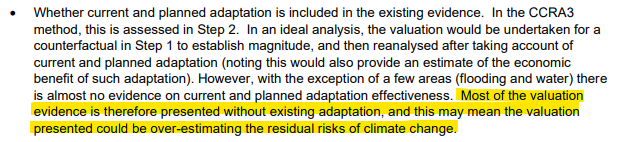
  • The report totally ignores adaptation, as this section reveals:

Image

It is absurd to assume that, for instance, farmers won’t adapt to slightly warmer weather.

  • Whatever may be the impacts of climate change, and no mention seems to have been made of the undoubted benefits, they will be dwarfed by natural variability and other human influence. Moorland wildfires, for instance, are mentioned several times, even though the actual data proves that the UK is not getting drier. But where is there any acknowledgment of the overwhelmingly key factors in wildfires – arson and accidents, both aggravated by easy accessibility nowadays. If we are so concerned about wildfire, surely we should be addressing these factors, and not trying to control the weather?

In terms of the specific risk areas, the first four all seem to revolve around floods and drought, with a few wildfires thrown in:

 image

They really are making a meal out of wildfires, which only affect a miniscule proportion of our moorlands.

As for the other two, where is the evidence that either floods or droughts are getting worse? If they have not in the past, why should we believe the CCC when they tell us they will in future.

The idea, anyway, that floods will diminish soil fertility is ridiculous. It is flooding which restores fertility.

The CCC talk about land management and new crops and technologies, as if farmers have not been doing these since time immemorial. But England is not suddenly going to turn into Texas in climate terms, and the enormous year-to-year, as well as month-to-month, variations will continue to dwarf longer term climate changes. If these happen at all, they will occur so slowly as to be barely noticeable, and will allow plenty of time to adapt

image

They go into the realms of fantasy when it comes to supply chains:

image

According to the CCC, extreme weather is already causing disruption:

image

But what does “extreme weather” have to do with “climate change”. There is certainly no evidence that it is getting worse.

We have already learnt from the pandemic that it is dangerous to be over reliant on China for so much of what we buy, and it should be a top priority for any government to reduce this.

But the danger is that Net Zero policies will destroy our industrial base and place even more dependence on imported goods.

But this next section must surely take the biscuit!

image

Again from the CCC:

image 

So the the weather related risks to our electricity system will grow as we become more dependent on wind power.

WOW!! I did not see that one coming!


It gets worse:

image

Obviously whoever wrote this gibberish did not read the ONS’ latest report, pointing out that global warming has saved half a million lives in Britain.

The CCC perpetuates the lie about 2500 heat-related deaths in 2020, failing to point out that death rates in recent hot summers have actually been lower than cold, wet ones.

Apparently we are all going to be too hot to work as well! Have they not heard of air-conditioning? Or mechanisation which takes the hard labour out of most jobs?

And what about all of the lost productivity during cold winters, when the whole country can seize up with a few inches of snow? We are told these are things of the past now.

image

And finally, even if none of these calamities come to our shores, there is always the rest of the world to worry about:

image

image


I think the CCC have been watching too many disaster movies!


The whole report is just another attempt to scare the children and persuade people to accept the high costs of Net Zero.

via NOT A LOT OF PEOPLE KNOW THAT

https://ift.tt/33IWh4r

January 18, 2022 at 10:33AM

Norway: Record Oil & Gas Export Revenue in 2021! How Else Could They Have Funded Massive EV Subsidies?

Guest “Irony can be so ironic” by David Middleton

Norway Announces Record Oil & Gas Revenues in 2021

January 14, 2022 by David NikelHome » News from Norway » Norway Announces Record Oil & Gas Revenues in 2021

In spite of the climate crisis, Norway’s love affair with petroleum seems to be continuing. Never before has the country enjoyed such high revenue from its oil and gas industry.

The Norwegian Petroleum Directorate said 2021 had been a “great year” for oil and gas in Norway. Oil and gas production has remained high as both demand and prices have increased.

The news was announced by the Norwegian Petroleum Directorate’s Ingrid Sølvberg at the presentation of their annual resorts. As pointed out by our friends at the Barents Observer, “she did not mention the word ‘climate’ even once.”

It’s the latest chapter in Norway’s very visible conflict between its desire to be a leader in the green shift while remaining one of the world’s biggest producers of oil and gas.

Norway’s oil and gas industry in numbers

In the final quarter of 2021, Norway’s oil and gas exports reached more than NOK 100 billion (USD $11.5 billion) per month. That’s almost three times more than in the same period the previous year.

Production of oil in 2021 increased to 102 million standard cubic meters and natural gas to 113 billion cubic meters. Norway has now extracted approximately half of all oil and gas resources available on the Norwegian continental shelf.

[…]

Life in Norway

Irony #1

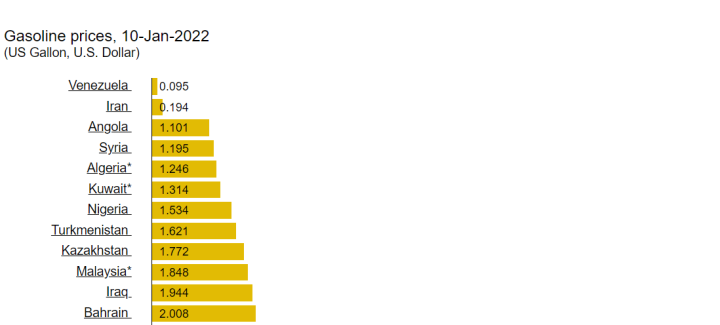
Despite racking up $11.5 billion/month in oil & gas export revenue, Norwegians pay more for gasoline than almost every other nation on Earth.

Cheap ↑ to Expensive ↓

Irony #2

In part, due to exorbitant gasoline prices, EV sales are booming in Norway, particularly Tesla vehicles manufactured in Red China.

January 03, 2022 09:53 AM

EV sales rose 48% in Norway last year, led by Tesla

Electric cars made up nearly two thirds of overall registrations

Reuters

OSLO — Sales of electric cars in Norway rose by 48 percent last year, ensuring that almost two out of every three new vehicles were battery powered and making Tesla the top selling brand.

Seeking to become the first nation to end the sale of gasoline and diesel cars by 2025, oil-producing Norway exempts full-electric vehicles from taxes imposed on models using internal combustion engines.

Tesla took an 11.5 percent share of the overall car market, making it the number one brand for the first time on a full-year basis ahead of Volkswagen with 9.4 percent.

The U.S. automaker on Sunday reported record quarterly deliveries that far exceeded Wall Street estimates, riding out global chip shortages as it ramped up China production.

[…]

Automotive News Europe

Norway compensates for the exorbitant gasoline prices by massively subsidizing EV purchases.

The Norwegian EV incentives:

* No purchase/import taxes (1990-)

* Exemption from 25% VAT on purchase (2001-)

* No annual road tax (1996-2021). Reduced tax from 2021. Full tax from 2022..

* No charges on toll roads or ferries (1997- 2017).

* Maximum 50% of the total amount on ferry fares for electric vehicles (2018-)

* Maximum 50% of the total amount on toll roads (2019)

* Free municipal parking (1999- 2017)

* Parking fee for EVs was introduced locally with an upper limit of a maximum 50% of the full price (2018-)

* Access to bus lanes (2005-).

* New rules allow local authorities to limit the access to only include EVs that carry one or more passengers (2016)

* 50 % reduced company car tax (2000-2018). Company car tax reduction reduced to 40% (2018-) and 20 percent from 2022.

* Exemption from 25% VAT on leasing (2015)

* Fiscal compensation for the scrapping of fossil vans when converting to a zero-emission van (2018)

[…]

The progressive tax system makes most EV models cheaper to buy compared to a similar petrol model, even if the import price for EVs are much higher. This is the main reason why the Norwegian EV market is so successful compared to any other country.

Norwegian EV policy

Irony #3

Norway’s EV subsidies are funded by oil & gas export revenue and are not even close to “carbon neutral.”

Norway an EV role model? Their pathway is expensive and paid for with oil & gas exports

June 4, 2021 by Schalk Cloete

Norway is an EV leader thanks to a generous pot of tax incentives. Today, battery-electric cars make up more than half of all new car sales in Norway. Schalk Cloete takes a detailed look at what those incentives cost, and how many tonnes of CO2 they avoid. In short, Norway – a major oil and gas exporter – needs to sell over 100 barrels of oil (which emits 40 tonnes of CO2) to pay for the tax breaks it gives EVs to avoid one tonne of CO2. And Norway’s electricity is almost completely clean thanks to hydro power, so the CO2 avoidance costs will be higher in other countries. In other words, most countries cannot take this pathway to achieve EV dominance. It’s very expensive, and paying for it – certainly in Norway’s case – emits large amounts of carbon. Cloete is therefore very critical of some of the hype around EV targets. He wants to see the emphasis shift to behaviour change that reduces car use. And instead of being an EV leader, Norway should consider being a leader in turning oil and gas into low-carbon fuels.

I love living in Norway. It’s a beautiful country with nothing other than the weather to complain about. But this Nordic dream comes with a sizable oil stain; a foundation built on 50 years of lucrative hydrocarbon exports.

From official data, I estimate that Norway has sold fossil fuels amounting to roughly 44 billion barrels of oil equivalent – a CO2 legacy in the vicinity of 15 gigatons. Norwegian production costs are attractively low, so we can reasonably assume a profit of $23/barrel to reach a cool $1 trillion in historical cumulative hydrocarbon profit (resource rent, to be more precise).

[…]

CO2 avoidance costs

The best thing about BEVs in Norway is that electricity comes almost completely from clean hydropower. This means that BEV emissions relative to conventional cars come only from battery manufacturing.

…paid for by selling barrels of oil

[See graph below]

From the above graph, a BEV like the ID4 with an 80 kWh battery will avoid about 15 tons of CO2 relative to an HEV when electricity emits no CO2 (zero well-to-tank fuel cycle emissions for the BEV). Relative to a PHEV, the saving is about 6 tons of CO2.

Hence, in total, the CO2 avoidance cost of incentivising people to buy the ID4 in Norway is $36,500/15 = $2,400/ton relative to the RAV4 and $23,300/6 = $3,900/ton relative to the RAV4 Prime.

For perspective, each barrel of oil that Norway sells to help finance these large tax breaks emits about 0.43 tons of CO2 upon use. Making the $2,400 required to avoid one ton of CO2 with the ID4 at the previously assumed resource rent of $23/barrel requires the sale of 104 barrels (45 tons of CO2). Relative to the RAV4 Prime, it comes to 73 tons of oil CO2 per ton of CO2 avoided. These numbers reveal the Norwegian BEV revolution to be little more than a band-aid on a 50-year oil legacy.

[…]

EnergyPostEU

Schalk Cloete is a fan of EV’s, he’s a “research scientist dedicated to sustainable development” and he supports decarbonizing Norway’s oil & gas exports. I haven’t checked his numbers (nor do I have time to do so); but they don’t seem unreasonable. If he is correct, Norway’s EV subsidies result in the export of 45 to 73 tons of CO2 emissions for every 1 ton of avoided domestic emissions.

This works for Norway. They have abundant cheap ($0.14/kWh) electricity due to their world class hydroelectric resources and infrastructure. They have world class oil oil & gas resources; which they efficiently exploit. They have a relatively small population. They can probably afford to do this for many more years to come.

Is natural gas petroleum? Generally no, although it is usually associated with petroleum.

Petroleum is defined as:

A broadly defined class of liquid hydrocarbon mixtures. Included are crude oil, lease condensate, unfinished oils, refined products obtained from the processing of crude oil, and natural gas plant liquids. Note: Volumes of finished petroleum products include non hydrocarbon compounds, such as additives and detergents, after they have been blended into the products.

EIA

I would have captioned the graph as “Actual and projected sale of oil & gas 1971‐2022.”

Is it hypocritical for Norway to export 45 to 73 tons of CO2 emissions for every 1 ton of avoided domestic emissions? No. It’s just good business – for Norway. This model won’t work very well for the rest of the European EV bandwagon.

Is it ironic? Fracking A it is!

Irony can be so ironic!

Is it hilarious that climate alarmists and social justice warriors are stupid enough to think that Norway is saving the planet? Frack yeah!

Larry the Cable Guy would say:

via Watts Up With That?

https://ift.tt/3qDjUEv

January 18, 2022 at 08:23AM