Month: January 2022

European governments scramble to manage fuel price spikes amid energy crunch

By Paul Homewood


image

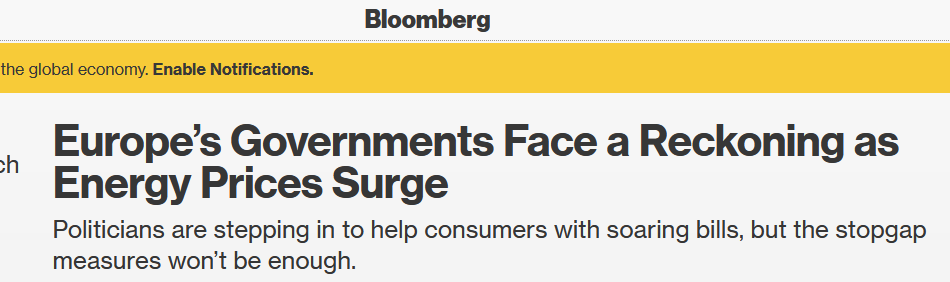
Europe is gripped by one of the worst energy crunches in history, forcing politicians to step in as soaring prices threaten to leave millions of households unable to pay their bills.
But with market forces signalling that the crisis will last way beyond the winter, the dilemma facing leaders is that their stopgap measures are unlikely to be enough.


The cost of electricity and gas across the continent already looks like one of the biggest challenges facing nations as they navigate their way out of the pandemic.
Ministers in the five biggest European economies – Germany, the UK, France, Italy and Spain – have so far come up with a patchwork of grants and time-limited tax cuts to help consumers heat and power their homes.
Indeed, the common thread seems to be to hope the problem goes away while also leaning more on companies.
Electricite de France shares plummeted by a record on January 14 as the French government confirmed plans to force the company to sell more power at a hefty discount.
Gas more than tripled last year and energy companies, analysts and traders all say that high prices are set to persist, already a key driver of now rampant inflation.
Contracts have eased from their peak, yet the weather may still get colder. There is also mounting tension with Russia over a possible invasion of Ukraine, which could disrupt vital supplies.
“The scale of the crisis makes government measures insufficient to cover all impacts across the economy,” said Simone Tagliapietra, a fellow at European economic think tank Bruegel. 
“The longer this situation persists, the more governments will be forced to target their support towards specific segments of society – a difficult triage, both economically and politically.”
Bank of America estimates European households will pay an average of 54pc more for energy this year than in 2020, with the biggest increases in the UK and Italy, where average yearly bills are set to jump by more than €875.
Assistance deployed so far also reflects the different political cultures: Bank of America reckons that plans announced so far include an annualised €337 per household in Italy, more in France and yet zero in the UK.
The trouble is that it all comes as governments need to tighten their belts after almost two years of state largess to protect businesses and workers through Covid-19.
They also have to balance the impact of state intervention on the energy companies they are relying on to deliver on ambitious national climate goals to phase out carbon emissions.
Then there are the more acute political implications coming to a head in April.
French President Emmanuel Macron faces an election, while the squeeze on the cost of living in the UK is set to tighten with an increase in the energy price cap, adding to the turmoil engulfing Prime Minister Boris Johnson.
The UK government is examining ways to help domestic consumers by expanding grants and discounts to pensioners and low-income households, and industry proposals for loans to delay some of the jump in costs coming in April.
Mr Johnson has said a cut in value-added tax on bills is too blunt an instrument.

https://www.bloomberg.com/news/articles/2022-01-16/europe-s-energy-crisis-how-governments-are-trying-to-curb-soaring-bills

via NOT A LOT OF PEOPLE KNOW THAT

https://ift.tt/3IbneN8

January 17, 2022 at 01:15PM

European Union Fiddling Their Own Rules to Fund the Climate Revolution

Guest essay by Eric Worrall

EU rules designed to prevent out of control spending are in tatters, as top EU officials conspire to circumvent their own fiscal rules and breach debt limits, to fund the green energy transition.

EU budget offers debt loophole to battle climate change

Policymakers are trying to turn the economy green while keeping EU finances in check.

BY BJARKE SMITH-MEYER January 14, 2022 6:45 pm

The EU’s €1.2 trillion war chest — also known as its long-term budget — has emerged as a possible workaround on how to finance the expensive fight against climate change despite carrying heavy debt from the pandemic.

Failing to plug that green hole would see Europe fall short of its own green goals and risk damaging its credibility as a global force for climate action. The EU budget could be the solution to avoid that dilemma, according to the head of the International Monetary Fund.

Under normal circumstances, governments must cap their budget deficits to 3 percent of GDP and try to limit their debt to 60 percent under an EU fiscal framework called the Stability and Growth Pact, or SGP. Those rules have been on ice since March 2020 to ensure governments could battle the pandemic without fear of punishment from Brussels and enact stimulus programs that pushed debt levels up to uncomfortable heights.

Golden rule loses shine

The EU budget could neutralize that threat by providing capitals with a cash pot they can request money from by presenting spending plans with specific targets that Brussels can police. “It’s such an obvious candidate,” one of the EU officials said on the condition of anonymity, as no decisions have been made. “Carbon dioxide doesn’t care about borders.”

It might also be an attractive alternative to another approach — floated by some think tanks — that would introduce a “golden rule” that omits green investments from the SGP’s deficit cap. That pitch is losing traction amid fears that it would encourage greenwashing.

“Everything magically becomes green,” said Marco Buti, who heads the cabinet for Economy Commissioner Paolo Gentiloni, on Wednesday during an online debate on the deficit.

Read more: https://www.politico.eu/article/eu-budget-climate-change-greenhouse-gas-emissions-fossil-fuels/

Stagflation and hyper-inflationary pressures do not care about what is in the hearts of the bureaucrats who sign the cheques, it does not matter if bureaucrats believe they have the best of intentions, when they parachute too much money into the economy.

The road to hell is paved with good intentions.

The ongoing collapse of the Turkish Lira right on the border of the European Union, is a clear and present lesson on how easily ordinary people can lose confidence in a fiat currency. Those fiscal rules were created for a reason.

via Watts Up With That?

https://ift.tt/3Icm57Z

January 17, 2022 at 12:51PM

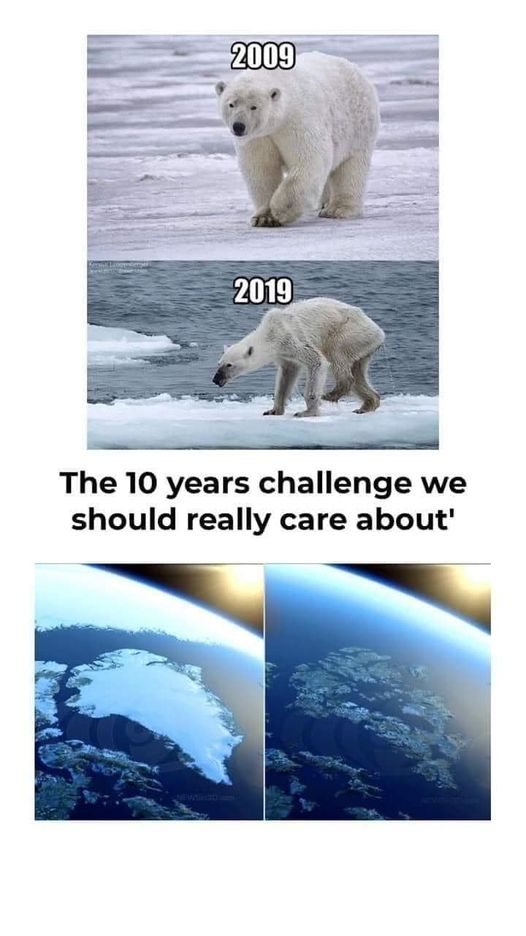
False starving polar bear meme from 2019 making social media rounds with Greenland added

I have discovered that an entirely false meme has been circulating social media. For the record, here it is with an explanation of what’s wrong with it, which is everything.

First of all, the photo of the starving bear with an injured leg was taken in 2015, not 2019, somewhere around Svalbard, Norway. Its emaciated condition had nothing to do with lack of sea ice or global warming.

It was included in a meme that was circulating online in 2019, constructed as part of a ’10 year challenge’ (before and after) on Instagram by someone who either made an error or deliberately misrepresented the year the starving bear image was taken.

A description of that starving bear image from 2015, with links to more info, is available in this post:

These starving polar bears falsely blamed on climate change have scared kids to death (12 September 2019).

An injured or very old bear can’t hunt. If it can’t hunt, it can’t eat and will starve. This is true of all animals. It has nothing to do with lack of sea ice or global warming. Starvation is the most common natural cause of death for polar bears.

People who post these kind of images want attention: the photographer who took the starving bear photo told the CBC:

“I wanted to reach people. I wanted to send a message and get a reaction, but I didn’t expect it to be so big,” she said.

According to a polar bear researcher who had conducted a comprehensive survey of polar bears in the Svalbard region the same summer that starving bear photo was taken, the polar bears in general were “as fat as pigs.”

The fact that this meme has been getting traction suggests it’s time to post this again:

Lastly, the image of Greenland without an icecap is obviously manipulated or misrepresented (could it have been taken with a filter meant to highlight melt ponds on the ice that makes it look like there is no underlying ice?). Greenland’s ice cap has not disappeared.

The current meme has added the manipulated Greenland images to the false polar bear meme from 2019: someone used it on Reddit to make a point about capitalism.

The whole thing is bogus.

Note: I was alerted to this meme via this Facebook page but I doubt that’s who started it.

via polarbearscience

https://ift.tt/3nzUjKF

January 17, 2022 at 12:38PM

China Coal Output Hits New Record

By Paul Homewood


 image

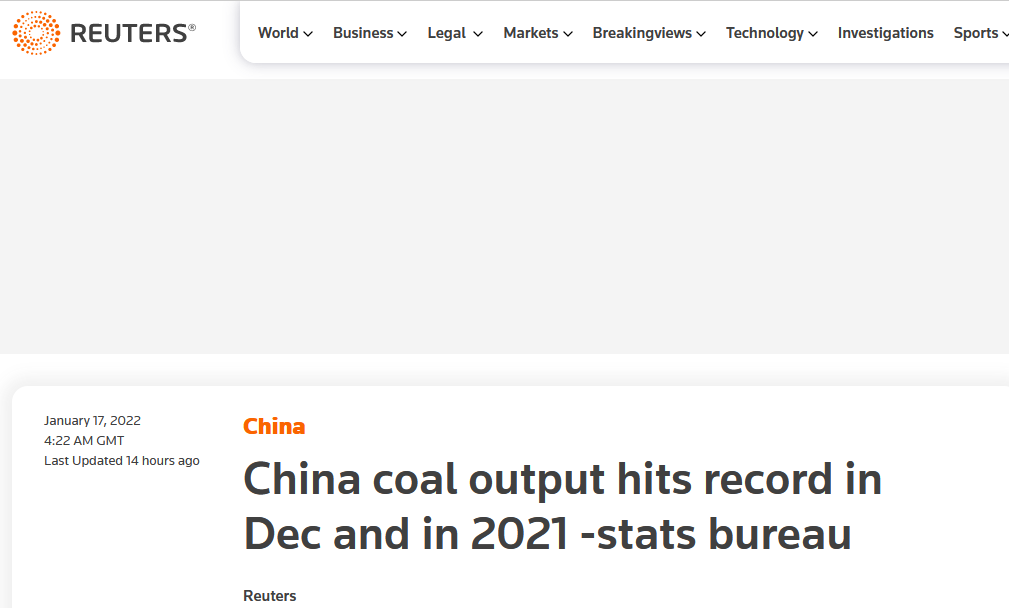
SINGAPORE, Jan 17 (Reuters) – China’s coal output hit record highs in December and in the full year of 2021, as the government continued to encourage miners to ramp up production to ensure sufficient energy supplies in the winter heating season.

China, the world’s biggest coal miner and consumer, produced 384.67 million tonnes of the fossil fuel last month, up 7.2% year-on-year, data from the National Bureau of Statistics showed on Monday. This compared with a previous record of 370.84 million tonnes set in November. read more

For the full year of 2021, output touched a record 4.07 billion tonnes, up 4.7% on the previous year.

https://www.reuters.com/world/china/china-coal-output-hits-record-dec-2021-stats-bureau-2022-01-17/


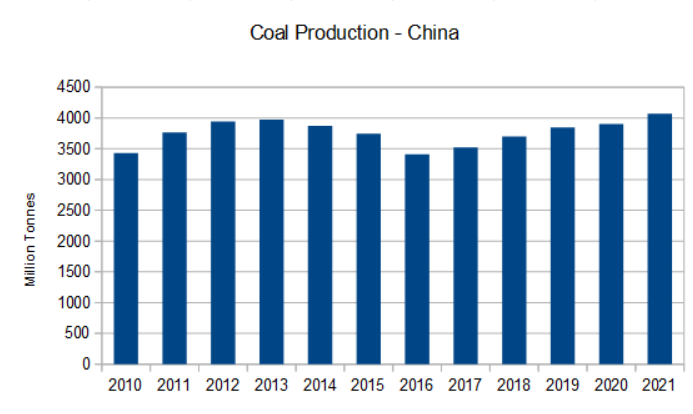
Significantly, output is 5.8% up on the pre-pandemic year of 2019, and maintains the steadily increasing trend which began in 2016:

image

BP Energy Review

via NOT A LOT OF PEOPLE KNOW THAT

https://ift.tt/3A7hHEs

January 17, 2022 at 12:27PM