
Guest “Can you say bass-ackwards?” by David Middleton
Increased U.S. natural gas exports = higher U.S. prices: Who knew?
By Kurt Cobb, originally published by Resource Insights
February 6, 2022Few people noticed when energy reporters wrote in early January that the United States had become the world’s largest exporter of liquefied natural gas (LNG). Now, a group of U.S. senators has noticed and say those exports may be driving up heating and electricity costs for their constituents. In a letter to the secretary of energy, they are asking the secretary “to conduct a review of LNG exports and their impact on domestic prices and the public interest, and develop a plan to ensure natural gas remains affordable for American households.”
Who knew that exporting natural gas from American gas fields would raise natural gas prices at home? Well, the natural gas industry certainly knew. In the last decade, the industry was smarting under persistent low prices as it continually overproduced gas into a flooded domestic market.
It pushed for and succeeded in relaxing rules for exports in general and for expedited approvals of new export cargoes and facilities. The U.S. Department of Energy still has de facto control over most natural gas exports. But policy in the last five years has been to assist and encourage expansion of those exports.
The industry has always contended that there would be plenty of gas to go around because of the extraordinary growth in gas production from deep shale deposits that new technology can now extract. The so-called shale gas revolution, which arrived in the early part of the last decade, foretold an era of plentiful and cheap supplies—so much supply, in fact, that America would become a major exporter.
But the revolution seems to have stalled as marketed U.S. natural gas production has hit a plateau around 3 trillion cubic feet per month since late 2018.
[…]
There is nothing resilient about Mr. Cobb’s pile of utter horst schist.
But the revolution seems to have stalled as marketed U.S. natural gas production has hit a plateau around 3 trillion cubic feet per month since late 2018.
Mr. Cobb links to the following chart to support his “plateau” platitude:

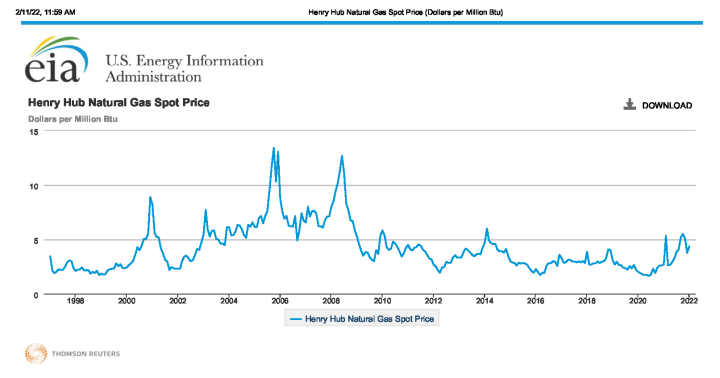
Natural gas prices have been depressed since 2014, falling below $2/mmBTU for much of 2020.
Natural gas consumption crashed in 2020, due to the shamdemic. This led to a sharp drop in natural gas production. As the economy was liberated from the shamdemic, demand for natural gas rapidly increased. Prices and production then rebounded quite resiliently. The daily production rate has already exceeded the 2019 record.
And is forecast to continue rising through 2023, supported by relatively higher natural gas prices.
U.S. marketed natural gas production forecast to rise in 2022 and 2023
In the February 2022 Short-Term Energy Outlook (STEO), we forecast that U.S. natural gas marketed production will increase to average a record-high of 106.6 billion cubic feet per day (Bcf/d) in 2023. We estimate that the natural gas spot price at the U.S. benchmark Henry Hub will average $3.92 per million British thermal units (MMBtu) in 2022, an eight-year high, and will average $3.60/MMBtu throughout 2023.
We expect that the Henry Hub price through 2023 will spur continued increases in U.S. drilling activity and natural gas production. In the February STEO, we forecast that U.S. marketed natural gas production will increase to 104.4 Bcf/d in 2022, up 2.9 Bcf/d from 2021. In 2022 and 2023, the combined marketed production from Alaska and the Federal Offshore Gulf of Mexico (GOM) will average 2.9 Bcf/d, while the remainder, around 97% of the production, will come from the U.S. Lower 48 states (L48) excluding GOM.
[…]
The current relatively high natural gas price environment should lead to more investment in natural gas drilling & production and maintain high production rates for at least the next couple of years.
There is no shortage of natural gas, at least not in the U.S.
“Increased U.S. natural gas exports = higher U.S. prices: Who knew?“
No one knew.
At least no one who knows anything about natural gas or economics in general “knew” that increased natural gas exports equaled higher U.S. prices.
We are able to export natural gas because we produce more than we consume. If natural gas exports were prohibited, we wouldn’t have excess natural gas production.
When the U.S. consumed more natural gas than it consumed, we were a net importer and prices were higher.

The relationship between production, consumption, net imports and prices aren’t particularly difficult to comprehend. While many other variables come into play, natural gas prices have had a negative correlation with the volume of gas we export since 2007, our peak year of natural gas imports.
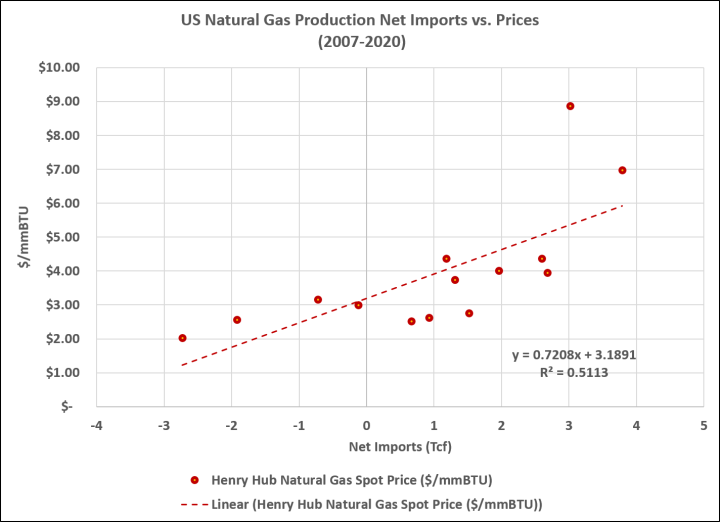
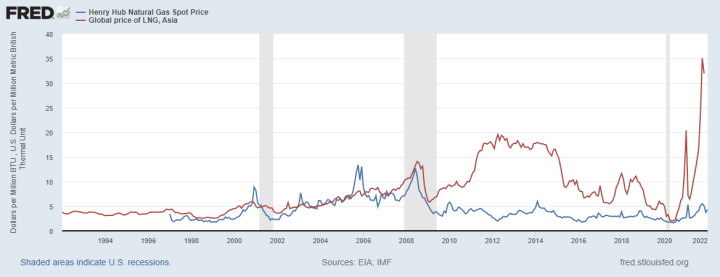
When nations produce less natural gas than they consume (net importers) they tend to pay more for the gas. Liquified natural gas (LNG) is far more expensive than domestic natural gas (Henry Hub).
https://ift.tt/sm1ydrw
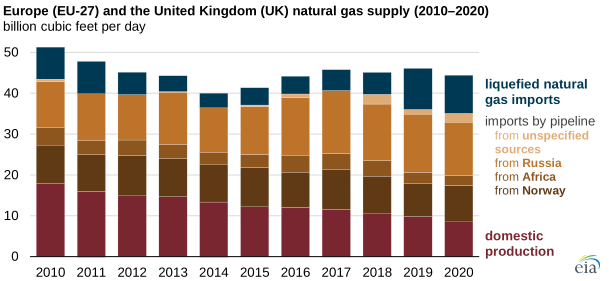
The price in Europe for imported Russian pipeline gas is currently about the same as LNG. Europe imports most of there natural gas and pays about 10 times as much per mmBTU as the world’s leading natural gas exporter.
The moral to the story is: Increased U.S. natural gas exports imports = higher U.S. prices!
via Watts Up With That?
February 11, 2022 at 04:14PM
 Iowa Climate Science Education