
By Paul Homewood
h/t Philip Bratby
Another grossly one-sided piece by the BBC, which might just have been written by Carbon Brief (indeed part of it was!):

With the cost of living rising, are Britain’s plans to cut greenhouse gas emissions too expensive?
A small but vocal group of Conservative MPs are arguing that with energy prices soaring, the government should rethink how it reaches what’s known as ‘net zero’ by 2050.
The group has made a number of key arguments. So what are they saying, and what does the data tell us?
Three years ago the goal of net zero was written into UK law with the backing of MPs from all sides.
Broadly speaking it’s a commitment to transform the way our economy operates. Net zero means not adding to the amount of greenhouse gases in the atmosphere. Achieving it means reducing emissions as much as possible, as balancing out any that remain.
There’s consensus among the world’s scientists that it’s vital if we’re to have a chance of keeping global temperature rises to manageable levels.
https://www.bbc.co.uk/news/science-environment-60489328
I think you can see where they are going. “A small vocal group of MPs”, which the article goes on to refer to as “Eurosceptics”. In other, a few extremists, who should be ignored.
“Written into law with the backing of all sides” – but strangely no mention of the fact that the public were never given a choice!
The article then proceeds to offer a biased, misleading account of why, according to the BBC, these MPs are totally wrong. Yet there is no attempt at all to balance any of this with arguments from the other side.
Below are the BBC’s main talking points:

In fact, Environmental Levies and other climate policies, which don’t include the social costs of providing insulation and rebates for poor households as the BBC claims, will add £17.6 billion to energy bills this year, according to the OBR.
Not all of this appears on domestic bills, as industry, commerce and the public sector will also pay their share. However it is the public who will ultimately pay this bill, which equates to £650 per household.

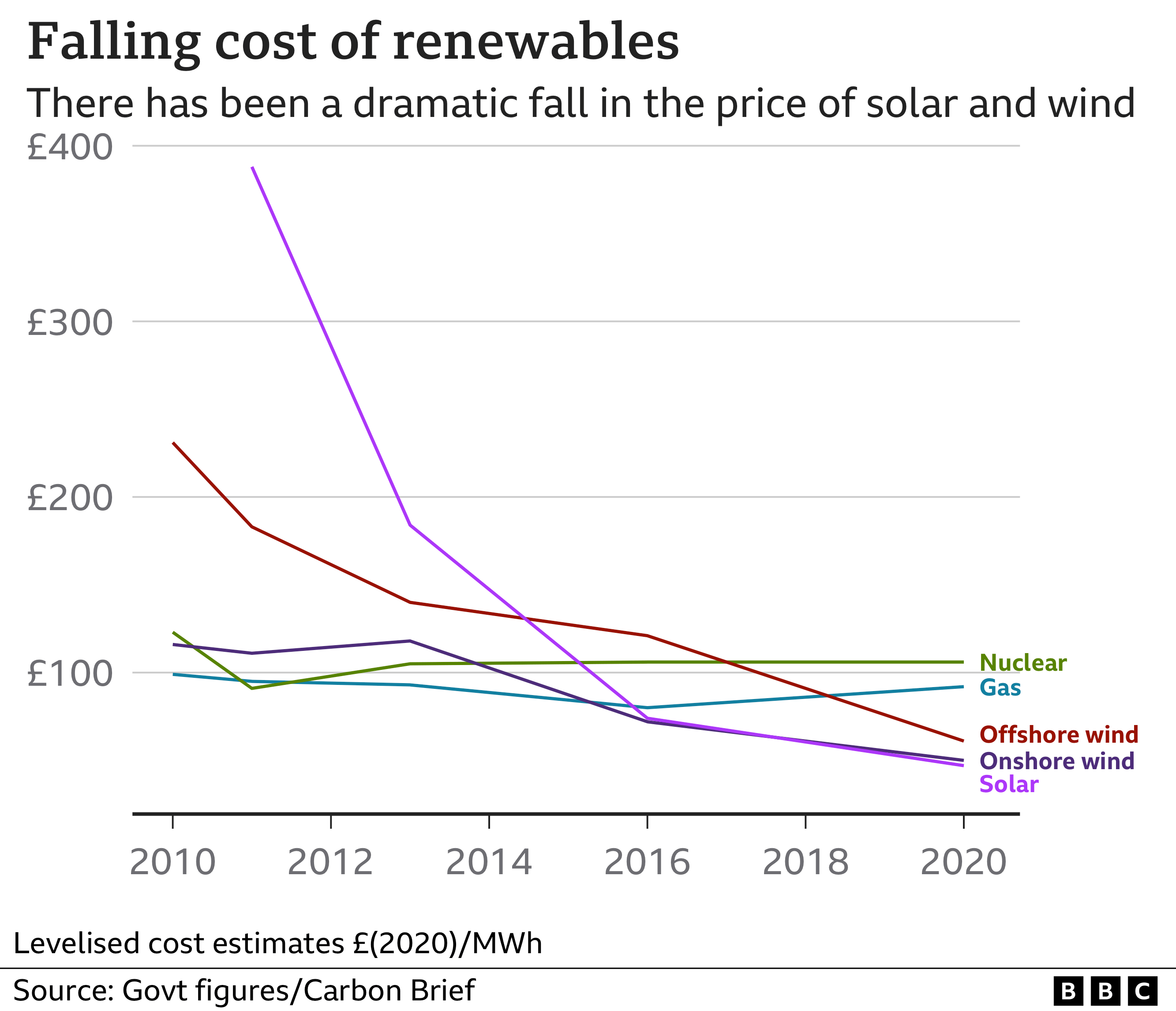
A grossly misleading and dishonest claim.
The cost of gas generation, as shown on their graph, includes £32/MWh for “Carbon Costs”. But these are not “costs” but “taxation”. Without this, CCGT costs would be £53/MWh, in other words lower than offshore wind:

https://www.gov.uk/government/publications/beis-electricity-generation-costs-2020
There is also no mention of the costs of dealing with the intermittency of wind and solar power, which currently run at over £3 billion a year. equating to £34/MWh.
Nor is there any mention of the fact that actual offshore wind costs are working out much higher than those highly optimistic projections, as evinced by actual company accounts.

Whether fracking reduces our energy prices totally misses the point – even if UK gas is sold at world prices, the country will still benefit hugely, and in particular government revenues will be boosted.
The BBC claim that “ this analysis from the London School of Economics suggests that fracking’s supporters are overly upbeat”
In fact the analysis is based on a Warwick Business School study in March 2020, which concluded that “UK fracking could produce between 90 and 330 billion cubic metres (bcm) of natural gas between 2020 and 2050. This would represent between 17 and 22 per cent of projected cumulative UK consumption over that period.”
By any account, that is a huge amount. There is no mention either by the BBC of maximising gas and oil reserves in the North Sea, which would also help to maintain domestic supplies at current levels in the next three decades.

There are all sorts of estimates of the cost of Net Zero, most of which are much higher than the Committee on Climate Change’s calculation, which has already been shown to be fundamentally flawed.
In reality, trying to forecast what our economy will look like in 2050 is a mug’s game.
But what we do know is just how much we are all going have to pay in the short run. Heat pumps, electric cars, hydrogen networks and the rest will cost ordinary people dear in the years to come.
On top of that, millions of jobs will be at risk because of decarbonisation targets placed on industry.
The article closes with this absurd paragraph:

So all of this will be avoided by the UK getting to Net Zero, while the rest of the world carries on as normal?
The whole story is a cheap attempt to take down the arguments of the Net Zero Group of MPs.
via NOT A LOT OF PEOPLE KNOW THAT
February 23, 2022 at 09:27AM
 Iowa Climate Science Education