
By Paul Homewood

As requested, an analysis of the amounts paid in taxation by North Sea oil and gas businesses.
This is the latest chart from BEIS:
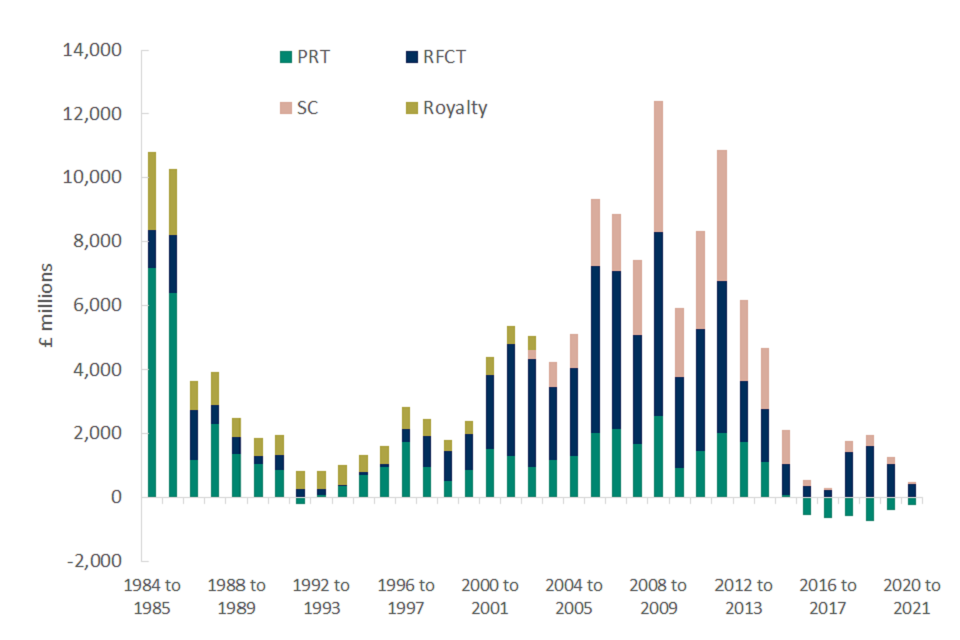
PRT is Petroleum Revenue Tax, a surcharge on fields given permission before 1993, subsequently cancelled in 2015.
RFCT is Ring Fenced Corporation Tax – basically ordinary Corporation Tax payable on profit which all businesses pay. But as it is ring fenced, oil and gas companies cannot offset losses from other parts of their business.
SC is the Supplementary Charge, an extra tax of 10% on profits in addition to RFCT. It was introduced at this level in 2002, hiked to 20% by Gordon Brown in 2006, and raised again to 30% in 2011 by George Osborne. This partially explains the jump in tax revenue between 2005 and 2014. As I say, it has since been cut back to 10%.
As all companies pay Corporation Tax, I have excluded this element, so the extra taxation, over and above normal tax, paid by North Sea oil and gas businesses looks like this:

The decline in recent years reflects three factors, apart from he aforementioned cut in SC and abolition of PRT:
1) Falling production
2) Lower oil prices.
3) Decommissioning Costs
The first two obviously reduce profits. And if they result in losses, previous taxes paid can be reclaimed against RFCT, PRT and SC.
Decommissioning costs are also allowed to be deducted from previous years’ profits, and taxation reclaimed. Given that oil fields are a finite asset, this is perfectly reasonable.
Tax rebates such as these are labelled as “subsidies” and “tax reliefs” by green groups. They are nothing of the sort, as companies are only recovering tax they have already overpaid.
Net revenue, excluding RFCT, was minus £174 million in 2020/21, mainly due to the rock bottom levels of oil prices. With prices recovering to high levels, I would expect government revenues to recover strongly this year.
Nevertheless, if we take total tax revenue in the last 20 years, ie since 2001/2, it amounts to £46.7 billion. Again, this excludes ordinary Corporation Tax, which added another £52.2 billion.
Of course, these are not the only taxes paid for fossil fuel production or consumption. This year the government will rake in £28.8 billion from fuel duties for road transport.
Compare this to the £11.1 billion paid out in green subsidies this year:

via NOT A LOT OF PEOPLE KNOW THAT
February 26, 2022 at 05:03AM
 Iowa Climate Science Education