Month: April 2022

Diesel Driven: World’s First “Net-Zero” Wind Power/Pumped Hydro System A Dismal Failure

The climate/RE cult’s latest mantra “net-zero”, apparently means wind and solar connected to batteries or pumped hydro. The notion has it that wind and solar’s hopeless intermittency can be overcome by a few TWh’s worth of giant lithium-ion batteries or, where geography and hydrology permit, pumped hydro systems.

The latter model involves using wind and solar to pump water uphill into turkey’s nest dams so that, when the sun sets and/or calm weather sets in, hydro power will merrily fill the inevitable daily gaps in wind/solar power production and keep the grid up and running.

Well, that’s the story, anyway.

The wind/pumped hydro model is at the heart of the “net-zero” energy generation systems being pumped by politicians and rent seekers, alike.

In a cooking show, ‘here’s one we prepared earlier moment’, a large-scale wind and pumped hydro experiment has been playing out on an island in the Atlantic, El Hierro (one of the Canary Islands, controlled by Spain) over the last 7 years.

Turns out that, rather than being able to rely exclusively on wind power – backed up with pumped hydro to smooth out the rougher patches – the island remains heavily dependent on ‘dirty’ diesel generators to keep the lights on.

As is typical of the wind and solar cult, it requires some diligent digging to get to the real production numbers. Francis Menton does just that in the piece below.

How About A Pilot Project To Demonstrate The Feasibility Of Fully Wind/Solar/Battery Electricity Generation?
Manhattan Contrarian
Francis Menton
25 January 2022

At this current crazy moment, most of the “Western” world (Europe, the U.S., Canada, Australia) is hell bent on achieving a “net zero” energy system. As I understand this concept, it means that, within two or three decades, all electricity production will be converted from the current mostly-fossil-fuel generation mix to almost entirely wind, solar and storage. On top of that, all or nearly all energy consumption that is not currently electricity (e.g., transportation, industry, heat, agriculture) must be converted to electricity, so that the energy for these things can also be supplied solely by the wind, sun, and batteries. Since electricity is currently only about a quarter of final energy consumption, that means that we are soon to have an all-electric energy generation and consumption system producing around four times the output of our current electricity system, all from wind and solar, backed up as necessary only by batteries or other storage.

A reasonable question is, has anybody thought to construct a small-to-moderate scale pilot project to demonstrate that this is feasible? Before embarking on “net zero” for a billion people, how about trying it out in a place with, say, 10,000, or 50,000, or 100,000 people. See if it can actually work, and how much it will cost. Then, if it works at reasonable cost, start expanding it.

As far as I can determine, that has never been done anywhere. However, there is something somewhat close. An island called El Hierro, which is one of the Canary Islands and is part of Spain, embarked more than a decade ago on constructing an electricity system consisting only of wind turbines and a pumped-storage water reservoir. El Hierro has a population of about 11,000. It is a very mountainous volcanic island, so it provided a fortuitous location for construction of a large pumped-storage hydro project, with an upper reservoir in an old volcanic crater right up a near-cliff from a lower reservoir just above sea level. The difference in elevation of the two reservoirs is about 660 meters, or more than 2000 feet. Here is a picture of the upper reservoir, looking down to the ocean, to give you an idea of just how favorable a location for pumped-storage hydro this is:


The El Hierro wind/storage system began operations in 2015. How has it done? I would say that it is at best a huge disappointment, really bordering on disaster. It has never come close to realizing the dream of 100% wind/storage electricity for El Hierro, instead averaging 50% or less when averaged over a full year (although it has had some substantial periods over 50%). Moreover, since only about one-quarter of El HIerro’s final energy consumption is electricity, the project has replaced barely 10% of El Hierro’s fossil fuel consumption.

Here is the website of the company that runs the wind/hydro system, Gorona del Viento. Get ready for some excited happy talk:

A wind farm produces energy which is directed into the Island’s electricity grid to satisfy the population’s demand for electricity. The surplus energy that is not consumed directly by the Island’s inhabitants is used to pump water between two reservoirs set at different altitudes. During times of wind shortage, the water stored in the Upper Reservoir is discharged into the Lower Reservoir, where the Wind-Pumped Hydro Power Station is, to generate electricity from its turbines. . . . The diesel-engine-powered Power Station only comes into operation in exceptional circumstances when there is neither sufficient wind or water to produce the energy to meet demand.

Over at the page for production statistics, it’s still more excitement about tons of carbon emissions avoided (15,484 in 2020!) and hours of 100% renewable generation (1293 in 2020!). I think that they’re hoping you don’t know that there are 8784 hours in a 366 day year like 2020.

But how about some real information on how much of the island’s electricity, and of its final energy consumption, this system is able to generate? Follow links on that page for production statistics, and you will find that the system produced some 56% of the electricity for El Hierro in 2018, 54% in 2019, and 42% for 2020. No figures are yet provided for 2021. At least for the last three years of reported data, things seem to be going quite rapidly in the wrong direction. I suspect that that’s not what you had in mind when you read that the diesel generators only come into operation in “exceptional circumstances” when wind generation is low. And with electricity constituting only about 25% of El Hierro’s final energy consumption, the reported generation statistics would mean that the percent of final energy consumption from the wind/storage facility ran about 14% in 2018, 13.5% in 2019, and barely 10% in 2020.

So why don’t they just build the system a little bigger? After all, if this system can provide around 50% +/- of El Hierro’s electricity, can’t you just double it in size to get to 100%? The answer is, absolutely not. The 50% can be achieved only with those diesel generators always present to provide full backup when needed. Without that, you need massively more storage to get you through what could be weeks of wind drought, let alone through wind seasonality that means that you likely need 30 days’ or more full storage. Get out your spreadsheet to figure out how much.

Roger Andrews did the calculation for El Hierro in a January 2018 post on the Energy Matters website. His conclusion: El Hierro would need a pumped-storage reservoir some 40 times the size of the one it had built in order to get rid of the diesel backup. Andrews provides plenty of information as to the basis of his calculations and his assumptions, so feel free to take another crack at his calculations with better assumptions. But unfortunately, his main assumption is that the pattern of wind intermittency for any given year will be just as sporadic as it was for 2017.

Then take a look at the picture and see if you can figure out where or how El Hierro is going to build that 40 times bigger reservoir. Time to look into a few billions of dollars worth of lithium ion batteries — for 11,000 people.

And of course, for those of us here in the rest of the world, we don’t have massive volcanic craters sitting 2000 feet right up a cliff from the sea. For us, it’s batteries or nothing. Or maybe just stick with the fossil fuels for now.

So the closest thing we have to a “demonstration project” of the fully wind/storage electricity has come up woefully short, and really has only proved that the whole concept will necessarily fail on the necessity of far more storage than is remotely practical or affordable. The idea that our political betters plow forward toward “net zero” without any demonstration of feasibility I find completely incomprehensible.
Manhattan Contrarian

Shhh, don’t let ’em see these reliable little fellas.

via STOP THESE THINGS

https://ift.tt/egAh63D

April 17, 2022 at 02:31AM

New Identifier Icon

I am ramping up my efforts to get climate information to the public and have a new icon to identify my websites. This icon is now on the browser tab for both Real Climate Science and Real Climate Tools

via Real Climate Science

https://ift.tt/v2h3cjm

April 17, 2022 at 02:06AM

IPCC Scientists: Climate Change Doom is Doomier than People Realise

Guest essay by Eric Worrall

h/t Dr. Willie Soon; IPCC Lead Author Glen Peters and friends are dismayed some people have misinterpreted a call for immediate emissions reductions to mean that we still have a few years to act.

Climate change: Key UN finding widely misinterpreted

By Matt McGrath
Environment correspondent

In the document, researchers wrote that greenhouse gases are projected to peak “at the latest before 2025”.

This implies that carbon could increase for another three years and the world could still avoid dangerous warming. 

But scientists say that’s incorrect and that emissions need to fall immediately.

“Global greenhouse gases are projected to peak between 2020 and at the latest by 2025, in global modelled pathways that limit warming to 1.5C,” the summary states.

Most media outlets including the BBC concluded that meant emissions could rise until 2025 and the world could still stay under 1.5C. 

“When you read the text as it’s laid out, it does give the impression that you’ve got to 2025 which I think is a very unfortunate outcome,” said Glen Peters, from the Centre for International Climate Research in Oslo, and an IPCC lead author. 

So what went wrong? 

“Because models work on 5-year increments, we can’t derive statements with higher precision,” said Dr Joeri Rogelj, from Imperial College London, and an IPCC lead author.

Read more: https://www.bbc.com/news/science-environment-61110406

I can understand Glen Peters and Dr. Joeri Rogelj’s disappointment. I mean, they go to all the trouble of writing what is probably the bleakest, most doom laden climate report in history, only to accidentally leave a sliver of hope, an excuse to delay climate action. And like water falling through a leaky bucket, even the BBC slipped through the crack in their narrative.

Better luck next time alarmists.

via Watts Up With That?

https://ift.tt/pi62ZVb

April 17, 2022 at 12:52AM

Leonard Lim’s Exquisite Photography of John Brewer Reef

Originally posted at Jennifer Marohasy’s Blog

Jennifer Marohasy,

The Australian Institute of Marine Science (AIMS) have been tasked with reporting on the state of the corals and coral cover.  They surveyed John Brewer Reef in March, made no mention of any coral bleaching in their report, and stated coral cover to be just 21.8%.  There are no photographs.

AIMS have large ships to survey the corals but they don’t employ professional underwater photographers who might show us the true state of the corals including at the reef crest where coral cover is often more than 80%.

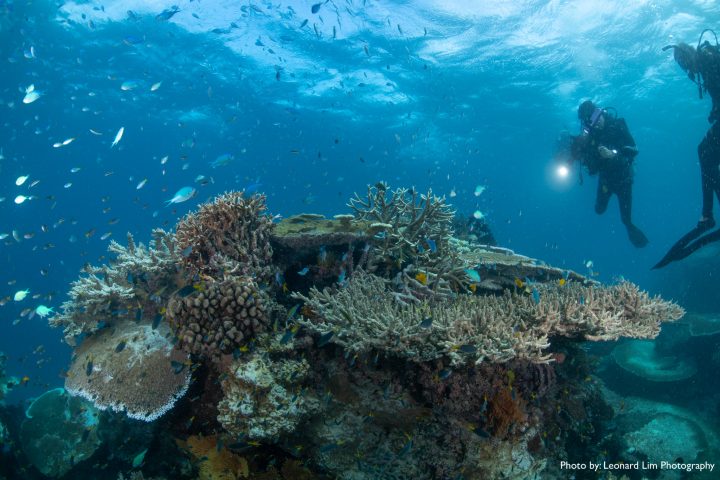
Underwater photographer Leonard Lim visited this same coral reef a month later and his extraordinary underwater photographs show a coral wonderland with more than 100% coral cover across much of the reef crest that extends for nearly 5 kms.   At the reef crest a great diversity of different corals compete for light – often growing one over another.  It would be absurd to suggest there was only 21.8% coral cover here.

Photographs by Leonard Lim taken on 10th April 2022 show more than 100% coral cover at the reef crest.

AIMS misleadingly report that coral cover at John Brewer is just 21.8% by surveying only the perimeter of this reef.  There methodology is absurd, and it avoids those habitats with most coral cover.

Jennifer Marohasy swimming from the reef crest down to the sandy bottom where AIMS undertake their surveys to measure coral cover. Photographed on 10th April 2022 at John Brewer Reef by Leonard Lim.
Cinematographer Stuart Ireland filming below the reef crest at John Brewer Reef on 12th April 2022. Photograph by Leonard Lim.

Anyone serious about accurately reporting coral cover at John Brewer reef would swim around the perimeter and also over the top where most of the coral is – this is what photographer Leonard Lim did.

Each of Leonard Lim’s photographs are a work of art, and also an accurate depiction of this reef for that moment in time.   From Leonard Lim’s photograph we can see how coral cover varies with the different reef habitats as does the form of the different coral species.  They are flat topped across the reef crest where sea level is such a limit to growth.  Around the perimeter the corals are sparser and taller.

There is such diversity and such beauty at this reef.  Yet the New York Times is reporting a sixth massive coral bleaching event and The Guardian is explaining that John Brewer Reef is at the centre of it all.  These sources of news for millions of people are taking their lead from taxpayer funded activists at leading Australian research institutions including the Australian Institute of Marine Science (AIMS) that purports to accurately show coral cover by reporting it to one decimal place (21.8%) while it is only in the small print that it is explained they only survey the perimeter of coral reefs.

Then of course there is Terry Hughes from James Cook University.  He is straight forward about his reasons for lamenting the beauty of this wonderland.    He was on national radio last year saying that the Great Barrier Reef Marine Park Area deserved to be downgraded by the United Nations because he didn’t like Australia’s climate change policies.

Journalist Fran Kelly made the very reasonable comment that a listing should have something to do with actual impacts.

‘…if we look at it more broadly though, Terry, I mean, if climate change impacts are used as a justification for an endangered listing, then every reef must be, therefore, listed in danger because climate change is a problem [all over the world]. Every World Heritage Site that is affected in any way by climate change, must be listed as endangered. Is that the logical extension of this?’

The University Professor gave a very political reply.

‘Not really. There are 29 World Heritage Sites that have coral reefs. Four of them are in Australia. But other countries that are responsible for those World Heritage properties have much better climate policies [not necessarily better reefs] than Australia does. Australia is still refusing to sign up to a net zero target by 2050, which makes it a complete outlier. And I think this draft decision from UNESCO is pointing the finger at Australia and saying, If you’re serious about saving the Great Barrier Reef, you need to do something about your climate policies.’

Everybody claims to want to save the Great Barrier Reef but very few take the time to visit it.  Professor Hughes flies over it at an altitude of 150 metres and scores the state of the corals out an aeroplane window.   I would argue it is impossible to know their true health from this altitude.  Certainly to see the exquisite beauty captured so perfectly by photographer Leonard Lim it is necessary to get under the water.

It is a travesty and a tragedy that one of the most beautiful and biodiversity ecosystems on this Earth is being falsely reported as dying.

It is evident in Leonard Lim’s photographs and also in the soon to be released long documentary filmed by Stuart Ireland that there are bleached corals at John Brewer Reef and many corals are fluorescing which is a form of bleaching.

The brightest pink and purple corals have expelled their symbiotic algae and increased their levels of natural pigmentation.  This fluorescing is happening late in the season.  These same corals are likely to be replete with new algae, with new zooxanthellae) within a few months.  Corals naturally vary their colour during a single year though it is rare to see such a large number fluorescing.  This was last observed at the Great Barrier Reef in 1998 and 2017.

The fluorescing plate coral in the foreground is bleaching from brown to a more colourful pink. Photographed by Leonard Lim on 10th April 2022 with Jennifer Marohasy top right corner.

Coral bleaching was reported during the very first scientific expedition to the Great Barrier Reef undertaken by the Royal Society in 1929.  There are paintings of coral bleaching observed in 1867 by Eugen von Ransonnet from a diving bell in the Red Sea.

Also, with me on 12th April was underwater cinematographer Stuart Ireland. He is currently editing a long documentary that shows not only the corals we swam over, but also the cheeky clown fish, clouds of blue chromis fish and a friendly white tipped reef shark.  I saw metre-long Maori wrasse, tiny nudibranchs, and speckled sweet lip – all swimming in the crystal-clear warm waters of this most magical reef that is one of thousands that comprise the Great Barrier Reef, which is still one of great wonders of the world.

My visits this week (Sunday 10th and Tuesday 12th April 2022) were arranged through Adrenalin Snorkel & Dive, and I’m already planning a next trip with Paul in October.

All my research is funded by the B. Macfie Family Foundation through the Institute of Public Affairs.

via Watts Up With That?

https://ift.tt/MPgrWxN

April 16, 2022 at 08:58PM